
DST CONCEPT NOTE SOVEREIGN INNOVATION FUND Presentation to
- Slides: 15
DST CONCEPT NOTE: SOVEREIGN INNOVATION FUND Presentation to the: Portfolio Committee 23 May 2018
The So. IF: Background and Rationale 1. In 2015 DST identified enduring funding gaps in the NSI for the development of technology-based firms from locally developed ideas 2. Further scoping and stakeholder engagements in 2016 and 2017 showed that between the portfolios of the TIA and the instruments of the dti, DSBD and EDD (i. e. including the IDC), there remain such funding gaps 3. The Sovereign Innovation Fund (So. IF), (endorsed by Cabinet and announced in the SONA in 2016), is envisaged to bridge these gaps and to accelerate the development of a much higher proportion of export oriented technology-based South African firms 2
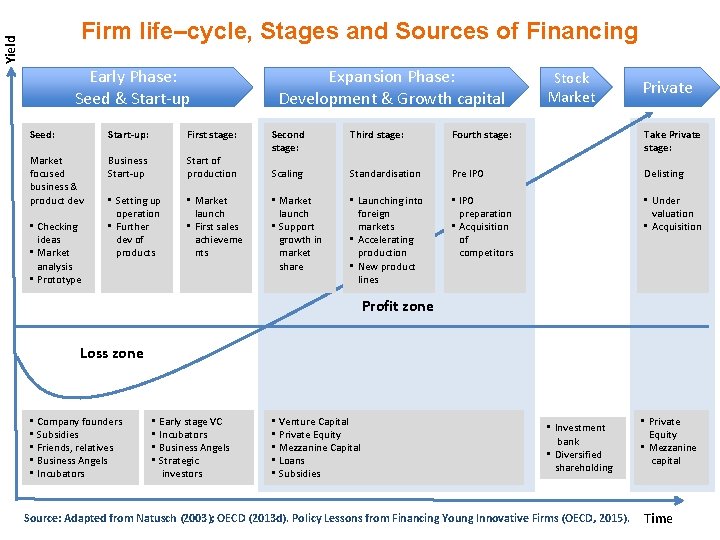
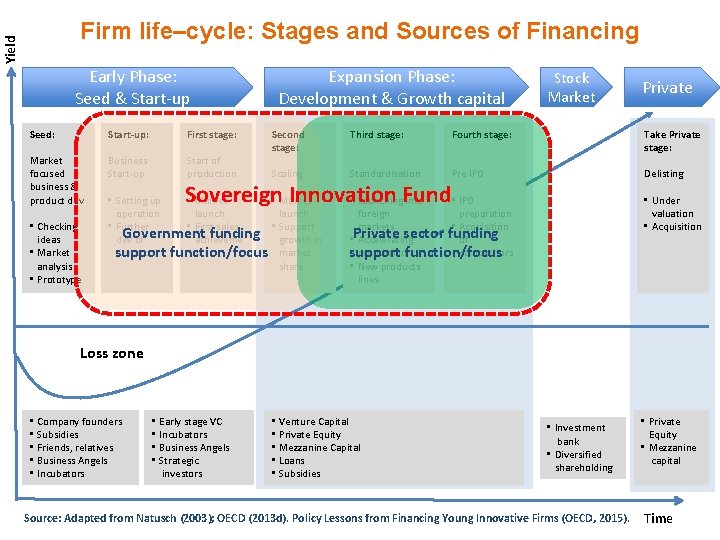
Yield Firm life–cycle, Stages and Sources of Financing Early Phase: Seed & Start-up Seed: Start-up: First stage: Market focused business & product dev Business Start-up Start of production • Setting up operation • Further dev of products • Market launch • First sales achieveme nts • Checking ideas • Market analysis • Prototype Expansion Phase: Development & Growth capital Stock Market Private Second stage: Third stage: Fourth stage: Take Private stage: Scaling Standardisation Pre IPO Delisting • Market launch • Support growth in market share • Launching into foreign markets • Accelerating production • New product lines • IPO preparation • Acquisition of competitors • Under valuation • Acquisition Profit zone Loss zone • Company founders • Subsidies • Friends, relatives • Business Angels • Incubators • Early stage VC • Incubators • Business Angels • Strategic investors • Venture Capital • Private Equity • Mezzanine Capital • Loans • Subsidies • Investment bank • Diversified shareholding Source: Adapted from Natusch (2003); OECD (2013 d). Policy Lessons from Financing Young Innovative Firms (OECD, 2015). • Private Equity • Mezzanine capital Time 3
So. IF purpose 1. So. IF to be initiated in the 2019/20 FY as a separate, standalone public-private funding partnership that is aimed at harvesting and commercialising SA tech innovations 2. Differentiated from other funding instruments - focus on supporting tech innovation and commercialisation in highrisk tech development initiatives 3. Serve as new national financing instrument, involving formal equity finance funded by investments from the public and private sectors. Government funding is utilised to de-risk early stage tech development phases and thereby create opportunities for later stage investments from the private sector 4
Yield Firm life–cycle: Stages and Sources of Financing Early Phase: Seed & Start-up Seed: Start-up: First stage: Market focused business & product dev Business Start-up Start of production • Checking ideas • Market analysis • Prototype Expansion Phase: Development & Growth capital Stock Market Second stage: Third stage: Fourth stage: Take Private stage: Scaling Standardisation Pre IPO Delisting Sovereign • Market Innovation • Launching. Fund into • IPO • Setting up • Market operation launch • Further • First sales Government funding dev of achieveme products function/focus nts support Private launch • Support growth in market share • Under valuation • Acquisition foreign preparation markets • Acquisition sector funding • Private Accelerating of productionfunction/focus competitors support • New products lines Loss zone • Company founders • Subsidies • Friends, relatives • Business Angels • Incubators • Early stage VC • Incubators • Business Angels • Strategic investors • Venture Capital • Private Equity • Mezzanine Capital • Loans • Subsidies • Investment bank • Diversified shareholding Source: Adapted from Natusch (2003); OECD (2013 d). Policy Lessons from Financing Young Innovative Firms (OECD, 2015). • Private Equity • Mezzanine capital Time 5
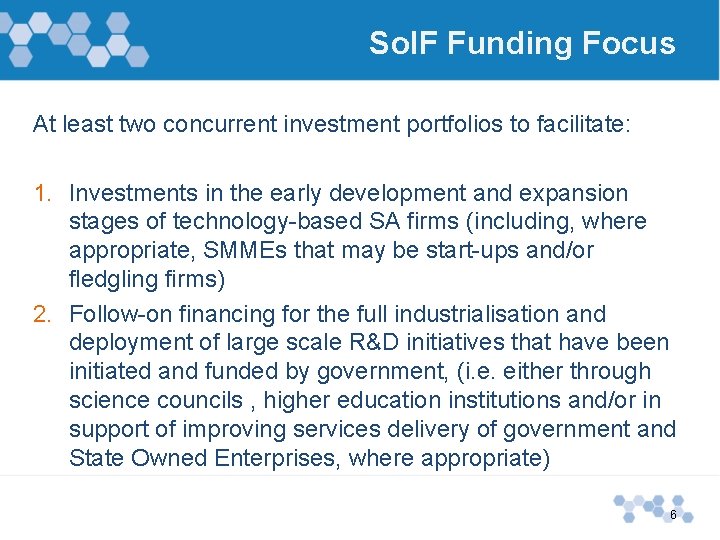
So. IF Funding Focus At least two concurrent investment portfolios to facilitate: 1. Investments in the early development and expansion stages of technology-based SA firms (including, where appropriate, SMMEs that may be start-ups and/or fledgling firms) 2. Follow-on financing for the full industrialisation and deployment of large scale R&D initiatives that have been initiated and funded by government, (i. e. either through science councils , higher education institutions and/or in support of improving services delivery of government and State Owned Enterprises, where appropriate) 6
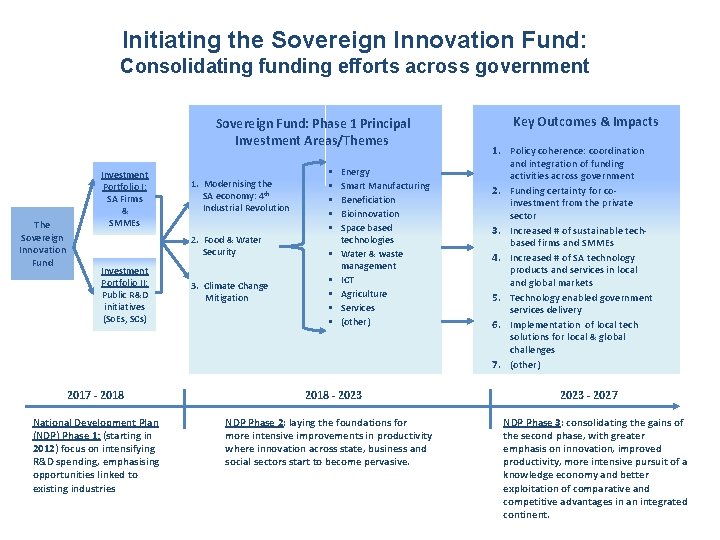
Initiating the Sovereign Innovation Fund: Consolidating funding efforts across government Sovereign Fund: Phase 1 Principal Investment Areas/Themes The Sovereign Innovation Fund Investment Portfolio I: SA Firms & SMMEs 1. Modernising the SA economy: 4 th Industrial Revolution 2. Food & Water Security Investment Portfolio II: Public R&D initiatives (So. Es, SCs) 2017 - 2018 National Development Plan (NDP) Phase 1: (starting in 2012) focus on intensifying R&D spending, emphasising opportunities linked to existing industries 3. Climate Change Mitigation § § § § § Energy Smart Manufacturing Beneficiation Bioinnovation Space based technologies Water & waste management ICT Agriculture Services (other) 2018 - 2023 NDP Phase 2: laying the foundations for more intensive improvements in productivity where innovation across state, business and social sectors start to become pervasive. Key Outcomes & Impacts 1. Policy coherence: coordination and integration of funding activities across government 2. Funding certainty for coinvestment from the private sector 3. Increased # of sustainable techbased firms and SMMEs 4. Increased # of SA technology products and services in local and global markets 5. Technology enabled government services delivery 6. Implementation of local tech solutions for local & global challenges 7. (other) 2023 - 2027 NDP Phase 3: consolidating the gains of the second phase, with greater emphasis on innovation, improved productivity, more intensive pursuit of a knowledge economy and better exploitation of comparative and competitive advantages in an integrated continent. 7
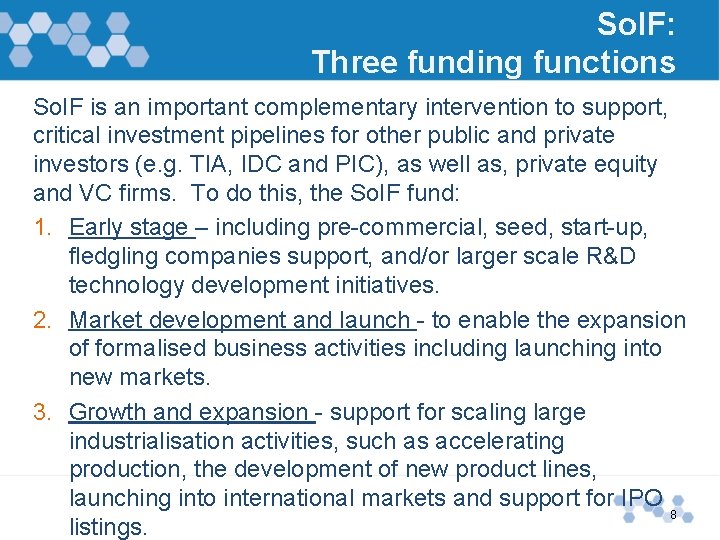
So. IF: Three funding functions So. IF is an important complementary intervention to support, critical investment pipelines for other public and private investors (e. g. TIA, IDC and PIC), as well as, private equity and VC firms. To do this, the So. IF fund: 1. Early stage – including pre-commercial, seed, start-up, fledgling companies support, and/or larger scale R&D technology development initiatives. 2. Market development and launch - to enable the expansion of formalised business activities including launching into new markets. 3. Growth and expansion - support for scaling large industrialisation activities, such as accelerating production, the development of new product lines, launching into international markets and support for IPO 8 listings.
SME Innovation Fund The 2018 State of the Nation Address and 2018 Budget Speech commit government to establishing a “SME Innovation Fund specifically focusing on start-ups. ” National Treasury has set aside funding of R 2. 1 billion over the MTEF to support the Fund. 9
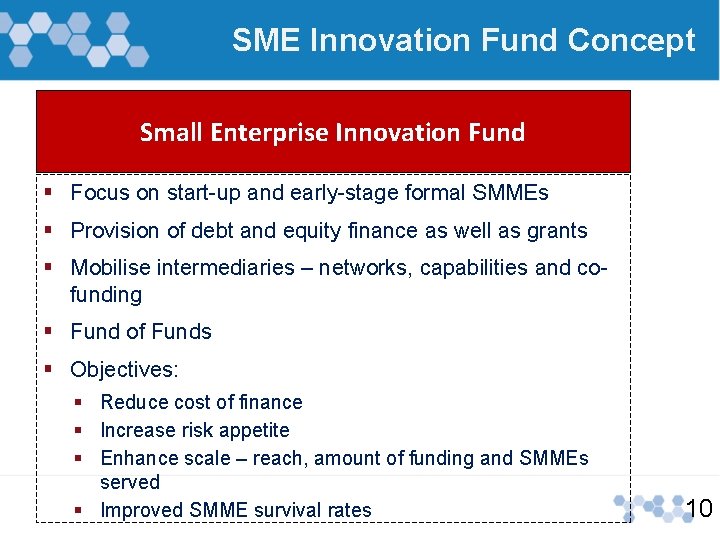
SME Innovation Fund Concept Small Enterprise Innovation Fund § Focus on start-up and early-stage formal SMMEs § Provision of debt and equity finance as well as grants § Mobilise intermediaries – networks, capabilities and cofunding § Fund of Funds § Objectives: § Reduce cost of finance § Increase risk appetite § Enhance scale – reach, amount of funding and SMMEs served § Improved SMME survival rates 10
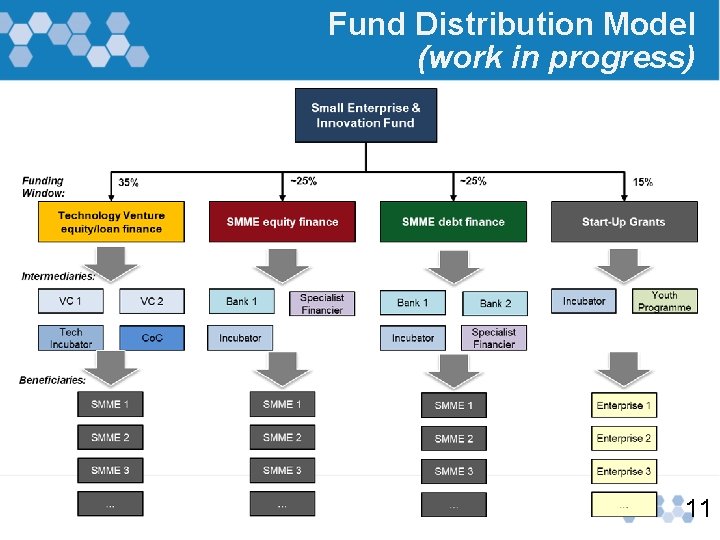
Fund Distribution Model (work in progress) 11
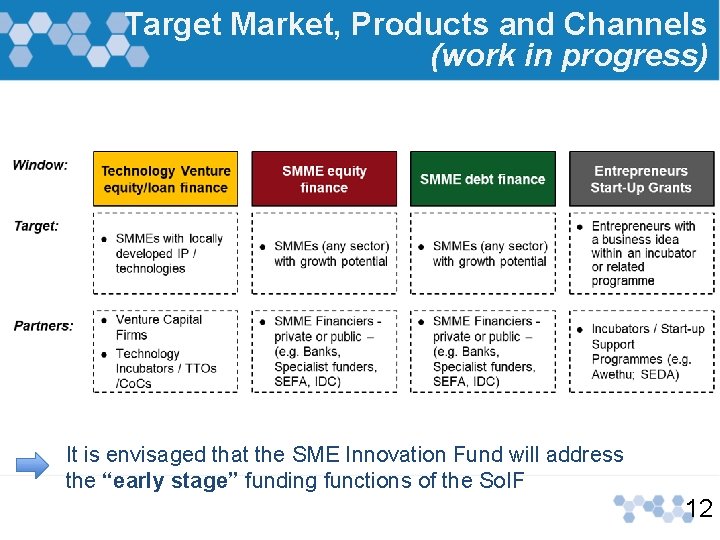
Target Market, Products and Channels (work in progress) It is envisaged that the SME Innovation Fund will address the “early stage” funding functions of the So. IF 12
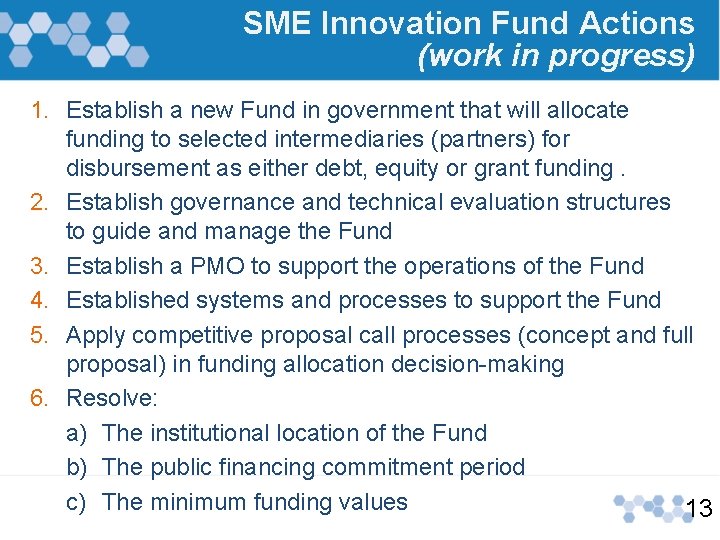
SME Innovation Fund Actions (work in progress) 1. Establish a new Fund in government that will allocate funding to selected intermediaries (partners) for disbursement as either debt, equity or grant funding. 2. Establish governance and technical evaluation structures to guide and manage the Fund 3. Establish a PMO to support the operations of the Fund 4. Established systems and processes to support the Fund 5. Apply competitive proposal call processes (concept and full proposal) in funding allocation decision-making 6. Resolve: a) The institutional location of the Fund b) The public financing commitment period c) The minimum funding values 13
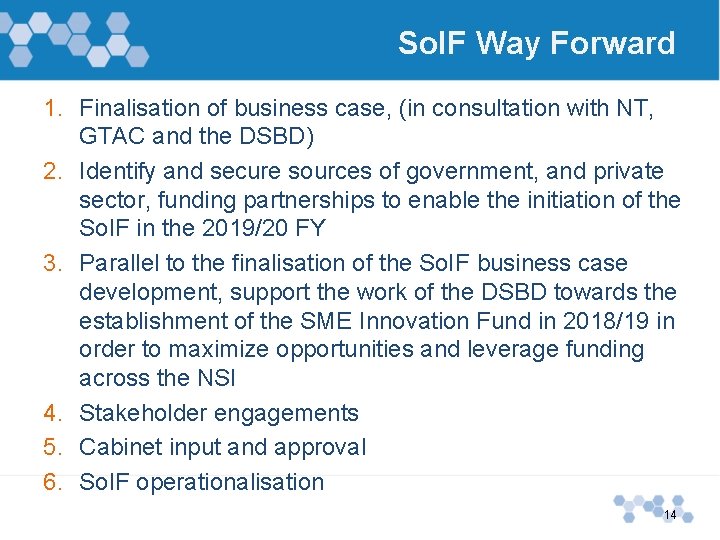
So. IF Way Forward 1. Finalisation of business case, (in consultation with NT, GTAC and the DSBD) 2. Identify and secure sources of government, and private sector, funding partnerships to enable the initiation of the So. IF in the 2019/20 FY 3. Parallel to the finalisation of the So. IF business case development, support the work of the DSBD towards the establishment of the SME Innovation Fund in 2018/19 in order to maximize opportunities and leverage funding across the NSI 4. Stakeholder engagements 5. Cabinet input and approval 6. So. IF operationalisation 14
Thank you for your attention Questions / Comments? 15