
DSpace Digital Library Software Kaushal Giri Dy Manager
DSpace - Digital Library Software Kaushal Giri Dy. Manager – Knowledge Centre Export-Import Bank of India kaushal. giri@eximbankindia. in Nilesh Shewale Librarian Don Bosco Institute of Technology shewale. nilesh 2008@gmail. co m
2 Outline of Talk q Introduction q Features of Digital Library q Why DSpace Digital Library q Architecture and System Requirement q What is DSpace? q H/W and S/W requirements q What DSpace can do?
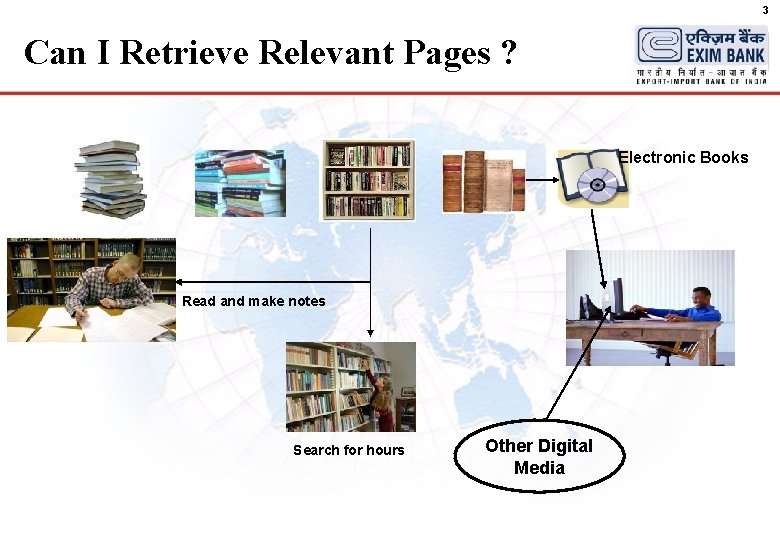
3 Can I Retrieve Relevant Pages ? Electronic Books Read and make notes Search for hours Other Digital Media
4 Introduction Digital libraries encompass a whole range of information services related work such as è Organization of digital information è Information retrieval è User interface è Archiving and preservation è Services and social issues è Evaluation and applications to particular areas
5 Features of Digital Library q Low cost, including all hardware and software components q Technically simple to install and manage q Robust q Scalable q Open and inter-operable q Modular q User Friendly q Multi-user (including both searching and maintenance) q Multimedia digital object enabled q Platform independent (including both client and server components) interoperable
6 Why DSpace Digital Library q DSpace is è An open source technology platform which can be customized and its capabilities can be extended è A service model for open access and/or digital archiving for perpetual access è A platform to build an Institutional Repository and the collections are searchable and retrievable by/on the Web è To make available institution-based scholarly material in digital formats. The collection will be open and interoperable.

7 Architecture and System Requirement The DSpace system is organized into three layers è The Storage Layer: responsible for physical storage of metadata and content è The Business Layer: deals with managing the content of the archive, users of the archive (e-people), authorization, and workflow è The Application Layer: containing components that communicate with the networked world outside of the individual DSpace installation
8 DSpace is a joint project of MIT Libraries and Hewlett-Packard Labs
9 What is DSpace? q Digital Object management system q Create, search and retrieve digital objects q Facilitate preservation of digital objects q An open source software q Allows open access and digital archiving q Allows building Institutional Repositories
10 H/W and S/W requirements q UNIX recommended (Java-based program should run on anything) q Open source, built on Apache web server and Tomcat Servlet engine q Uses postgre. SQL or Oracle relational database
11 What DSpace can do? q Captures è Digital content in any formats directly from creators (e. g. researcher, authors) q Describes è Descriptive, technical, rights metadata è Persistent identifiers q OAI-PMH version 2. 0 compliant è Allow metadata creation
12 Possible types of Content q Preprints, articles q Postprints q Technical Reports q Conference Papers q Theses/Dissertations q Datasets è e. g. statistical, geospatial, scientific
13 Formats of Content q Images è visual, scientific, etc. q Audio files q Video files q Digitized library collections
14 Information Model • Communities – Departments, Labs, Research Centers, Schools… • Collections • Items • Files (bitstreams) – Multiple formats - same content – Complex objects – multiple files
15 Intellectual Property q Click-through license during submission q Grants DSpace non-exclusive right to acquire, manage, preserve, distribute the item q Does not grant DSpace copyright q Copy of license stored with item
16 Goodies q Modular architecture, well-defined APIs q 100% open source è Programmed in java è RDBMS and SQL for metadata q CNRI “handles” for persistent identifiers q Open. URL linking q OAI-PMH for exposing metadata
17 Backend Technology q Apache, Tomcat, Open. SSL/mod_ssl q Java q Postgre. SQL/Oracle q CNRI Handle System 5 (persistent ids) q Lucene Search Engine
18 Standards q Dublin Core only è Descriptive metadata only q OAI-PMH v 2. 0 (Open Archive’s Initiative Protocol for metadata harvesting) q UNICODE Compliant
19 Capabilities q Exports in XML format q Supports crosswalks through OAI-PMH èDC (Dublin Core) èQualified DC èMETS (Metadata Encoding and Transmission Standard èMODS (Metadata Object Description Schema – sibling of MARCXML) q Can be extended to any Metadata Schema
20 Customization q Screens (Manakin) q E-mails q Any language interface q Metadata q Input-forms q Display of results q Fields to be Indexed q Access restrictions
21 Advanced Feature q Grid Compliant (Storage) q LDAP authentication q Usage statistics generation q SFX Server integration q RSS (Really Simple Syndication) q Item Recommendation to a friend q Use of Thesaurus (though not OWL/SKOS/RDF) q Full-text indexing of PDF, MS-WORD files
22 & Questions nswers A

23 Thanks for Your Patience & Attention! • kaushal. giri@eximbankindia. in • shewale. nilesh@gmail. com
- Slides: 23