
DSP Toolkit Independent Assessment Report Template Example Health
![DSP Toolkit Independent Assessment Report Template Example [Health and Social Care Organisation Name] [DATE]](https://slidetodoc.com/presentation_image_h2/49859eebe696214f24d9c9e25d7a0ff3/image-1.jpg "DSP Toolkit Independent Assessment Report Template Example [Health and Social Care Organisation Name] [DATE]")

![Timetable and information request Information request Timetable Document Request [date] Prior to the onsite](https://slidetodoc.com/presentation_image_h2/49859eebe696214f24d9c9e25d7a0ff3/image-25.jpg "Timetable and information request Information request Timetable Document Request [date] Prior to the onsite")


- Slides: 32
DSP Toolkit Independent Assessment Report Template Example [Health and Social Care Organisation Name] [DATE]
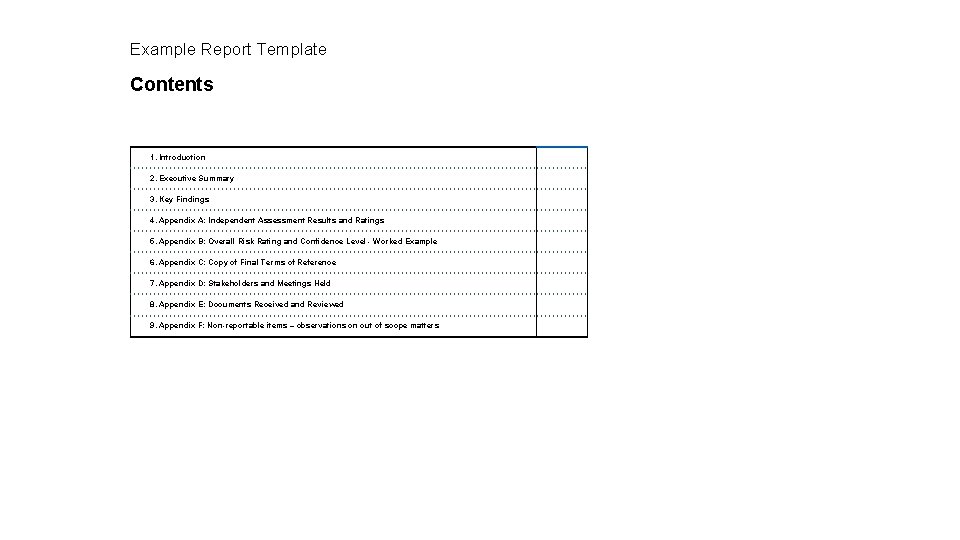
Example Report Template Contents 1. Introduction 2. Executive Summary 3. Key Findings 4. Appendix A: Independent Assessment Results and Ratings 5. Appendix B: Overall Risk Rating and Confidence Level - Worked Example 6. Appendix C: Copy of Final Terms of Reference 7. Appendix D: Stakeholders and Meetings Held 8. Appendix E: Documents Received and Reviewed 9. Appendix F: Non-reportable items – observations on out of scope matters
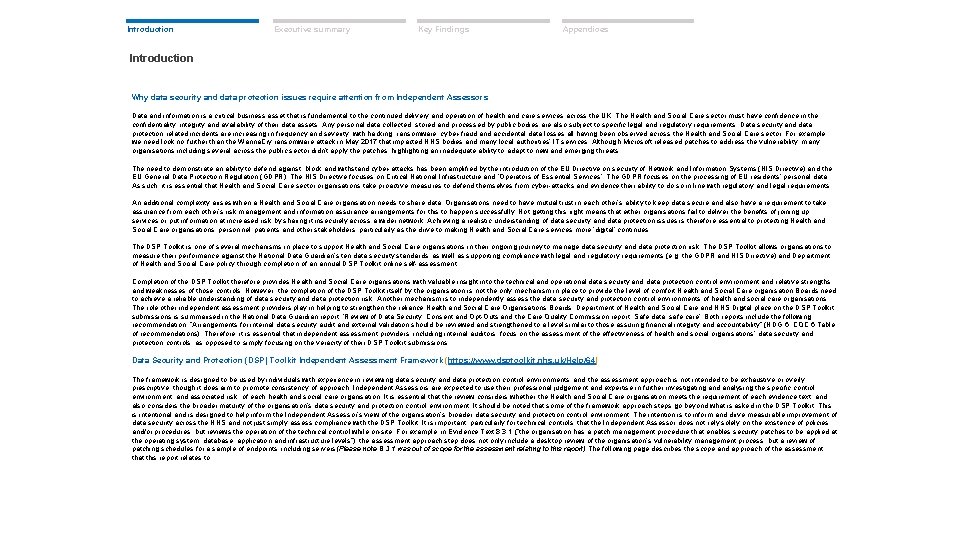
Introduction Executive summary Key Findings Appendices Introduction Why data security and data protection issues require attention from Independent Assessors Data and information is a critical business asset that is fundamental to the continued delivery and operation of health and care services across the UK. The Health and Social Care sector must have confidence in the confidentiality, integrity and availability of their data assets. Any personal data collected, stored and processed by public bodies are also subject to specific legal and regulatory requirements. Data security and data protection related incidents are increasing in frequency and severity; with hacking, ransomware, cyber-fraud and accidental data losses all having been observed across the Health and Social Care sector. For example, we need look no further than the Wanna. Cry ransomware attack in May 2017 that impacted NHS bodies and many local authorities’ IT services. Although Microsoft released patches to address the vulnerability, many organisations including several across the public sector didn’t apply the patches, highlighting an inadequate ability to adapt to new and emerging threats. The need to demonstrate an ability to defend against, block and withstand cyber-attacks has been amplified by the introduction of the EU Directive on security of Network and Information Systems (NIS Directive) and the EU General Data Protection Regulation (GDPR). The NIS Directive focuses on Critical National Infrastructure and ‘Operators of Essential Services’. The GDPR focuses on the processing of EU residents’ personal data. As such, it is essential that Health and Social Care sector organisations take proactive measures to defend themselves from cyber-attacks and evidence their ability to do so in line with regulatory and legal requirements. An additional complexity arises when a Health and Social Care organisation needs to share data. Organisations need to have mutual trust in each other’s ability to keep data secure and also have a requirement to take assurance from each other’s risk management and information assurance arrangements for this to happen successfully. Not getting this right means that either organisations fail to deliver the benefits of joining up services or put information at increased risk by sharing it insecurely across a wider network. Achieving a realistic understanding of data security and data protection issues is therefore essential to protecting Health and Social Care organisations, personnel, patients and other stakeholders; particularly as the drive to making Health and Social Care services more ‘digital’ continues. The DSP Toolkit is one of several mechanisms in place to support Health and Social Care organisations in their ongoing journey to manage data security and data protection risk. The DSP Toolkit allows organisations to measure their performance against the National Data Guardian’s ten data security standards, as well as supporting compliance with legal and regulatory requirements (e. g. the GDPR and NIS Directive) and Department of Health and Social Care policy through completion of an annual DSP Toolkit online self-assessment. Completion of the DSP Toolkit therefore provides Health and Social Care organisations with valuable insight into the technical and operational data security and data protection control environment and relative strengths and weaknesses of those controls. However, the completion of the DSP Toolkit itself by the organisation is not the only mechanism in place to provide the level of comfort Health and Social Care organisation Boards need to achieve a reliable understanding of data security and data protection risk. Another mechanism is to independently assess the data security and protection control environments of health and social care organisations. The role other independent assessment providers play in helping to strengthen the reliance Health and Social Care Organisations Boards, Department of Health and Social Care and NHS Digital place on the DSP Toolkit submissions is summarised in the National Data Guardian report, ‘Review of Data Security, Consent and Opt-Outs and the Care Quality Commission report, Safe data, safe care’. Both reports include the following recommendation: “Arrangements for internal data security audit and external validation should be reviewed and strengthened to a level similar to those assuring financial integrity and accountability” (NDG 6, CQC 6 Table of recommendations). Therefore, it is essential that independent assessment providers, including internal auditors, focus on the assessment of the effectiveness of health and social organisations’ data security and protection controls, as opposed to simply focusing on the veracity of their DSP Toolkit submissions. Data Security and Protection (DSP) Toolkit Independent Assessment Framework (https: //www. dsptoolkit. nhs. uk/Help/64) The framework is designed to be used by individuals with experience in reviewing data security and data protection control environments, and the assessment approach is not intended to be exhaustive or overly prescriptive, though it does aim to promote consistency of approach. Independent Assessors are expected to use their professional judgement and expertise in further investigating and analysing the specific control environment, and associated risk, of each health and social care organisation. It is essential that the review considers whether the Health and Social Care organisation meets the requirement of each evidence text, and also considers the broader maturity of the organisation’s data security and protection control environment. It should be noted that some of the framework approach steps go beyond what is asked in the DSP Toolkit. This is intentional and is designed to help inform the Independent Assessor’s view of the organisation’s broader data security and protection control environment. The intention is to inform and drive measurable improvement of data security across the NHS and not just simply assess compliance with the DSP Toolkit. It is important, particularly for technical controls, that the Independent Assessor does not rely solely on the existence of policies and/or procedures, but reviews the operation of the technical control while on-site. For example, in Evidence Text 8. 3. 1 (“the organisation has a patch management procedure that enables security patches to be applied at the operating system, database, application and infrastructure levels”), the assessment approach step does not only include a desktop review of the organisation’s vulnerability management process, but a review of patching schedules for a sample of endpoints, including servers (Please note 8. 3. 1 was out of scope for the assessment relating to this report). The following page describes the scope and approach of the assessment that this report relates to.
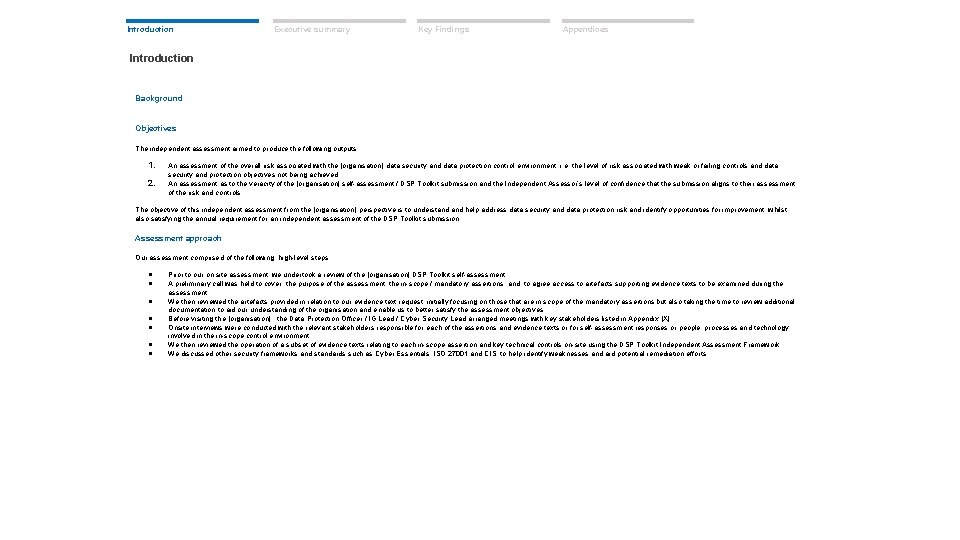
Introduction Executive summary Key Findings Appendices Introduction Background Objectives The independent assessment aimed to produce the following outputs: 1. 2. An assessment of the overall risk associated with the [organisation] data security and data protection control environment. i. e. the level of risk associated with weak or failing controls and data security and protection objectives not being achieved; An assessment as to the veracity of the [organisation] self-assessment / DSP Toolkit submission and the Independent Assessor’s level of confidence that the submission aligns to their assessment of the risk and controls. The objective of this independent assessment from the [organisation] perspective is to understand help address data security and data protection risk and identify opportunities for improvement; whilst also satisfying the annual requirement for an independent assessment of the DSP Toolkit submission. Assessment approach Our assessment comprised of the following high-level steps: ● ● ● ● Prior to our on site assessment, we undertook a review of the [organisation] DSP Toolkit self-assessment. A preliminary call was held to cover: the purpose of the assessment; the in-scope / mandatory assertions; and, to agree access to artefacts supporting evidence texts to be examined during the assessment. We then reviewed the artefacts provided in relation to our evidence text request, initially focusing on those that are in scope of the mandatory assertions but also taking the time to review additional documentation to aid our understanding of the organisation and enable us to better satisfy the assessment objectives. Before visiting the [organisation] , the Data Protection Officer / IG Lead / Cyber Security Lead arranged meetings with key stakeholders listed in Appendix [X]. Onsite interviews were conducted with the relevant stakeholders responsible for each of the assertions and evidence texts or for self-assessment responses or people, processes and technology involved in the in-scope control environment. We then reviewed the operation of a subset of evidence texts relating to each in-scope assertion and key technical controls on-site using the DSP Toolkit Independent Assessment Framework. We discussed other security frameworks and standards such as Cyber Essentials, ISO 27001 and CIS, to help identify weaknesses and aid potential remediation efforts.
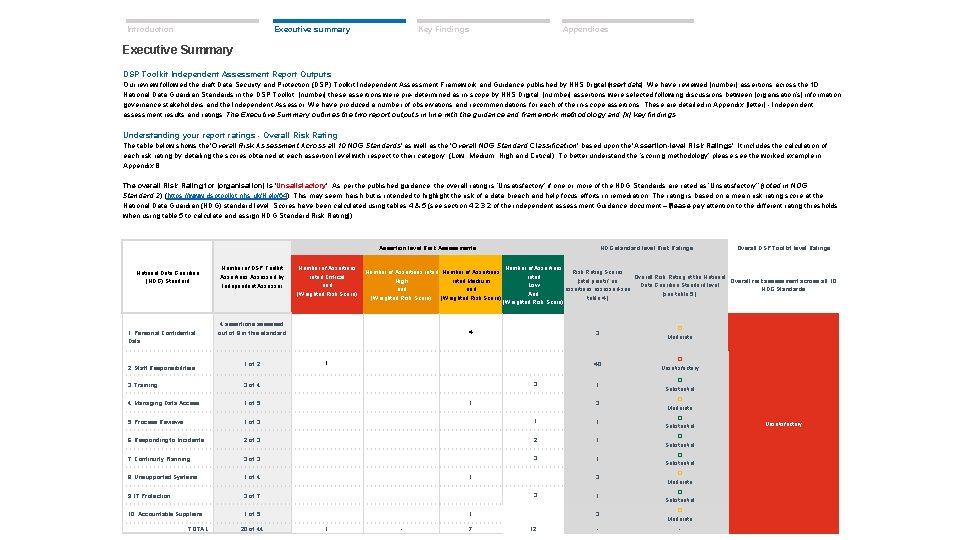
Introduction Key Findings Executive summary Appendices Executive Summary DSP Toolkit Independent Assessment Report Outputs Our review followed the draft Data Security and Protection (DSP) Toolkit Independent Assessment Framework and Guidance published by NHS Digital i[nsert date]. We have reviewed [number] assertions across the 10 National Data Guardian Standards in the DSP Toolkit. [number] these assertions were pre-determined as in-scope by NHS Digital. [number] assertions were selected following discussions between [organisation’s] information governance stakeholders and the Independent Assessor. We have produced a number of observations and recommendations for each of the in-scope assertions. These are detailed in Appendix [letter] - Independent assessment results and ratings. The Executive Summary outlines the two report outputs in line with the guidance and framework methodology and [x] key findings. Understanding your report ratings - Overall Risk Rating The table below shows the ‘Overall Risk Assessment Across all 10 NDG Standards’ as well as the ‘Overall NDG Standard Classification’ based upon the ‘Assertion-level Risk Ratings’. It includes the calculation of each risk rating by detailing the scores obtained at each assertion level with respect to their category, (Low, Medium, High and Critical). To better understand the ‘scoring methodology’ please see the worked example in Appendix B. The overall Risk Rating for [organisation] is ‘Unsatisfactory’. As per the published guidance, the overall rating is ‘Unsatisfactory’ if one or more of the NDG Standards are rated as ‘Unsatisfactory’’ n ( oted in NDG Standard 2) (https: //www. dsptoolkit. nhs. uk/Help/64). This may seem harsh but is intended to highlight the risk of a data breach and help focus efforts in remediation. The rating is based on a mean risk rating score at the National Data Guardian (NDG) standard level. Scores have been calculated using tables 4 & 5 (see section 4. 2. 3. 2 of the independent assessment Guidance document – Please [ pay attention to the different rating thresholds when using table 5 to calculate and assign NDG Standard Risk Rating]) Assertion level Risk Assessments National Data Guardian (NDG) Standard 1. Personal Confidential Data 2. Staff Responsibilities Number of DSP Toolkit Assertions Assessed by Independent Assessor Number of Assertions rated Critical and (Weighted Risk Score) Number of Assertions rated Number of Assertions High rated Medium and (Weighted Risk Score) 4 assertions assessed out of 8 in this standard 1 of 2 3. Training 3 of 4 4. Managing Data Access 1 of 5 5. Process Reviews 1 of 3 NDG standard level Risk Ratings Number of Assertions Risk Rating Scores rated Overall Risk Rating at the National [total points/ no. Overall risk assessment across all 10 Low Data Guardian Standard level assertions assessed-see NDG Standards And [see table 5. ] table 4. ] (Weighted Risk Score) 4 1 3 1 1 3 � Moderate 40 � Unsatisfactory 1 � Substantial 3 � Moderate 1 � Substantial 6. Responding to Incidents 2 of 3 2 1 � Substantial 7. Continuity Planning 3 of 3 3 1 � Substantial 8. Unsupported Systems 1 of 4 3 � Moderate 9. IT Protection 3 of 7 1 � Substantial 10. Accountable Suppliers 1 of 5 3 � Moderate - - TOTAL 20 of 44 1 3 1 1 - 7 Overall DSP Toolkit level Ratings 12 Unsatisfactory
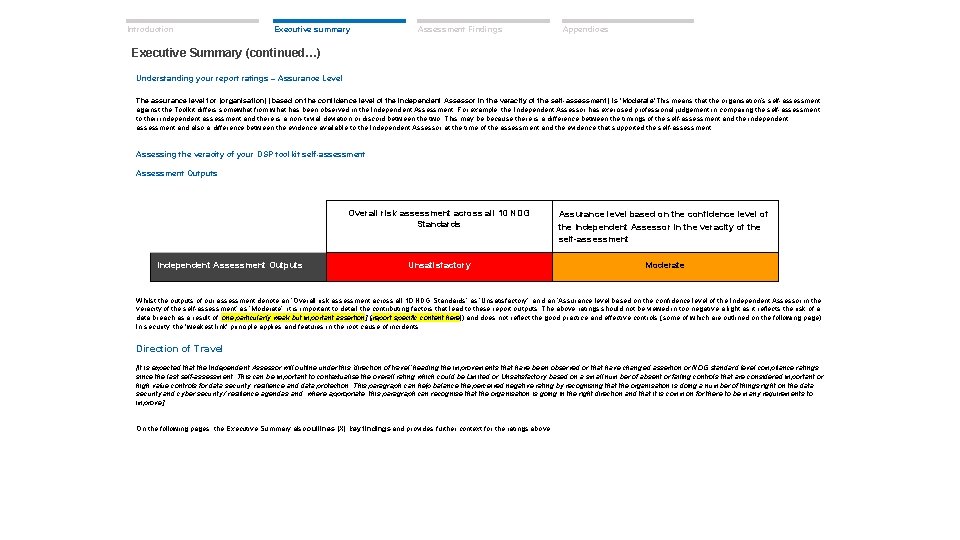
Introduction Executive summary Assessment Findings Appendices Executive Summary (continued…) Understanding your report ratings – Assurance Level The assurance level for [organisation] (based on the confidence level of the Independent Assessor in the veracity of the self-assessment) is ‘Moderate’. This means that the organisation’s self-assessment against the Toolkit differs somewhat from what has been observed in the Independent Assessment. For example, the Independent Assessor has exercised professional judgement in comparing the self-assessment to their independent assessment and there is a non-trivial deviation or discord between the two. This may be because there is a difference between the timings of the self-assessment and the independent assessment and also a difference between the evidence available to the Independent Assessor at the time of the assessment and the evidence that supported the self-assessment. Assessing the veracity of your DSP toolkit self-assessment Assessment Outputs Independent Assessment Outputs Overall risk assessment across all 10 NDG Standards Assurance level based on the confidence level of the Independent Assessor in the veracity of the self-assessment Unsatisfactory Moderate Whilst the outputs of our assessment denote an ‘Overall risk assessment across all 10 NDG Standards’ as ‘Unsatisfactory’, and an ‘Assurance level based on the confidence level of the Independent Assessor in the veracity of the self-assessment’ as ‘Moderate’, it is important to detail the contributing factors that lead to these report outputs. The above ratings should not be viewed in too negative a light as it reflects the risk of a data breach as a result of [one particularly weak but important assertion] ([report specific content here]) and does not reflect the good practice and effective controls (some of which are outlined on the following page). In security, the 'weakest link' principle applies and features in the root cause of incidents. Direction of Travel [It is expected that the Independent Assessor will outline under this ‘direction of travel’ heading the improvements that have been observed or that have changed assertion or NDG standard level compliance ratings since the last self-assessment. This can be important to contextualise the overall rating which could be Limited or Unsatisfactory based on a small number of absent or failing controls that are considered important or high value controls for data security, resilience and data protection. This paragraph can help balance the perceived negative rating by recognising that the organisation is doing a number of things right on the data security and cyber security / resilience agendas and, where appropriate, this paragraph can recognise that the organisation is going in the right direction and that it is common for there to be many requirements to improve]. On the following pages, the Executive Summary also outlines [X] key findings and provides further context for the ratings above.
Introduction Executive summary Assessment Findings Appendices Executive Summary (continued…) Good Practice: During our review we noted the following areas of good practice: [please include text here. ] Key Findings Summary: The following [X] findings are described in more detail in the following section, but are summarised here as being amongst the most important issues to address in order to improve the data security and data protection control environment at [name of health and social care organisation here. ] The following section expands on the implications of the findings and recommendations for management to consider in order to address these key findings.
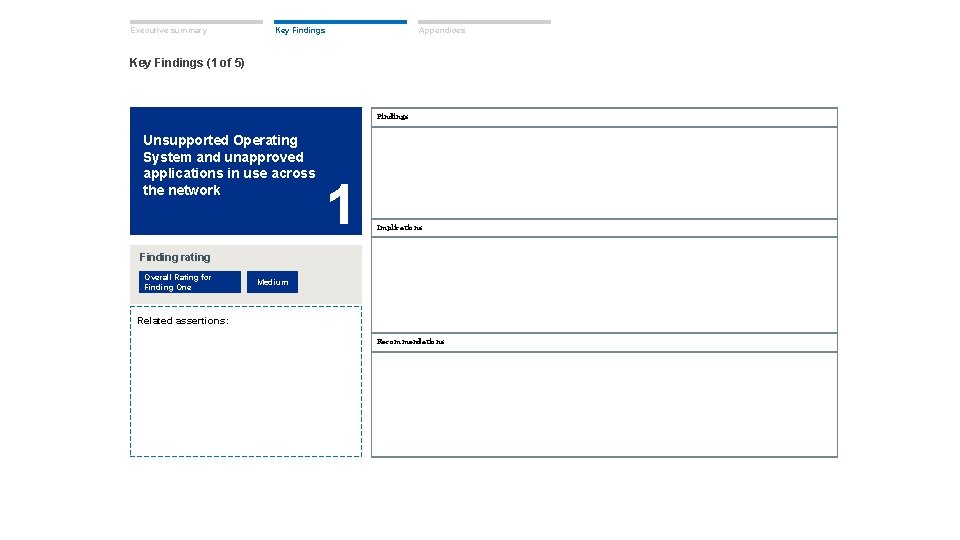
Executive summary Key Findings Appendices Key Findings (1 of 5) Findings Unsupported Operating System and unapproved applications in use across the network 1 Implications Finding rating Overall Rating for Finding One Medium Related assertions: Recommendations
Appendix A - Independent assessment results and ratings
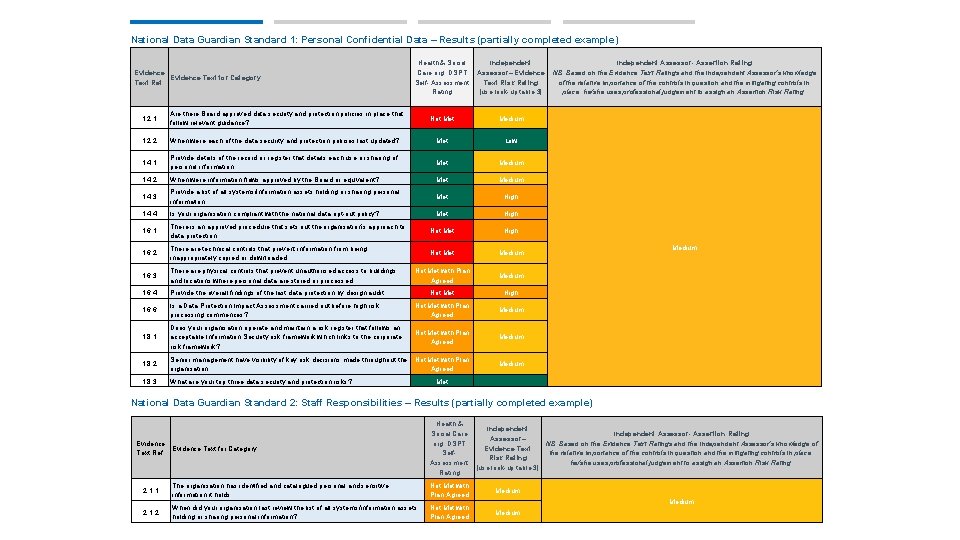
National Data Guardian Standard 1: Personal Confidential Data – Results (partially completed example) Evidence Text for Category Text Ref. Health & Social Care org. DSPT Self- Assessment Rating Independent Assessor– Evidence Text Risk Rating [use look-up table 3] Not Medium 1. 2. 1 Are there Board approved data security and protection policies in place that follow relevant guidance? 1. 2. 2 When were each of the data security and protection policies last updated? Met Low 1. 4. 1 Provide details of the record or register that details each use or sharing of personal information. Met Medium 1. 4. 2 When were information flows approved by the Board or equivalent? Met Medium 1. 4. 3 Provide a list of all systems/information assets holding or sharing personal information. Met High 1. 4. 4 Is your organisation compliant with the national data opt-out policy? Met High 1. 6. 1 There is an approved procedure that sets out the organisation’s approach to data protection Not Met High 1. 6. 2 There are technical controls that prevent information from being inappropriately copied or downloaded. Not Medium 1. 6. 3 There are physical controls that prevent unauthorised access to buildings and locations where personal data are stored or processed. Not Met with Plan Agreed Medium 1. 6. 4 Provide the overall findings of the last data protection by design audit. Not Met High 1. 6. 6 Is a Data Protection Impact Assessment carried out before high risk processing commences? Not Met with Plan Agreed Medium 1. 8. 1 Does your organisation operate and maintain a risk register that follows an acceptable Information Security risk framework which links to the corporate risk framework? Not Met with Plan Agreed Medium 1. 8. 2 Senior management have visibility of key risk decisions made throughout the organisation. Not Met with Plan Agreed Medium 1. 8. 3 What are your top three data security and protection risks? Independent Assessor- Assertion Rating NB. Based on the Evidence Text Ratings and the Independent Assessor’s knowledge of the relative importance of the controls in question and the mitigating controls in place, he/she uses professional judgement to assign an Assertion Risk Rating. Medium Met National Data Guardian Standard 2: Staff Responsibilities – Results (partially completed example) Evidence Text for Category Text Ref. Health & Social Care org. DSPT Self. Assessment Rating Independent Assessor- Assertion Rating Assessor– NB. Based on the Evidence Text Ratings and the Independent Assessor’s knowledge of Evidence Text the relative importance of the controls in question and the mitigating controls in place, Risk Rating he/she uses professional judgement to assign an Assertion Risk Rating. [use look-up table 3] 2. 1. 1 The organisation has identified and catalogued personal and sensitive information it holds. Not Met with Plan Agreed Medium 2. 1. 2 When did your organisation last review the list of all systems/information assets holding or sharing personal information? Not Met with Plan Agreed Medium
Appendix B - Overall risk rating and confidence level worked example
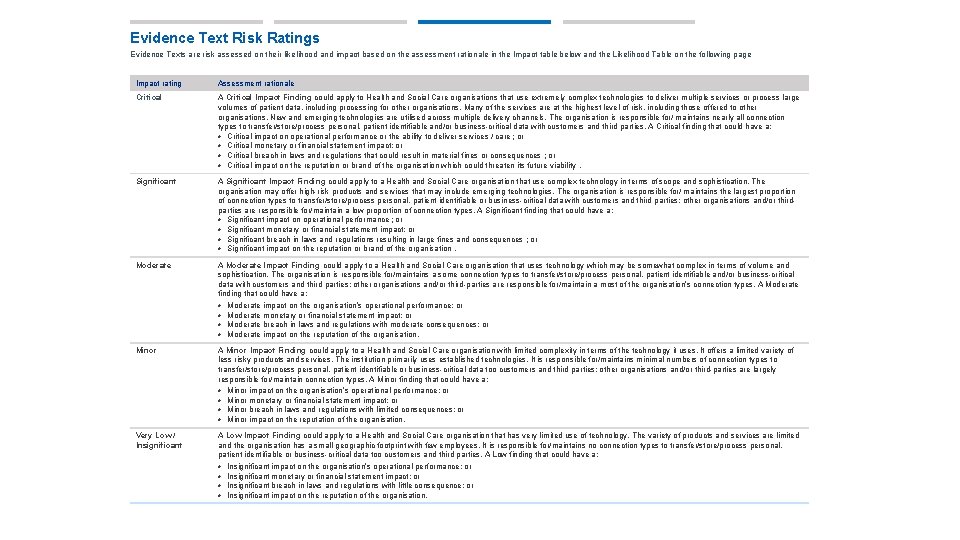
Evidence Text Risk Ratings Evidence Texts are risk assessed on their likelihood and impact based on the assessment rationale in the Impact table below and the Likelihood Table on the following page Impact rating Assessment rationale Critical A Critical Impact Finding could apply to Health and Social Care organisations that use extremely complex technologies to deliver multiple services or process large volumes of patient data, including processing for other organisations. Many of the services are at the highest level of risk, including those offered to other organisations. New and emerging technologies are utilised across multiple delivery channels. The organisation is responsible for/ maintains nearly all connection types to transfer/store/process personal, patient identifiable and/or business-critical data with customers and third parties. A Critical finding that could have a: • Critical impact on operational performance or the ability to deliver services / care ; or • Critical monetary or financial statement impact; or • Critical breach in laws and regulations that could result in material fines or consequences ; or • Critical impact on the reputation or brand of the organisation which could threaten its future viability. Significant A Significant Impact Finding could apply to a Health and Social Care organisation that use complex technology in terms of scope and sophistication. The organisation may offer high-risk products and services that may include emerging technologies. The organisation is responsible for/ maintains the largest proportion of connection types to transfer/store/process personal, patient identifiable or business-critical data with customers and third parties; other organisations and/or thirdparties are responsible for/maintain a low proportion of connection types. A Significant finding that could have a: • Significant impact on operational performance ; or • Significant monetary or financial statement impact; or • Significant breach in laws and regulations resulting in large fines and consequences ; or • Significant impact on the reputation or brand of the organisation. Moderate A Moderate Impact Finding could apply to a Health and Social Care organisation that uses technology which may be somewhat complex in terms of volume and sophistication. The organisation is responsible for/maintains a some connection types to transfer/store/process personal, patient identifiable and/or business-critical data with customers and third parties; other organisations and/or third-parties are responsible for/maintain a most of the organisation’s connection types. A Moderate finding that could have a: • Moderate impact on the organisation’s operational performance; or • Moderate monetary or financial statement impact; or • Moderate breach in laws and regulations with moderate consequences; or • Moderate impact on the reputation of the organisation. Minor A Minor Impact Finding could apply to a Health and Social Care organisation with limited complexity in terms of the technology it uses. It offers a limited variety of less risky products and services. The institution primarily uses established technologies. It is responsible for/maintains minimal numbers of connection types to transfer/store/process personal, patient identifiable or business-critical data too customers and third parties; other organisations and/or third-parties are largely responsible for/maintain connection types. A Minor finding that could have a: • Minor impact on the organisation’s operational performance; or • Minor monetary or financial statement impact; or • Minor breach in laws and regulations with limited consequences; or • Minor impact on the reputation of the organisation. Very Low / Insignificant A Low Impact Finding could apply to a Health and Social Care organisation that has very limited use of technology. The variety of products and services are limited and the organisation has a small geographic footprint with few employees. It is responsible for/maintains no connection types to transfer/store/process personal, patient identifiable or business-critical data too customers and third parties. A Low finding that could have a: • Insignificant impact on the organisation’s operational performance; or • Insignificant monetary or financial statement impact; or • Insignificant breach in laws and regulations with little consequence; or • Insignificant impact on the reputation of the organisation.
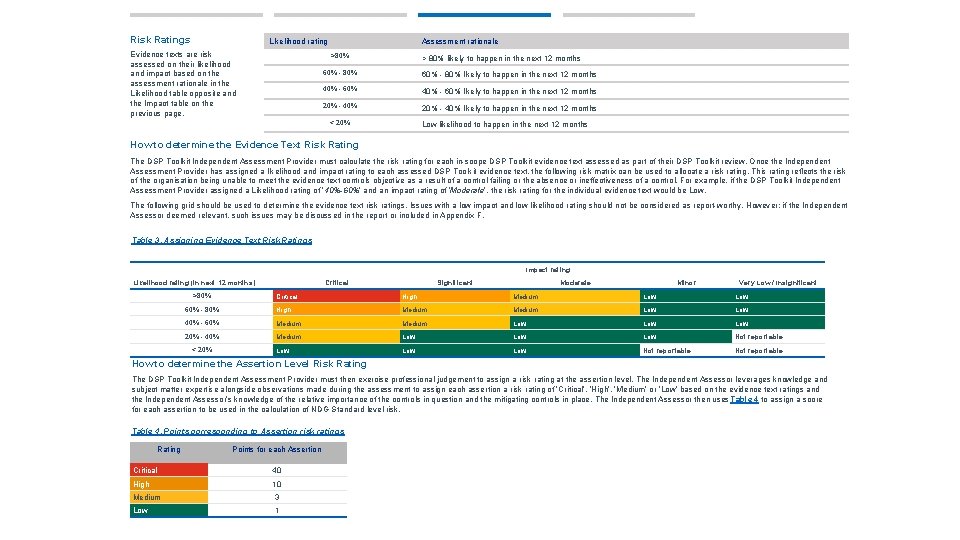
Risk Ratings Likelihood rating Evidence texts are risk assessed on their likelihood and impact based on the assessment rationale in the Likelihood table opposite and the Impact table on the previous page. Assessment rationale >80% > 80% likely to happen in the next 12 months 60% - 80% likely to happen in the next 12 months 40% - 60% likely to happen in the next 12 months 20% - 40% likely to happen in the next 12 months < 20% Low likelihood to happen in the next 12 months How to determine the Evidence Text Risk Rating The DSP Toolkit Independent Assessment Provider must calculate the risk rating for each in-scope DSP Toolkit evidence text assessed as part of their DSP Toolkit review. Once the Independent Assessment Provider has assigned a likelihood and impact rating to each assessed DSP Toolkit evidence text, the following risk matrix can be used to allocate a risk rating. This rating reflects the risk of the organisation being unable to meet the evidence text controls objective as a result of a control failing or the absence or ineffectiveness of a control. For example, if the DSP Toolkit Independent Assessment Provider assigned a Likelihood rating of ‘ 40%-60%’ and an impact rating of ‘Moderate’, the risk rating for the individual evidence text would be Low. The following grid should be used to determine the evidence text risk ratings. Issues with a low impact and low likelihood rating should not be considered as report-worthy. However; if the Independent Assessor deemed relevant, such issues may be discussed in the report or included in Appendix F. Table 3. Assigning Evidence Text Risk Ratings Impact rating Likelihood rating (in next 12 months) >80% Critical Significant Moderate Minor Very Low / Insignificant Critical High Medium Low 60% - 80% High Medium Low 40% - 60% Medium Low Low 20% - 40% Medium Low Low Low Not reportable < 20% How to determine the Assertion Level Risk Rating The DSP Toolkit Independent Assessment Provider must then exercise professional judgement to assign a risk rating at the assertion level. The Independent Assessor leverages knowledge and subject matter expertise alongside observations made during the assessment to assign each assertion a risk rating of ‘Critical’, ‘High’, ‘Medium’ or ‘Low’ based on the evidence text ratings and the Independent Assessor’s knowledge of the relative importance of the controls in question and the mitigating controls in place. The Independent Assessor then uses Table 4 to assign a score for each assertion to be used in the calculation of NDG Standard level risk. Table 4. Points corresponding to Assertion risk ratings Rating Points for each Assertion Critical 40 High 10 Medium 3 Low 1
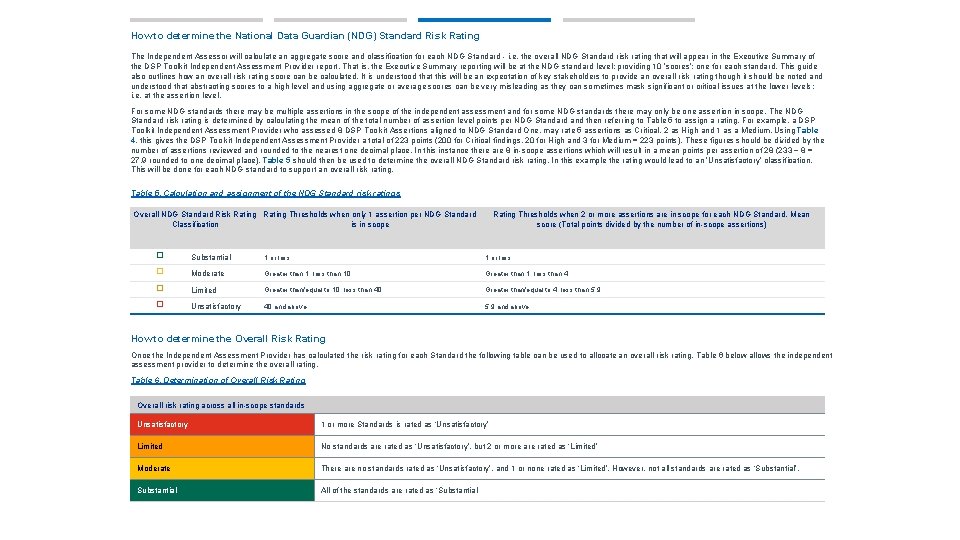
How to determine the National Data Guardian (NDG) Standard Risk Rating The Independent Assessor will calculate an aggregate score and classification for each NDG Standard - i. e. the overall NDG Standard risk rating that will appear in the Executive Summary of the DSP Toolkit Independent Assessment Provider report. That is, the Executive Summary reporting will be at the NDG standard level; providing 10 ‘scores’; one for each standard. This guide also outlines how an overall risk rating score can be calculated. It is understood that this will be an expectation of key stakeholders to provide an overall risk rating though it should be noted and understood that abstracting scores to a high level and using aggregate or average scores can be very misleading as they can sometimes mask significant or critical issues at the lower levels; i. e. at the assertion level. For some NDG standards there may be multiple assertions in the scope of the independent assessment and for some NDG standards there may only be one assertion in scope. The NDG Standard risk rating is determined by calculating the mean of the total number of assertion level points per NDG Standard and then referring to Table 5 to assign a rating. For example, a DSP Toolkit Independent Assessment Provider who assessed 8 DSP Toolkit Assertions aligned to NDG Standard One, may rate 5 assertions as Critical, 2 as High and 1 as a Medium. Using Table 4, this gives the DSP Toolkit Independent Assessment Provider a total of 223 points (200 for Critical findings, 20 for High and 3 for Medium = 223 points). These figures should be divided by the number of assertions reviewed and rounded to the nearest one decimal place. In this instance there are 8 in-scope assertions which will result in a mean points per assertion of 28 (233 ÷ 8 = 27. 9 rounded to one decimal place). Table 5 should then be used to determine the overall NDG Standard risk rating. In this example the rating would lead to an ‘Unsatisfactory’ classification. This will be done for each NDG standard to support an overall risk rating. Table 5. Calculation and assignment of the NDG Standard risk ratings Overall NDG Standard Risk Rating Thresholds when only 1 assertion per NDG Standard Classification is in scope Rating Thresholds when 2 or more assertions are in scope for each NDG Standard. Mean score (Total points divided by the number of in-scope assertions) � Substantial 1 or less � Moderate Greater than 1, less than 10 Greater than 1, less than 4 � Limited Greater than/equal to 10, less than 40 Greater than/equal to 4, less than 5. 9 � Unsatisfactory 40 and above 5. 9 and above How to determine the Overall Risk Rating Once the Independent Assessment Provider has calculated the risk rating for each Standard the following table can be used to allocate an overall risk rating. Table 6 below allows the independent assessment provider to determine the overall rating. Table 6. Determination of Overall Risk Rating Overall risk rating across all in-scope standards Unsatisfactory 1 or more Standards is rated as ‘Unsatisfactory’ Limited No standards are rated as ‘Unsatisfactory’, but 2 or more are rated as ‘Limited’ Moderate There are no standards rated as ‘Unsatisfactory’, and 1 or none rated as ‘Limited’. However, not all standards are rated as ‘Substantial’. Substantial All of the standards are rated as ‘Substantial’
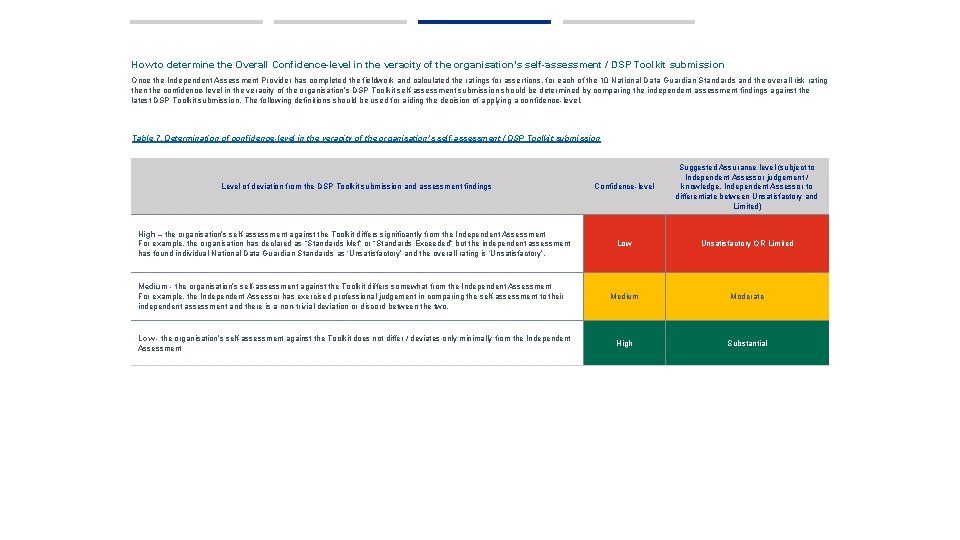
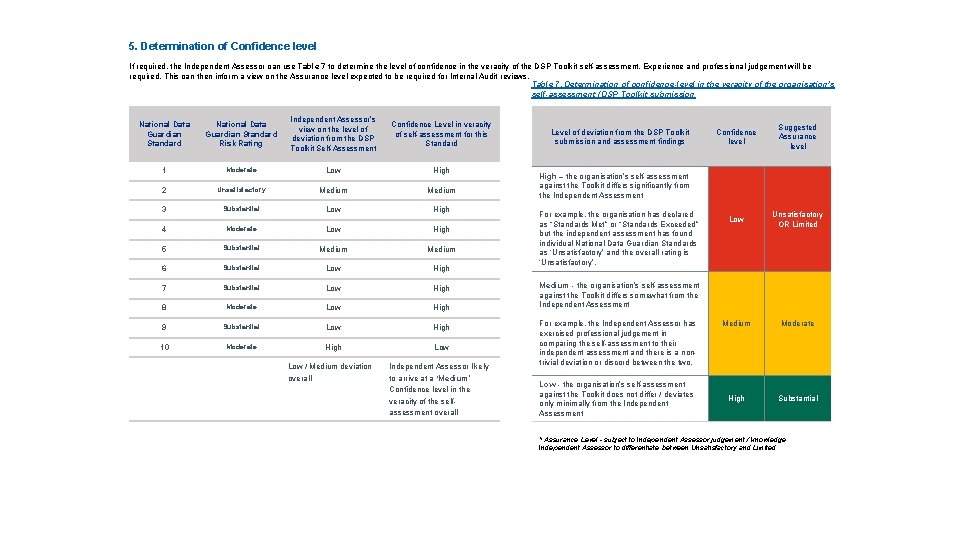
How to determine the Overall Confidence-level in the veracity of the organisation’s self-assessment / DSP Toolkit submission Once the Independent Assessment Provider has completed the fieldwork and calculated the ratings for assertions, for each of the 10 National Data Guardian Standards and the overall risk rating then the confidence-level in the veracity of the organisation’s DSP Toolkit self-assessment submission should be determined by comparing the independent assessment findings against the latest DSP Toolkit submission. The following definitions should be used for aiding the decision of applying a confidence-level. Table 7. Determination of confidence-level in the veracity of the organisation’s self-assessment / DSP Toolkit submission Level of deviation from the DSP Toolkit submission and assessment findings Confidence-level Suggested Assurance level (subject to Independent Assessor judgement / knowledge, Independent Assessor to differentiate between Unsatisfactory and Limited) High – the organisation’s self-assessment against the Toolkit differs significantly from the Independent Assessment For example, the organisation has declared as “Standards Met” or “Standards Exceeded” but the independent assessment has found individual National Data Guardian Standards as ‘Unsatisfactory’ and the overall rating is ‘Unsatisfactory’. Low Unsatisfactory OR Limited Medium Moderate High Substantial Medium - the organisation’s self-assessment against the Toolkit differs somewhat from the Independent Assessment For example, the Independent Assessor has exercised professional judgement in comparing the self-assessment to their independent assessment and there is a non-trivial deviation or discord between the two. Low - the organisation’s self-assessment against the Toolkit does not differ / deviates only minimally from the Independent Assessment
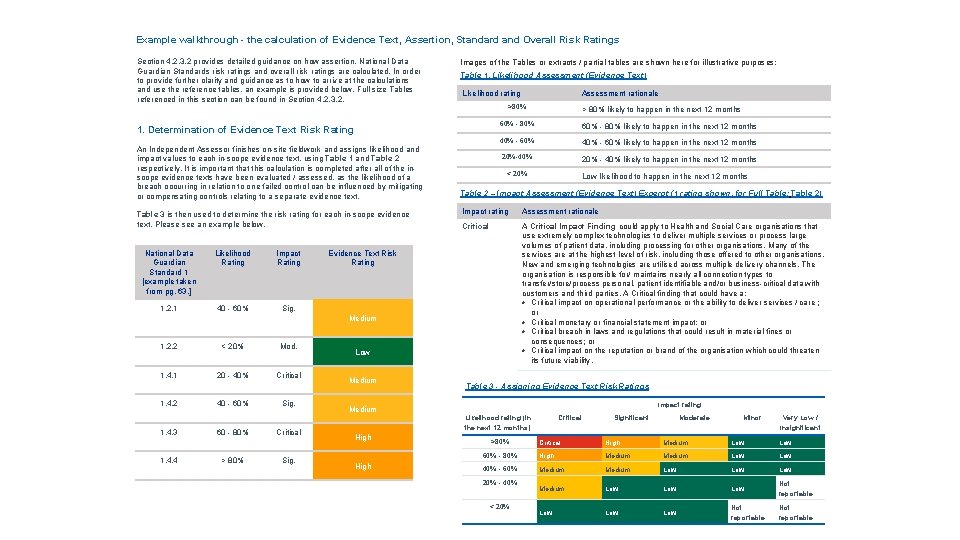
Example walkthrough - the calculation of Evidence Text, Assertion, Standard and Overall Risk Ratings Section 4. 2. 3. 2 provides detailed guidance on how assertion, National Data Guardian Standards risk ratings and overall risk ratings are calculated. In order to provide further clarity and guidance as to how to arrive at the calculations and use the reference tables, an example is provided below. Full size Tables referenced in this section can be found in Section 4. 2. 3. 2. Images of the Tables or extracts / partial tables are shown here for illustrative purposes: Table 1. Likelihood Assessment (Evidence Text) Likelihood rating >80% 1. Determination of Evidence Text Risk Rating An Independent Assessor finishes on-site fieldwork and assigns likelihood and impact values to each in-scope evidence text, using Table 1 and Table 2 respectively. It is important that this calculation is completed after all of the inscope evidence texts have been evaluated / assessed, as the likelihood of a breach occurring in relation to one failed control can be influenced by mitigating or compensating controls relating to a separate evidence text. Table 3 is then used to determine the risk rating for each in-scope evidence text. Please see an example below. National Data Guardian Standard 1 [example taken from pg. 63. ] Likelihood Rating Impact Rating 1. 2. 1 40 - 60% Sig. < 20% Mod. 1. 4. 1 20 - 40% Critical 60% - 80% likely to happen in the next 12 months 40% - 60% likely to happen in the next 12 months 20%-40% 20% - 40% likely to happen in the next 12 months < 20% 1. 4. 2 40 - 60% Sig. 1. 4. 3 60 - 80% Critical 1. 4. 4 > 80% Sig. Low likelihood to happen in the next 12 months Table 2 – Impact Assessment (Evidence Text) Excerpt (1 rating shown, for Full Table: Table 2) Impact rating Assessment rationale Critical A Critical Impact Finding could apply to Health and Social Care organisations that use extremely complex technologies to deliver multiple services or process large volumes of patient data, including processing for other organisations. Many of the services are at the highest level of risk, including those offered to other organisations. New and emerging technologies are utilised across multiple delivery channels. The organisation is responsible for/ maintains nearly all connection types to transfer/store/process personal, patient identifiable and/or business-critical data with customers and third parties. A Critical finding that could have a: • Critical impact on operational performance or the ability to deliver services / care ; or • Critical monetary or financial statement impact; or • Critical breach in laws and regulations that could result in material fines or consequences; or • Critical impact on the reputation or brand of the organisation which could threaten its future viability. Evidence Text Risk Rating Low Medium > 80% likely to happen in the next 12 months 60% - 80% Medium 1. 2. 2 Assessment rationale Table 3 - Assigning Evidence Text Risk Ratings Impact rating Medium Likelihood rating (in the next 12 months) High >80% Critical Significant Moderate Minor Very Low / Insignificant Critical High Medium Low 60% - 80% High Medium Low 40% - 60% Medium Low Low Low Not reportable 20% - 40% < 20%
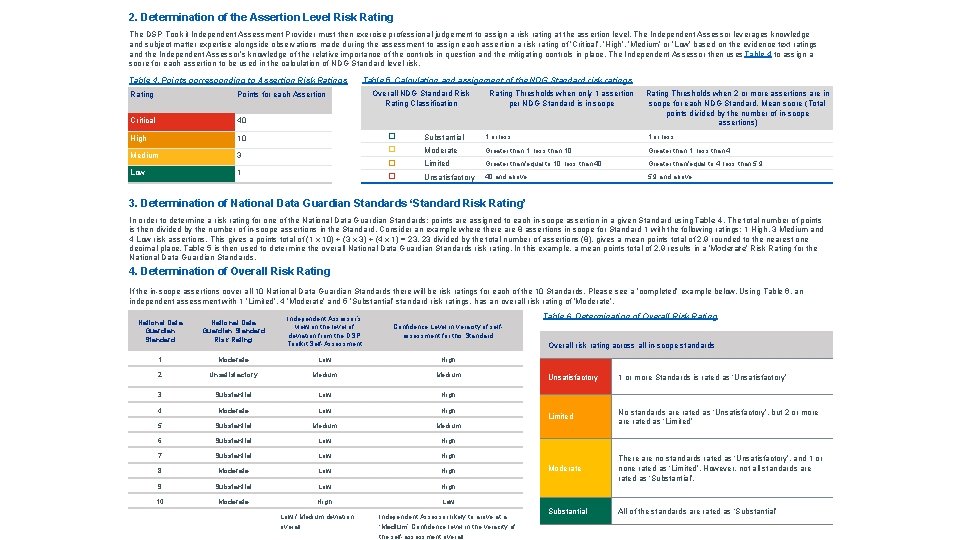
2. Determination of the Assertion Level Risk Rating The DSP Toolkit Independent Assessment Provider must then exercise professional judgement to assign a risk rating at the assertion level. The Independent Assessor leverages knowledge and subject matter expertise alongside observations made during the assessment to assign each assertion a risk rating of ‘Critical’, ‘High’, ‘Medium’ or ‘Low’ based on the evidence text ratings and the Independent Assessor’s knowledge of the relative importance of the controls in question and the mitigating controls in place. The Independent Assessor then uses Table 4 to assign a score for each assertion to be used in the calculation of NDG Standard level risk. Table 4. Points corresponding to Assertion Risk Ratings Rating Points for each Assertion Critical 40 High 10 Medium 3 Low 1 Table 5. Calculation and assignment of the NDG Standard risk ratings Overall NDG Standard Risk Rating Classification Rating Thresholds when only 1 assertion per NDG Standard is in scope Rating Thresholds when 2 or more assertions are in scope for each NDG Standard. Mean score (Total points divided by the number of in-scope assertions) � Substantial 1 or less � Moderate Greater than 1, less than 10 Greater than 1, less than 4 � Limited Greater than/equal to 10, less than 40 Greater than/equal to 4, less than 5. 9 � Unsatisfactory 40 and above 5. 9 and above 3. Determination of National Data Guardian Standards ‘Standard Risk Rating’ In order to determine a risk rating for one of the National Data Guardian Standards; points are assigned to each in-scope assertion in a given Standard using Table 4. The total number of points is then divided by the number of in-scope assertions in the Standard. Consider an example where there are 8 assertions in scope for Standard 1 with the following ratings: 1 High, 3 Medium and 4 Low risk assertions. This gives a points total of (1 x 10) + (3 x 3) + (4 x 1) = 23. 23 divided by the total number of assertions (8), gives a mean points total of 2. 9 rounded to the nearest one decimal place. Table 5 is then used to determine the overall National Data Guardian Standards risk rating. In this example, a mean points total of 2. 9 results in a ‘Moderate’ Risk Rating for the National Data Guardian Standards. 4. Determination of Overall Risk Rating If the in-scope assertions cover all 10 National Data Guardian Standards there will be risk ratings for each of the 10 Standards. Please see a ‘completed’ example below. Using Table 6, an independent assessment with 1 ‘Limited’, 4 ‘Moderate’ and 5 ‘Substantial’ standard risk ratings, has an overall risk rating of ‘Moderate’. Table 6. Determination of Overall Risk Rating National Data Guardian Standard Risk Rating Independent Assessor’s view on the level of deviation from the DSP Toolkit Self-Assessment Confidence Level in veracity of selfassessment for this Standard 1 Moderate Low High 2 Unsatisfactory Medium 3 Substantial Low High Overall risk rating across all in-scope standards 4 Moderate Low High 5 Substantial Medium 6 Substantial Low High 7 Substantial Low High 8 Moderate Low High 9 Substantial Low High 10 Moderate High Low / Medium deviation overall Independent Assessor likely to arrive at a ‘Medium’ Confidence level in the veracity of the self-assessment overall Unsatisfactory 1 or more Standards is rated as ‘Unsatisfactory’ Limited No standards are rated as ‘Unsatisfactory’, but 2 or more are rated as ‘Limited’ Moderate There are no standards rated as ‘Unsatisfactory’, and 1 or none rated as ‘Limited’. However, not all standards are rated as ‘Substantial’. Substantial All of the standards are rated as ‘Substantial’
5. Determination of Confidence level If required, the Independent Assessor can use Table 7 to determine the level of confidence in the veracity of the DSP Toolkit self-assessment. Experience and professional judgement will be required. This can then inform a view on the Assurance level expected to be required for Internal Audit reviews. Table 7. Determination of confidence-level in the veracity of the organisation’s self-assessment / DSP Toolkit submission National Data Guardian Standard Risk Rating Independent Assessor’s view on the level of deviation from the DSP Toolkit Self-Assessment Confidence Level in veracity of self-assessment for this Standard 1 Moderate Low High 2 Unsatisfactory Medium 3 Substantial Low High 4 Moderate Low High 5 Substantial Medium 6 Substantial Low High 7 Substantial Low High 8 Moderate Low High 9 Substantial Low High 10 Moderate High Low / Medium deviation overall Independent Assessor likely to arrive at a ‘Medium’ Confidence level in the veracity of the selfassessment overall Level of deviation from the DSP Toolkit submission and assessment findings Confidence level Suggested Assurance level Low Unsatisfactory OR Limited Medium Moderate High Substantial High – the organisation’s self-assessment against the Toolkit differs significantly from the Independent Assessment For example, the organisation has declared as “Standards Met” or “Standards Exceeded” but the independent assessment has found individual National Data Guardian Standards as ‘Unsatisfactory’ and the overall rating is ‘Unsatisfactory’. Medium - the organisation’s self-assessment against the Toolkit differs somewhat from the Independent Assessment For example, the Independent Assessor has exercised professional judgement in comparing the self-assessment to their independent assessment and there is a nontrivial deviation or discord between the two. Low - the organisation’s self-assessment against the Toolkit does not differ / deviates only minimally from the Independent Assessment * Assurance Level - subject to Independent Assessor judgement / knowledge, Independent Assessor to differentiate between Unsatisfactory and Limited.
Appendix A: Independent assessment results and ratings Appendix B: Improvement roadmap Appendix C: Overall risk rating and confidence level - worked example Appendix C - Copy of Final Terms of Reference
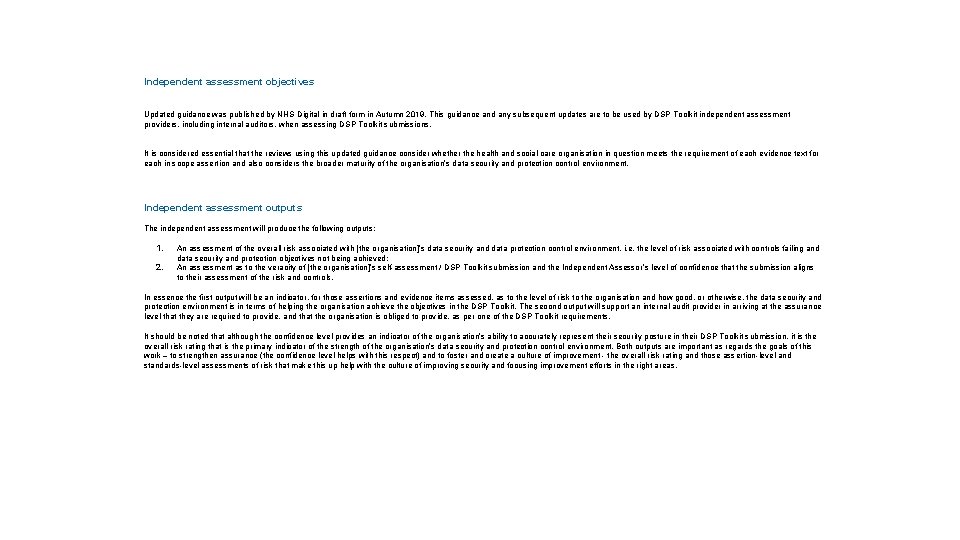
Independent assessment objectives Updated guidance was published by NHS Digital in draft form in Autumn 2019. This guidance and any subsequent updates are to be used by DSP Toolkit independent assessment providers, including internal auditors, when assessing DSP Toolkit submissions. It is considered essential that the reviews using this updated guidance consider whether the health and social care organisation in question meets the requirement of each evidence text for each in scope assertion and also considers the broader maturity of the organisation’s data security and protection control environment. Independent assessment outputs The independent assessment will produce the following outputs: 1. 2. An assessment of the overall risk associated with [the organisation]’s data security and data protection control environment. i. e. the level of risk associated with controls failing and data security and protection objectives not being achieved; An assessment as to the veracity of [the organisation]’s self-assessment / DSP Toolkit submission and the Independent Assessor’s level of confidence that the submission aligns to their assessment of the risk and controls. In essence the first output will be an indicator, for those assertions and evidence items assessed, as to the level of risk to the organisation and how good, or otherwise, the data security and protection environment is in terms of helping the organisation achieve the objectives in the DSP Toolkit. The second output will support an internal audit provider in arriving at the assurance level that they are required to provide, and that the organisation is obliged to provide, as per one of the DSP Toolkit requirements. It should be noted that although the confidence level provides an indicator of the organisation’s ability to accurately represent their security posture in their DSP Toolkit submission, it is the overall risk rating that is the primary indicator of the strength of the organisation’s data security and protection control environment. Both outputs are important as regards the goals of this work – to strengthen assurance (the confidence level helps with this respect) and to foster and create a culture of improvement - the overall risk rating and those assertion-level and standards-level assessments of risk that make this up help with the culture of improving security and focusing improvement efforts in the right areas.
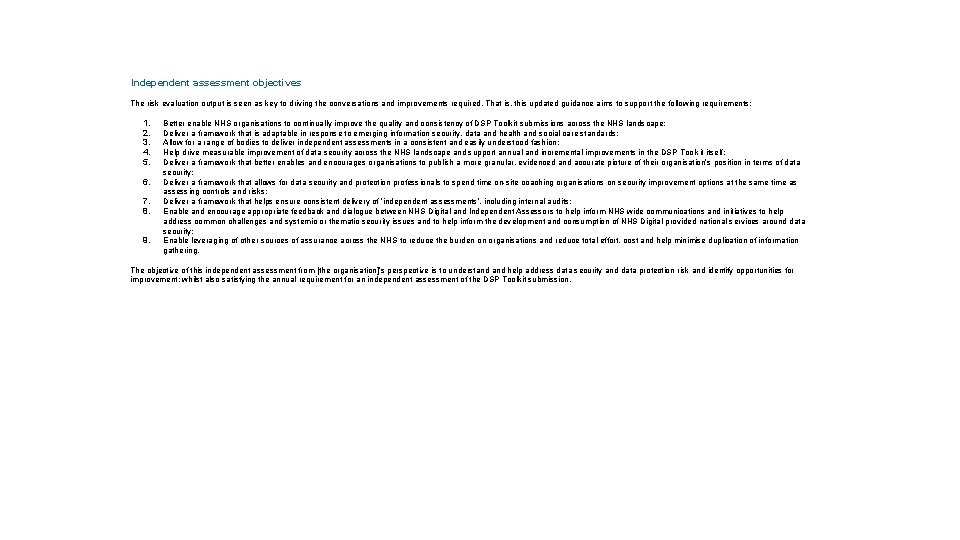
Independent assessment objectives The risk evaluation output is seen as key to driving the conversations and improvements required. That is, this updated guidance aims to support the following requirements: 1. Better enable NHS organisations to continually improve the quality and consistency of DSP Toolkit submissions across the NHS landscape; 2. have. Deliver a framework that is adaptable in response emerging outlined information security, data and health and social care standards; We undertaken this DSP Toolkit review subject to thetolimitations below: 3. Allow for a range of bodies to deliver independent assessments in a consistent and easily understood fashion; 4. Help drive measurable improvement of data security across the NHS landscape and support annual and incremental improvements in the DSP Toolkit itself; 5. Deliver a framework that better enables and encourages organisations to publish a more granular, evidenced and accurate picture of their organisation’s position in terms of data security; 6. Deliver a framework that allows for data security and protection professionals to spend time on-site coaching organisations on security improvement options at the same time as assessing controls and risks; 7. Deliver a framework that helps ensure consistent delivery of ‘independent assessments’, including internal audits; 8. Enable and encourage appropriate feedback and dialogue between NHS Digital and Independent Assessors to help inform NHS wide communications and initiatives to help address common challenges and systemic or thematic security issues and to help inform the development and consumption of NHS Digital provided national services around data security; 9. Enable leveraging of other sources of assurance across the NHS to reduce the burden on organisations and reduce total effort, cost and help minimise duplication of information gathering. The objective of this independent assessment from [the organisation]’s perspective is to understand help address data security and data protection risk and identify opportunities for improvement; whilst also satisfying the annual requirement for an independent assessment of the DSP Toolkit submission.
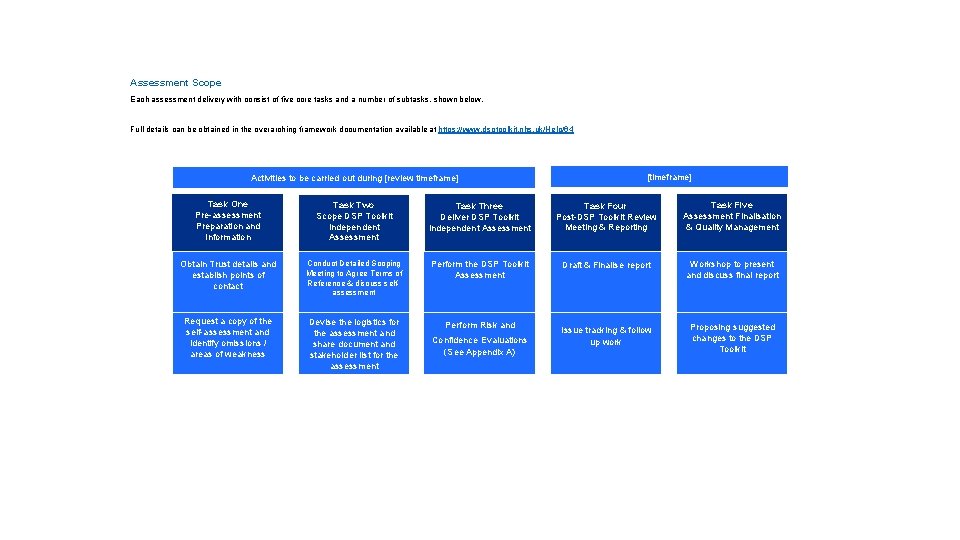
Assessment Scope Each assessment delivery with consist of five core tasks and a number of subtasks, shown below. Full details can be obtained in the overarching framework documentation available at https: //www. dsptoolkit. nhs. uk/Help/64 We have undertaken this DSP Toolkit review subject to the limitations outlined below: Activities to be carried out during [review timeframe] [timeframe] Task One Pre-assessment Preparation and Information Task Two Scope DSP Toolkit Independent Assessment Task Three Deliver DSP Toolkit Independent Assessment Task Four Post-DSP Toolkit Review Meeting & Reporting Task Five Assessment Finalisation & Quality Management Obtain Trust details and establish points of contact Conduct Detailed Scoping Meeting to Agree Terms of Reference & discuss selfassessment Perform the DSP Toolkit Assessment Draft & Finalise report Workshop to present and discuss final report Request a copy of the self-assessment and identify omissions / areas of weakness Devise the logistics for the assessment and share document and stakeholder list for the assessment Perform Risk and Issue tracking & follow up work Proposing suggested changes to the DSP Toolkit Confidence Evaluations (See Appendix A)
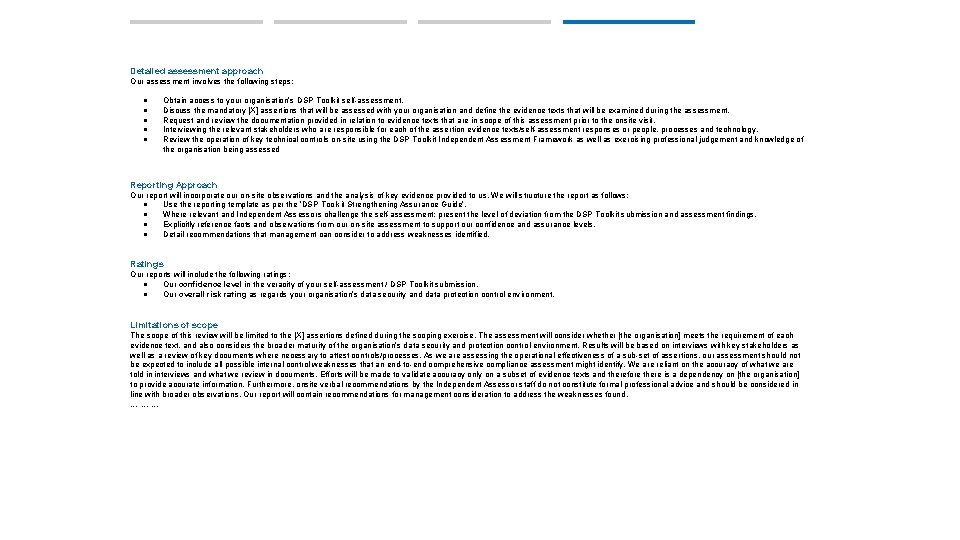
Detailed assessment approach Our assessment involves the following steps: ● ● ● Obtain access to your organisation’s DSP Toolkit self-assessment. Discuss the mandatory [X] assertions that will be assessed with your organisation and define the evidence texts that will be examined during the assessment. Request and review the documentation provided in relation to evidence texts that are in scope of this assessment prior to the onsite visit. Interviewing the relevant stakeholders who are responsible for each of the assertion evidence texts/self-assessment responses or people, processes and technology. Review the operation of key technical controls on-site using the DSP Toolkit Independent Assessment Framework as well as exercising professional judgement and knowledge of the organisation being assessed Reporting Approach Our report will incorporate our on-site observations and the analysis of key evidence provided to us. We will structure the report as follows: ● Use the reporting template as per the ‘DSP Toolkit Strengthening Assurance Guide’. ● Where relevant and Independent Assessors challenge the self-assessment; present the level of deviation from the DSP Toolkit submission and assessment findings. ● Explicitly reference facts and observations from our on-site assessment to support our confidence and assurance levels. ● Detail recommendations that management can consider to address weaknesses identified. Ratings Our reports will include the following ratings: ● Our confidence level in the veracity of your self-assessment / DSP Toolkit submission. ● Our overall risk rating as regards your organisation’s data security and data protection control environment. Limitations of scope The scope of this review will be limited to the [X] assertions defined during the scoping exercise. The assessment will consider whether [the organisation] meets the requirement of each evidence text, and also considers the broader maturity of the organisation’s data security and protection control environment. Results will be based on interviews with key stakeholders as well as a review of key documents where necessary to attest controls/processes. As we are assessing the operational effectiveness of a sub-set of assertions, our assessment should not be expected to include all possible internal control weaknesses that an end-to-end comprehensive compliance assessment might identify. We are reliant on the accuracy of what we are told in interviews and what we review in documents. Efforts will be made to validate accuracy only on a subset of evidence texts and therefore there is a dependency on [the organisation] to provide accurate information. Furthermore, onsite verbal recommendations by the Independent Assessor staff do not constitute formal professional advice and should be considered in line with broader observations. Our report will contain recommendations for management consideration to address the weaknesses found. ………
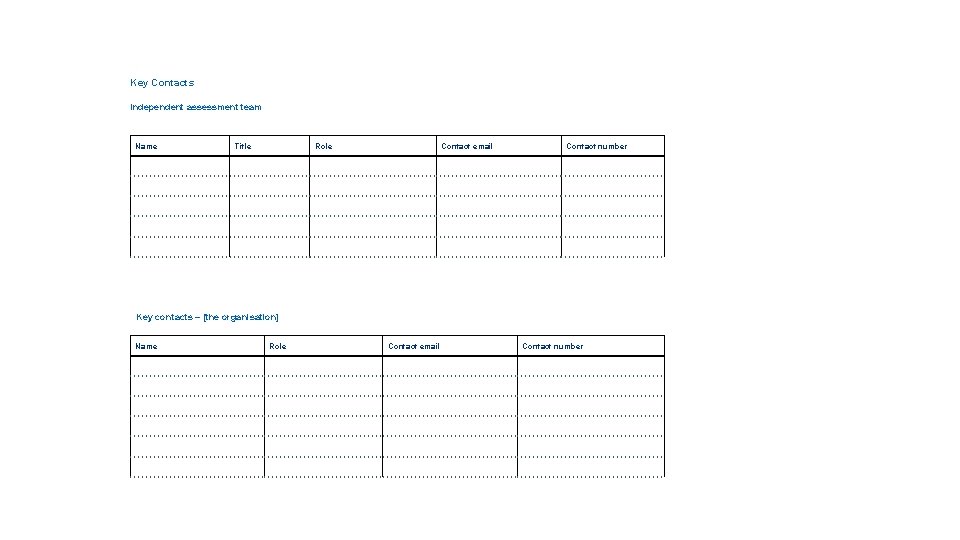
Key Contacts Independent assessment team Name Title Role Contact email Contact number Key contacts – [the organisation] Name Role Contact email Contact number
Timetable and information request Information request Timetable Document Request [date] Prior to the onsite assessment commencing, please share the requested documents that are listed in Appendix [X], or the closest equivalent documents / evidence that you have (we note that terminology and document names / policy titles may differ). Agree timescales and workshops Fieldwork start Fieldwork completed Draft report to client Response from client Secure data transmission We request supporting evidence to be sent to us ahead of the fieldwork start date in order for us to begin our review before any on-site work. To ensure that your information remains secure, we use a [secure end-to-end encryption (AES-256)…] No patient data should be uploaded / sent … during the assessment. We will not request, nor do we require any patient data in order to deliver the independent assessment. Final report to client Agreed timescales are subject to the following assumptions: • All relevant documentation, including source data, reports and procedures, will be made available to us promptly on request. • Staff and management will make reasonable time available for interviews and will respond promptly to follow-up questions or requests for documentation. Onsite interviews You hold ultimate responsibility for scheduling meetings between Independent Assessors and the identified [organisational] stakeholders. A typical list of roles and likely assertions for each is listed in Appendix [X] and Appendix [Y]. Please provide use of a secure / confidential room large enough for 2 Independent Assessors plus your identified stakeholders that also has conference calling facilities to host our interviews and include colleagues who are supporting the interviews remotely.
Appendix D: Stakeholders and Meetings Held
Stakeholders and Meetings Held Name Role Interview Date and Time
Appendix E: Documents Received and Reviewed
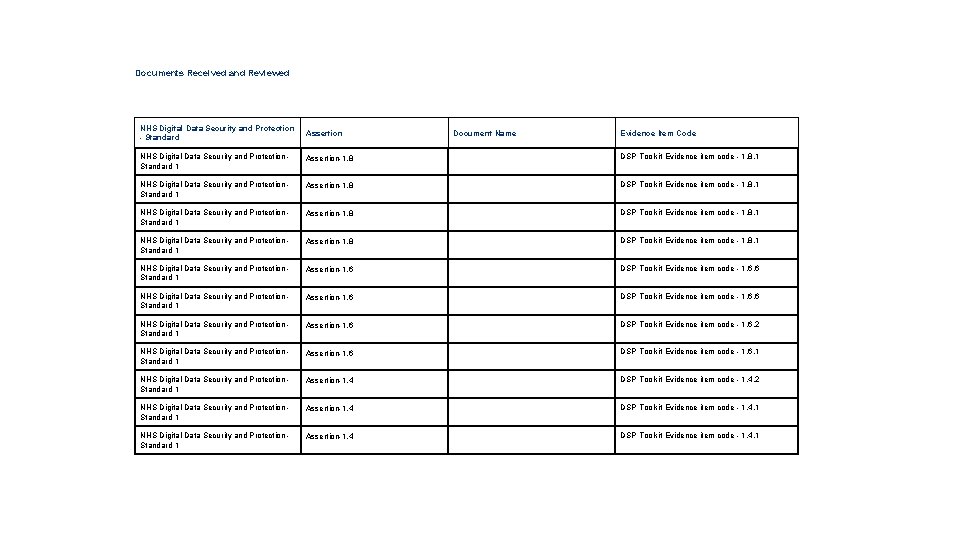
Documents Received and Reviewed NHS Digital Data Security and Protection - Standard Assertion NHS Digital Data Security and Protection Standard 1 Assertion-1. 8 DSP Toolkit Evidence item code - 1. 8. 1 NHS Digital Data Security and Protection Standard 1 Assertion-1. 6 DSP Toolkit Evidence item code - 1. 6. 6 NHS Digital Data Security and Protection Standard 1 Assertion-1. 6 DSP Toolkit Evidence item code - 1. 6. 2 NHS Digital Data Security and Protection Standard 1 Assertion-1. 6 DSP Toolkit Evidence item code - 1. 6. 1 NHS Digital Data Security and Protection Standard 1 Assertion-1. 4 DSP Toolkit Evidence item code - 1. 4. 2 NHS Digital Data Security and Protection Standard 1 Assertion-1. 4 DSP Toolkit Evidence item code - 1. 4. 1 Document Name Evidence Item Code
Appendix F: Non-reportable items – observations on out of scope matters
Non-reportable items – observations on out of scope matters The following observations are included for information purposes and relate to items outside the formally agreed scope and beyond the evidence being scrutinised by the Independent Assessor. It is hoped that the inclusion of such observations is helpful to the assessed organisation in contextualising and remediating data security and data protection issues.
NHS Digital Data Security and Protection Toolkit Independent Assessment Guide