
DSL webinar Signposting for Early Help Making a

DSL webinar Signposting for Early Help Making a referral A Good MARF 2 nd July 2020 Danielle Chrystal gsep@gloucestershire. gov. uk
Do I need to submit a MARF? Levels Of Intervention guidance https: //www. gscb. org. uk/media/2097927/gloucestershire-revised-loiguidance-v 6 -feb-2020. pdf • Importance of Early Help • Children and families may have different levels of need at different times across a range of issues. Having a graduated approach ensures that support will be appropriate, proportionate and at the lowest level of intervention. Applying a graduated approach is about providing the right level of support at the right time. If more or different support is needed, it builds on the support already in place and from the understanding of what has worked/ not worked in the past. • https: //www. gscb. org. uk/media/2097331/gcc_2387 -early-help-practiceguide_digital_dev 6 -v 2 -070420. pdf
• Early Help Co-Ordinators • Community Social Workers • The Glos. Families Directory where further information can be found https: //www. glosfamiliesdirectory. org. uk/kb 5/gloucs/ glosfamilies/family. page? familychannel=3_2_4 • ANY practitioner can contact their local Community Social Worker and request advice in principle (no parental consent therefore not sharing specific information i. e. child’s name) or with consent from parents, contact a CSW and share full details (as long as parents are clear in what they are consenting to).
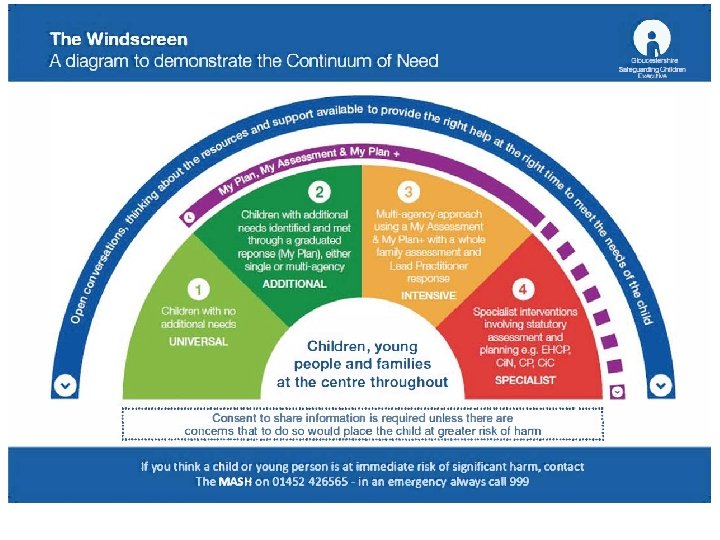
• Level 1 - These children will require no additional support beyond that which is universally available. • Level 2 - Children and young people with additional needs, who would benefit from extra help - often from practitioners who are already involved with them. • Level 3 – Intensive. Targeted Early Help response taking a multi-agency approach through an Early Help Assessment - ‘My Assessment and My Plan+’. The Lead Practitioner will coordinate support and review progress through the Team Around the Child/ Team Around the Family. • Level 4 – Specialist. A child or young person living in circumstances where there is a significant risk of abuse or neglect, where the young person themselves may pose a risk of serious harm to others or where there are complex needs in relation to disability. An unborn baby, child or young person living in circumstances where they are suffering or likely to suffer significant harm related to an identified risk associated with parental behaviour. These children will have complex needs across a range of domains that requires an assessment under the Children Act 1989
You’ve decided to submit a MARF Top Tips from the Multi Agency Safeguarding Hub • Clear disclosure + clear mark/bruise/injury = phone call to the MASH ASAP, then complete a MARF • Ask your Community Social Worker for help/support • bullet point their concerns initially to help clarify exactly what their concerns are - what are the key things they are worried about? • If possible, get someone else in school with safeguarding experience to read through the MARF to check it before it’s sent. Does it make sense? Is it clear what the concerns are? • so Have they submitted a MARF/referral before for this family and if what has changed since then/what has raised the level of concern? (Dates are helpful!)
• Before sending in your referral… • Put yourself in parents’ position • Put yourself in child’s position • Get someone else to check what you have written • Once you have sent in your referral • Make yourself/colleague available if we need to ask questions. • Don’t be afraid to chase up a response from ourselves. • Don’t be afraid to challenge us - Escalation Policy https: //www. gscb. org. uk/media/2095279/escalation-ofprofessional-concerns-guidance-february-2020 -amended. pdf
Consent • If you feel threshold has been met for a Level 4 response, you will need to speak to parents to obtain consent for the referral. There is a clear expectation that referral agencies will obtain consent prior to making contact about individual children and families, unless it is not appropriate to do so – if it would place a child at increased risk of harm. • Encourage transparency with parents and be clear as to what your concerns are at this time. Show them the completed MARF as this will aid engagement from parents. Dependant on the age and level of understanding of the child, they should also be informed as to referrals into MASH. • It can be difficult to get hold of parents to have these conversations – be creative in your approaches as to being able to speak to parents and evidence on the MARF how you have attempted to make contact with parents. But don’t let this delay a MARF being sent in and be mindful of the level of risk to the child vs the time taken to try and obtain consent.
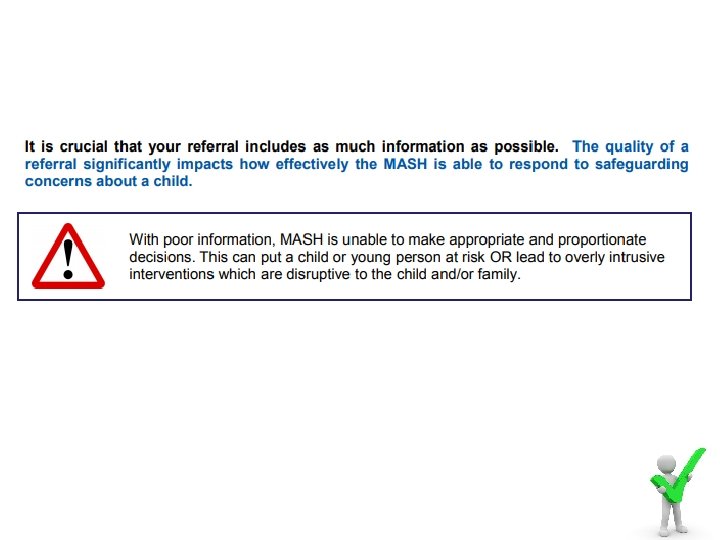
• Completing the MARF • When completing the MARF ensure you complete as much as possible to enable the MASH to make a clear decision and enable any further enquiries that need to be completed. Aspects to consider when completing the MARF: • Ensure you capture the voice of the child – what are their views, wishes and feelings? What do they want to happen next? Remember that this can be obtained by observations of body language, it doesn’t have to be wait a child says. • Be clear in what you write and don’t use generic terms such as ‘inappropriate’, ‘sexualised’, ‘poor home conditions’. Give examples of your concerns and what the impact is on the child. • Chronology – complete a timeline of your intervention and what has previously been attempted? • Have you noticed any changes in the child’s behaviour and/or wellbeing? If so, why do you think this is? • Fact vs Opinion – be clear as to what is factually accurate in your referral. But don’t be afraid to offer your own hypothesis based on your analysis of the concerns. • Submit pieces of evidence such as My Plans, My Assessments, as well as other work you have completed including the Neglect Toolkit, CSE screening tool etc. • How do you know what you know? It is first or third hand evidence? This is important for MASH to know when they are completing their enquiries.
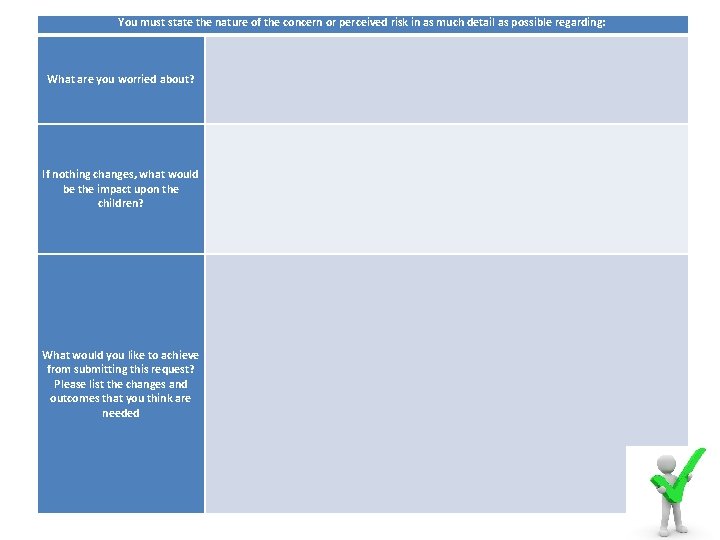
You must state the nature of the concern or perceived risk in as much detail as possible regarding: What are you worried about? If nothing changes, what would be the impact upon the children? What would you like to achieve from submitting this request? Please list the changes and outcomes that you think are needed
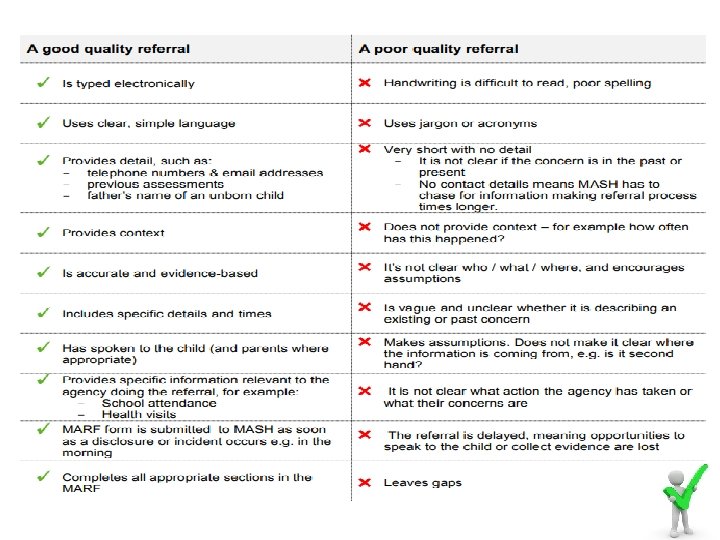
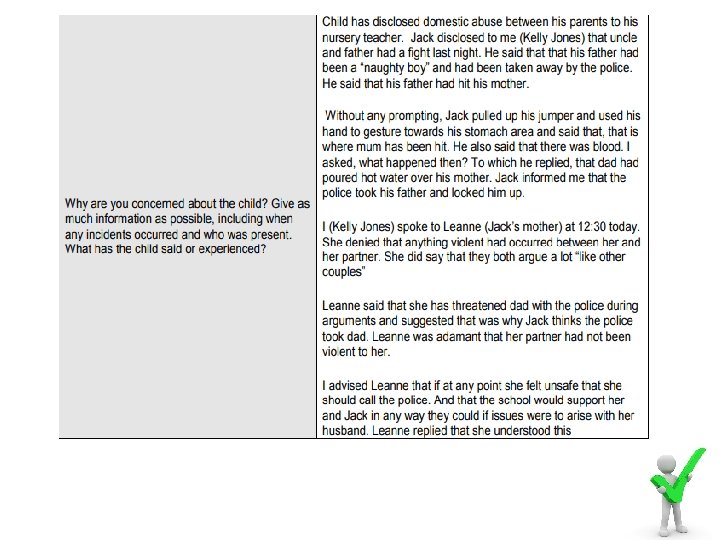
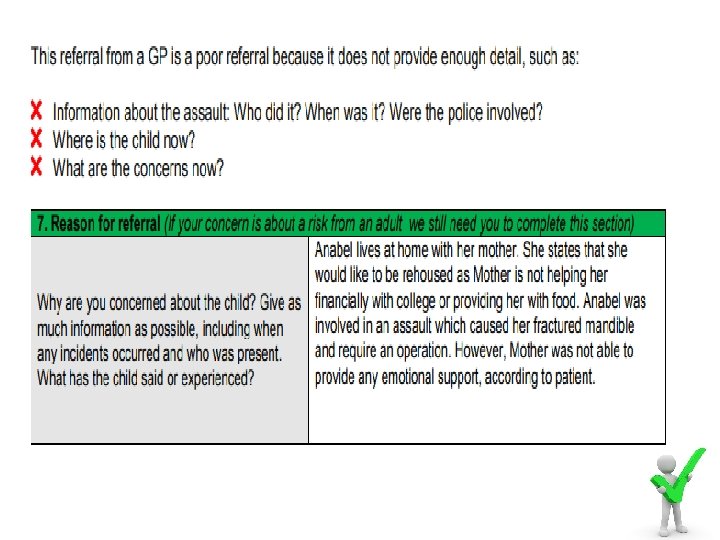
The following example has been completed by a nursery teacher to report a domestic abuse concern. It is a good quality referral because it: • Uses the child’s words and gestures to explain the concern • Makes it clear when the conversation took place • Tells us what advice has been given to the child’s parents • Provides a name that MASH can follow up
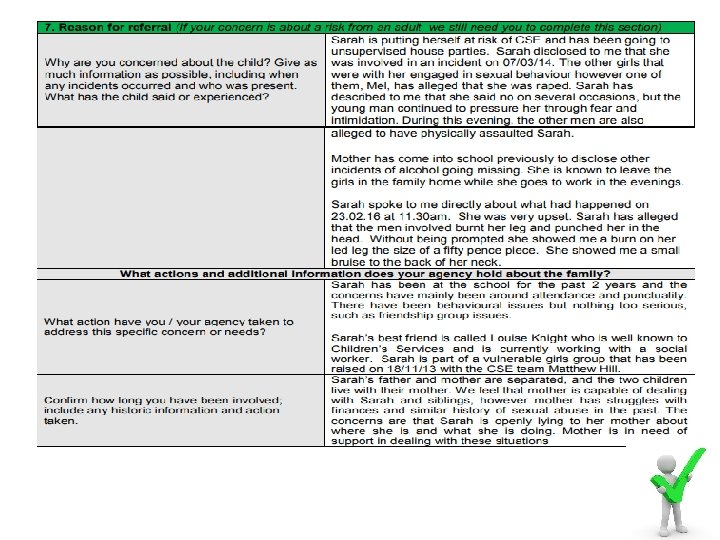
The following example has been completed by a school welfare officer to report a CSE concern. It is a good quality referral because it: • Is specific • Provides context about what the agency has been doing to support the young person and parent • Provides details such as the police log number and known links
• Within one working day of a referral being received, a local authority social worker should acknowledge receipt to the referrer and make a decision about next steps and the type of response required. • This will include determining whether: • The child requires immediate protection and urgent action is required • There is reasonable cause to suspect that the child is suffering or likely to suffer significant harm, and whether enquires must be made and the child assessed under section 47 of the Children Act 1989 • The child is in need and should be assessed under section 17 of the Children Act 1989 • Any services are required by the child and family and what type of services
Mind the Gap • After submitting a MARF, make sure you are contactable within 48 hours. It is crucial you leave contact details, the best time to call you or who else to speak to within your organisation if you are not available. • Don’t stop working with the family at this time of transition. The child will likely still require your on-going support and monitoring of their welfare – don’t assume that because you have completed a referral that the child will be safe. • You should be contacted with the outcome of the referral within 72 hours (is this right? ). If you haven’t make sure you contact MASH and chase this. • If you disagree with the outcome of the decision by MASH, you will need to follow the GSCE Escalation Policy to express your views and concerns, and follow the process accordingly.
Community Social Workers ·Tewkesbury – Nichola Spear M: 07785604872. Mon 9 -5, Tues 9 -1, Weds 9 -1 ·North Cotswolds and Stroud - Beverley Pitter M: 07760 172829 ·South Cotswolds - Mandy Hollands M: 07587 614861. Tues, Weds & Friday ·Gloucester - Debbie Webb M: 07947 505664 ·Gloucester – Nick Richardson Mobile: 07769 361867 ·Forest of Dean - Keira Shortman M: 07786 701973 ·Cheltenham – Sophie Morgan M: 07584 377898 ·Stroud – Brian Devers-Martin M: 07899994759. Mon 9 am to 1 pm, Tues and Thurs Team Manager – Nick Bollington M: 07464 654655 Advanced Practitioner – Isobel Neason M: 07901 663755
- Slides: 21