
DSHS and SNAPEd Partnerships Working with your Community

- Slides: 15
DSHS and SNAP-Ed Partnerships Working with your Community Services Offices (CSOs) Troy Burgess SNAP-Ed Program Consultant Office of Programs & Policy, CSD HQ
What I’d like to share with you all • A review on DSHS benefits and programs • Quick insight on other programs whom connect with the community • Review the CSD Agency Structure • Importance on partnerships • Connecting to a CSO • Examples of CSO partnerships • DSHS Goals
A small review on the Community Services Division & and programs offered
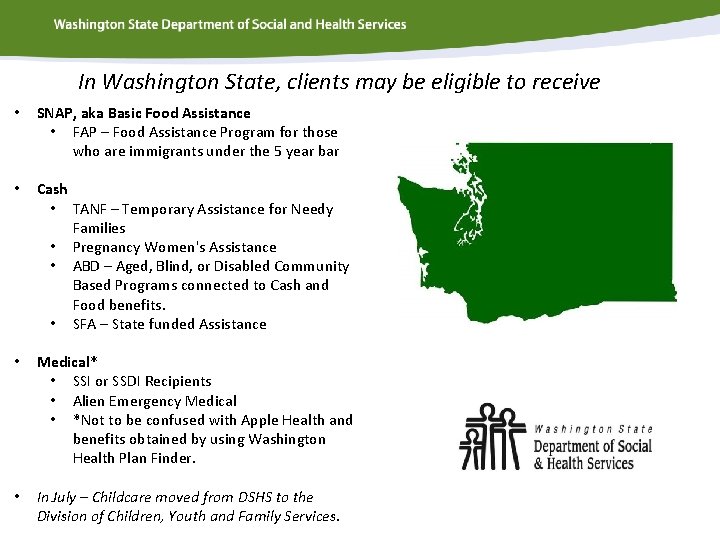
In Washington State, clients may be eligible to receive • SNAP, aka Basic Food Assistance • FAP – Food Assistance Program for those who are immigrants under the 5 year bar • Cash • TANF – Temporary Assistance for Needy Families • Pregnancy Women's Assistance • ABD – Aged, Blind, or Disabled Community Based Programs connected to Cash and Food benefits. • SFA – State funded Assistance • Medical* • SSI or SSDI Recipients • Alien Emergency Medical • *Not to be confused with Apple Health and benefits obtained by using Washington Health Plan Finder. • In July – Childcare moved from DSHS to the Division of Children, Youth and Family Services.
Additional programs that partner with your communities • Basic Food Employment & Training (BFET) – Connecting with 50+ Community Based Organizations in addition to Colleges with the State Board for Community & Technical Colleges (SBCTC) • Office of Refugee and Immigrant Assistance (ORIA) – Programs partnering with community agencies to assistant refugees and immigrants with education, training, housing resources, ESL classes, and immigration assistance • Workfirst (for TANF recipients) – Working with both colleges, training agencies, nonprofits, and more to provide training resources for parents and families • Basic Food Outreach – Working with agencies to assist individuals in signing up for Basic Food Assistance • Employment Pipeline – Working with local Workforce Development Councils and WIOA based agencies to offer career based resources to anyone seeking employment. • And more!
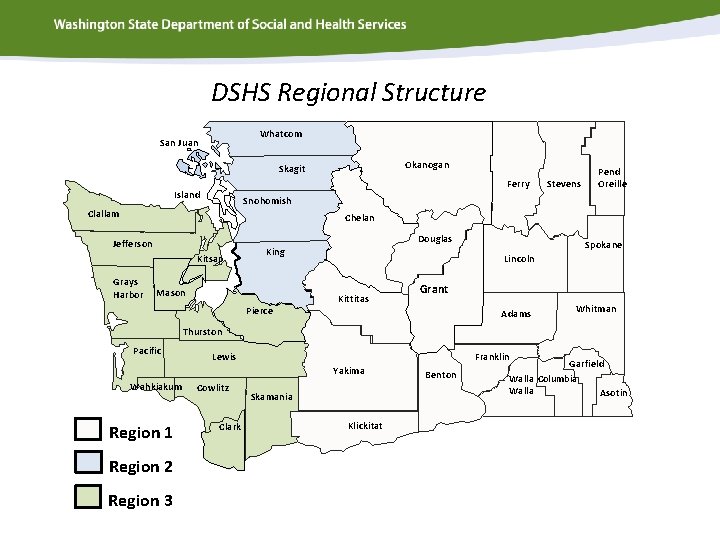
DSHS Regional Structure Whatcom San Juan Okanogan Skagit Ferry Island Stevens Pend Oreille Snohomish Clallam Chelan Douglas Jefferson Kitsap Grays Harbor King Mason Pierce Spokane Lincoln Kittitas Grant Adams Whitman Thurston Pacific Franklin Lewis Yakima Wahkiakum Region 1 Region 2 Region 3 Cowlitz Clark Skamania Klickitat Benton Garfield Walla Columbia Walla Asotin
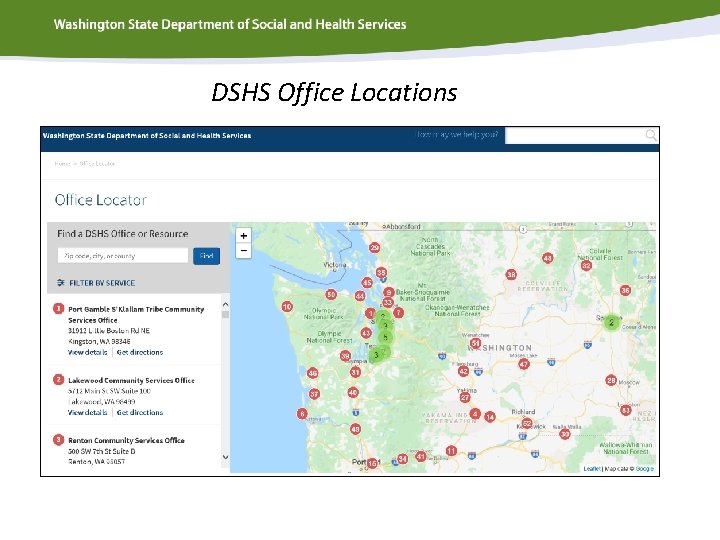
DSHS Office Locations
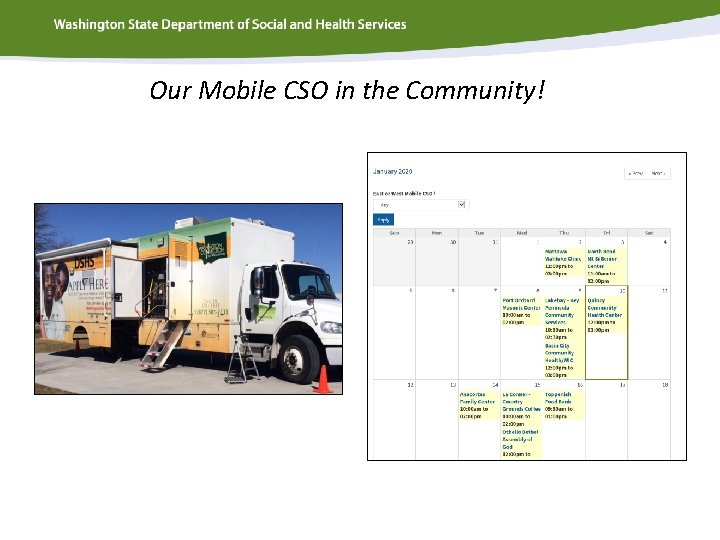
Our Mobile CSO in the Community!
Collaborating with your local CSO
Why CSO partnerships are important • We go beyond the standard services and go the extra mile for our clients • Individuals become engaged in the community support around them • Clients become aware and take advantage of their programs • Increased referrals • Increased participation • More outcomes • Investment and commitment go a long way
Helpful Suggestions on Connecting with your CSO • Find an office near you and connect with your local CSO • www. dshs. wa. gov/office-locations • Get in contact with your office and regional administrators • Contact information will follow this presentation • Introductions and backgrounds • Who you and your agency are • What your services include • What are your goals are? • What are the benefits for the clients? • Connecting through DSHS Community Based Programs and LPAs Stay committed!
For agencies and programs that have successful partnerships with CSO’s Share your practices • • • How did you connect? What activities did you do? What were successes? What were the challenges? Any outcomes?
SNAP-Ed in DSHS goals for better partnerships in 2020 and beyond • Reintroduce SNAP-Ed to our CSO staff • Improve their understanding of the program • Creating staff SNAP-Ed resources • Stronger connections with SNAP-Ed (You) and your SNAP-Ed leadership teams • Commitment to the program
A great example of CSO Partnership with SNAP-Ed The Mt. Vernon CSO regularly partners WSU Skagit County Extension office and other partners to bring valuable community to their office. Successes of this partnership include • Regular involvement in their LPAs • Planning community events together • Skagit County in the office “Lobby Takeover” which provides resources including • Cooking Demos • Information on nutrition and healthy eating campaigns • Local program information • CSO Staff and management investment in SNAP-Ed • “Our goal was to avoid telling our clients there are no resources”
Thank you! • • • Have any questions? Have examples on partnerships? Suggestions? Let us know! Troy Burgess SNAP-Ed Program Consultant Troy. Burgess@dshs. wa. gov 360 -584 -5162 Angela Amico SNAP-Ed Program Manager Angela. Amico@dshs. wa. gov 360 -725 -4613