
DSAEK in Eyes With Severe Preoperative Visual Acuity
- Slides: 10
DSAEK in Eyes With Severe Pre-operative Visual Acuity Loss. Paul Phillips, MD 1, 2, Mark A. Terry, MD 2, 3, Neda Shamie, MD 2, Anand Shah, MD 2, and Daniel Friend 3 2. 1. Sightline Ophthalmic Associates, Pittsburgh, PA 1. 2. Devers Eye Institute, Portland, OR 3. Lions Eye Bank of Oregon Vision Research Laboratory, Portland, OR Financial interest statement: Mark A. Terry, MD has a financial interest in the specialized DSAEK instruments used in this study. Funding for this project was supplied by The Lions Eye Bank of Oregon.
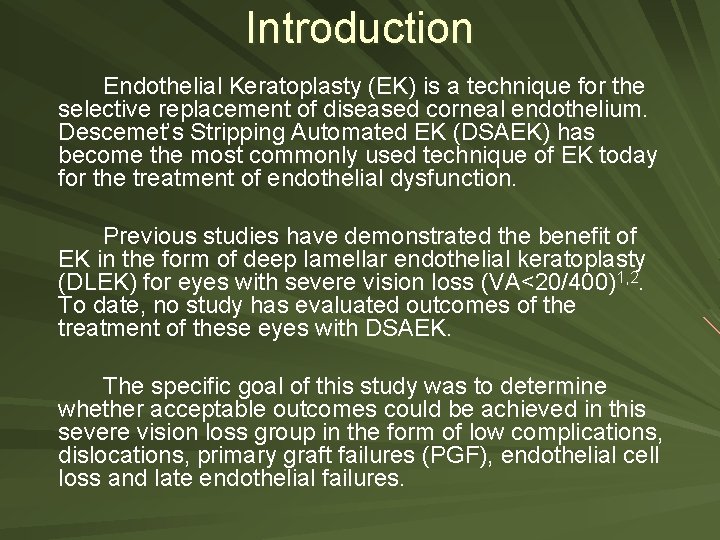
Introduction Endothelial Keratoplasty (EK) is a technique for the selective replacement of diseased corneal endothelium. Descemet’s Stripping Automated EK (DSAEK) has become the most commonly used technique of EK today for the treatment of endothelial dysfunction. Previous studies have demonstrated the benefit of EK in the form of deep lamellar endothelial keratoplasty (DLEK) for eyes with severe vision loss (VA<20/400)1, 2. To date, no study has evaluated outcomes of the treatment of these eyes with DSAEK. The specific goal of this study was to determine whether acceptable outcomes could be achieved in this severe vision loss group in the form of low complications, dislocations, primary graft failures (PGF), endothelial cell loss and late endothelial failures.
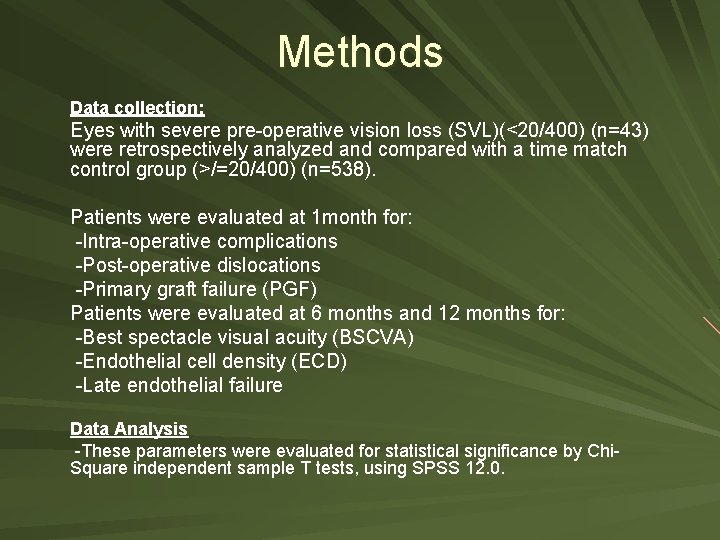
Methods Data collection: Eyes with severe pre-operative vision loss (SVL)(<20/400) (n=43) were retrospectively analyzed and compared with a time match control group (>/=20/400) (n=538). Patients were evaluated at 1 month for: -Intra-operative complications -Post-operative dislocations -Primary graft failure (PGF) Patients were evaluated at 6 months and 12 months for: -Best spectacle visual acuity (BSCVA) -Endothelial cell density (ECD) -Late endothelial failure Data Analysis -These parameters were evaluated for statistical significance by Chi. Square independent sample T tests, using SPSS 12. 0.
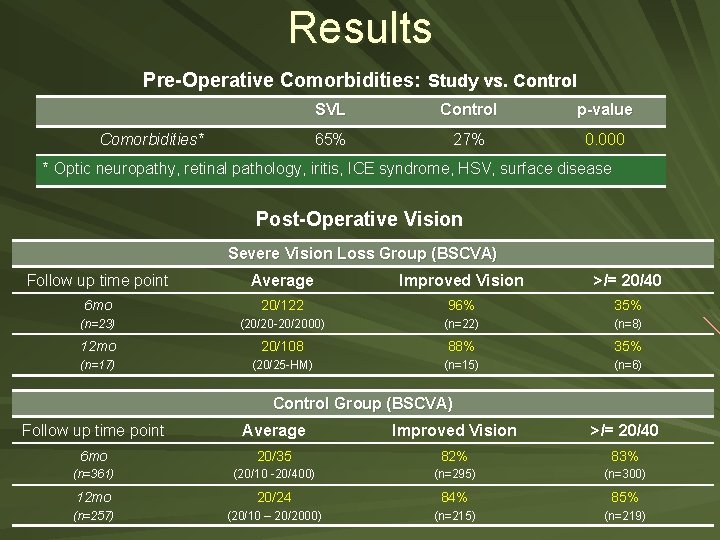
Results Pre-Operative Comorbidities: Study vs. Control Comorbidities* SVL Control p-value 65% 27% 0. 000 * Optic neuropathy, retinal pathology, iritis, ICE syndrome, HSV, surface disease Post-Operative Vision Severe Vision Loss Group (BSCVA) Follow up time point Average Improved Vision >/= 20/40 6 mo 20/122 96% 35% (n=23) (20/20 -20/2000) (n=22) (n=8) 12 mo 20/108 88% 35% (n=17) (20/25 -HM) (n=15) (n=6) Control Group (BSCVA) Follow up time point Average Improved Vision >/= 20/40 6 mo 20/35 82% 83% (n=361) (20/10 -20/400) (n=295) (n=300) 12 mo 20/24 84% 85% (n=257) (20/10 – 20/2000) (n=215) (n=219)
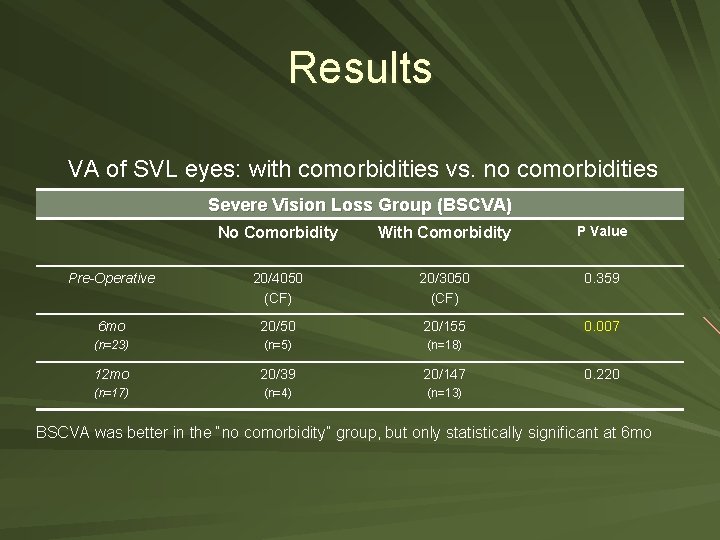
Results VA of SVL eyes: with comorbidities vs. no comorbidities Severe Vision Loss Group (BSCVA) No Comorbidity With Comorbidity P Value Pre-Operative 20/4050 (CF) 20/3050 (CF) 0. 359 6 mo 20/50 20/155 0. 007 (n=23) (n=5) (n=18) 12 mo 20/39 20/147 (n=17) (n=4) (n=13) 0. 220 BSCVA was better in the “no comorbidity” group, but only statistically significant at 6 mo
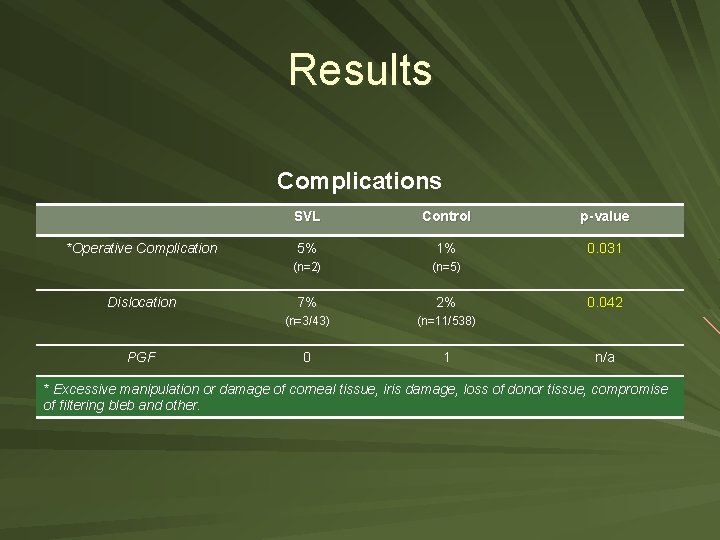
Results Complications *Operative Complication Dislocation PGF SVL Control p-value 5% 1% 0. 031 (n=2) (n=5) 7% 2% (n=3/43) (n=11/538) 0 1 0. 042 n/a * Excessive manipulation or damage of corneal tissue, iris damage, loss of donor tissue, compromise of filtering bleb and other.
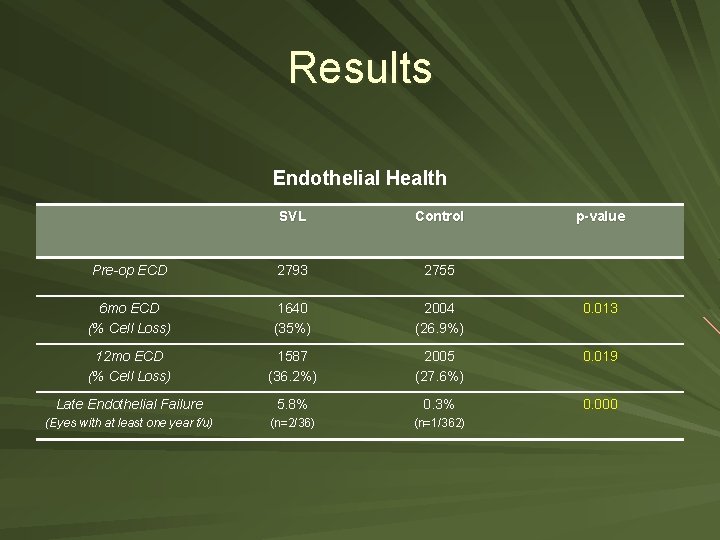
Results Endothelial Health SVL Control p-value Pre-op ECD 2793 2755 6 mo ECD (% Cell Loss) 1640 (35%) 2004 (26. 9%) 0. 013 12 mo ECD (% Cell Loss) 1587 (36. 2%) 2005 (27. 6%) 0. 019 Late Endothelial Failure 5. 8% 0. 3% 0. 000 (Eyes with at least one year f/u) (n=2/36) (n=1/362)
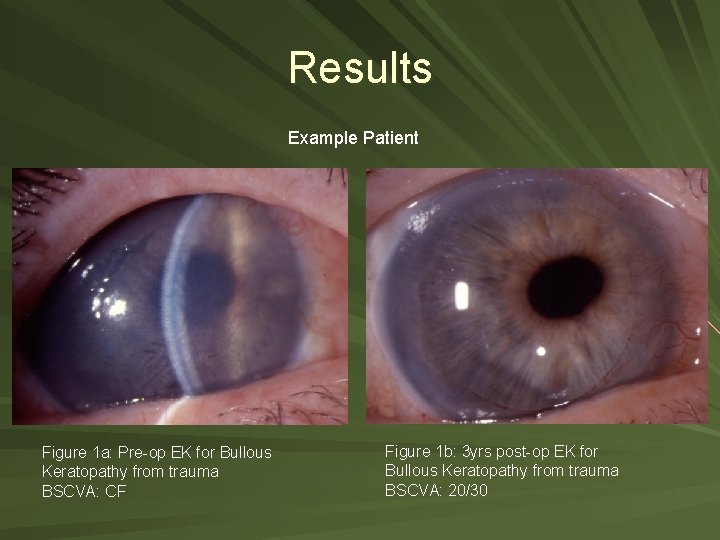
Results Example Patient Figure 1 a: Pre-op EK for Bullous Keratopathy from trauma BSCVA: CF Figure 1 b: 3 yrs post-op EK for Bullous Keratopathy from trauma BSCVA: 20/30
Discussion When compared to a time matched control group, vision in the SVL group was more limited. – This limitation in vision may be due to a higher rate of comorbidities, but may also be limited by inherent chronic stromal changes, as there was not a significant difference in final acuities between eyes with and without comorbidities at one year in the SVL group. While there was not a higher incidence of PGF in SVL group, there were higher rates of dislocation and intra-operative complications. – We believe that the dislocation (7%) and intra-operative complication (5%) rates in the SVL group are acceptable, however these rates may be higher than the control group due to the more complex nature of surgery in these eyes. Post-operative endothelial cell loss is also higher in the SVL group, with increased rates of late endothelial failure. – We believe that rates of ECD loss (36. 2%) and late endothelial failure (5. 8%) are acceptable, but may possibly be higher due to increased intra-operative trauma and significant comorbidities, such as the presence of glaucoma, filtering tubes and trabeculectomies. – In the future, data from a greater number of eyes with SVL, with long term followup, will help to clarify the true difference in outcomes in this population.
Discussion Despite a significantly higher rate of comorbid conditions in the severe vision loss (SVL) study group, DSAEK was performed in these eyes with relatively: - Low intra-operative complications - Low dislocation rates - Low primary graft failure rates - Improved vision - Reasonable preservation of endothelium and rates of late endothelial failure