
DS 449 United States Countervailing and Antidumping Measures
- Slides: 29
DS 449 United States Countervailing and Antidumping Measures on Certain Products from China ITRN 603 - Global Trade Relations Cece Ly and Phil Kim Spring 2021
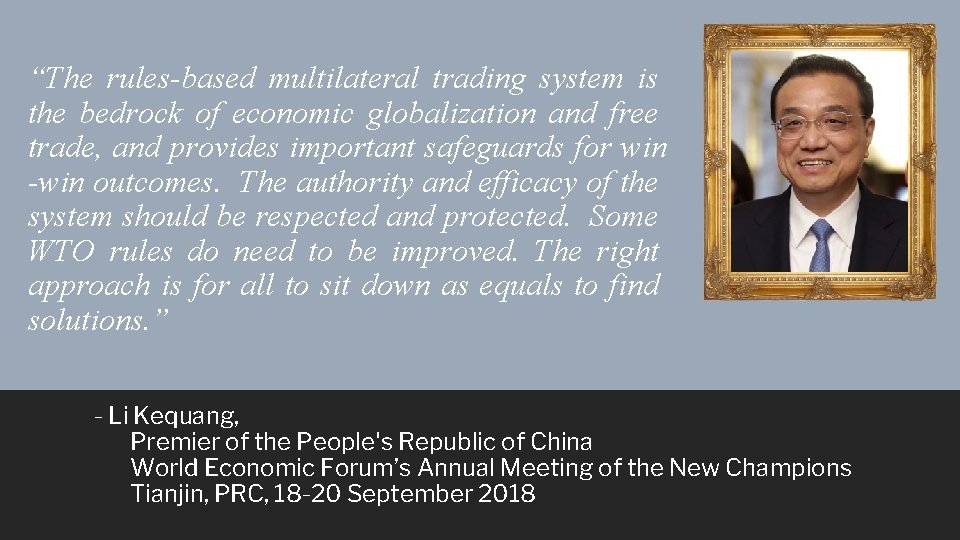
“The rules-based multilateral trading system is the bedrock of economic globalization and free trade, and provides important safeguards for win -win outcomes. The authority and efficacy of the system should be respected and protected. Some WTO rules do need to be improved. The right approach is for all to sit down as equals to find solutions. ” - Li Kequang, Premier of the People's Republic of China World Economic Forum’s Annual Meeting of the New Champions Tianjin, PRC, 18 -20 September 2018
Agenda 1. History and Context 2. Prior Proceedings 3. The Main WTO Issue - Contested Issue/WTO Agreement and Provisions - Positions of Main Parties - Decision/Recommendation of the Panel/Appellate Body - Implementations of Findings - Proposal for Resolution 1. Observations of Case
History and Context Key Terms Dumping: A process wherein a company exports a product at a price that is significantly lower than the price it normally charges in its domestic market Anti-dumping Duty (AD): A tariff that a domestic government imposes on foreign imports that it believes are priced below fair market value Countervailing Duty (CVD): A tariffs levied on imported goods to offset subsidies made to producers of these goods in the exporting country Non-Market Economy (NME): Economies where the government has a complete or substantially complete monopoly of its trade and where all domestic prices are fixed by the State Double Remedies: The simultaneous use of Antidumping duty and Countervailing duty, resulting in the same instance(s) of subsidization being offset twice.
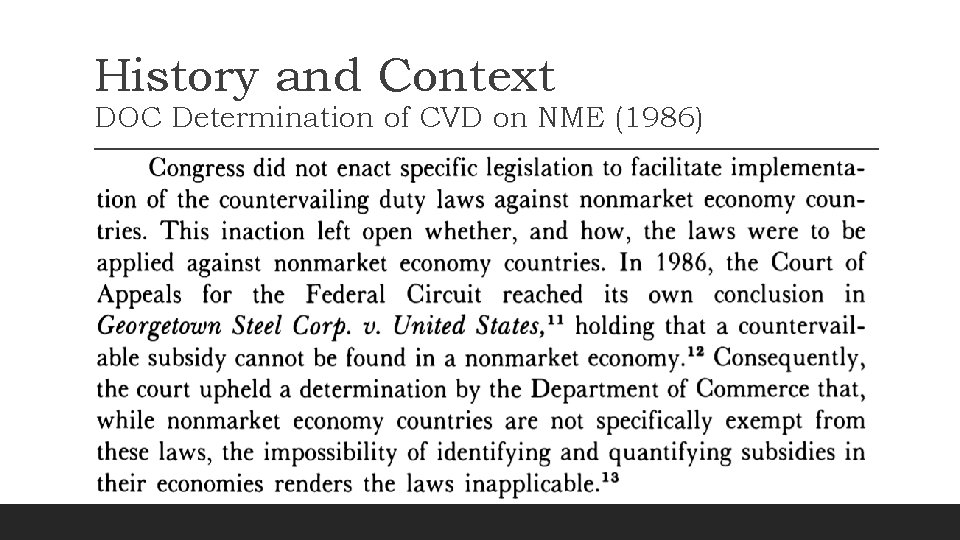
History and Context DOC Determination of CVD on NME (1986)
History and Context Coated Free Sheet Paper from the People's Republic of China - On March 30, 2007, the U. S. Department of Commerce for the first time applied the countervailing duty law - or anti-subsidies law - to imports from the People's Republic of China - For the first time, subsidies given to Chinese manufacturers or other producers may be offset by duties imposed at the U. S. border - The case deals with unfair assistance provided by the Government of China to certain manufacturers of high-end paper products - While this particular determination covered only coated free sheet paper, the case set the precedent that applied across the manufacturing sector and fundamentally altered the landscape of Sino-American trade
History and Context GPX International Tire Corp. v. United States - On December 19, 2011, the U. S. Court of Appeals for the Federal Circuit (CAFC) issued a decision that will impact a large number of U. S. trade remedy cases involving China - The CAFC panel unanimously ruled that the U. S. Department of Commerce (DOC) may not apply countervailing duty (CVD) law to non-market economy (NME) countries, such as China - The CAFC ruled that existing law does not allow U. S. companies to seek relief against imported goods from China that benefit from Chinese government subsidies
History and Context China’s Status as a Non-Market Economy - Under the legal structure of the World Trade Organization (WTO), the designation of China as a NME allows its trading partners to determine whether China's exports are being sold at unfairly low prices - If it is found that China is exporting at unfair prices, trading partners may apply additional anti-dumping duties - Since 2001, China has been subject to a special presumption that it is a NME under Article 15 of the protocol by which China joined the WTO - This presumption expired on December 11, 2016, and while China believes that it must now be accorded market economy status, the U. S. argues that China is not automatically eligible and has commenced a procedure to determine whether China is still a NME.
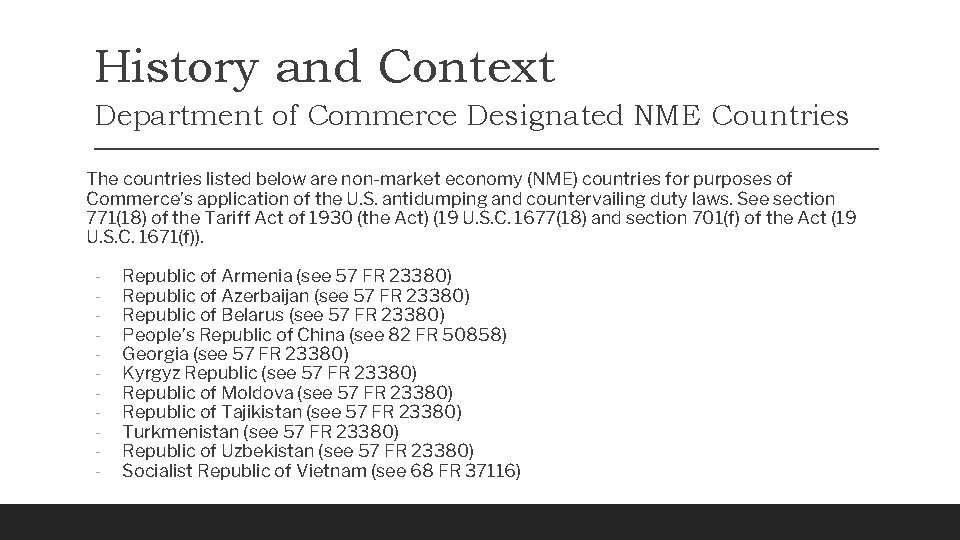
History and Context Department of Commerce Designated NME Countries The countries listed below are non-market economy (NME) countries for purposes of Commerce’s application of the U. S. antidumping and countervailing duty laws. See section 771(18) of the Tariff Act of 1930 (the Act) (19 U. S. C. 1677(18) and section 701(f) of the Act (19 U. S. C. 1671(f)). - Republic of Armenia (see 57 FR 23380) Republic of Azerbaijan (see 57 FR 23380) Republic of Belarus (see 57 FR 23380) People’s Republic of China (see 82 FR 50858) Georgia (see 57 FR 23380) Kyrgyz Republic (see 57 FR 23380) Republic of Moldova (see 57 FR 23380) Republic of Tajikistan (see 57 FR 23380) Turkmenistan (see 57 FR 23380) Republic of Uzbekistan (see 57 FR 23380) Socialist Republic of Vietnam (see 68 FR 37116)
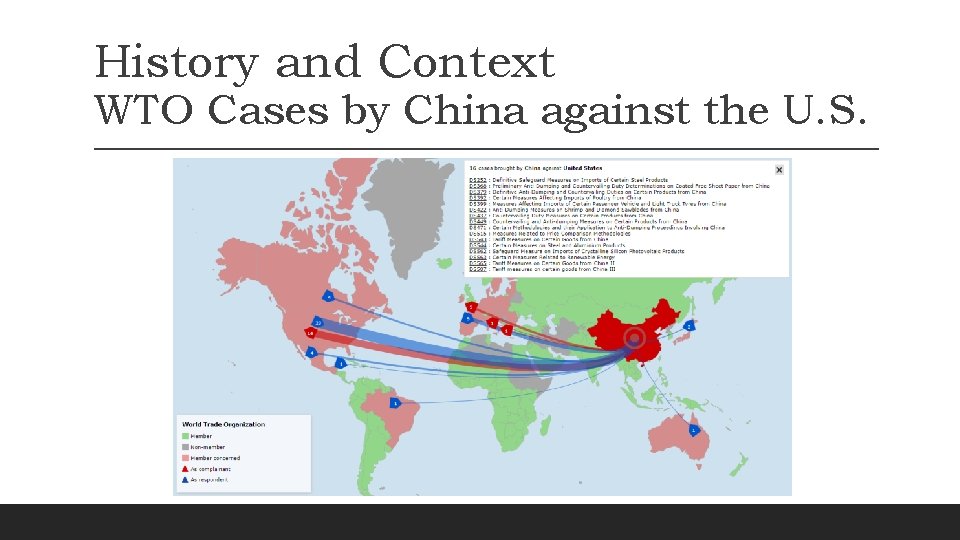
History and Context WTO Cases by China against the U. S.
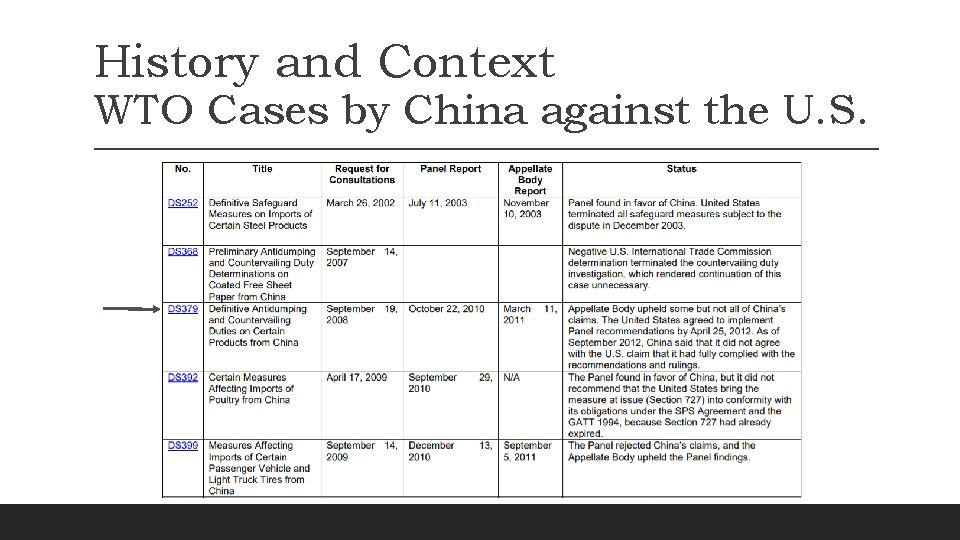
History and Context WTO Cases by China against the U. S.
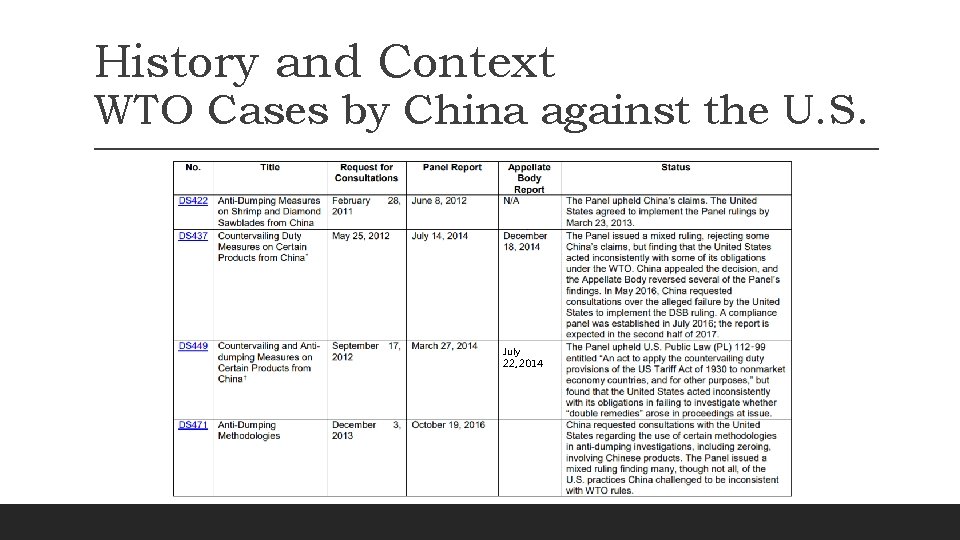
History and Context WTO Cases by China against the U. S. July 22, 2014
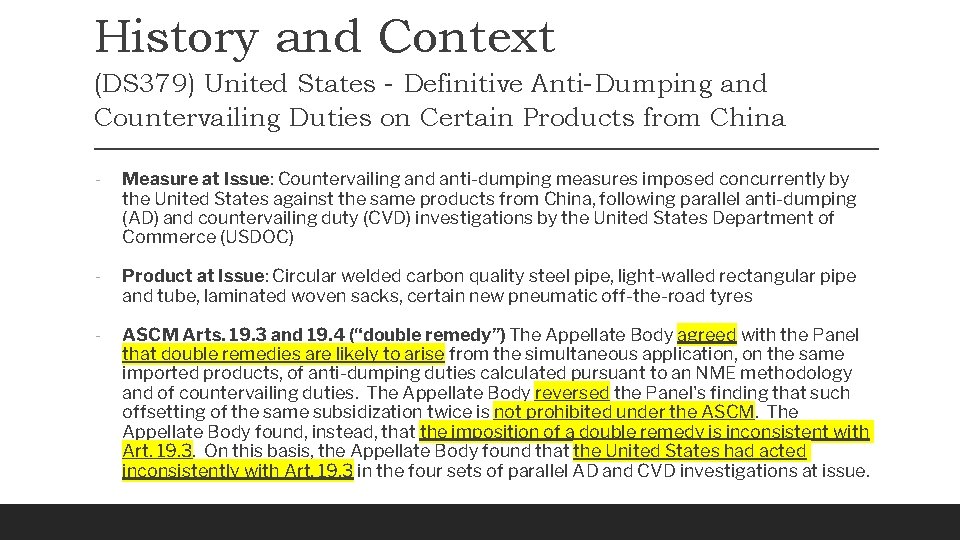
History and Context (DS 379) United States - Definitive Anti-Dumping and Countervailing Duties on Certain Products from China - Measure at Issue: Countervailing and anti-dumping measures imposed concurrently by the United States against the same products from China, following parallel anti-dumping (AD) and countervailing duty (CVD) investigations by the United States Department of Commerce (USDOC) - Product at Issue: Circular welded carbon quality steel pipe, light-walled rectangular pipe and tube, laminated woven sacks, certain new pneumatic off-the-road tyres - ASCM Arts. 19. 3 and 19. 4 (“double remedy”): The Appellate Body agreed with the Panel that double remedies are likely to arise from the simultaneous application, on the same imported products, of anti-dumping duties calculated pursuant to an NME methodology and of countervailing duties. The Appellate Body reversed the Panel's finding that such offsetting of the same subsidization twice is not prohibited under the ASCM. The Appellate Body found, instead, that the imposition of a double remedy is inconsistent with Art. 19. 3. On this basis, the Appellate Body found that the United States had acted inconsistently with Art. 19. 3 in the four sets of parallel AD and CVD investigations at issue.
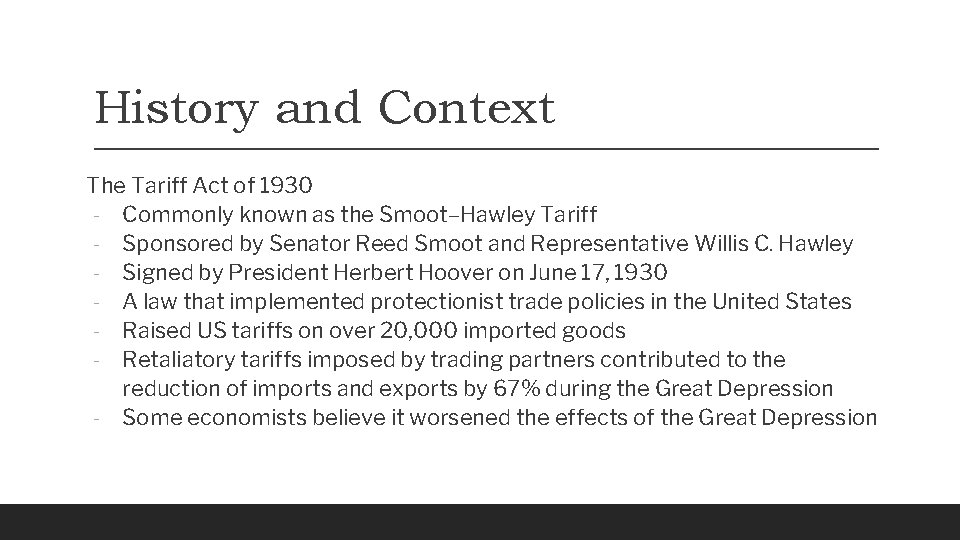
History and Context The Tariff Act of 1930 - Commonly known as the Smoot–Hawley Tariff - Sponsored by Senator Reed Smoot and Representative Willis C. Hawley - Signed by President Herbert Hoover on June 17, 1930 - A law that implemented protectionist trade policies in the United States - Raised US tariffs on over 20, 000 imported goods - Retaliatory tariffs imposed by trading partners contributed to the reduction of imports and exports by 67% during the Great Depression - Some economists believe it worsened the effects of the Great Depression
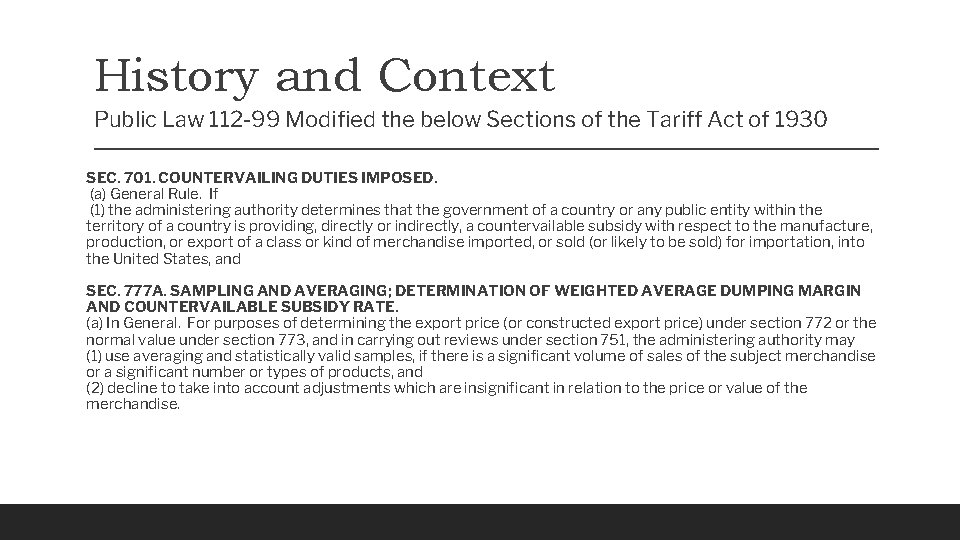
History and Context Public Law 112 -99 Modified the below Sections of the Tariff Act of 1930 SEC. 701. COUNTERVAILING DUTIES IMPOSED. (a) General Rule. If (1) the administering authority determines that the government of a country or any public entity within the territory of a country is providing, directly or indirectly, a countervailable subsidy with respect to the manufacture, production, or export of a class or kind of merchandise imported, or sold (or likely to be sold) for importation, into the United States, and SEC. 777 A. SAMPLING AND AVERAGING; DETERMINATION OF WEIGHTED AVERAGE DUMPING MARGIN AND COUNTERVAILABLE SUBSIDY RATE. (a) In General. For purposes of determining the export price (or constructed export price) under section 772 or the normal value under section 773, and in carrying out reviews under section 751, the administering authority may (1) use averaging and statistically valid samples, if there is a significant volume of sales of the subject merchandise or a significant number or types of products, and (2) decline to take into account adjustments which are insignificant in relation to the price or value of the merchandise.
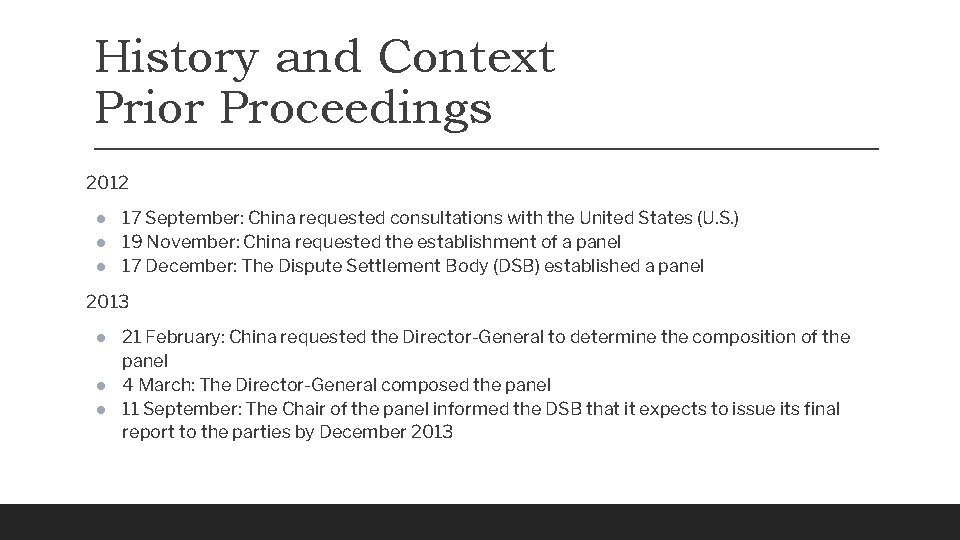
History and Context Prior Proceedings 2012 ● 17 September: China requested consultations with the United States (U. S. ) ● 19 November: China requested the establishment of a panel ● 17 December: The Dispute Settlement Body (DSB) established a panel 2013 ● 21 February: China requested the Director-General to determine the composition of the panel ● 4 March: The Director-General composed the panel ● 11 September: The Chair of the panel informed the DSB that it expects to issue its final report to the parties by December 2013
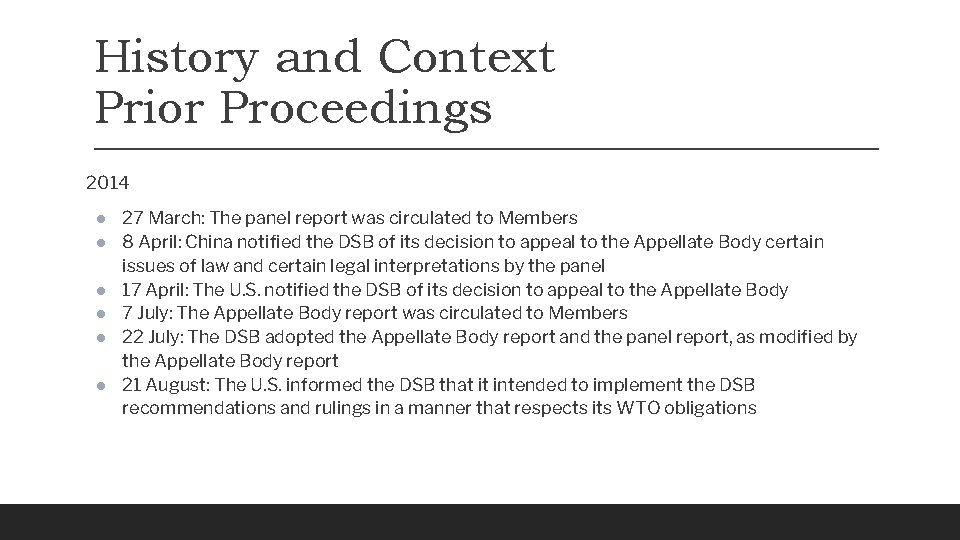
History and Context Prior Proceedings 2014 ● 27 March: The panel report was circulated to Members ● 8 April: China notified the DSB of its decision to appeal to the Appellate Body certain issues of law and certain legal interpretations by the panel ● 17 April: The U. S. notified the DSB of its decision to appeal to the Appellate Body ● 7 July: The Appellate Body report was circulated to Members ● 22 July: The DSB adopted the Appellate Body report and the panel report, as modified by the Appellate Body report ● 21 August: The U. S. informed the DSB that it intended to implement the DSB recommendations and rulings in a manner that respects its WTO obligations
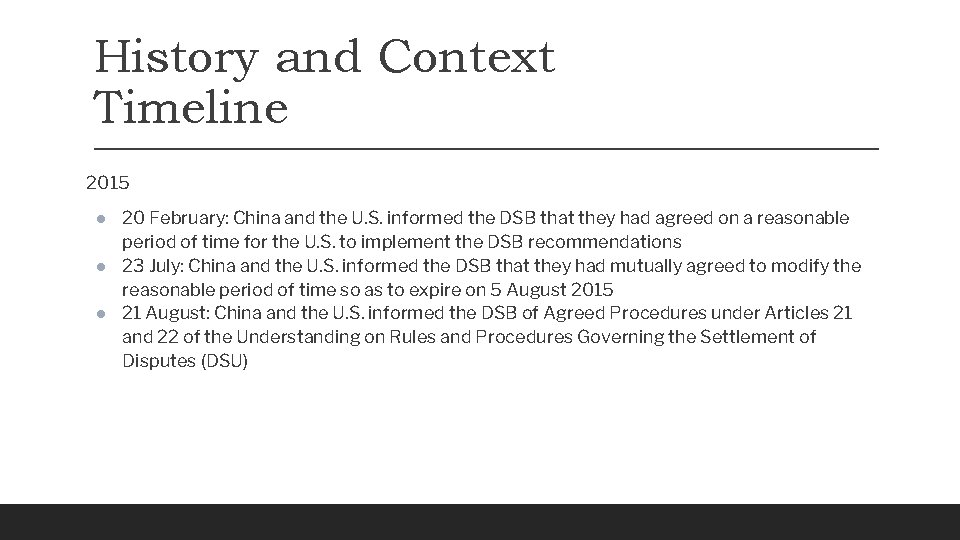
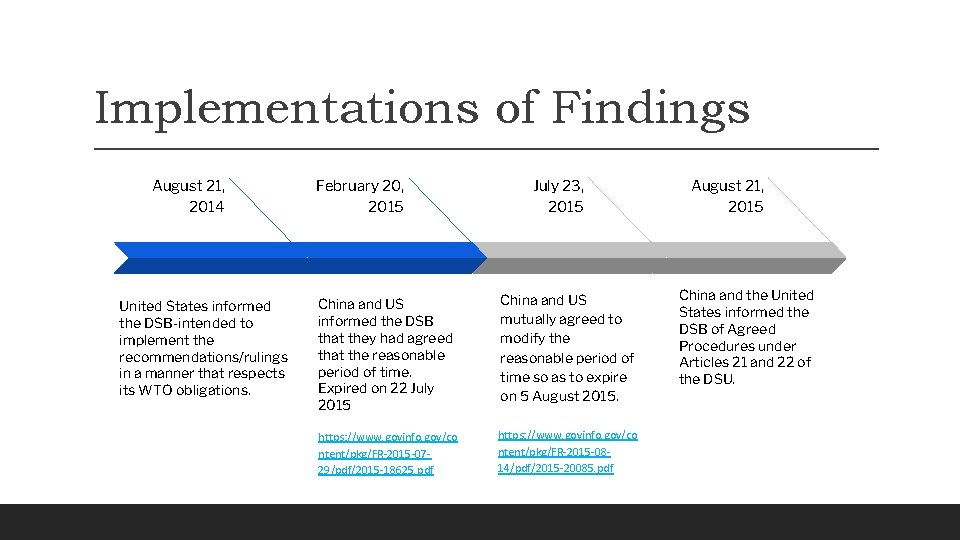
History and Context Timeline 2015 ● 20 February: China and the U. S. informed the DSB that they had agreed on a reasonable period of time for the U. S. to implement the DSB recommendations ● 23 July: China and the U. S. informed the DSB that they had mutually agreed to modify the reasonable period of time so as to expire on 5 August 2015 ● 21 August: China and the U. S. informed the DSB of Agreed Procedures under Articles 21 and 22 of the Understanding on Rules and Procedures Governing the Settlement of Disputes (DSU)
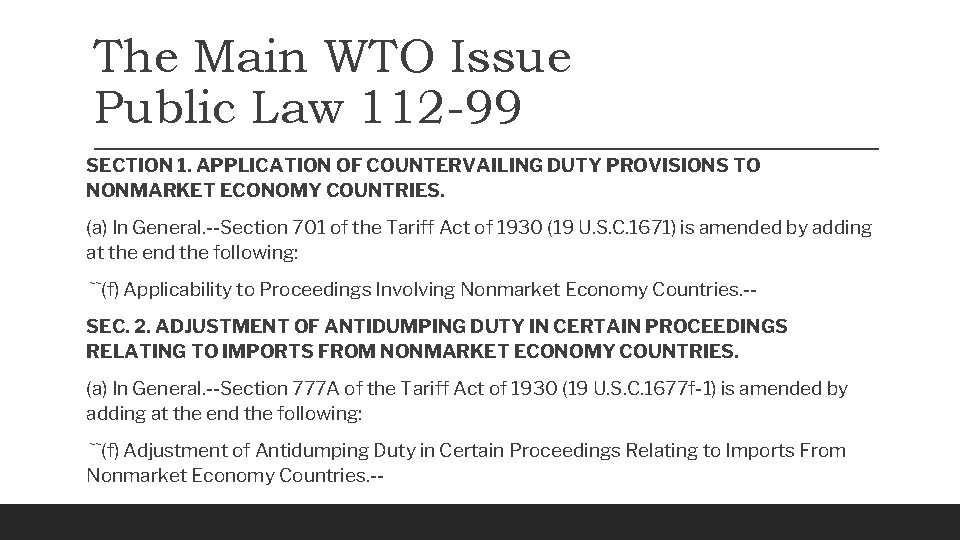
The Main WTO Issue Public Law 112 -99 SECTION 1. APPLICATION OF COUNTERVAILING DUTY PROVISIONS TO NONMARKET ECONOMY COUNTRIES. (a) In General. --Section 701 of the Tariff Act of 1930 (19 U. S. C. 1671) is amended by adding at the end the following: ``(f) Applicability to Proceedings Involving Nonmarket Economy Countries. -SEC. 2. ADJUSTMENT OF ANTIDUMPING DUTY IN CERTAIN PROCEEDINGS RELATING TO IMPORTS FROM NONMARKET ECONOMY COUNTRIES. (a) In General. --Section 777 A of the Tariff Act of 1930 (19 U. S. C. 1677 f-1) is amended by adding at the end the following: ``(f) Adjustment of Antidumping Duty in Certain Proceedings Relating to Imports From Nonmarket Economy Countries. --
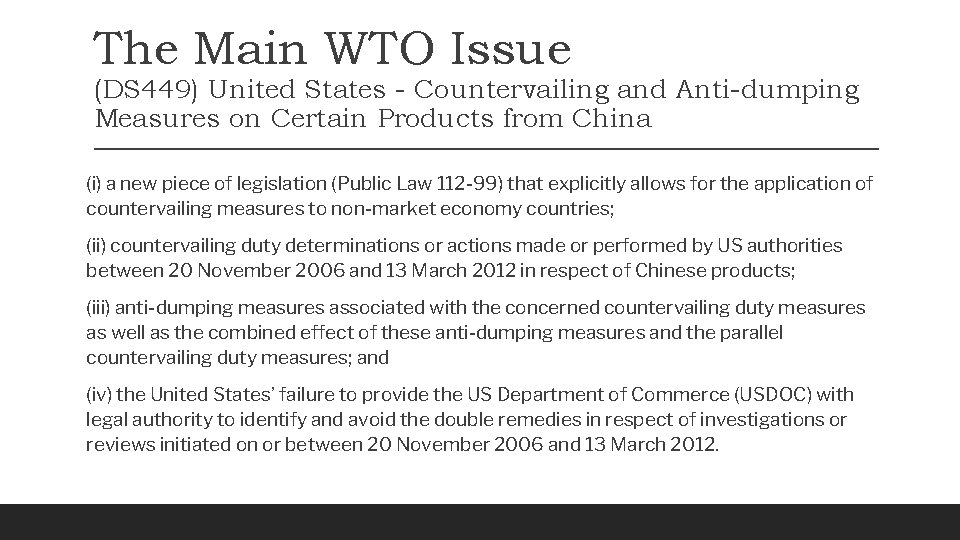
The Main WTO Issue (DS 449) United States - Countervailing and Anti-dumping Measures on Certain Products from China (i) a new piece of legislation (Public Law 112 -99) that explicitly allows for the application of countervailing measures to non-market economy countries; (ii) countervailing duty determinations or actions made or performed by US authorities between 20 November 2006 and 13 March 2012 in respect of Chinese products; (iii) anti-dumping measures associated with the concerned countervailing duty measures as well as the combined effect of these anti-dumping measures and the parallel countervailing duty measures; and (iv) the United States’ failure to provide the US Department of Commerce (USDOC) with legal authority to identify and avoid the double remedies in respect of investigations or reviews initiated on or between 20 November 2006 and 13 March 2012.
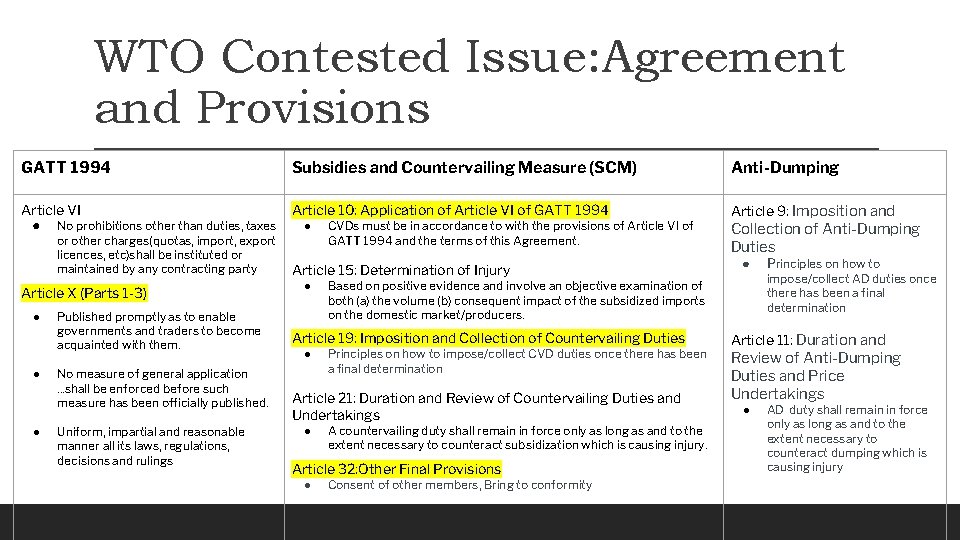
WTO Contested Issue: Agreement and Provisions GATT 1994 Subsidies and Countervailing Measure (SCM) Anti-Dumping Article VI ● No prohibitions other than duties, taxes Article 10: Application of Article VI of GATT 1994 Article 9: Imposition and or other charges(quotas, import, export licences, etc)shall be instituted or maintained by any contracting party Article X (Parts 1 -3) ● ● ● Published promptly as to enable governments and traders to become acquainted with them. No measure of general application. . . shall be enforced before such measure has been officially published. Uniform, impartial and reasonable manner all its laws, regulations, decisions and rulings ● CVDs must be in accordance to with the provisions of Article VI of GATT 1994 and the terms of this Agreement. Article 15: Determination of Injury ● Principles on how to impose/collect CVD duties once there has been a final determination Article 21: Duration and Review of Countervailing Duties and Undertakings ● A countervailing duty shall remain in force only as long as and to the extent necessary to counteract subsidization which is causing injury. Article 32: Other Final Provisions ● ● Based on positive evidence and involve an objective examination of both (a) the volume (b) consequent impact of the subsidized imports on the domestic market/producers. Article 19: Imposition and Collection of Countervailing Duties ● Collection of Anti-Dumping Duties Consent of other members, Bring to conformity Principles on how to impose/collect AD duties once there has been a final determination Article 11: Duration and Review of Anti-Dumping Duties and Price Undertakings ● AD duty shall remain in force only as long as and to the extent necessary to counteract dumping which is causing injury
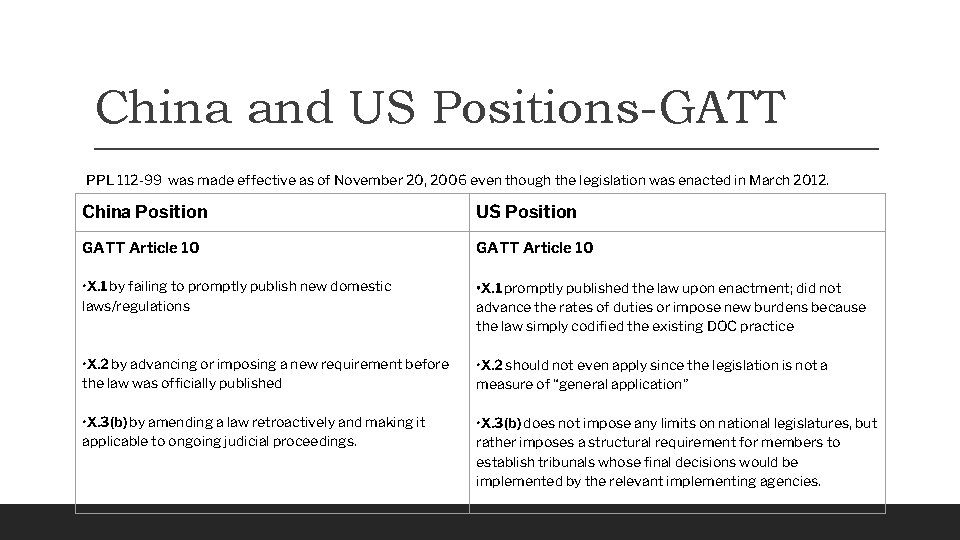
China and US Positions-GATT PPL 112 -99 was made effective as of November 20, 2006 even though the legislation was enacted in March 2012. China Position US Position GATT Article 10 • X. 1 by failing to promptly publish new domestic laws/regulations • X. 1 promptly published the law upon enactment; did not advance the rates of duties or impose new burdens because the law simply codified the existing DOC practice • X. 2 by advancing or imposing a new requirement before the law was officially published • X. 2 should not even apply since the legislation is not a measure of “general application” • X. 3(b) by amending a law retroactively and making it applicable to ongoing judicial proceedings. • X. 3(b) does not impose any limits on national legislatures, but rather imposes a structural requirement for members to establish tribunals whose final decisions would be implemented by the relevant implementing agencies.
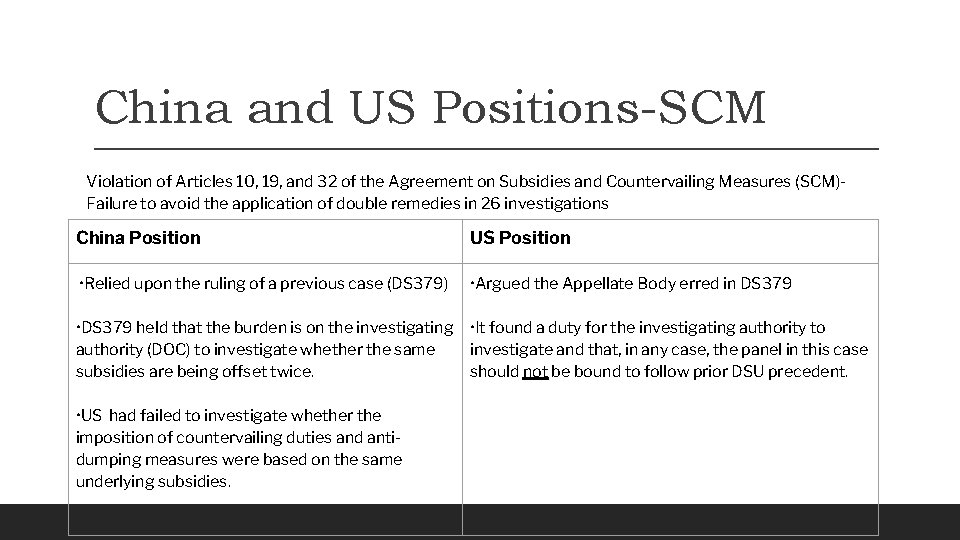
China and US Positions-SCM Violation of Articles 10, 19, and 32 of the Agreement on Subsidies and Countervailing Measures (SCM)Failure to avoid the application of double remedies in 26 investigations China Position US Position • Relied upon the ruling of a previous case (DS 379) • Argued the Appellate Body erred in DS 379 • DS 379 held that the burden is on the investigating authority (DOC) to investigate whether the same subsidies are being offset twice. • It found a duty for the investigating authority to investigate and that, in any case, the panel in this case should not be bound to follow prior DSU precedent. • US had failed to investigate whether the imposition of countervailing duties and antidumping measures were based on the same underlying subsidies.
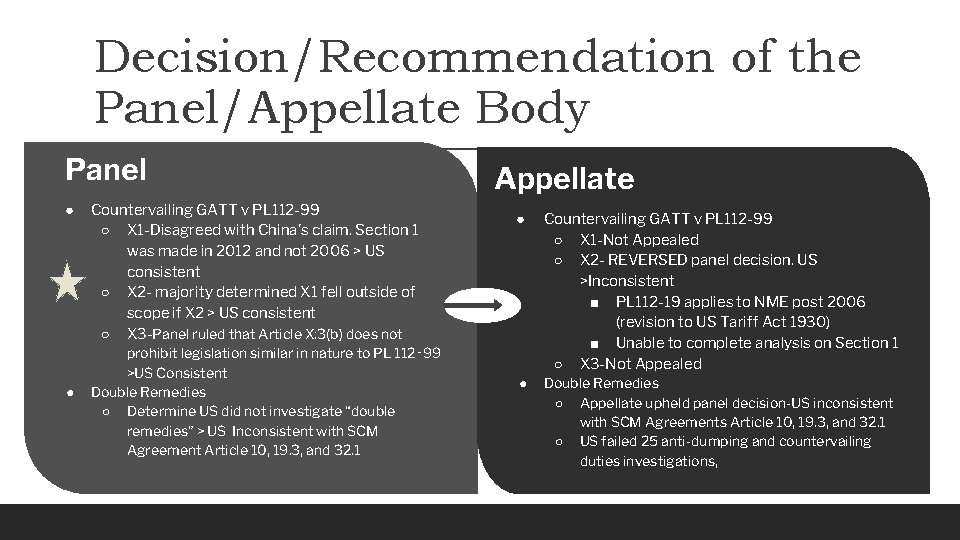
Decision/Recommendation of the Panel/Appellate Body Panel ● ● Countervailing GATT v PL 112 -99 ○ X 1 -Disagreed with China’s claim. Section 1 was made in 2012 and not 2006 > US consistent ○ X 2 - majority determined X 1 fell outside of scope if X 2 > US consistent ○ X 3 -Panel ruled that Article X: 3(b) does not prohibit legislation similar in nature to PL 112‑ 99 >US Consistent Double Remedies ○ Determine US did not investigate “double remedies” > US Inconsistent with SCM Agreement Article 10, 19. 3, and 32. 1 Appellate ● ● Countervailing GATT v PL 112 -99 ○ X 1 -Not Appealed ○ X 2 - REVERSED panel decision. US >Inconsistent ■ PL 112 -19 applies to NME post 2006 (revision to US Tariff Act 1930) ■ Unable to complete analysis on Section 1 ○ X 3 -Not Appealed Double Remedies ○ Appellate upheld panel decision-US inconsistent with SCM Agreements Article 10, 19. 3, and 32. 1 ○ US failed 25 anti-dumping and countervailing duties investigations,
Implementations of Findings August 21, 2014 United States informed the DSB-intended to implement the recommendations/rulings in a manner that respects its WTO obligations. February 20, 2015 July 23, 2015 China and US informed the DSB that they had agreed that the reasonable period of time. Expired on 22 July 2015 China and US mutually agreed to modify the reasonable period of time so as to expire on 5 August 2015. https: //www. govinfo. gov/co ntent/pkg/FR-2015 -0729/pdf/2015 -18625. pdf https: //www. govinfo. gov/co ntent/pkg/FR-2015 -0814/pdf/2015 -20085. pdf August 21, 2015 China and the United States informed the DSB of Agreed Procedures under Articles 21 and 22 of the DSU.
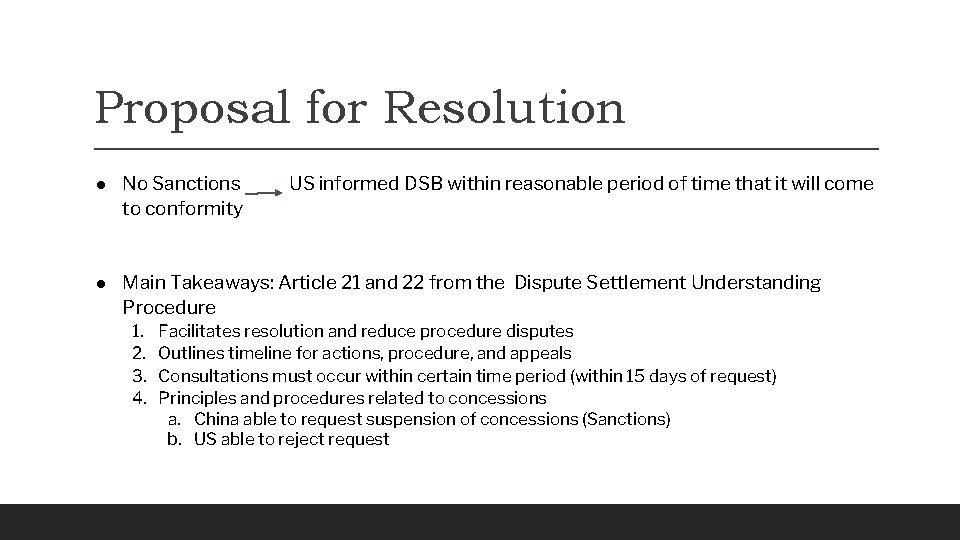
Proposal for Resolution ● No Sanctions to conformity US informed DSB within reasonable period of time that it will come ● Main Takeaways: Article 21 and 22 from the Dispute Settlement Understanding Procedure 1. 2. 3. 4. Facilitates resolution and reduce procedure disputes Outlines timeline for actions, procedure, and appeals Consultations must occur within certain time period (within 15 days of request) Principles and procedures related to concessions a. China able to request suspension of concessions (Sanctions) b. US able to reject request
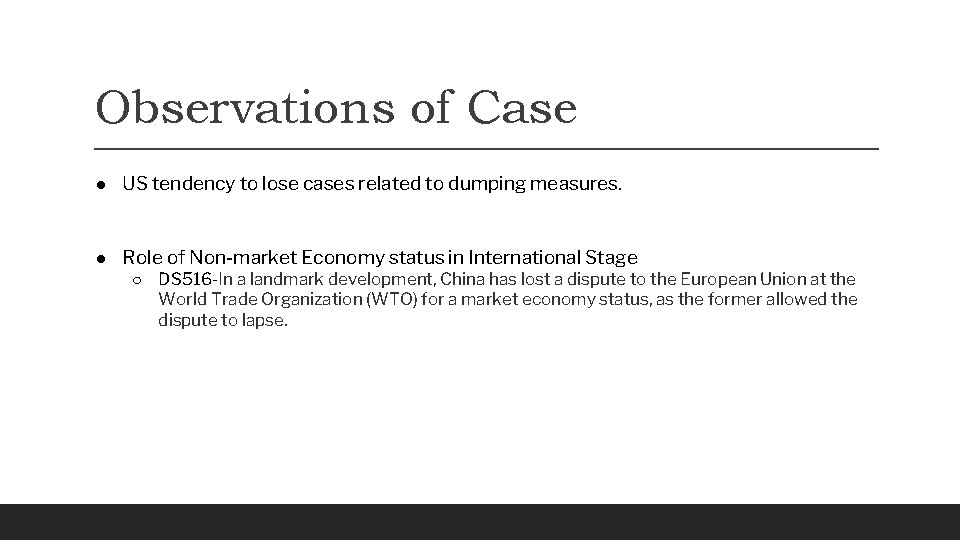
Observations of Case ● US tendency to lose cases related to dumping measures. ● Role of Non-market Economy status in International Stage ○ DS 516 -In a landmark development, China has lost a dispute to the European Union at the World Trade Organization (WTO) for a market economy status, as the former allowed the dispute to lapse.
References 1. Britannica. (2021). Smoot-Hawley Tariff Act. Retrieved from https: //www. britannica. com/topic/Smoot-Hawley-Tariff-Act 2. Cloutier, Christopher T. and Gilbert B. Kaplan. (2007 May 1). The First Affirmative Countervailing Duty Case Against China. Retrieved from https: //ccbjournal. com/articles/first-affirmative-countervailing-duty-case-against-china 3. Hoyt, Robert F. (1988). Implementation and Policy: Problems in the Application of Countervailing Duty Laws to Nonmarket Economy Countries. Retreived from https: //www-jstor-org. mutex. gmu. edu/stable/pdf/3312141. pdf? refreqid= excelsior%3 Ad 1 d 7 a 9 bcc 50 bdf 6 eb 81461 a 95159 f 1 ef 4. Kelton, Will. (2020 April 2). Countervailing Duties. Retrieved from https: //www. investopedia. com/terms/c/countervailingduties. asp 5. Kelton, Will. (2020 October 6). Anti-Dumping Duty. Retrieved from https: //www. investopedia. com/terms/a/anti-dumpingduty. asp 6. Levine, David J. and Raymond Paretzky. (2011 December 20). New Court Ruling Renders U. S. Anti-Subsidy Law Inapplicable to China. Retrieved from https: //www. lexology. com/library/detail. aspx? g=e 6 bd 87 bc-842 c-404 c-90 fb-f 4 d 06 b 29 c 5 bf
References 7. Trachtman, Joel. (2017 April 12). Is China a Non-Market Economy, and Why Does It Matter? . Retreived from https: //econofact. org/is-china-a-non-market-economy-and-why-does-it-matter 8. U. S. Congress. (2012 March 13). Public Law 112 -99. Retrieved from https: //www. congress. gov/112/plaws/publ 99/PLAW 112 publ 99. pdf 9. World Trade Organization (WTO). DS 449: United States — Countervailing and Anti-dumping Measures on Certain Products from China. Retreived from https: //www. wto. org/english/tratop_e/dispu_e/cases_e/ds 449_e. htm 10. World Trade Organization (WTO). (2014 July 7). United States - Countervailing and Anti-Dumping Measures on Certain Products from China, Report of the Appellate Body. Retreived from https: //www. wto. org/english/tratop_e/dispu_e/449 abr_e. pdf 11. U. S. -China Economic and Security Review Commission. (2019 April). WTO Cases Brought by China against the United States. Retrieved from https: //www. uscc. gov/sites/default/files/WTO%20 Cases%20 Brought%20 by%20 China%20 against% 20 the%20 United%20 States_4. 30. 2019. pdf 12. World Trade Organization. Technical Information on Anti-Dumping. Retreived from https: //www. wto. org/english/tratop_e/adp_info_e. htm