
DRYBULK MINERAL COMMODITY GROUPS By Mark Butler BULKCARGO
DRY-BULK MINERAL COMMODITY GROUPS By Mark Butler
BULK-CARGO FACILITIES • Bulk-cargo facilities include: • dry-bulk terminals for handling such products as metal ores (copper, iron, antimony, tin, manganese, aluminum ore, bauxite), coal, coke, cement clinkers, and dry chemical products, such as soda ash, salt, sugar, alumina silica, sulphur, and chemical fertilizers

DRY-BULK CARGO • Dry-bulk cargo is customary divided into two groups. • major bulk cargoes • minor-bulk cargoes
DRY-BULK CARGO • The major bulk cargoes in order of tonnage shipped are: • Coal and Coke • Iron Ore • Grain and Oil Seeds • Bauxite and Alumina • Phosphates
COAL • Coal has a stowage factor that varies between 1. 00 and 1. 40 cubic meters per tonne. • All types of coal, even anthracite, are subject to spontaneous combustion caused by heating of the coal as it absorbs oxygen from the air.
COAL • Coal is a mineral that can be used as solid fuel and as a raw material for coke, gas manufacturing, briquettes, and tar. Coal is an important supplier of energy. Unsorted coal, which comes directly from the mines, is called forder coal. It is mixed with much stone.
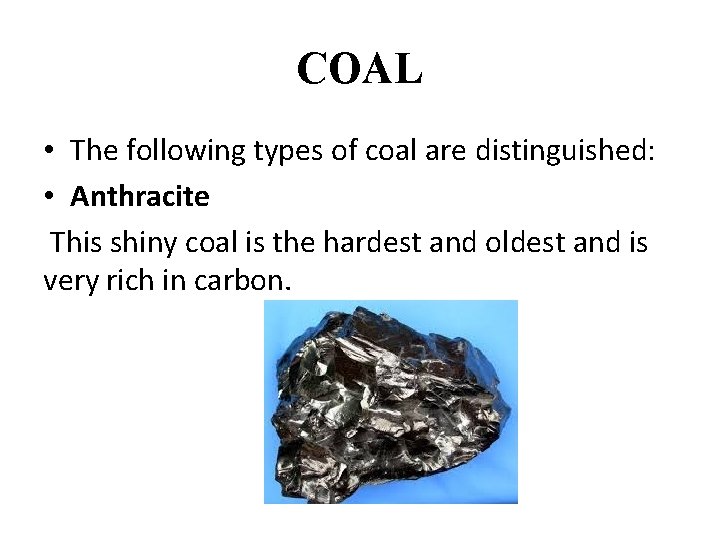
COAL • The following types of coal are distinguished: • Anthracite This shiny coal is the hardest and oldest and is very rich in carbon.
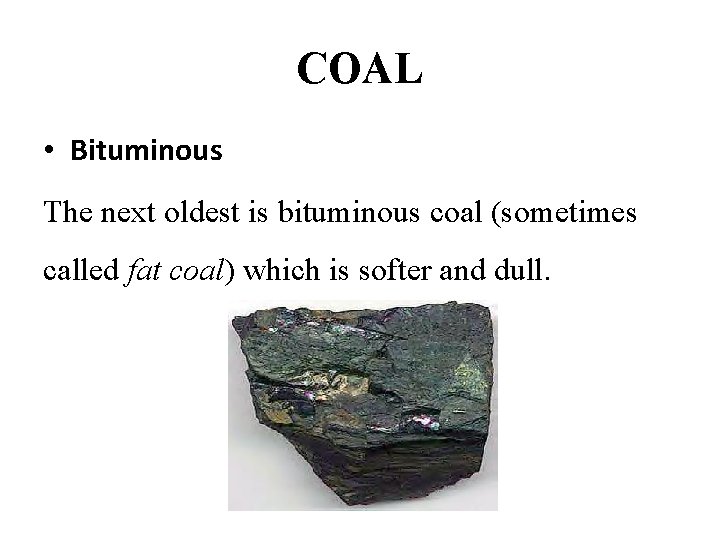
COAL • Bituminous The next oldest is bituminous coal (sometimes called fat coal) which is softer and dull.
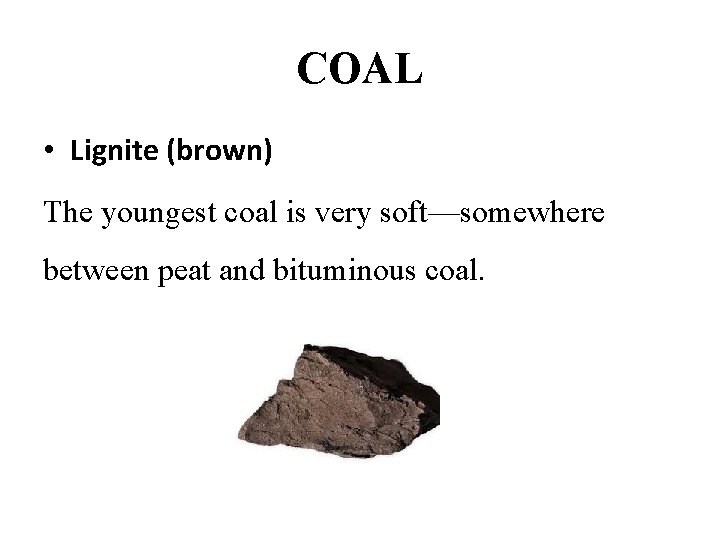
COAL • Lignite (brown) The youngest coal is very soft—somewhere between peat and bituminous coal.
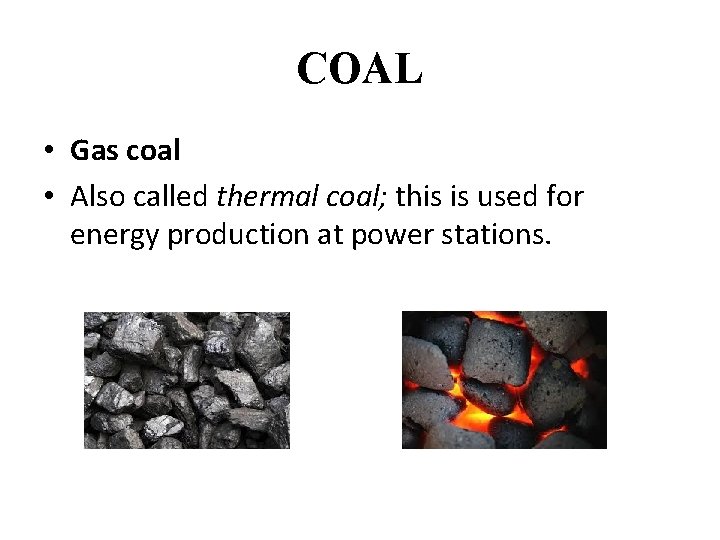
COAL • Gas coal • Also called thermal coal; this is used for energy production at power stations.
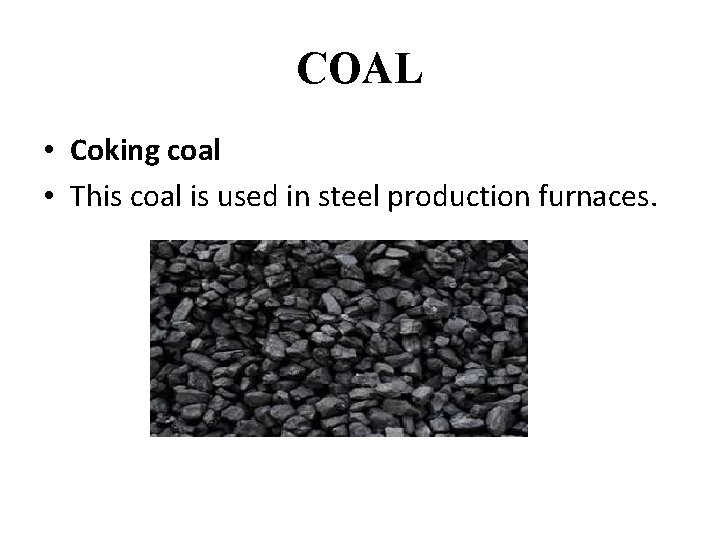
COAL • Coking coal • This coal is used in steel production furnaces.
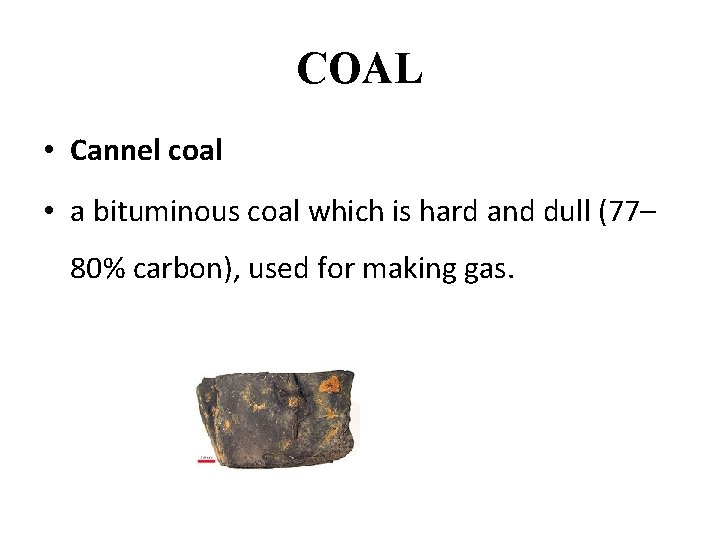
COAL • Cannel coal • a bituminous coal which is hard and dull (77– 80% carbon), used for making gas.
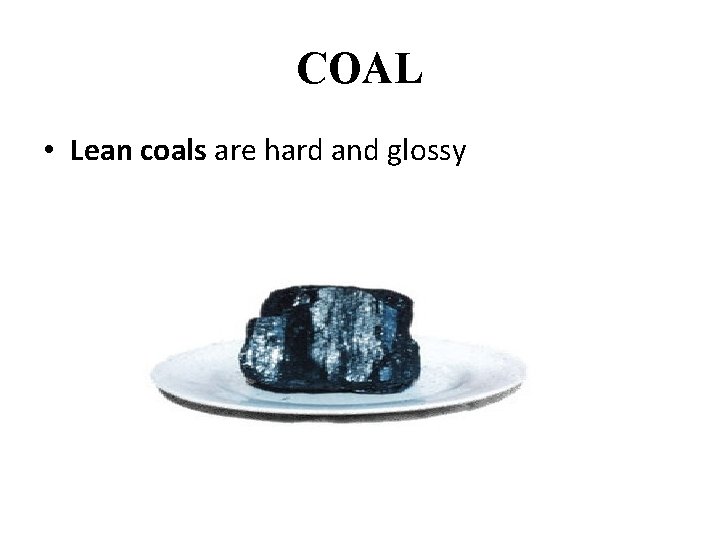
COAL • Lean coals are hard and glossy
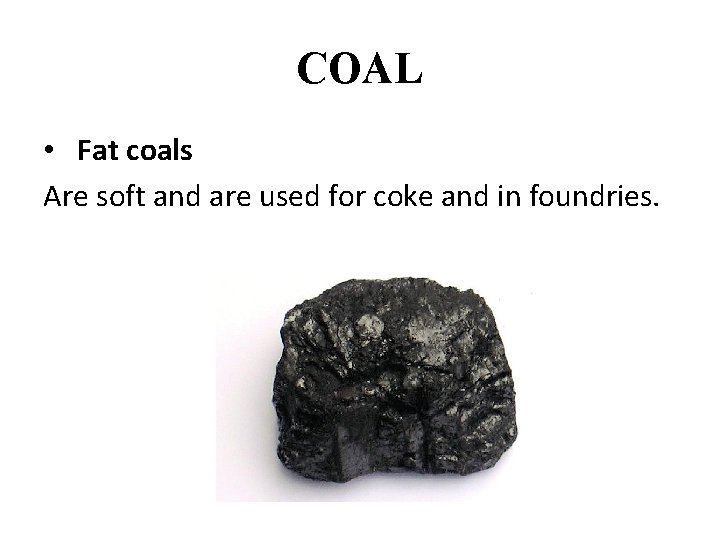
COAL • Fat coals Are soft and are used for coke and in foundries.
COAL • Coal is also classified by the dimensions of the pieces as follows: • fine coal: up to 4 mm diameter • slack: from 5 to 9 mm • nuts: from 10 to 80 mm. A number from 5 to 1 indicates the relative diameter: • nuts 5 are the smallest • nuts 1 are the biggest
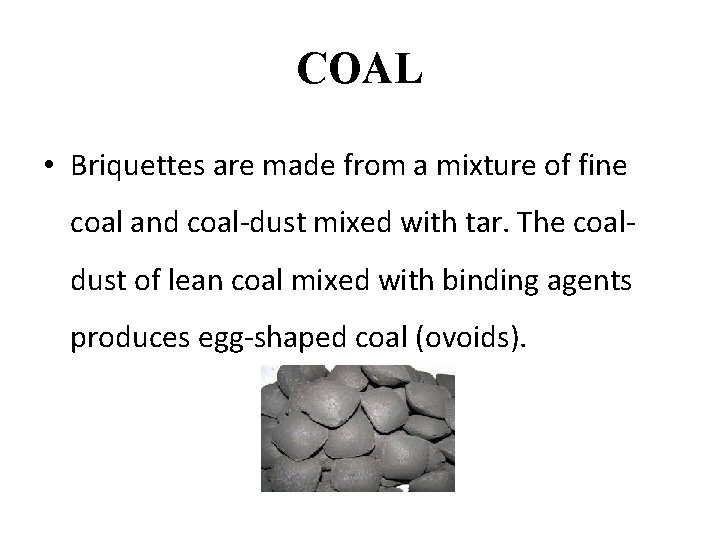
COAL • Briquettes are made from a mixture of fine coal and coal-dust mixed with tar. The coaldust of lean coal mixed with binding agents produces egg-shaped coal (ovoids).
COKE • Coke is coal with the gas taken out. • Coke, known as petroleum coke (petcoke), is also produced by the carbonization of crude oil • This happens during strong heating in a closed furnace, without air, so without combustion. • This process is called carbonization. .
LOADING AND DISCHARGING • During loading and discharging care has to be taken not to dump coal from a great height. This causes breakage of the coal. If this results in much breakage, than there is a chance of gas formation in the cargo of coal. At the same time, the possibility of heating exists. Breakage also causes a decrease in quality.
COAL VS COKE • Coal and coke are common fuels used for household and industrial combustion purposes. Both are present in the natural environment. However, coke is produced by man for the excessive usage
COAL VS COKE • Coal is a fossil fuel similar to natural gas and oil, which is in a solid rock form. • Coal is formed by accumulating plant debris in swamps. • The process takes thousands of years. • When plant materials collect on swamps, they degrade very slowly.
COAL VS COKE • Main economic usage of coal is to produce electricity. • By burning coal, heat is obtained and then this heat energy is used to produce steam. • Finally, electricity is produced by running a steam generator.
COAL VS COKE • Coke is a naturally found carbonaceous solid, but it can be made by man too. Man-made coke is used commonly. • Coke has a hard, porous structure, and it is grey in color. It is produced from bituminous coal.
COAL VS COKE • Coal is baked in an airless furnace at a very high temperature (above 2000 degrees Celsius) to remove water, gas and coal-tar, and at the end of the coking process, it contains zero amount of water. However, later small amount of water can be absorbed by the porous structure.
COAL VS COKE • Coke is useful as a fuel in stoves and furnaces. It burns with no smoke; therefore, better as a fuel than bituminous coal itself. Coke is also used as a reducing agent in smelting iron ore.
ORE • An ore is a naturally occurring material containing one or more extractable, economically valuable minerals. • The term also refers to the minerals thus extracted. Most often the term refers to material containing metallic elements, such as iron ore or copper ore.
ORE • Ores are an important bulk good. Each mineral, out of which can be won a metal in an economic way is called an ore. Ores are extracted underground as well as at the surface of the earth (strip mining).
ORE • Iron Ore • Iron (Fe) is one of the most abundant rockforming elements, constituting about 5% of the Earth's crust. It is the fourth most abundant element after oxygen, silicon and aluminums, and after aluminum, the most abundant and widely distributed metal.
ORE • Iron ores are rocks from which metallic iron can be economically extracted. These rocks are usually found in the form of hematite (Fe 2 O 3) or magnetite (Fe 3 O 4). About 98% of world iron ore production is used to make iron in the form of steel. • Iron ore is a mineral block which may be found underground. It is the most common mineral which may be used to make tools and armor.
ORE • Iron ore is the most important dry-bulk commodity in international sea-borne trade. Iron ore includes ores such as magnetite, hematite, limonite, siderite, and roasted iron pyrites.
ORE • The ore shipped has a stowage factor, which varies between 0. 30 and 0. 80 cubic meters per ton. Iron ore is always transported in bulk and in full shiploads.
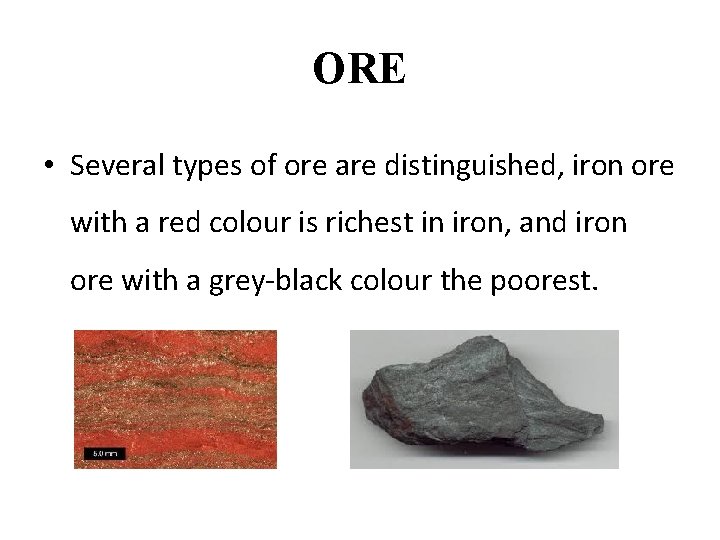
ORE • Several types of ore are distinguished, iron ore with a red colour is richest in iron, and iron ore with a grey-black colour the poorest.
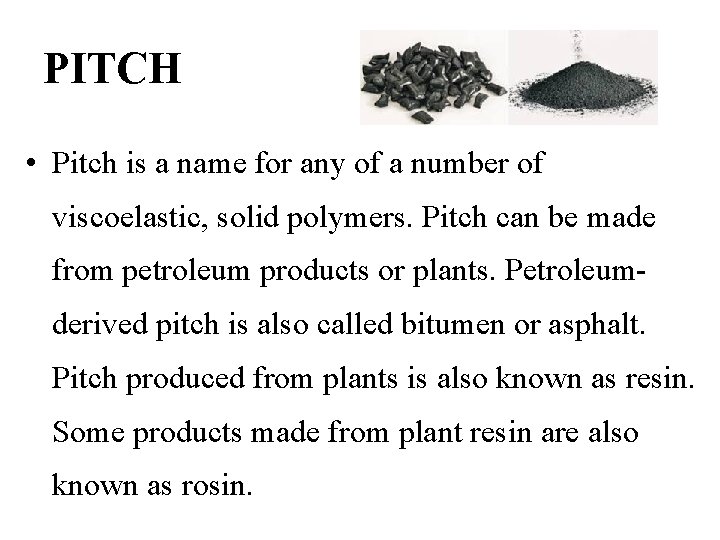
PITCH • Pitch is a name for any of a number of viscoelastic, solid polymers. Pitch can be made from petroleum products or plants. Petroleumderived pitch is also called bitumen or asphalt. Pitch produced from plants is also known as resin. Some products made from plant resin are also known as rosin.
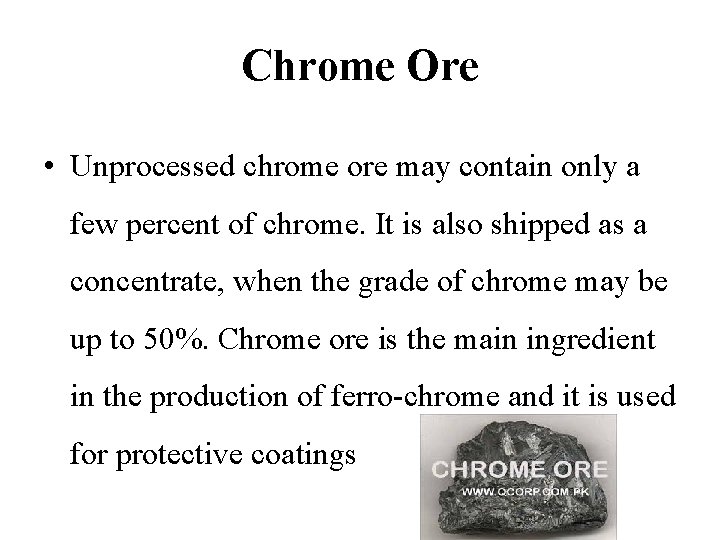
Chrome Ore • Unprocessed chrome ore may contain only a few percent of chrome. It is also shipped as a concentrate, when the grade of chrome may be up to 50%. Chrome ore is the main ingredient in the production of ferro-chrome and it is used for protective coatings
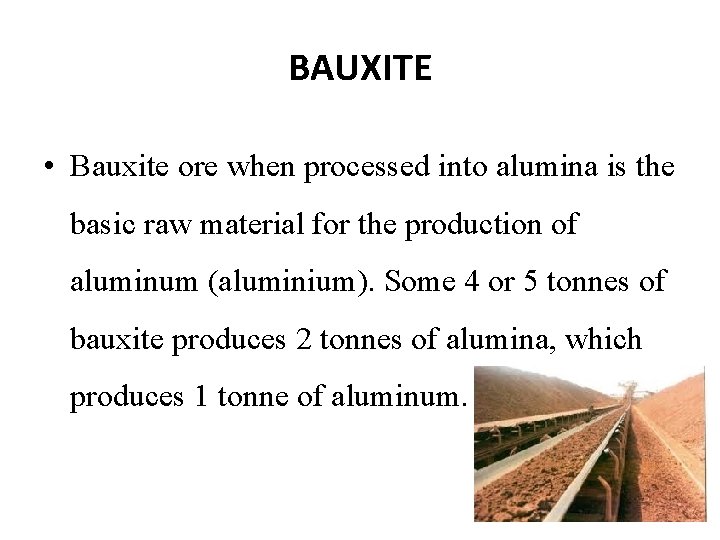
BAUXITE • Bauxite ore when processed into alumina is the basic raw material for the production of aluminum (aluminium). Some 4 or 5 tonnes of bauxite produces 2 tonnes of alumina, which produces 1 tonne of aluminum.
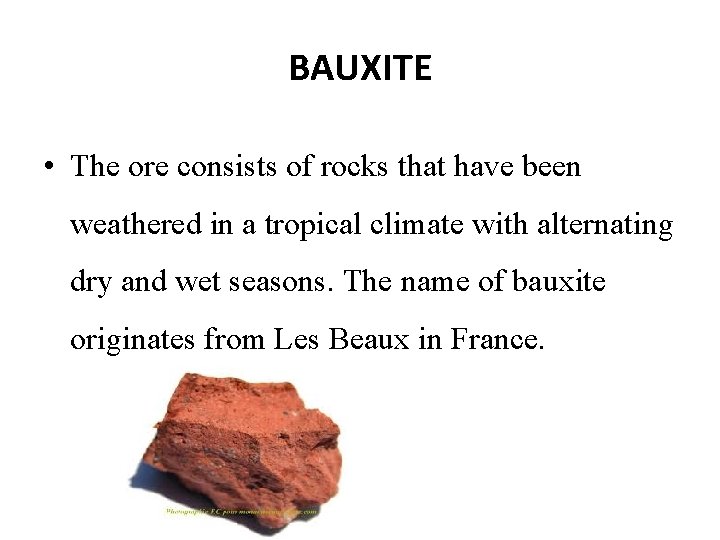
BAUXITE • The ore consists of rocks that have been weathered in a tropical climate with alternating dry and wet seasons. The name of bauxite originates from Les Beaux in France.
BAUXITE • The integrated structure of the world’s aluminum industry results in many terminals being owned and operated by industry. These commodities, particularly alumina, are dusty and require precautions against plant and area pollution.
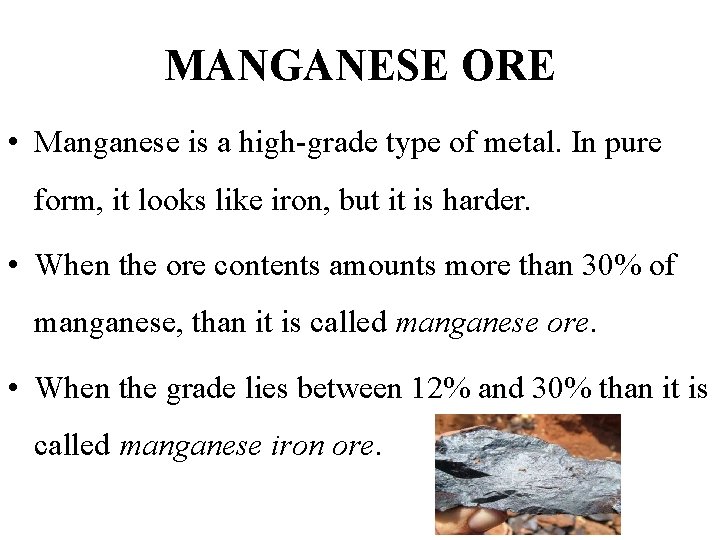
MANGANESE ORE • Manganese is a high-grade type of metal. In pure form, it looks like iron, but it is harder. • When the ore contents amounts more than 30% of manganese, than it is called manganese ore. • When the grade lies between 12% and 30% than it is called manganese iron ore.
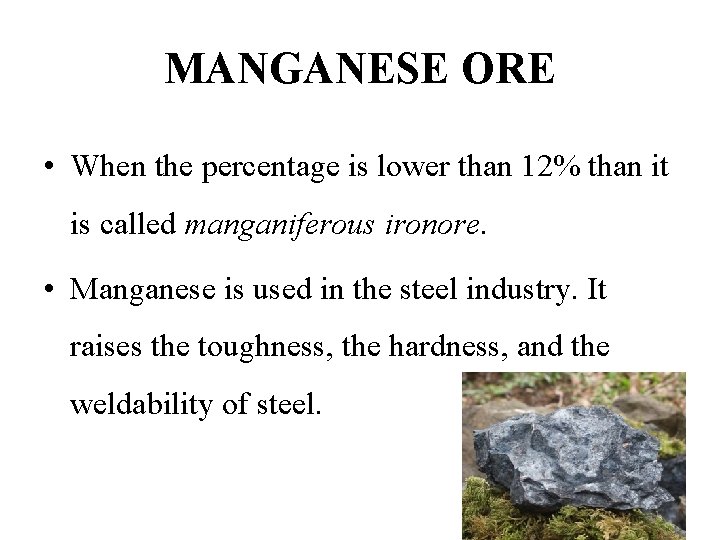
MANGANESE ORE • When the percentage is lower than 12% than it is called manganiferous ironore. • Manganese is used in the steel industry. It raises the toughness, the hardness, and the weldability of steel.
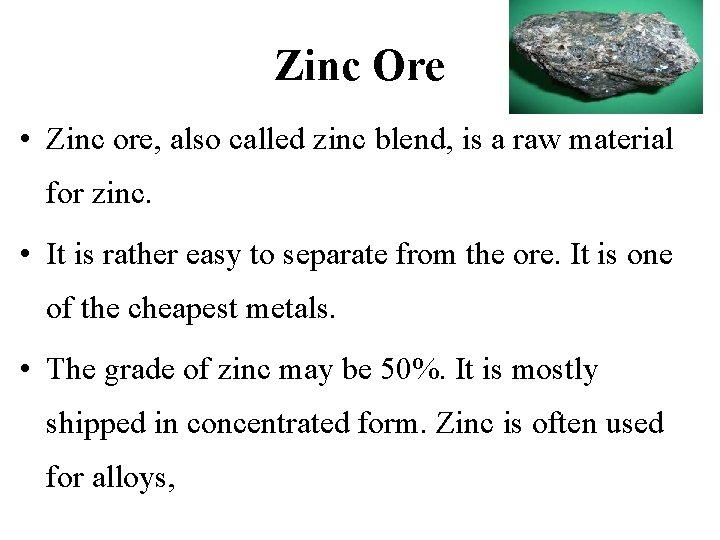
Zinc Ore • Zinc ore, also called zinc blend, is a raw material for zinc. • It is rather easy to separate from the ore. It is one of the cheapest metals. • The grade of zinc may be 50%. It is mostly shipped in concentrated form. Zinc is often used for alloys,
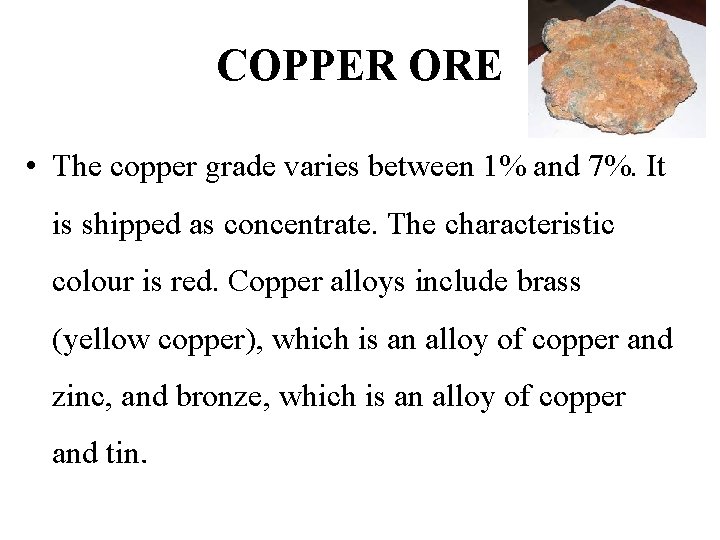
COPPER ORE • The copper grade varies between 1% and 7%. It is shipped as concentrate. The characteristic colour is red. Copper alloys include brass (yellow copper), which is an alloy of copper and zinc, and bronze, which is an alloy of copper and tin.
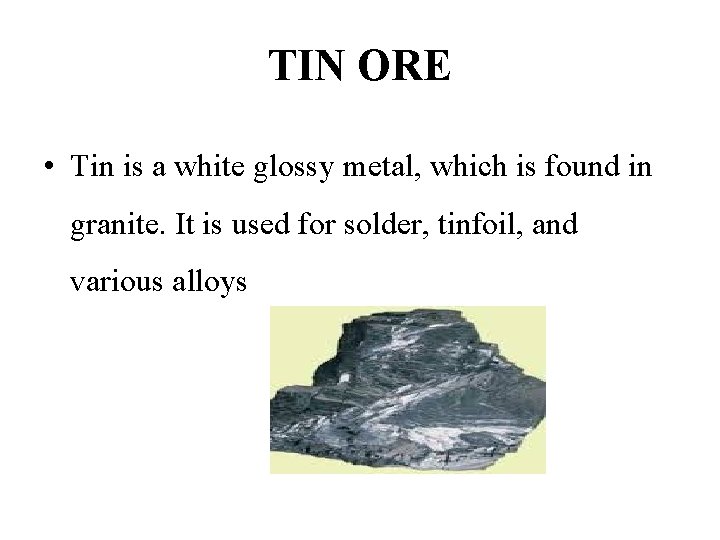
TIN ORE • Tin is a white glossy metal, which is found in granite. It is used for solder, tinfoil, and various alloys
Iron and Steel Scrap • Scrap consists of cut pieces of rail, beams, plates, and other waste of steel factories. • The big producers of this scrap are the railway, shipbuilding, and breakers' yards.
Pig Iron • This is crude iron, which is extracted from blast furnaces. The crude iron exists in many variations, depending of the other chemical materials, which it contains.
Cement • The manufacture of Portland cement was started under licence granted in 1949. • Limestone, the major raw material. • There are two basic methods of transporting cement by sea. In bags or in bulk.
Terminal Design and Layout • Radical differences exist between the character of dry-bulk cargo terminals, especially those designed to handle mineral ores, and the average all-purpose commercial port. • The requirements with respect to location, depth of water, type of infrastructure, layout, equipment, storage facilities.
• Unlike in a general cargo port, a terminal used for the exporting of mineral ores does not need to be located close to the main centres of commercial and industrial activity. • Bulk carriers require huge stocks of ore at the terminal and therefore extensive storage facilities are required
• To achieve the required speeds of loading, a network of belt conveyors is needed, linking powerful reclaimers to ship loaders. • The storage area on land requires the proper equipment for unloading vehicles from the mines, for stacking the ores on the stockpiles, and for reclaiming ore for delivery by belt conveyor to the ship-loader.
Safety and Security in Dry-Bulk Terminals • Before anyone enters a dry-bulk terminal, they have to be acquainted with safety rules and regulations, because of the many risks • When cargo is hoisted, pieces of ore or coal may fall from the grab, so never walk underneath a hoisted grab.
Personnel safety equipment safety helmets (hard-hat protection) safety shoes and boots Gloves bright-coloured clothes and/or reflective tape
masks to protect against dust goggles skin protection—ointment or talcum powder, especially when handling pitch and pitch coal.
Danger Notices observe notices indicating where to walk know where the safety lines are that stop the conveyor belts heed warning signals, either as sound, light signals, or messages sent by port phone or intercom especially to persons working with big machines like bulldozers and big cranes if you intend to work in the vicinity of heavy equipment, report to the operator know the locations of first aid stations
look out for shunting of railway cars when working with grabs into a railway car. Do not walk close, because side doors may be pushed open by the grab, or falling overflow never come too close to big-wheeled machines because pieces of ore may be flung out of the tire profile be careful not to slip. Slippery areas may be created by rain or damp weather conditions; by cargoes like china clay; and on places where dust precipitates. In addition, when ballast water is pumped out of the ship alongside the terminal and the water is pumped by accident on to the terminal be aware that ship’s hawsers and mooring lines may break with very dangerous consequences .

- Slides: 53