
Dryad LINQ for Scientific Analyses MSR Internship Final
![CAP 3 - DNA Sequence Assembly Program [1] EST (Expressed Sequence Tag) corresponds to](https://slidetodoc.com/presentation_image_h/128a61758f477a9303f47d492ff7786e/image-7.jpg "CAP 3 - DNA Sequence Assembly Program [1] EST (Expressed Sequence Tag) corresponds to")

- Slides: 20
Dryad. LINQ for Scientific Analyses MSR Internship – Final Presentation Jaliya Ekanayake jekanaya@cs. indiana. edu School of Informatics and Computing Indiana University Bloomington SALSA
Acknowledgements to • ARTS Team – Nelson Araujo (my mentor) – Christophe Poulain – Roger Barga – Tim Chou • Dryad Team at Silicon Valley • School of Informatics and Computing, Indiana University – Prof. Geoffrey Fox (my advisor) – Thilina Gunarathne – Scott Beason – Xiaohong Qiu SALSA
Goals • Evaluate the usability of Dryad. LINQ for scientific analyses – Develop a series of scientific applications using Dryad. LINQ – Compare them with similar Map. Reduce implementations (E. g. Hadoop) – Run above Dryad. LINQ applications on Cloud SALSA
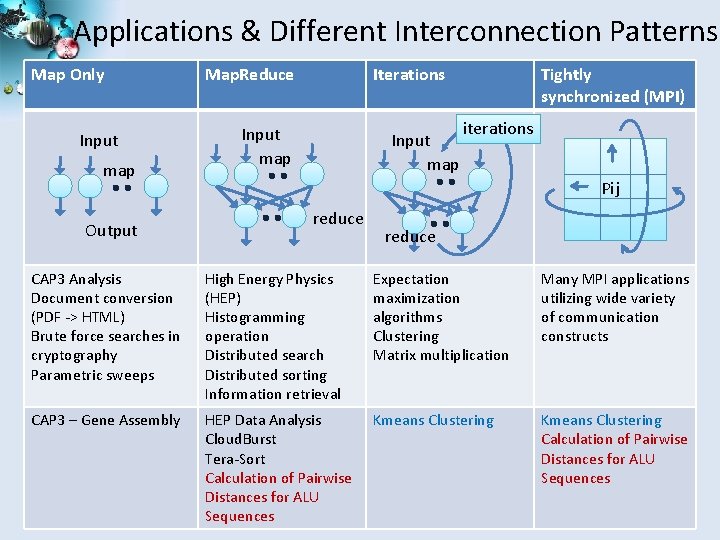
Applications & Different Interconnection Patterns Map Only Input map Output Map. Reduce Iterations Input map Tightly synchronized (MPI) iterations Pij reduce CAP 3 Analysis Document conversion (PDF -> HTML) Brute force searches in cryptography Parametric sweeps High Energy Physics (HEP) Histogramming operation Distributed search Distributed sorting Information retrieval Expectation maximization algorithms Clustering Matrix multiplication Many MPI applications utilizing wide variety of communication constructs CAP 3 – Gene Assembly HEP Data Analysis Cloud. Burst Tera-Sort Calculation of Pairwise Distances for ALU Sequences Kmeans Clustering Calculation of Pairwise Distances for ALU Sequences SALSA
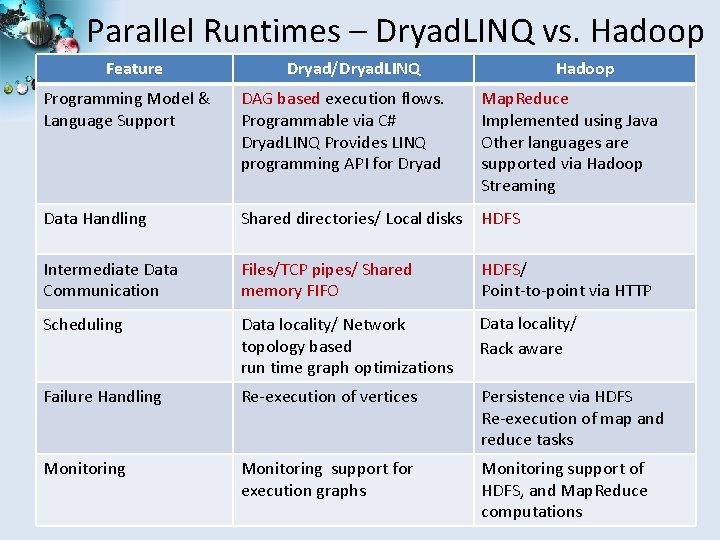
Parallel Runtimes – Dryad. LINQ vs. Hadoop Feature Dryad/Dryad. LINQ Hadoop Programming Model & Language Support DAG based execution flows. Programmable via C# Dryad. LINQ Provides LINQ programming API for Dryad Map. Reduce Implemented using Java Other languages are supported via Hadoop Streaming Data Handling Shared directories/ Local disks HDFS Intermediate Data Communication Files/TCP pipes/ Shared memory FIFO HDFS/ Point-to-point via HTTP Scheduling Data locality/ Network topology based run time graph optimizations Data locality/ Rack aware Failure Handling Re-execution of vertices Persistence via HDFS Re-execution of map and reduce tasks Monitoring support for execution graphs Monitoring support of HDFS, and Map. Reduce computations SALSA
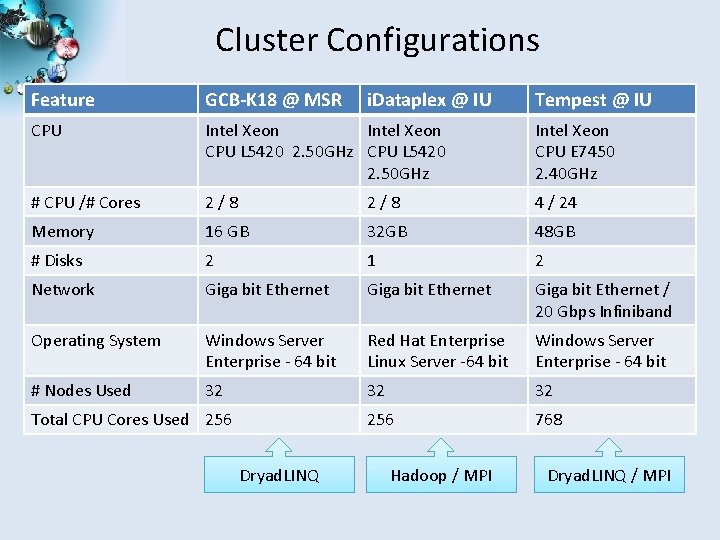
Cluster Configurations Feature GCB-K 18 @ MSR CPU Intel Xeon CPU L 5420 2. 50 GHz CPU L 5420 2. 50 GHz Intel Xeon CPU E 7450 2. 40 GHz # CPU /# Cores 2 / 8 4 / 24 Memory 16 GB 32 GB 48 GB # Disks 2 1 2 Network Giga bit Ethernet / 20 Gbps Infiniband Operating System Windows Server Enterprise - 64 bit Red Hat Enterprise Linux Server -64 bit Windows Server Enterprise - 64 bit # Nodes Used 32 32 32 256 768 Total CPU Cores Used 256 Dryad. LINQ i. Dataplex @ IU Hadoop / MPI Tempest @ IU Dryad. LINQ / MPI SALSA
CAP 3 - DNA Sequence Assembly Program [1] EST (Expressed Sequence Tag) corresponds to messenger RNAs (m. RNAs) transcribed from the genes residing on chromosomes. Each individual EST sequence represents a fragment of m. RNA, and the EST assembly aims to re-construct full-length m. RNA sequences for each expressed gene. Input files (FASTA) GCB-K 18 -N 01 Cap 3 data. pf Dryad. Datacap 3 data 10 0, 344, CGB-K 18 -N 01 1, 344, CGB-K 18 -N 01 … V V Cap 3 data. 0000 9, 344, CGB-K 18 -N 01 \GCB-K 18 -N 01Dryad. Datacap 3cluster 34442. fsa \GCB-K 18 -N 01Dryad. Datacap 3cluster 34443. fsa . . . \GCB-K 18 -N 01Dryad. Datacap 3cluster 34467. fsa Output files Input files (FASTA) IQueryable<Line. Record> input. Files=Partitioned. Table. Get <Line. Record>(uri); IQueryable<Output. Info> = input. Files. Select(x=>Execute. CAP 3(x. line)); SALSA [1] X. Huang, A. Madan, “CAP 3: A DNA Sequence Assembly Program, ” Genome Research, vol. 9, no. 9, pp. 868 -877, 1999.
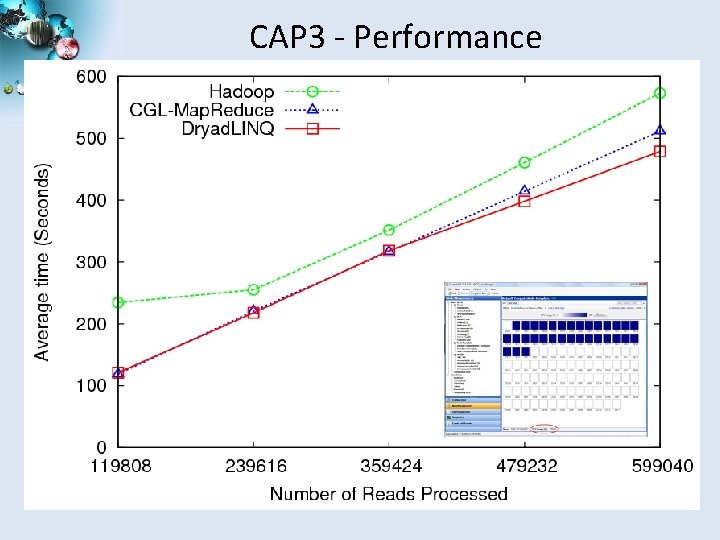
CAP 3 - Performance SALSA
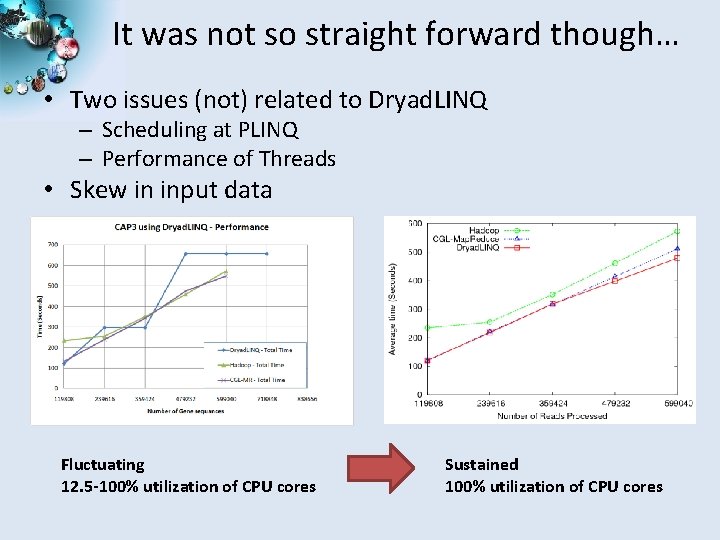
It was not so straight forward though… • Two issues (not) related to Dryad. LINQ – Scheduling at PLINQ – Performance of Threads • Skew in input data Fluctuating 12. 5 -100% utilization of CPU cores Sustained 100% utilization of CPU cores SALSA
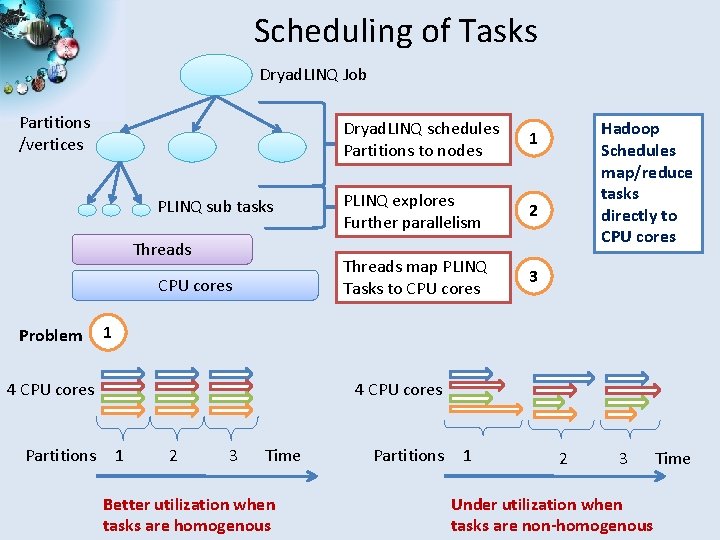
Scheduling of Tasks Dryad. LINQ Job Partitions /vertices PLINQ sub tasks Threads CPU cores Problem 1 PLINQ explores Further parallelism 2 Threads map PLINQ Tasks to CPU cores 3 Hadoop Schedules map/reduce tasks directly to CPU cores 1 4 CPU cores Partitions Dryad. LINQ schedules Partitions to nodes 4 CPU cores 1 2 3 Time Better utilization when tasks are homogenous Partitions 1 2 3 Time Under utilization when tasks are non-homogenous SALSA
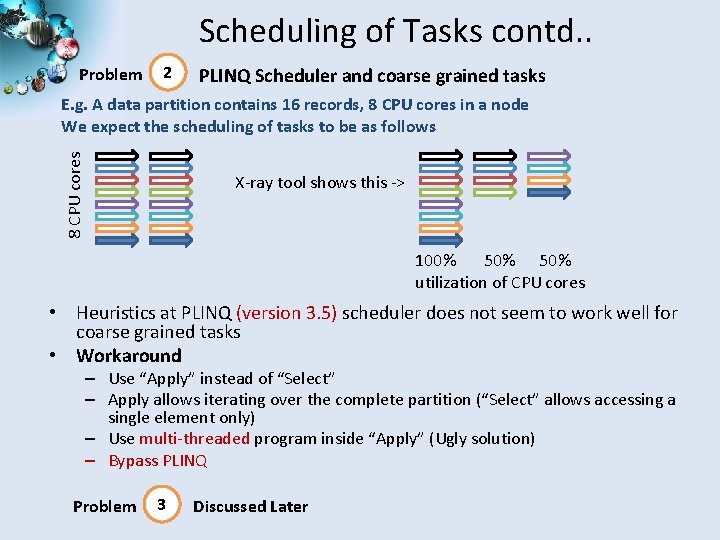
Scheduling of Tasks contd. . Problem 2 PLINQ Scheduler and coarse grained tasks 8 CPU cores E. g. A data partition contains 16 records, 8 CPU cores in a node We expect the scheduling of tasks to be as follows X-ray tool shows this -> 100% 50% utilization of CPU cores • Heuristics at PLINQ (version 3. 5) scheduler does not seem to work well for coarse grained tasks • Workaround – Use “Apply” instead of “Select” – Apply allows iterating over the complete partition (“Select” allows accessing a single element only) – Use multi-threaded program inside “Apply” (Ugly solution) – Bypass PLINQ Problem 3 Discussed Later SALSA
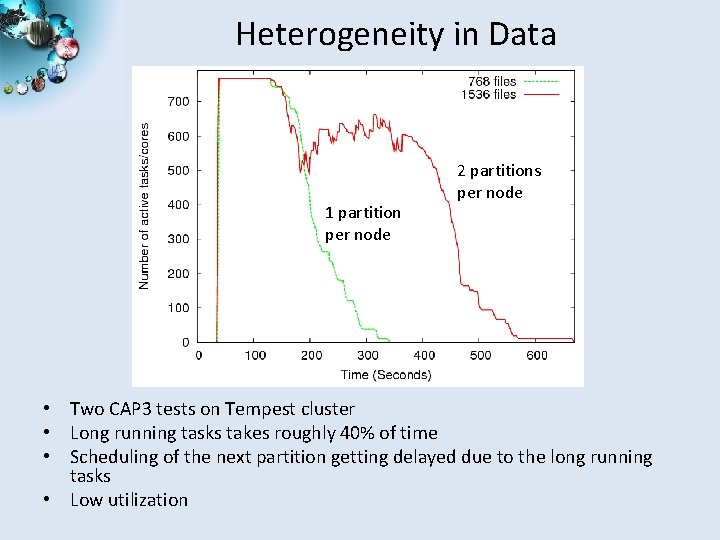
Heterogeneity in Data 1 partition per node 2 partitions per node • Two CAP 3 tests on Tempest cluster • Long running tasks takes roughly 40% of time • Scheduling of the next partition getting delayed due to the long running tasks • Low utilization SALSA
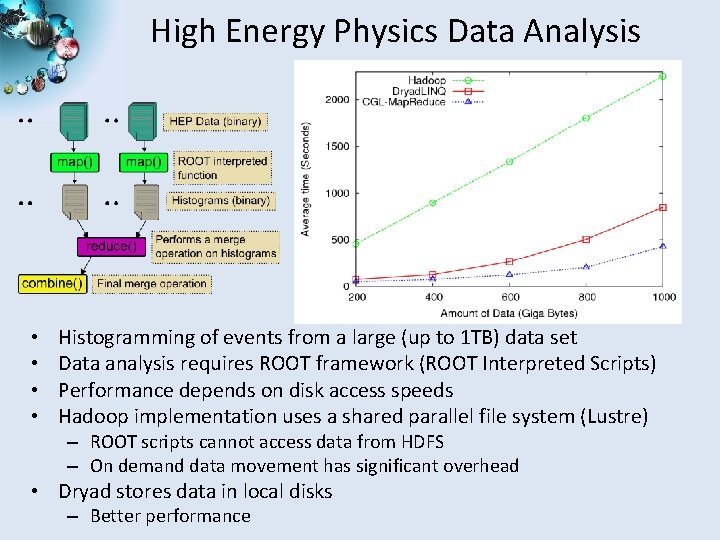
High Energy Physics Data Analysis • • Histogramming of events from a large (up to 1 TB) data set Data analysis requires ROOT framework (ROOT Interpreted Scripts) Performance depends on disk access speeds Hadoop implementation uses a shared parallel file system (Lustre) – ROOT scripts cannot access data from HDFS – On demand data movement has significant overhead • Dryad stores data in local disks – Better performance SALSA
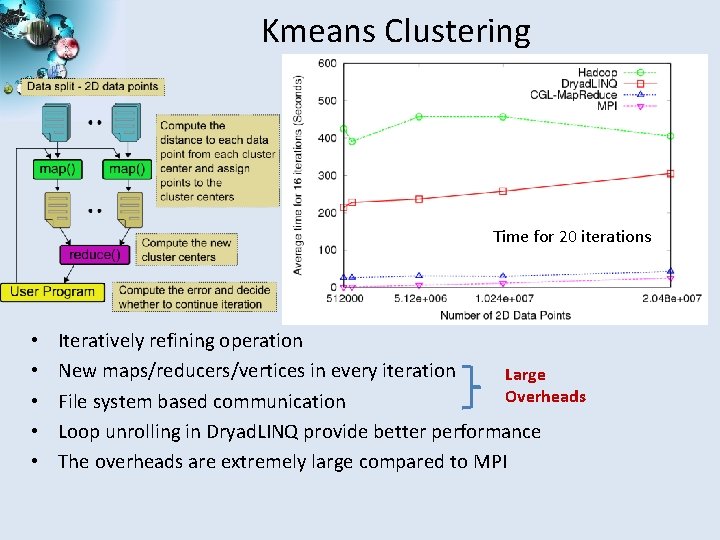
Kmeans Clustering Time for 20 iterations • • • Iteratively refining operation New maps/reducers/vertices in every iteration Large Overheads File system based communication Loop unrolling in Dryad. LINQ provide better performance The overheads are extremely large compared to MPI SALSA
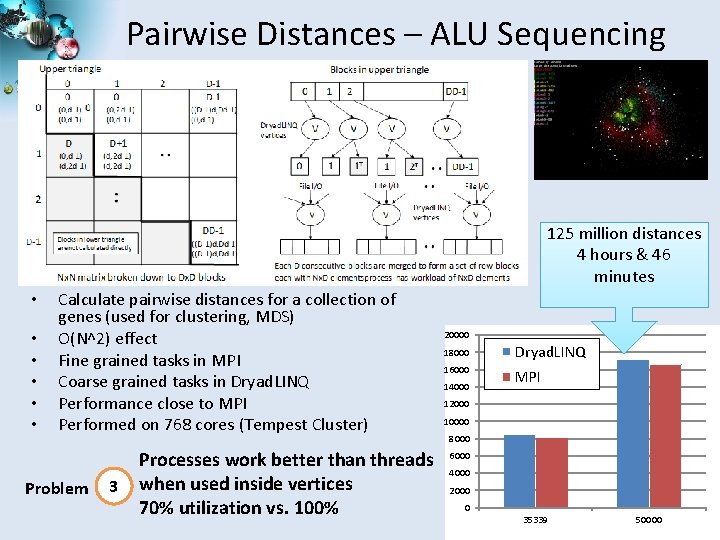
Pairwise Distances – ALU Sequencing 125 million distances 4 hours & 46 minutes • • • Calculate pairwise distances for a collection of genes (used for clustering, MDS) O(N^2) effect Fine grained tasks in MPI Coarse grained tasks in Dryad. LINQ Performance close to MPI Performed on 768 cores (Tempest Cluster) Problem 3 Processes work better than threads when used inside vertices 70% utilization vs. 100% 20000 18000 Dryad. LINQ 16000 MPI 14000 12000 10000 8000 6000 4000 2000 0 35339 50000 SALSA
Questions? SALSA
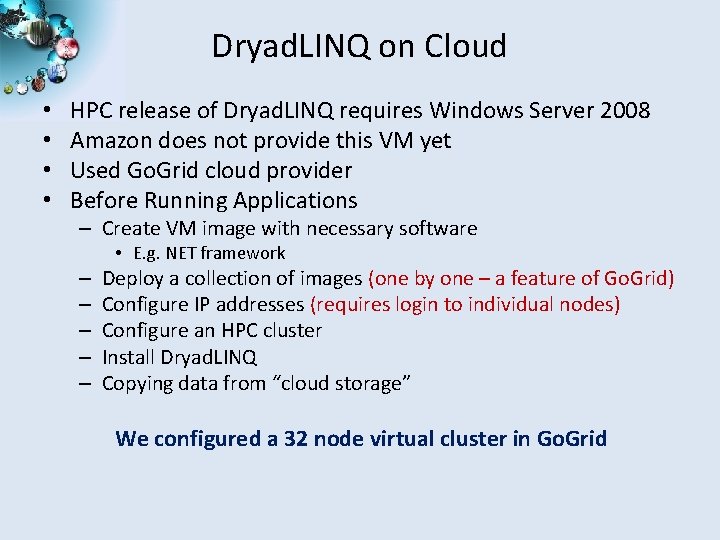
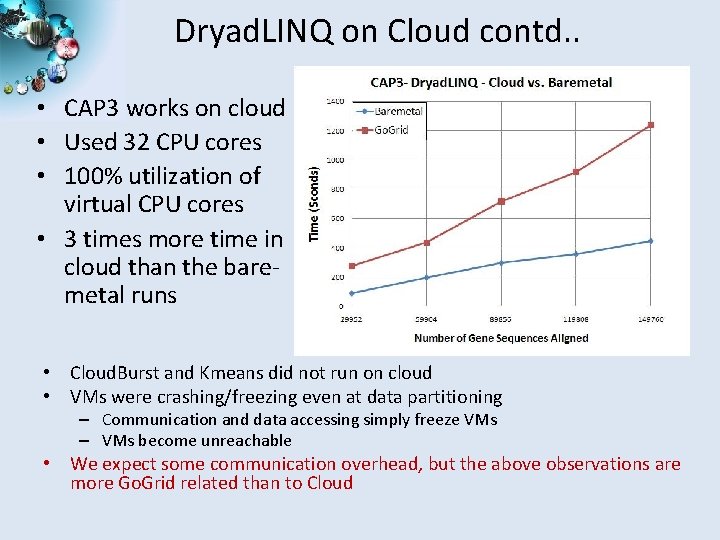
Dryad. LINQ on Cloud • • HPC release of Dryad. LINQ requires Windows Server 2008 Amazon does not provide this VM yet Used Go. Grid cloud provider Before Running Applications – Create VM image with necessary software • E. g. NET framework – – – Deploy a collection of images (one by one – a feature of Go. Grid) Configure IP addresses (requires login to individual nodes) Configure an HPC cluster Install Dryad. LINQ Copying data from “cloud storage” We configured a 32 node virtual cluster in Go. Grid SALSA
Dryad. LINQ on Cloud contd. . • CAP 3 works on cloud • Used 32 CPU cores • 100% utilization of virtual CPU cores • 3 times more time in cloud than the baremetal runs • Cloud. Burst and Kmeans did not run on cloud • VMs were crashing/freezing even at data partitioning – Communication and data accessing simply freeze VMs – VMs become unreachable • We expect some communication overhead, but the above observations are more Go. Grid related than to Cloud SALSA
Conclusions • Six applications with various computation, communication, and data access requirements • All Dryad. LINQ applications work, and in many cases perform better than Hadoop • We can definitely use Dryad. LINQ for scientific analyses • We did not implement (find) – Applications that can only be implemented using Dryad. LINQ but not with typical Map. Reduce • Current release of Dryad. LINQ has some performance limitations • Dryad. LINQ hides many aspects of parallel computing from user • Coding is much simpler in Dryad. LINQ than Hadoop (provided that the performance issues are fixed) • More simplicity comes with less control and sometimes it is hard to fine-tune • We showed that it is possible to run Dryad. LINQ on Cloud SALSA
Thank You! SALSA