
Dry Needling The treatment of myofascial trigger points






- Slides: 15
Dry Needling The treatment of myofascial trigger points In-service by Lauren Luttrell, SPT Mary Washington Healthcare Rehabilitation Services of Fredericksburg 7/10/17 http: //stabilityatlanta. com/wp-content/uploads/2014/10/needling. jpg
APTA Official Statement on Dry Needling: “Dry needling is a skilled intervention provided by physical therapists that uses a thin filiform needle to penetrate the skin and stimulate underlying myofascial trigger points, muscular tissues, and connective tissues for the management of neuromuscular pain and movement impairments. Dry needling is part of the physical therapist professional scope of practice and has been recognized as being part of the legal scope of practice in a majority of states” (1)
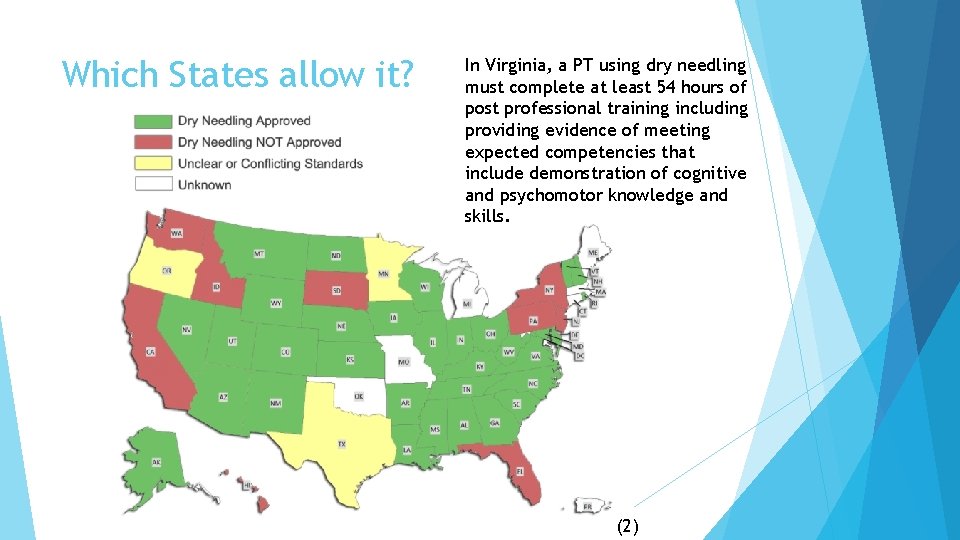
Which States allow it? In Virginia, a PT using dry needling must complete at least 54 hours of post professional training including providing evidence of meeting expected competencies that include demonstration of cognitive and psychomotor knowledge and skills. (2)
Billing for Dry Needling ▶ “Practitioners who seek to bill any third party payer should first check the payer’s coverage policy to determine if dry needling is a covered service and if the policy specifies which code is used to report the service. Absent a specific payer policy, the use of CPT code 97140 (Manual therapy) for the performance of dry needling should not be utilized” (1) ▶ “CPT specifically states to select the procedure or service that accurately identifies the service performed. Do not select a CPT code that merely approximates the service provided. If no such specific code exists, then report the service using the appropriate unlisted physical medicine/rehabilitation service or procedure code 97799. ” (1)
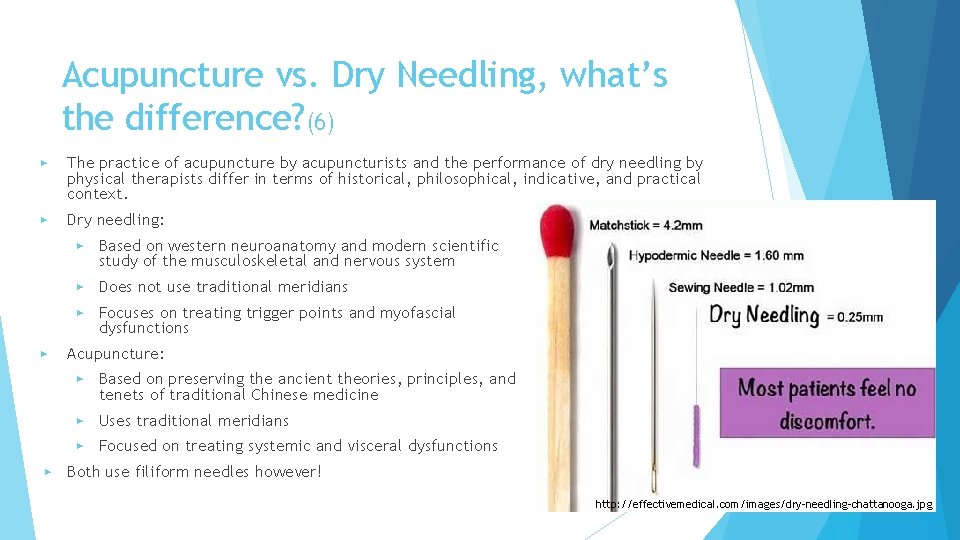
Acupuncture vs. Dry Needling, what’s the difference? (6) ▶ The practice of acupuncture by acupuncturists and the performance of dry needling by physical therapists differ in terms of historical, philosophical, indicative, and practical context. ▶ Dry needling: ▶ ▶ ▶ Based on western neuroanatomy and modern scientific study of the musculoskeletal and nervous system ▶ Does not use traditional meridians ▶ Focuses on treating trigger points and myofascial dysfunctions Acupuncture: ▶ Based on preserving the ancient theories, principles, and tenets of traditional Chinese medicine ▶ Uses traditional meridians ▶ Focused on treating systemic and visceral dysfunctions Both use filiform needles however! http: //effectivemedical. com/images/dry-needling-chattanooga. jpg
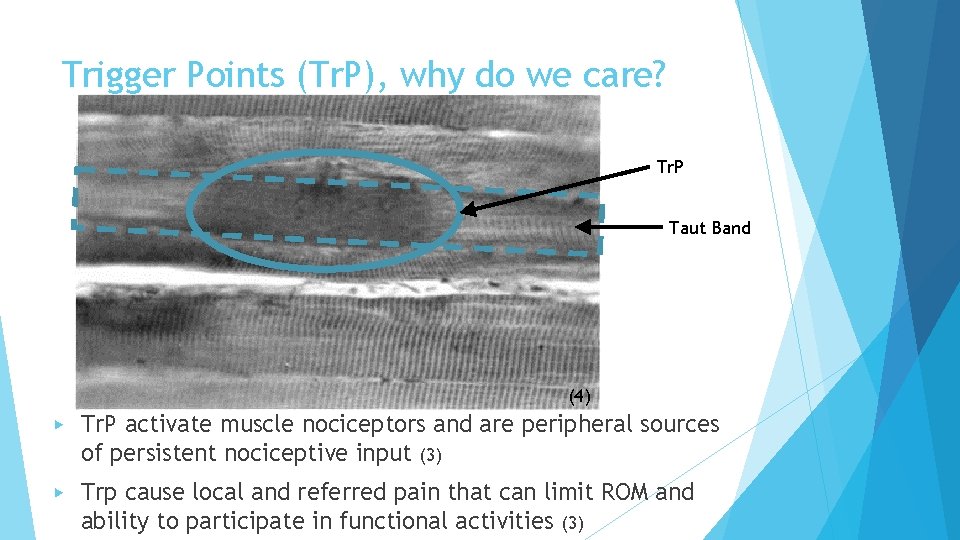
Trigger Points (Tr. P), why do we care? Tr. P Taut Band (4) ▶ Tr. P activate muscle nociceptors and are peripheral sources of persistent nociceptive input (3) ▶ Trp cause local and referred pain that can limit ROM and ability to participate in functional activities (3)
Pathophysiology (aka how does it work? ) ▶ ▶ Myofascial Tr. Ps are found within a taut band of skeletal muscle fibers and are a result of dysfunctional motor end plates, end plate noise, and increased release of acetylcholine at the neuromuscular junction near a trigger point (3) ▶ Active: spontaneously painful, larger than latent, characterized by decreased p. H and decreased circulation ▶ Latent: only painful when stimulated (i. e. digital pressure) that still contribute to nociception Stimulation of Tr. Ps by a needle can lead to a local twitch response (LTR), which is a spinal cord reflex that causes an involuntary contraction and secondary relaxation of the taut band of a muscle, alleviation and mitigation of motor endplate noise, and a reduction of the concentration of numerous nociceptive, inflammatory, and immune system related chemicals (3)
Typical Session ▶ Obtain a written physician’s referral specifically for dry needling ▶ Obtain verbal and/or written consent of patient ▶ Position the patient comfortably in a supine, side-lying, or prone position ▶ PT must don gloves to in order to practice consistent with OSHA Blood Borne Pathogens Standard ▶ Palpate perpendicularly to muscle fiber direction to find a taut band of muscle. Then, palpate along taut band for an irritable trigger point. Once the Tr. P is found, border the Tr. P with index and middle finger and insert needle quickly but gently into trigger point. ▶ Once needle has penetrated the skin, the needle can be oscillated within the patient for improved localization of the Tr. P to stimulate a LTR. ▶ After needle is removed, direct pressure to the area of needle insertion can help with post-needle soreness and swelling ▶ Video: https: //www. youtube. com/watch? v=es. QPGy. WFas. A http: //www. lindept. com/dryneedling. pdf
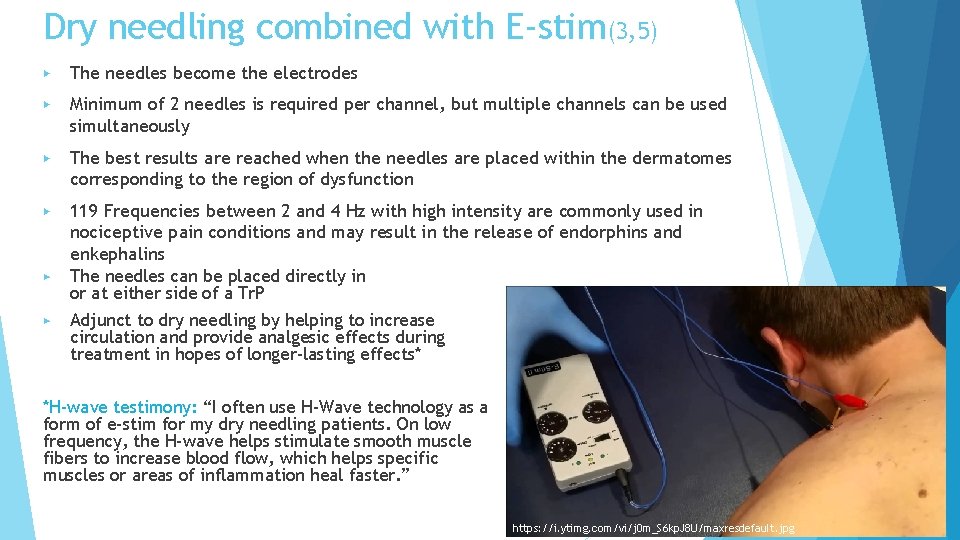
Dry needling combined with E-stim(3, 5) ▶ The needles become the electrodes ▶ Minimum of 2 needles is required per channel, but multiple channels can be used simultaneously ▶ The best results are reached when the needles are placed within the dermatomes corresponding to the region of dysfunction ▶ 119 Frequencies between 2 and 4 Hz with high intensity are commonly used in nociceptive pain conditions and may result in the release of endorphins and enkephalins The needles can be placed directly in or at either side of a Tr. P Adjunct to dry needling by helping to increase circulation and provide analgesic effects during treatment in hopes of longer-lasting effects* ▶ ▶ *H-wave testimony: “I often use H-Wave technology as a form of e-stim for my dry needling patients. On low frequency, the H-wave helps stimulate smooth muscle fibers to increase blood flow, which helps specific muscles or areas of inflammation heal faster. ” https: //i. ytimg. com/vi/j 0 m_S 6 kp. J 8 U/maxresdefault. jpg
Precautions/ Contraindications: Possible adverse effects: ▶ Paresthesias ▶ Pneumothorax ▶ Immunocompromised ▶ Trauma to internal organs ▶ Tumors Immediate vicinity of joint replacement ▶ Injury to nerves ▶ ▶ Epilepsy ▶ Bleeding ▶ Cognitively impaired ▶ Infections ▶ Local or systemic infections ▶ Local lymphedema ▶ Those with bleeding disorders ▶ First trimester of pregnancy ▶ Vascular Disease (varicose veins) ▶ Children <12 yo ▶ Depth of needling near internal organs
Evidence: ▶ Trigger point dry needling is effective at decreasing pain in a variety of diagnoses when combined with other physical therapy interventions such as a progressive therapeutic stretching and muscle strengthening programs (8) ▶ Deep dry needling + passive stretching to patients with chronic nonspecific neck pain was associated with better and clinically meaningful results for pain, mechanical hyperalgesia, range of cervical motion, neck muscle strength, and neck disability when compared with passive stretching only in the short-term and at 6 -months follow-up (9) ▶ Dry needling** to the lateral hip for GTPS was not inferior to cortisone injection for the outcomes of pain relief or reduction in functional limitations after 6 weeks (10) ▶ Not combined with other treatments**
Evidence ▶ Compared with control/sham, dry needling resulted in significant improvement, specifically in the short and medium term, in neck and shoulder pain associated with myofascial trigger points (11) ▶ Dry needling provided statistically significant reductions in plantar heel pain/plantar fasciitis (12) ▶ Statistically significant benefit from trigger point dry needling for the reduction in pain related to myofascial trigger points in multiple body areas (C-spine, L-spine, TMJ, UE, LE) suggesting broad applicability of TDN treatment for multiple muscle groups (TMJ, Extensor carpi radialis, lumbar paraspinals, cervical paraspinals, gastroc/soleus) (13)
Getting Certified: ▶ http: //www. myopainseminars. com (NC/MD) ▶ https: //structureandfunction. net (OH/SC/MD/GA) ▶ http: //www. kinetacore. com/ (VA/GA) ▶ http: //fishkincenter. com/dryneedlinginstitute/ (MD/CT/KY) ▶ http: //www. iamt. org (TN/OH/KY) ▶ Cost: ~$1, 200 ▶ Course hours: 12 -30 hours
References: 1. https: //www. ndbpt. org/pdf/dryneedling. pdf 2. https: //integrativedryneedling. com/dry-needling-training/scope-of-practice/ 3. http: //www. apta. org/State. Issues/Dry. Needling/Clinical. Practice. Resource. Paper/ 4. Simons, D. G. and W. C. Stolov (1976). "Microscopic features and transient contraction of palpable bands in canine muscle. " American Journal of Physical Medicine 55(2): 65 -88 5. https: //www. orthocarolina. com/news/cat/latest-news/subcat/news-on-the-fly/detail/dry-needling-with-e-stim-how-it-can-help-pain 6. http: //www. thedryneedlinginstitute. net/wp-content/uploads/2012/04/ACUPUNCTURE-VS-DRY-NEEDLING. pdf 7. Furlan AD, van Tulder MW, et al. Acupuncture and dry-needling for low back pain. Cochrane Database Syst Rev 2005; (1): CD 001351. 8. Trigger Point Dry Needling. (2017). Journal of Orthopaedic & Sports Physical Therapy, 47(3), 150. 9. Cerezo-Téllez, E. , Torres-Lacomba, M. , Fuentes-Gallardo, I. , Perez-Muñoz, M. , Mayoral-Del-Moral, O. , Lluch-Girbés, E. , . . . Falla, D. (2016). Effectiveness of dry needling for chronic nonspecific neck pain: A randomized, single-blinded, clinical trial. Pain, 157(9), 1905 -17. 10. Brennan, K. , Allen, B. , & Maldonado, Y. (2017). Dry Needling Versus Cortisone Injection in the Treatment of Greater Trochanteric Pain Syndrome: A Non-Inferiority Randomized Clinical Trial. Journal of Orthopaedic & Sports Physical Therapy, 47(4), 1 -30. 11. Liu, Lin, Huang, Qiang-Min, Liu, Qing-Guang, Ye, Gang, Bo, Cheng-Zhi, Chen, Meng-Jin, & Li, Ping. (2015). Effectiveness of Dry Needling for Myofascial Trigger Points Associated With Neck and Shoulder Pain: A Systematic Review and Meta-Analysis. Archives of Physical Medicine and Rehabilitation, 96(5), 944 -955. 12. Cotchett, M. , Munteanu, S. , & Landorf, K. (2014). Effectiveness of trigger point dry needling for plantar heel pain: A randomized controlled trial. Physical Therapy, 94(8), 1083 -94. 13. Boyles, R. , Fowler, R. , Ramsey, D. , & Burrows, E. (2015). Effectiveness of trigger point dry needling for multiple body regions: A systematic review. The Journal of Manual & Manipulative Therapy, 23(5), 276 -93.
Questions?