
Dry matter partitioning What is it How is
- Slides: 19
Dry matter partitioning • What is it ? • How is it measured ? • For what ? • Source & sink relationship
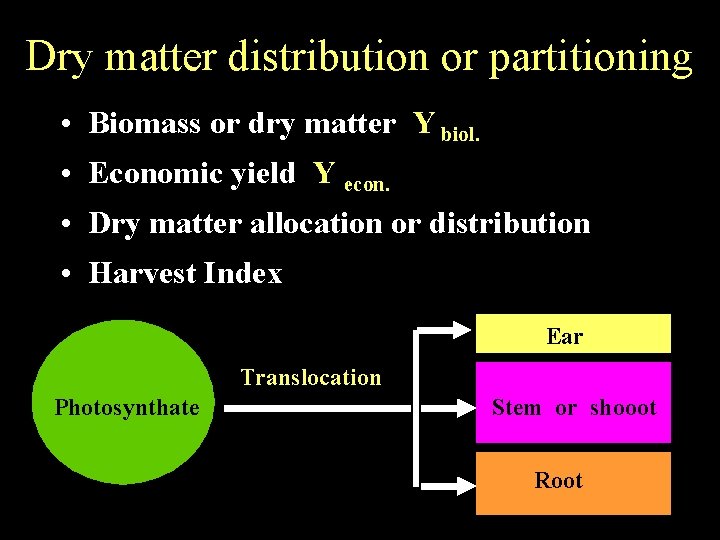
Dry matter distribution or partitioning • Biomass or dry matter Y biol. • Economic yield Y econ. • Dry matter allocation or distribution • Harvest Index Ear Translocation Photosynthate Stem or shooot Root
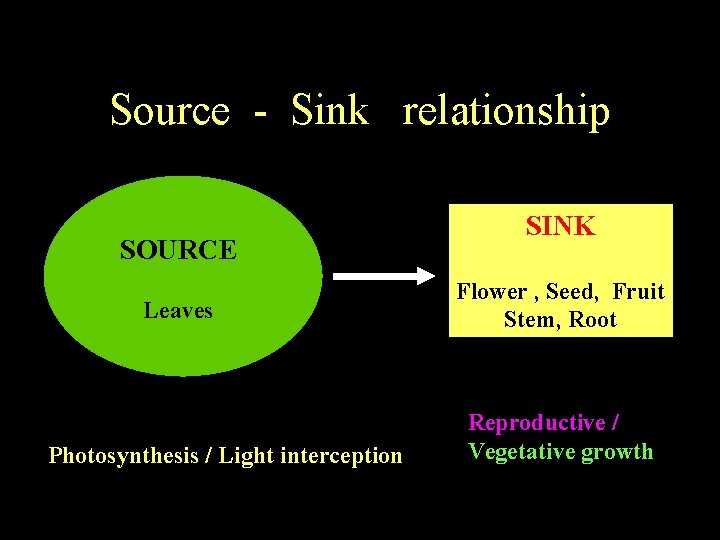
Source - Sink relationship SOURCE Leaves Photosynthesis / Light interception SINK Flower , Seed, Fruit Stem, Root Reproductive / Vegetative growth
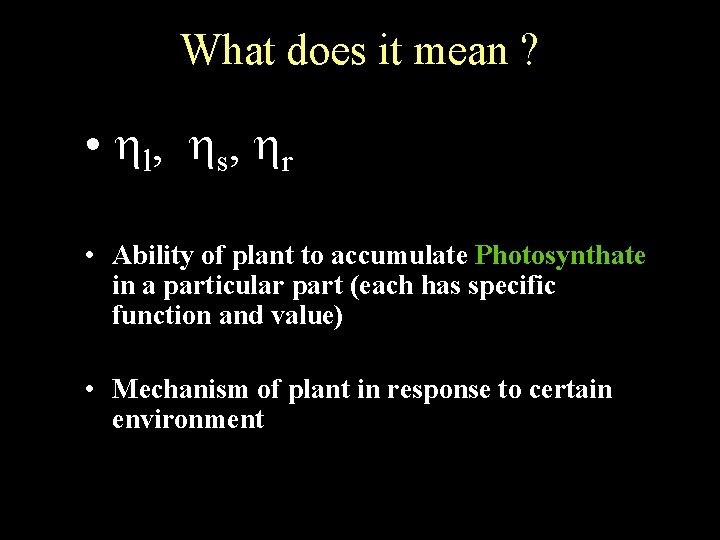
What does it mean ? • hl , hs , hr • Ability of plant to accumulate Photosynthate in a particular part (each has specific function and value) • Mechanism of plant in response to certain environment
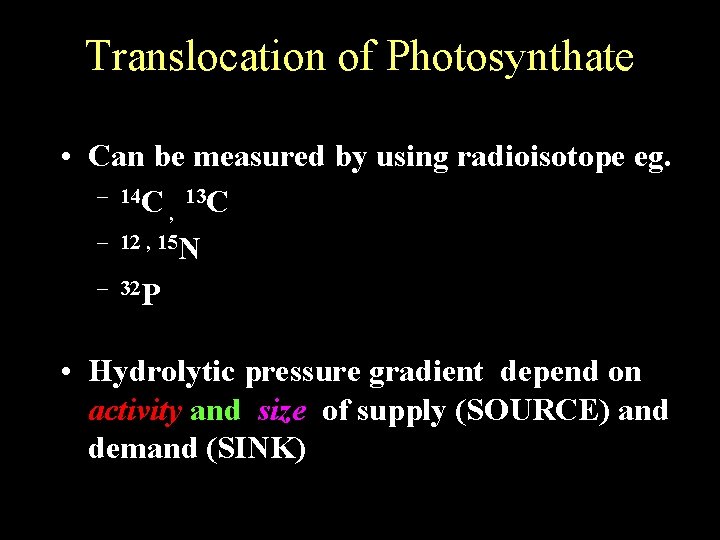
Translocation of Photosynthate • Can be measured by using radioisotope eg. – 14 C 13 C , – 12 , 15 N – 32 P • Hydrolytic pressure gradient depend on activity and size of supply (SOURCE) and demand (SINK)
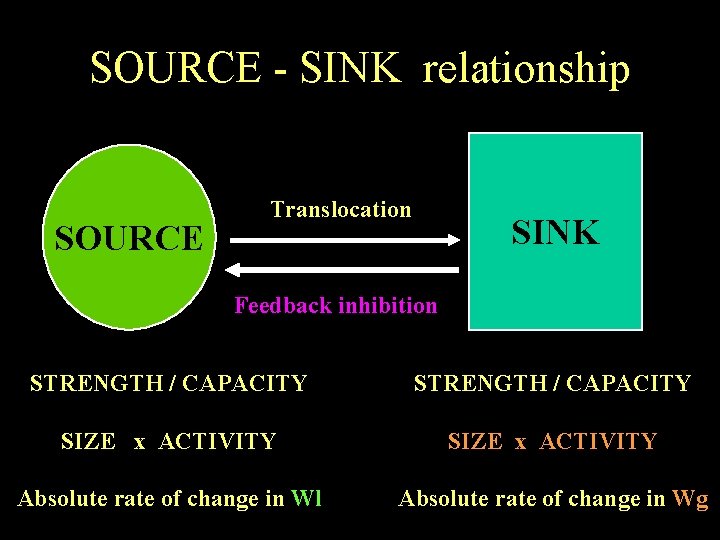
SOURCE - SINK relationship SOURCE Translocation SINK Feedback inhibition STRENGTH / CAPACITY SIZE x ACTIVITY Absolute rate of change in Wl Absolute rate of change in Wg
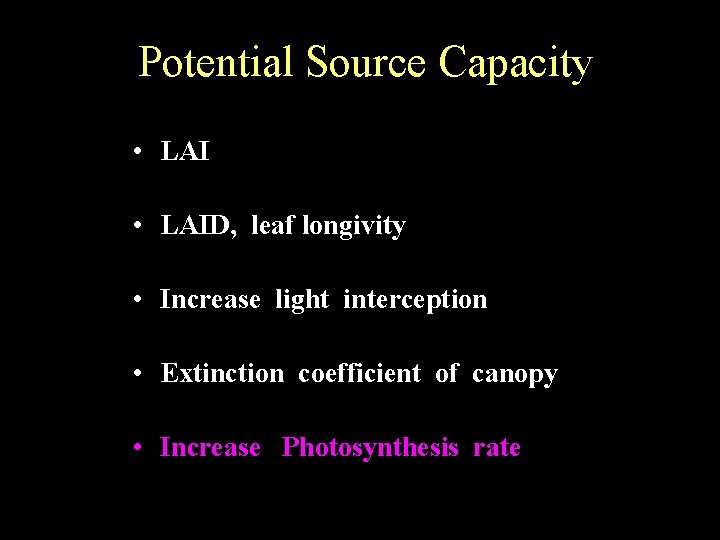
Potential Source Capacity • LAID, leaf longivity • Increase light interception • Extinction coefficient of canopy • Increase Photosynthesis rate
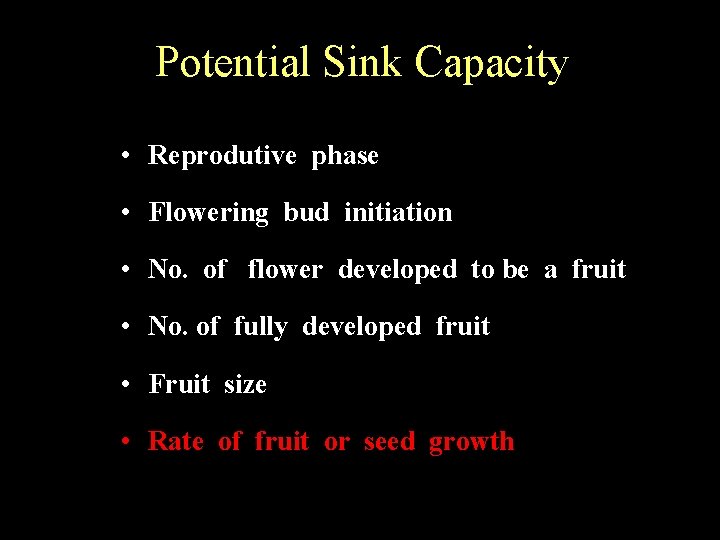
Potential Sink Capacity • Reprodutive phase • Flowering bud initiation • No. of flower developed to be a fruit • No. of fully developed fruit • Fruit size • Rate of fruit or seed growth
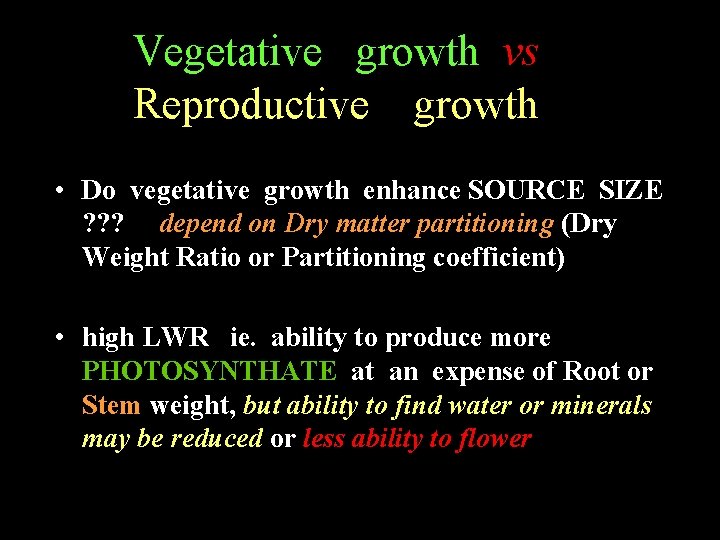
Vegetative growth vs Reproductive growth • Do vegetative growth enhance SOURCE SIZE ? ? ? depend on Dry matter partitioning (Dry Weight Ratio or Partitioning coefficient) • high LWR ie. ability to produce more PHOTOSYNTHATE at an expense of Root or Stem weight, but ability to find water or minerals may be reduced or less ability to flower
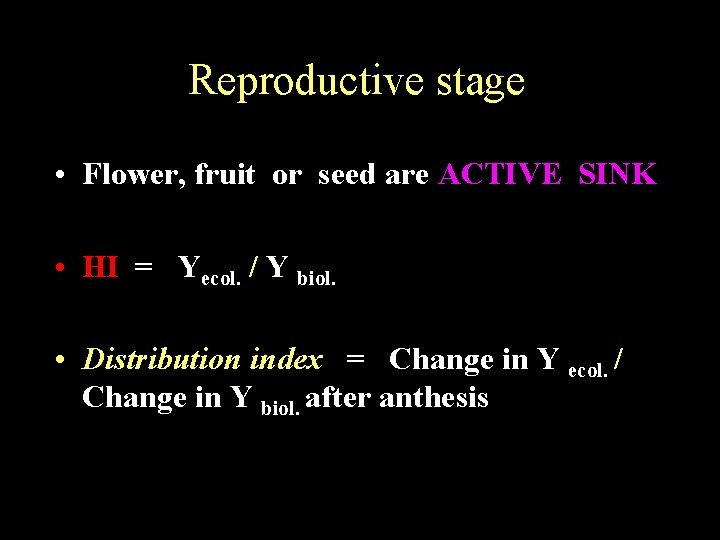
Reproductive stage • Flower, fruit or seed are ACTIVE SINK • HI = Yecol. / Y biol. • Distribution index = Change in Y ecol. / Change in Y biol. after anthesis
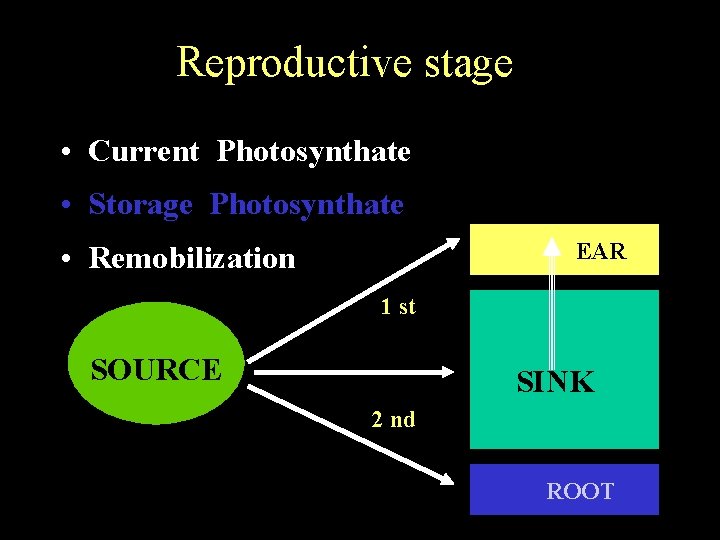
Reproductive stage • Current Photosynthate • Storage Photosynthate EAR • Remobilization 1 st SOURCE SINK 2 nd ROOT
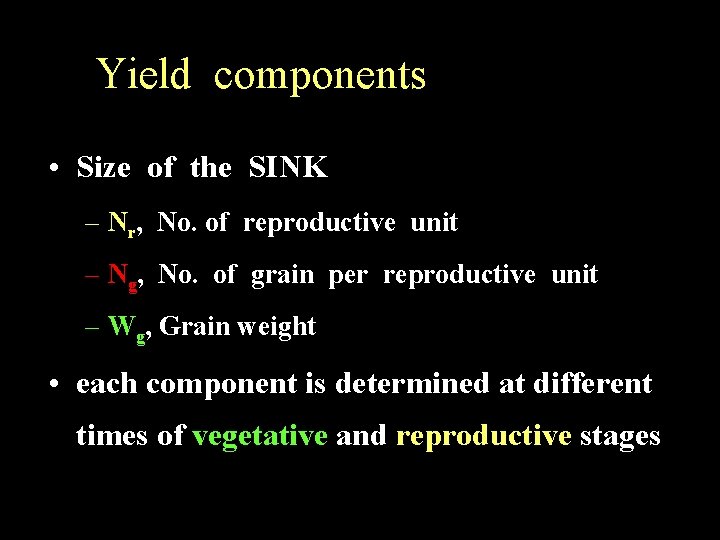
Yield components • Size of the SINK – Nr, No. of reproductive unit – Ng, No. of grain per reproductive unit – Wg, Grain weight • each component is determined at different times of vegetative and reproductive stages
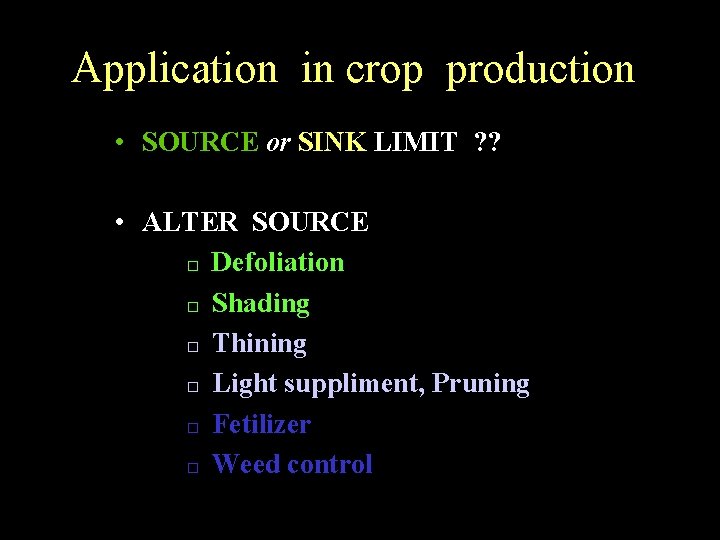
Application in crop production • SOURCE or SINK LIMIT ? ? • ALTER SOURCE o Defoliation o Shading o Thining o Light suppliment, Pruning o Fetilizer o Weed control
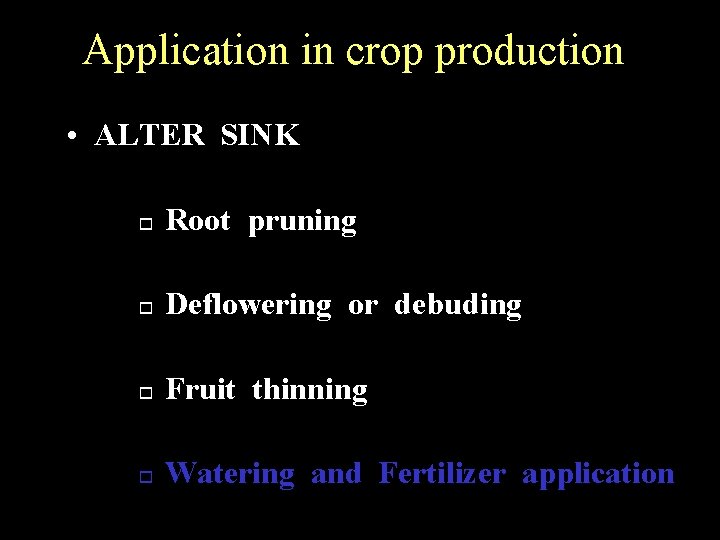
Application in crop production • ALTER SINK o Root pruning o Deflowering or debuding o Fruit thinning o Watering and Fertilizer application
����� paper ������� Board, J. E. and Qiang, Tan. 1995. Assimilatory capacity effects on soybean yield components and pod number. Crop Sci. 35(2) : 846851. Cirilo, A. G. and F. H. Andrade. 1994. Sowing date and maize productivity. I crop growth and dry matter partitioning. II. Kernel number determination. Crop Sci. 34(4) : 1039 -1046. James, J H. 1994. Canopy characteristics associated with deficient and excessive cotton plant population density. Crop Sci. 34(5) : 1291 -1297. Jiang, H. and D. B. Egli. 1995. Soybean seed number and crop growth rate during flowering. Agron. J. 87(2) : 264 -267. Jonathan, Lynch and N. S. Rdrignez, H. 1994. Photosynthetic nitrogen-use efficiency in relation to leaf longevity in common bean. Crop Sci. 34(4) : 1284 -1290.
����� paper ������� Kining, J. R. and D. P. Knievel. 1995. Response of maize seed number to solar radiation interception soon after anthesis. Agron. J. 87(2) : 228 -234. Pau, W. L. , J. J. Canberato, R. H. Mall, E. J. Kamprath and W. A. Jackson. 1995. Altering source-sink relationship in prolific maize hybrids: Consequences for nitrogen uptake and remobilization. Crop Sci. 35(2) : 836 -845. Pendelton, B. B. , G. L. Teetes and G. C. Paterson. 1994. Phenology of sorghum flowering. Crop Sci. 35(4) : 1263 -1266. Pettigrew, W. T. and W. R. Meredith Jr. 1994. Leaf gas exchange paratmeters vary among cotton genotypes. Crop Sci. 34(3) : 700705.
References Amthor, J. S. 1989. Respiration and Crop Productivity. Spring. Verlag. New York : pp. (QK 891 A 47 1989) Amthor, J. S. and Mcree, K. J. 1990. Carbon balance of stresses plants: A conceptual model for integrating research results. in (Alscher, R. G. and Cumming, J. R. eds) Stress Responses in Plants: Adaptation and Acclimation Mechanisms. Wiley-Liss, Inc. New York. 407 pp. (QK 754. S 77 1990 v. 12. ) Biscoe, P, and Gallagher, J. N. 1977. Weather, dry matter production and yield. in (Landsberg, J. J. and Cutting, C. V. eds) Environmental Effects on Crop Physiology. Academic Press. London. 75 -100. (S 600. 2 S 85 1977) Cowan, I. 1984. Optimization of productivity: carbon and water economy in higher plants. in (Pearson, C. J. ed) Control of Crop Productivity. Academic Press. Sydney. 13 -32. (S 600. 5 C 66 1984) Evans, L. T. 1993. Crop Evolution Adaptation and Yield. Cambridge Univ. Press. Cambridge : pp. (SB 106 D 74 E 92. 1993)
References Gardner, F. P. , R. B. Pearce and R. L. Mitchell. 1985. Physiology of Crop Plants. Iowa State Univ. Press. Ames. 327. Incoll, L. D. 1977. Field studies of photosynthesis monitoring with 14 CO 2. in (Landsberg, J. J. and C. C. Cutting eds) Environmental Effects on Crop Physiology. Academic Press. London : 137 -155. Loomis, R. S. and Connor, D. J. 1992. Crop Ecology: Productivity and Management in Agricultural Systems. Cambridge Univ. Press. Cambridge. 538 pp. (S 589. 7 L 66 1992) Milthrope, F. L. and J. Moorby. 1979. An Introduction to Crop Physiology. 2 nd ed. Cambridge Univ. Press. Sydney. 244 pp. Raghavendra, A. S. 1991. Physiology of Trees. John Wiley & Sons, Inc. New York 21 -51 pp. (QK 711. 2 P 49 1991) Sheehy, J. E. and Johnson, I. R. 1988. Physiological model of grass growth. in (Jones, M. B. and Lazenby, A. eds) The Grass Crop: The Physiological Basis of Production. Chapman and Hall. London: 243 -275. (SB 197 G 77 1988) Wardlaw, I. F. 1980. Translocation and source-sink relationships. in (Carlson, P. S. ed) The Biology of Crop Productivity. Academic Press. New York :