
Dry Ice Lab Purpose Observe changes in state
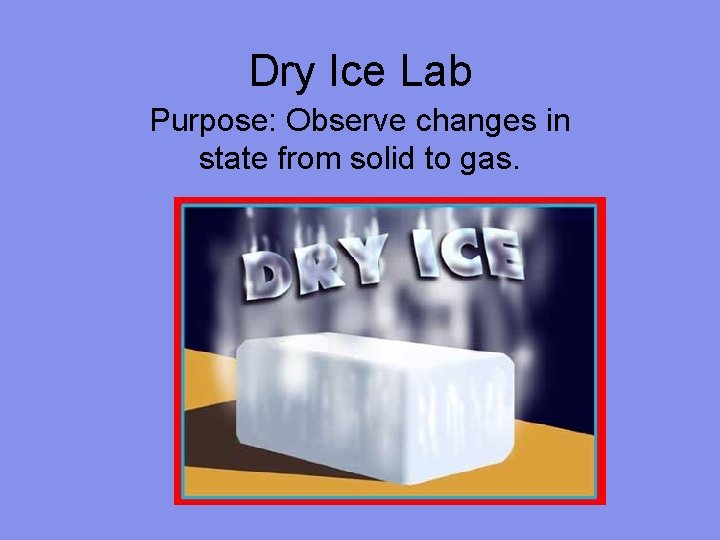
Dry Ice Lab Purpose: Observe changes in state from solid to gas.
Background: • Dry ice is carbon dioxide in its solid state. • Remember…dry ice sublimates instead of melting. • Carbon dioxide is found in the earth's atmosphere • Humans exhale carbon dioxide gas and plants use it for photosynthesis. • Carbon dioxide is a colorless, odorless, and tasteless compound. • Dry ice is -78 degrees Celsius (-109 degrees Fahrenheit) On your lab report: Summarize at least 2 facts about dry ice using your own words. Define sublimation
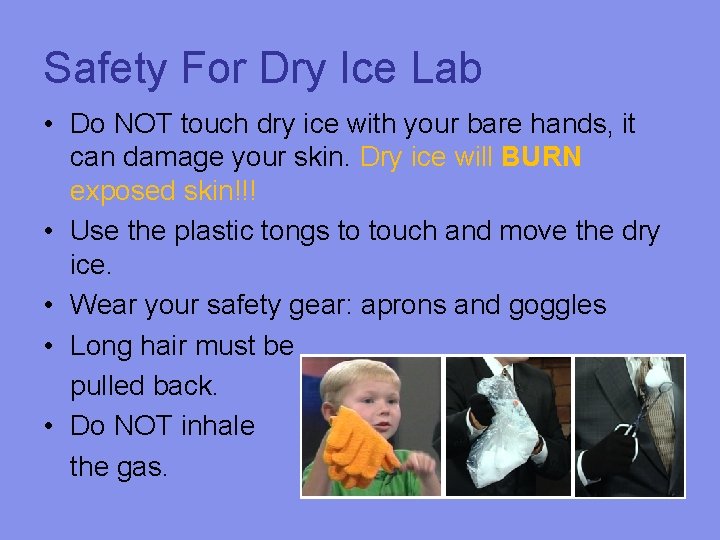
Safety For Dry Ice Lab • Do NOT touch dry ice with your bare hands, it can damage your skin. Dry ice will BURN exposed skin!!! • Use the plastic tongs to touch and move the dry ice. • Wear your safety gear: aprons and goggles • Long hair must be pulled back. • Do NOT inhale the gas.
Safety (cont. ) • Use caution when lighting the candle. • Make sure the area you work in is well ventilated. Do NOT close the doors. • Do not place dry ice or dry ice and water in a sealed plastic bottle or thin glass bottle. It will explode. People can be severely injured. It is against the law and it is a felony.
Divide your paper into 4 sections Each individual lab within this activity has its own procedure. We will step through these as a class using this presentation. No one is allowed to move ahead until we are all ready. • In each section record: • Hypothesis (if…, then… format) • Observations (answer questions) I don’t know is not an acceptable answer. Make an educated guess.
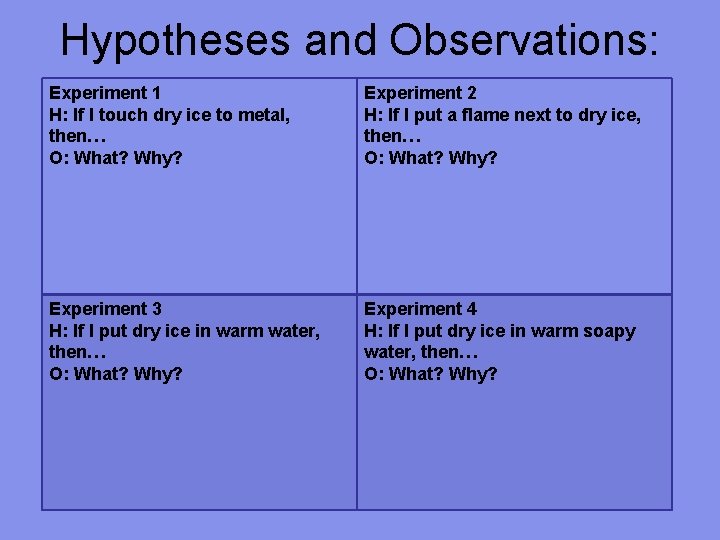
Hypotheses and Observations: Experiment 1 H: If I touch dry ice to metal, then… O: What? Why? Experiment 2 H: If I put a flame next to dry ice, then… O: What? Why? Experiment 3 H: If I put dry ice in warm water, then… O: What? Why? Experiment 4 H: If I put dry ice in warm soapy water, then… O: What? Why?
Experiment 1: Screaming Metal • Materials: lab spoon, Petri dish, dry ice. • Procedure: Place the metal spoon against the dry ice in the Petri dish. • Be careful not to let the spoon get too cold, you could get frost bite. • Results: What happens? Why do you think this happens?
Experiment 2 - Magic Fire Extinguisher • Materials: beaker, dry ice, match, candle, clay, small pie tin. • Procedure: Place the dry ice in your beaker. Light the match and light the candle. Place the candle near the dry ice. • Results: What happens? Why do you think this happened?
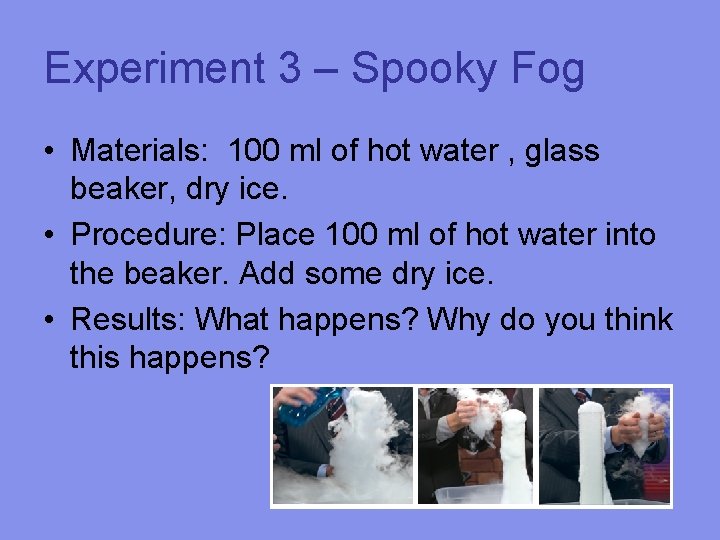
Experiment 3 – Spooky Fog • Materials: 100 ml of hot water , glass beaker, dry ice. • Procedure: Place 100 ml of hot water into the beaker. Add some dry ice. • Results: What happens? Why do you think this happens?
Experiment 4 – Soap Ooze • Materials: the spooky fog, 10 ml of liquid soap. • Procedure: Add the 10 ml of soap to the spooky fog experiment. • Results: What happens? Why do you think this happened?
Clean Up • Clean out the beaker really well so that it’s not soapy for the next period • Dry off the trays • Put lab trays back on the counter
Conclusion – Address the following questions using paragraph format 1. What is sublimation and how is it different from melting? 2. What is needed to cause a substance to sublimate? 3. Where is thermal energy coming from to cause the dry ice to sublimate? 4. Is sublimation a physical or chemical change? Explain your answer.
- Slides: 12