
DrugDisease Modeling Simulation in Oncology Mendel Jansen Director

- Slides: 17
Drug/Disease Modeling & Simulation in Oncology Mendel Jansen Director Modeling & Simulation Translational Medicine & Clinical Pharmacology, Daiichi Sankyo Development, UK PRISME Forum | SIG Modeling Human Biology & Disease intervention Hinxton (UK) 4 May 2011
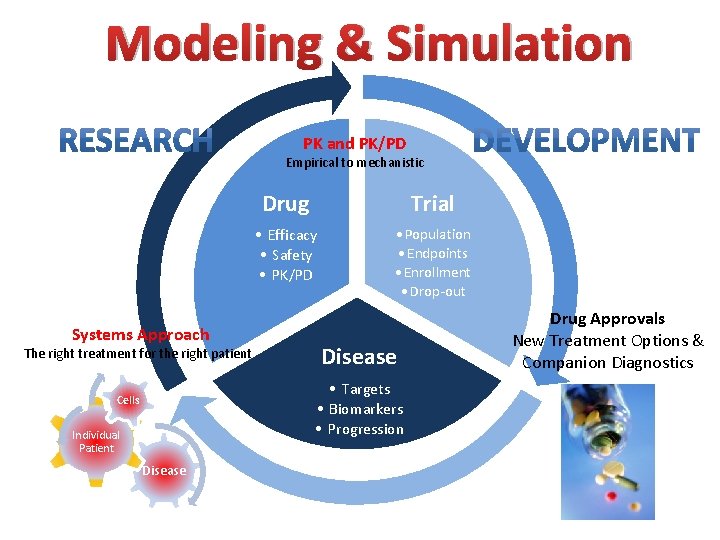
Modeling & Simulation PK and PK/PD Empirical to mechanistic Systems Approach The right treatment for the right patient Drug Trial • Efficacy • Safety • PK/PD • Population • Endpoints • Enrollment • Drop-out Disease • Targets • Biomarkers • Progression Cells Individual Patient Disease Drug Approvals New Treatment Options & Companion Diagnostics
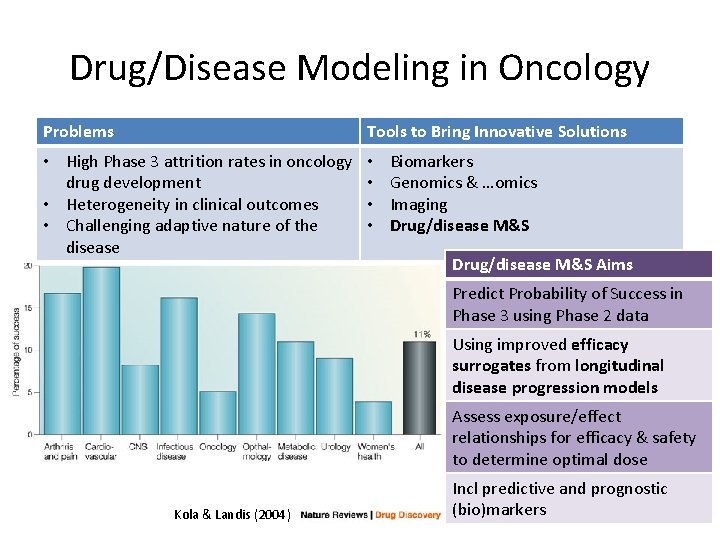
Drug/Disease Modeling in Oncology Problems Tools to Bring Innovative Solutions • High Phase 3 attrition rates in oncology drug development • Heterogeneity in clinical outcomes • Challenging adaptive nature of the disease • • Biomarkers Genomics & …omics Imaging Drug/disease M&S Aims Predict Probability of Success in Phase 3 using Phase 2 data Using improved efficacy surrogates from longitudinal disease progression models Assess exposure/effect relationships for efficacy & safety to determine optimal dose Kola & Landis (2004) Incl predictive and prognostic (bio)markers
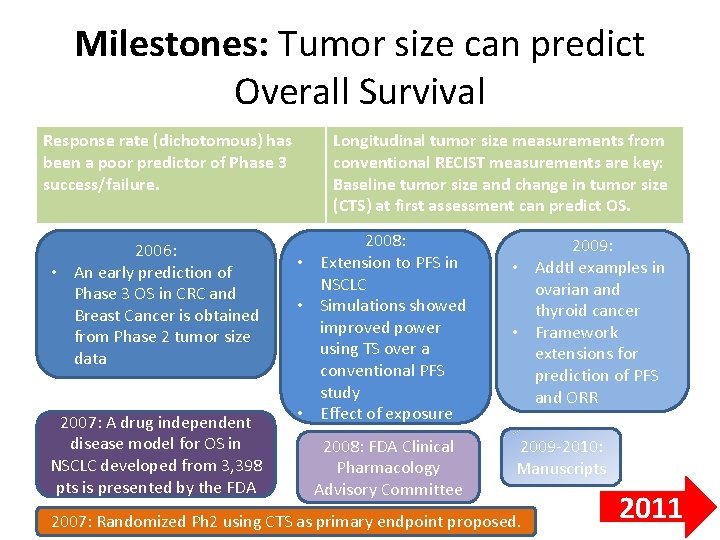
Milestones: Tumor size can predict Overall Survival Response rate (dichotomous) has been a poor predictor of Phase 3 success/failure. 2006: • An early prediction of Phase 3 OS in CRC and Breast Cancer is obtained from Phase 2 tumor size data 2007: A drug independent disease model for OS in NSCLC developed from 3, 398 pts is presented by the FDA Longitudinal tumor size measurements from conventional RECIST measurements are key: Baseline tumor size and change in tumor size (CTS) at first assessment can predict OS. 2008: • Extension to PFS in NSCLC • Simulations showed improved power using TS over a conventional PFS study • Effect of exposure 2008: FDA Clinical Pharmacology Advisory Committee 2009: • Addtl examples in ovarian and thyroid cancer • Framework extensions for prediction of PFS and ORR 2009 -2010: Manuscripts 2007: Randomized Ph 2 using CTS as primary endpoint proposed. 2011
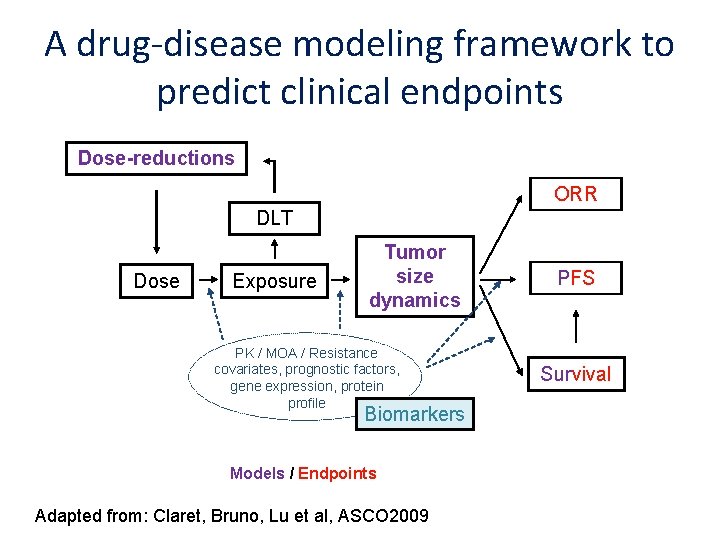
A drug-disease modeling framework to predict clinical endpoints Dose-reductions ORR DLT Dose Exposure Tumor size dynamics PK / MOA / Resistance covariates, prognostic factors, gene expression, protein profile Biomarkers Models / Endpoints Adapted from: Claret, Bruno, Lu et al, ASCO 2009 PFS Survival
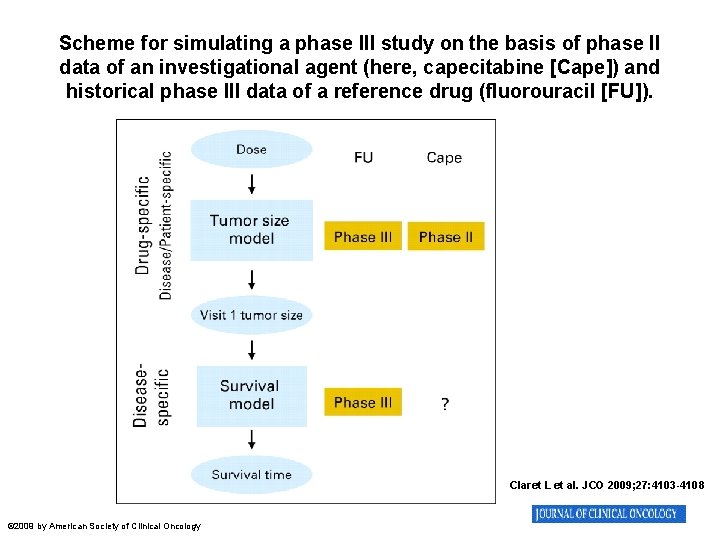
Scheme for simulating a phase III study on the basis of phase II data of an investigational agent (here, capecitabine [Cape]) and historical phase III data of a reference drug (fluorouracil [FU]). Claret L et al. JCO 2009; 27: 4103 -4108 © 2009 by American Society of Clinical Oncology
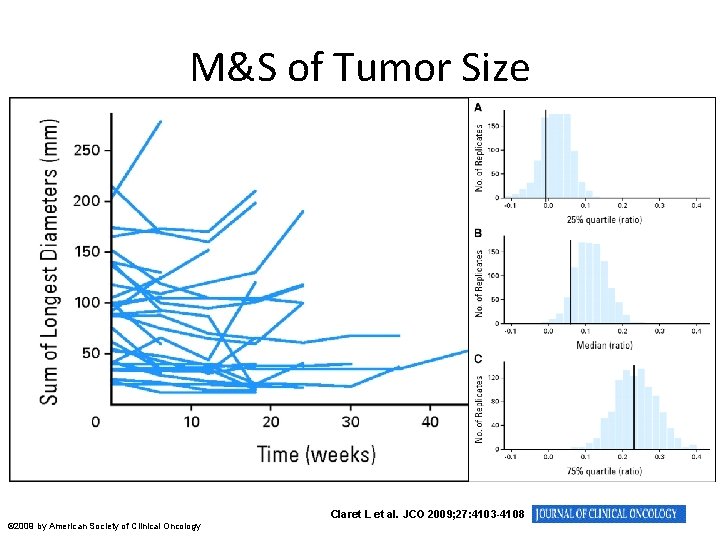
M&S of Tumor Size Claret L et al. JCO 2009; 27: 4103 -4108 © 2009 by American Society of Clinical Oncology
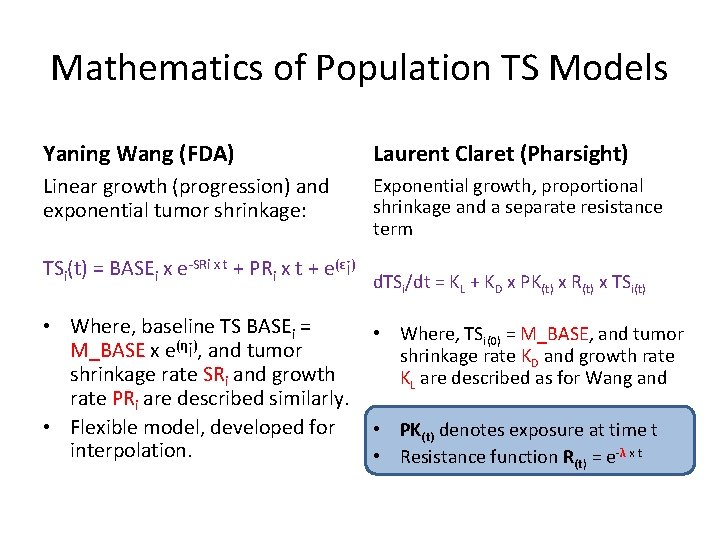
Mathematics of Population TS Models Yaning Wang (FDA) Laurent Claret (Pharsight) Linear growth (progression) and exponential tumor shrinkage: Exponential growth, proportional shrinkage and a separate resistance term TSi(t) = BASEi x e-SRi x t + PRi x t + e(εi) • Where, baseline TS BASEi = M_BASE x e(ηi), and tumor shrinkage rate SRi and growth rate PRi are described similarly. • Flexible model, developed for interpolation. d. TSi/dt = KL + KD x PK(t) x R(t) x TSi(t) • Where, TSi(0) = M_BASE, and tumor shrinkage rate KD and growth rate KL are described as for Wang and • PK(t) denotes exposure at time t • Resistance function R(t) = e-λ x t
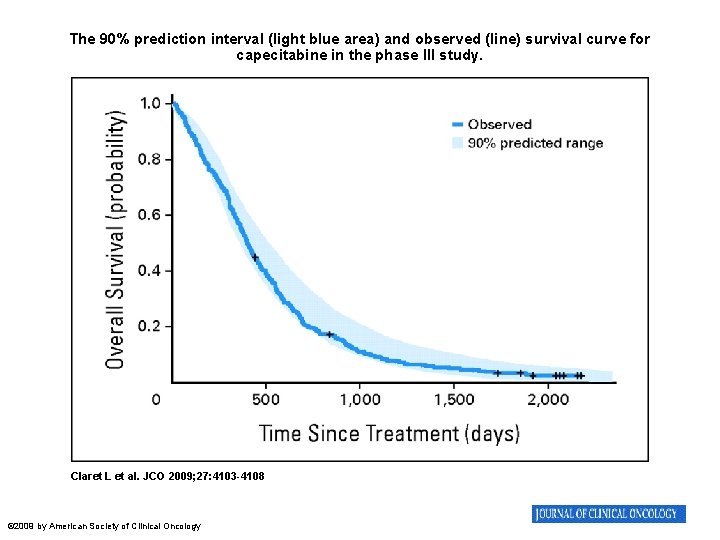
The 90% prediction interval (light blue area) and observed (line) survival curve for capecitabine in the phase III study. Claret L et al. JCO 2009; 27: 4103 -4108 © 2009 by American Society of Clinical Oncology
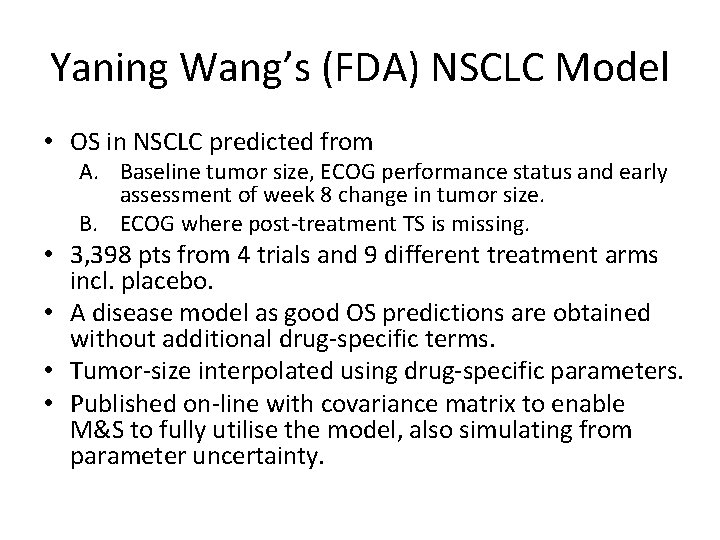
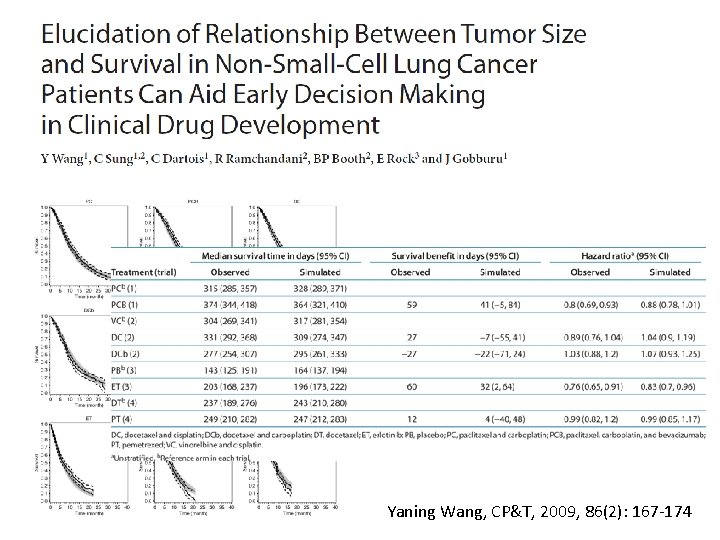
Yaning Wang’s (FDA) NSCLC Model • OS in NSCLC predicted from A. Baseline tumor size, ECOG performance status and early assessment of week 8 change in tumor size. B. ECOG where post-treatment TS is missing. • 3, 398 pts from 4 trials and 9 different treatment arms incl. placebo. • A disease model as good OS predictions are obtained without additional drug-specific terms. • Tumor-size interpolated using drug-specific parameters. • Published on-line with covariance matrix to enable M&S to fully utilise the model, also simulating from parameter uncertainty.
Yaning Wang, CP&T, 2009, 86(2): 167 -174
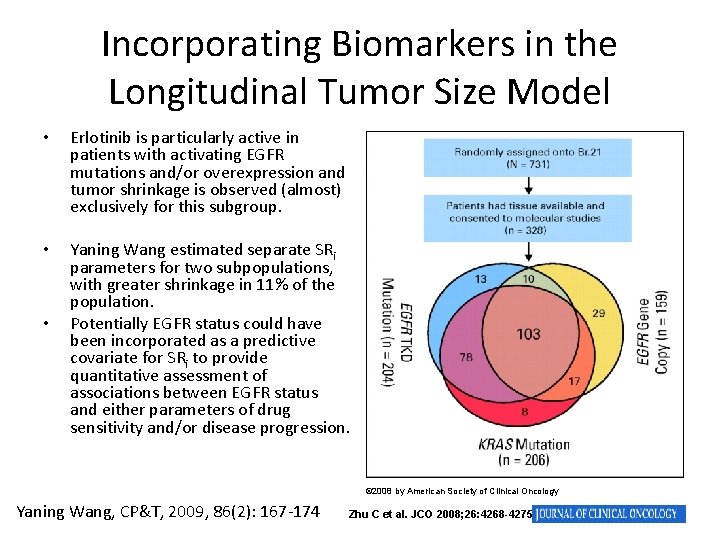
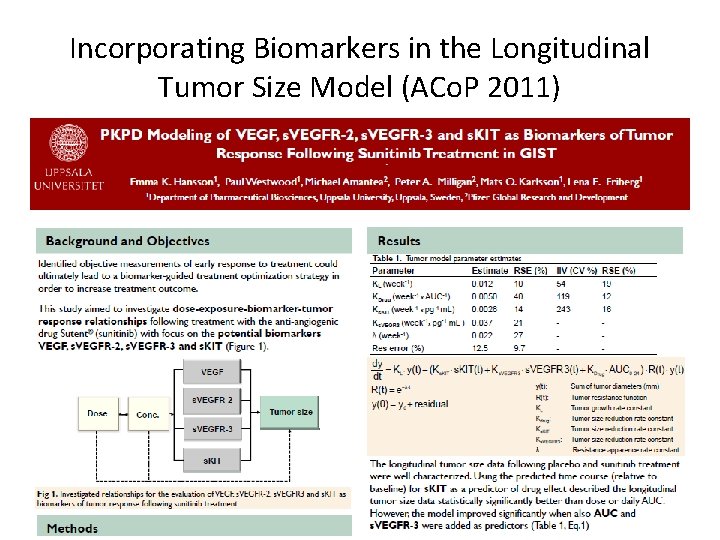
Incorporating Biomarkers in the Longitudinal Tumor Size Model • Erlotinib is particularly active in patients with activating EGFR mutations and/or overexpression and tumor shrinkage is observed (almost) exclusively for this subgroup. • Yaning Wang estimated separate SRi parameters for two subpopulations, with greater shrinkage in 11% of the population. Potentially EGFR status could have been incorporated as a predictive covariate for SRi to provide quantitative assessment of associations between EGFR status and either parameters of drug sensitivity and/or disease progression. • © 2008 by American Society of Clinical Oncology Yaning Wang, CP&T, 2009, 86(2): 167 -174 Zhu C et al. JCO 2008; 26: 4268 -4275
Incorporating Biomarkers in the Longitudinal Tumor Size Model (ACo. P 2011)
Survey of Clinical. Trials. Gov (03 MAY 11) • Search for “change in tumor size” shows applications as – Primary endpoints in randomised Ph 2 trials • “Change in tumor size from baseline to end of cycle 2 as” in a randomised Ph 2 NSCLC trial of LY 2181308 in combination with docetaxel vs docetaxel • “Change in tumour size at 12 weeks” in a study of AZD 4547 plus exemestane in ER+ / FGFR 1 breast cancer – Secondary endpoints in other Ph 2 and 3 trials – Primary endpoint in small single arm studies
Future Prospects • Increased publication of disease models for NSCLC and other cancer types. • Developing model libraries for control / reference treatments. • Increased utilisation of tumor size / survival relationships to predict PFS and OS. • Incorporation of predictive and prognostic biomarkers. • Synergies with improved imaging modalities to measure disease progression (e. g. volumetric CT and PET).
Summary • Oncology M&S aims to describe the dynamics of PK, PD effects on the drug target and also on efficacy and safety outcomes. • Tumour size at baseline and change in tumour size shortly after treatment are a good starting point for modelling OS and PFS. • Longitudinal / repeated continuous measures preferred over single dichotomous responder classification (in general!). • M&S framework is a useful drug/development tool to describe – Impact of drug on disease as a function of exposure and predictive markers – Disease progression as a function of prognostic markers and drug activity – Relationship between drug exposure and AEs / dose modifications / dropouts
Acknowledgements • Laurent Claret and Rene Bruno • Raymond Miller and Daiichi-Sankyo TMCP / M&S