
DrugCoated Balloons FDA View Nicole Ibrahim Ph D

Drug-Coated Balloons FDA View Nicole Ibrahim, Ph. D Interventional Cardiology Devices Branch Peripheral Vascular Devices Branch Division of Cardiovascular Devices Office of Device Evaluation CDRH/FDA CRT 2012, Washington, D. C. February 7, 2012
Nicole Ibrahim, Ph. D I have no real or apparent conflicts of interest to report.
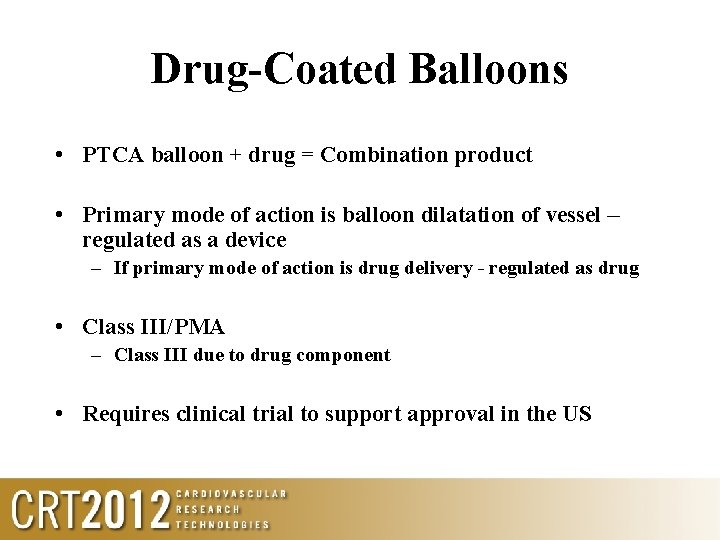
Drug-Coated Balloons • PTCA balloon + drug = Combination product • Primary mode of action is balloon dilatation of vessel – regulated as a device – If primary mode of action is drug delivery - regulated as drug • Class III/PMA – Class III due to drug component • Requires clinical trial to support approval in the US
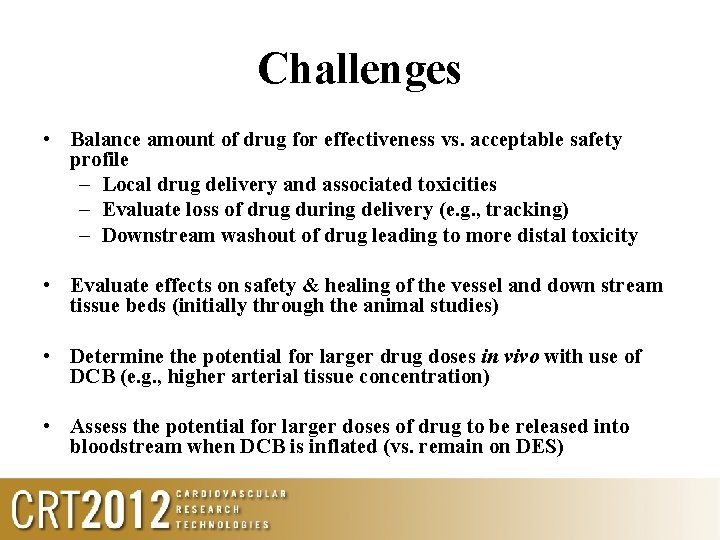
Challenges • Balance amount of drug for effectiveness vs. acceptable safety profile – Local drug delivery and associated toxicities – Evaluate loss of drug during delivery (e. g. , tracking) – Downstream washout of drug leading to more distal toxicity • Evaluate effects on safety & healing of the vessel and down stream tissue beds (initially through the animal studies) • Determine the potential for larger drug doses in vivo with use of DCB (e. g. , higher arterial tissue concentration) • Assess the potential for larger doses of drug to be released into bloodstream when DCB is inflated (vs. remain on DES)
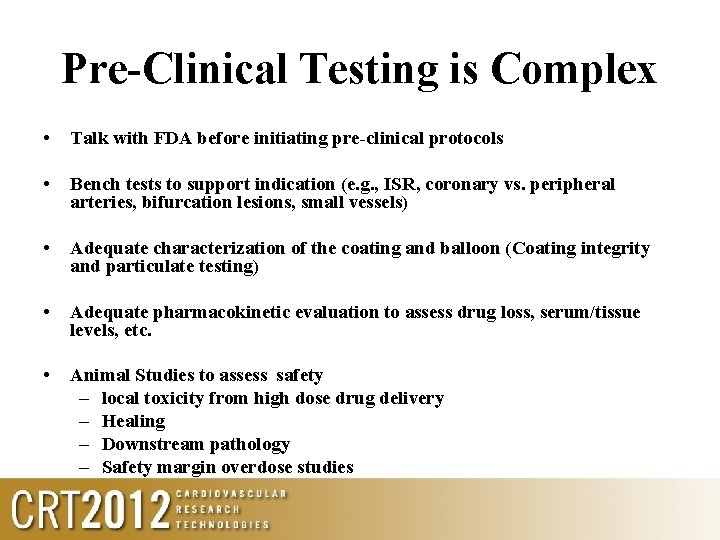
Pre-Clinical Testing is Complex • Talk with FDA before initiating pre-clinical protocols • Bench tests to support indication (e. g. , ISR, coronary vs. peripheral arteries, bifurcation lesions, small vessels) • Adequate characterization of the coating and balloon (Coating integrity and particulate testing) • Adequate pharmacokinetic evaluation to assess drug loss, serum/tissue levels, etc. • Animal Studies to assess safety – local toxicity from high dose drug delivery – Healing – Downstream pathology – Safety margin overdose studies
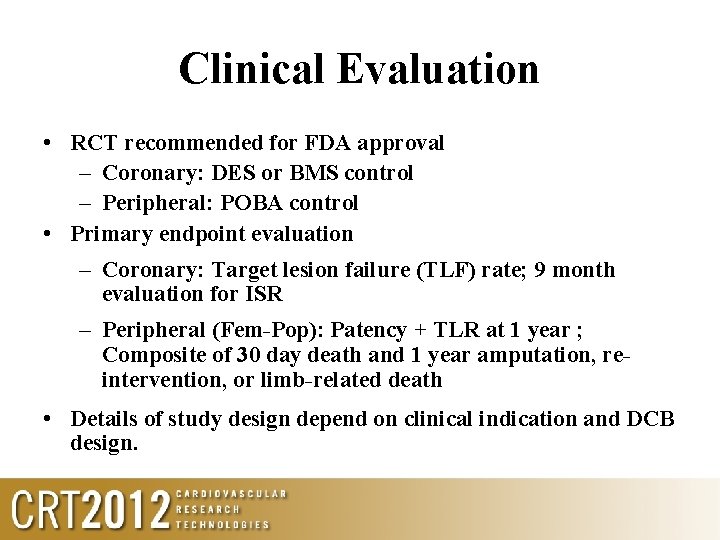
Clinical Evaluation • RCT recommended for FDA approval – Coronary: DES or BMS control – Peripheral: POBA control • Primary endpoint evaluation – Coronary: Target lesion failure (TLF) rate; 9 month evaluation for ISR – Peripheral (Fem-Pop): Patency + TLR at 1 year ; Composite of 30 day death and 1 year amputation, reintervention, or limb-related death • Details of study design depend on clinical indication and DCB design.
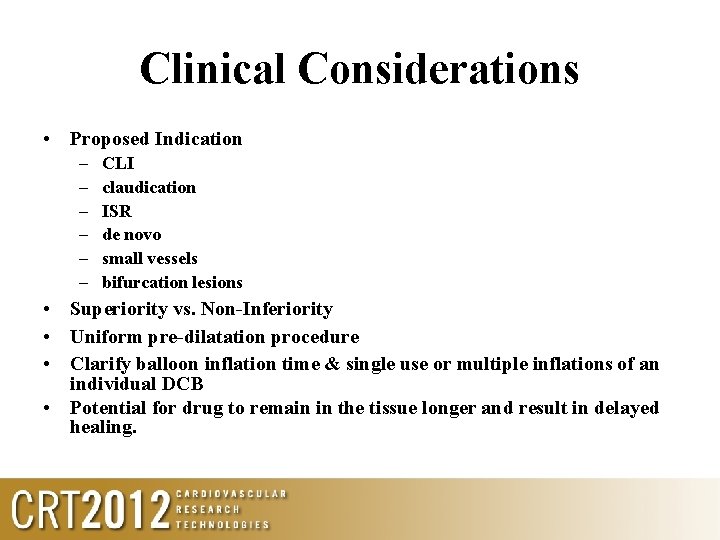
Clinical Considerations • Proposed Indication – – – CLI claudication ISR de novo small vessels bifurcation lesions • Superiority vs. Non-Inferiority • Uniform pre-dilatation procedure • Clarify balloon inflation time & single use or multiple inflations of an individual DCB • Potential for drug to remain in the tissue longer and result in delayed healing.
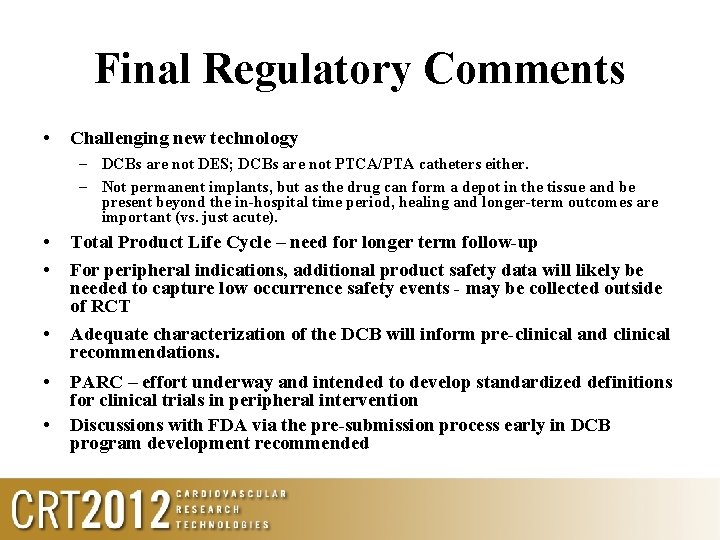
Final Regulatory Comments • Challenging new technology – DCBs are not DES; DCBs are not PTCA/PTA catheters either. – Not permanent implants, but as the drug can form a depot in the tissue and be present beyond the in-hospital time period, healing and longer-term outcomes are important (vs. just acute). • • • Total Product Life Cycle – need for longer term follow-up For peripheral indications, additional product safety data will likely be needed to capture low occurrence safety events - may be collected outside of RCT Adequate characterization of the DCB will inform pre-clinical and clinical recommendations. PARC – effort underway and intended to develop standardized definitions for clinical trials in peripheral intervention Discussions with FDA via the pre-submission process early in DCB program development recommended
FDA Guidance Documents • Draft Coronary DES Guidance http: //www. fda. gov/downloads/Drugs/Guidance. Compliance. R egulatory. Information/Guidances/UCM 072193. pdf • Class II Special Controls Guidance for PTCA Catheters http: //www. fda. gov/Medical. Devices/Device. Regulationand. Gui dance/Guidance. Documents/ucm 225145. htm

Thank You! Nicole Ibrahim (301) 796 -5171 nicole. ibrahim@fda. hhs. gov
- Slides: 10