
Drug therapy in hepatic impairment Medbase Ltd Liver

Drug therapy in hepatic impairment Medbase Ltd
Liver diseases relevant for pharmacokinetics • Chirrosis • • Alcohol liver disease Viral hepatitis B ja C Primary biliary chirrosis & sclerosing cholangitis Prevalence 200 -300/100. 000 inhabitants in Europe (J Hepatol 2013; 58: 593608. ) – Clearly the most important liver condition affecting pharmacokinetics of drugs • Liver toxicity caused by drugs, natural products and mushrooms – Paracetamol + other NSAIDs – Chapparal (Larrea tridentata), Amanita virosa -mushroom
Hepatic impairment and ADRs Eur J Clin Pharmacol. 2013; 69: 1565 -73. • Retrospective chart study in 400 patients with cirrhosis at hospital admission (Child-Pugh: A 18%; B 39%; C 43%) • Altogether 1653 prescriptions (0 -15 / patient) – Every fifth (336) prescription with an error (184 patients) • 36 contraindicated; 300 too high dose (no adjustment) – 69 adverse events related to non-adjustment of the dose in relation to the hepatic function • 68% preventable – Flaws in prescribing led to 94 extra in-hospital days – Problem drugs: • NSAIDs (g-i bleeding), hypnotics and other benzodiazepines, • PPIs (peritonitis)
Determining the liver function with regard to drug therapy • Laboratory testing: – Serum albumin (proteins) and INR (pro thromin time) are the best indicators for the drug metabolic function – Transaminases do not mirror drug metabolic capacity of the liver • Child-Pugh(-Turcotte) classification: – Bil, Alb, INR, Ascites, Encephalopathy – The most used method, e. g. EMA and FDA – Originally not developed for drug dosing, but for patient evaluation before shunt surgery (in chirrosis) – Not equally accurate as e. g. GFR in renal failure
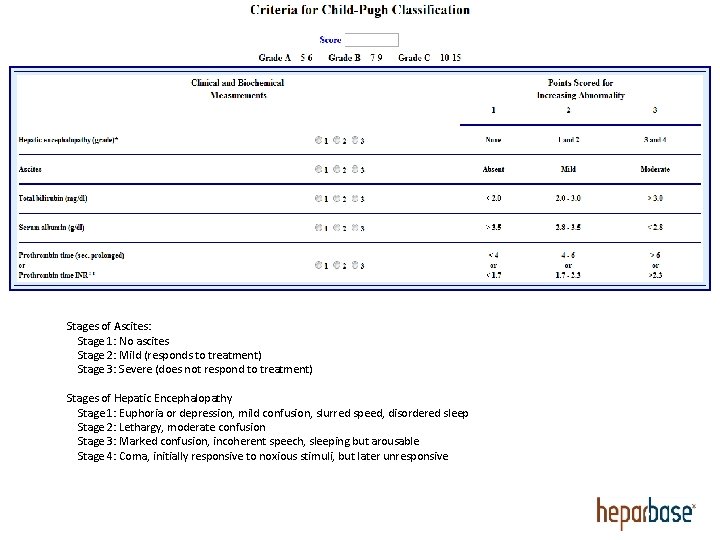
Stages of Ascites: Stage 1: No ascites Stage 2: Mild (responds to treatment) Stage 3: Severe (does not respond to treatment) Stages of Hepatic Encephalopathy Stage 1: Euphoria or depression, mild confusion, slurred speed, disordered sleep Stage 2: Lethargy, moderate confusion Stage 3: Marked confusion, incoherent speech, sleeping but arousable Stage 4: Coma, initially responsive to noxious stimuli, but later unresponsive
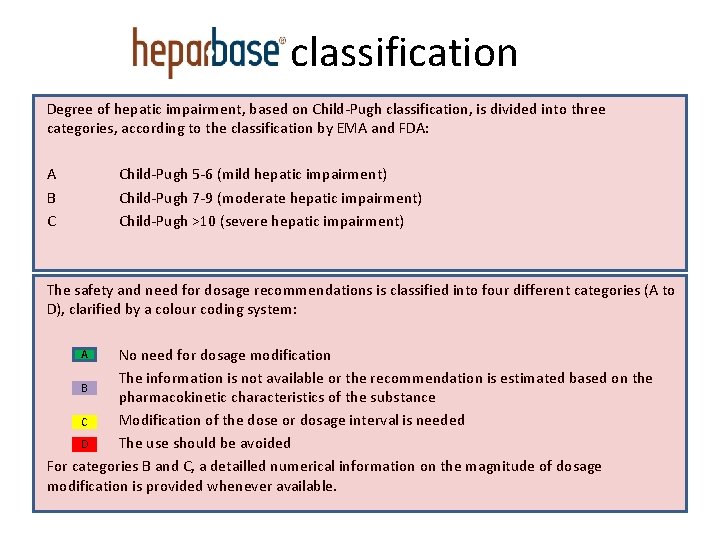
classification Degree of hepatic impairment, based on Child-Pugh classification, is divided into three categories, according to the classification by EMA and FDA: A B C Child-Pugh 5 -6 (mild hepatic impairment) Child-Pugh 7 -9 (moderate hepatic impairment) Child-Pugh >10 (severe hepatic impairment) The safety and need for dosage recommendations is classified into four different categories (A to D), clarified by a colour coding system: A No need for dosage modification The information is not available or the recommendation is estimated based on the B pharmacokinetic characteristics of the substance Modification of the dose or dosage interval is needed C The use should be avoided D For categories B and C, a detailled numerical information on the magnitude of dosage modification is provided whenever available.
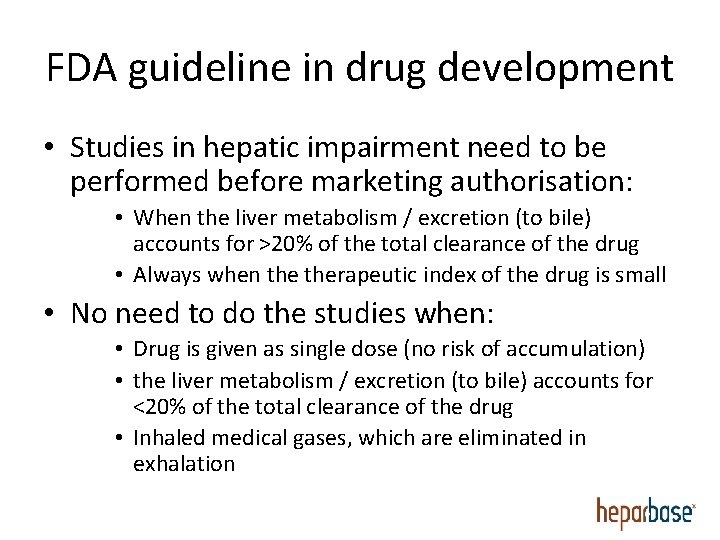
FDA guideline in drug development • Studies in hepatic impairment need to be performed before marketing authorisation: • When the liver metabolism / excretion (to bile) accounts for >20% of the total clearance of the drug • Always when therapeutic index of the drug is small • No need to do the studies when: • Drug is given as single dose (no risk of accumulation) • the liver metabolism / excretion (to bile) accounts for <20% of the total clearance of the drug • Inhaled medical gases, which are eliminated in exhalation
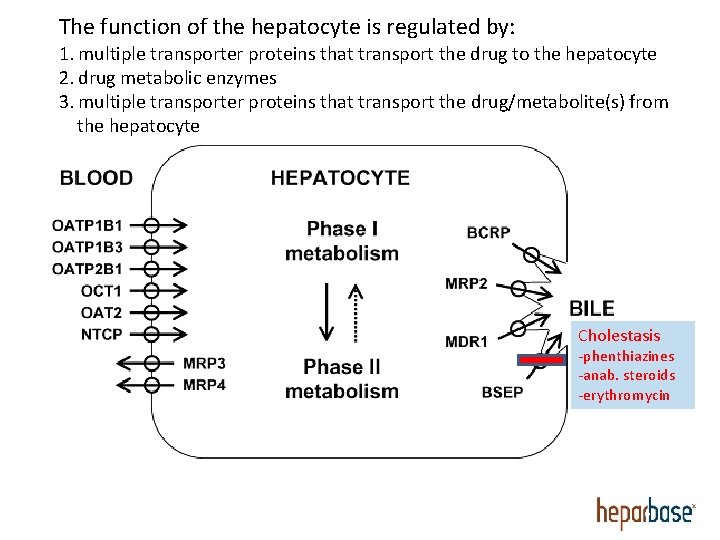
The function of the hepatocyte is regulated by: 1. multiple transporter proteins that transport the drug to the hepatocyte 2. drug metabolic enzymes 3. multiple transporter proteins that transport the drug/metabolite(s) from the hepatocyte Cholestasis -phenthiazines -anab. steroids -erythromycin
How does reduced liver function affect drug metabolism? • CYP-enzymes are most sensitive – Reduced number of hepatocytes low enzyme activity • CYP 2 C 19 most sensitive (effect seen in Child-Pugh A, B, C) • Then CYP 2 D 6 and 1 A 2 (effect seen in Child-Pugh B &C) – Drugs with high first pass effect (tizanidine, agomelatiini) – up to 100 -fold increased exposure in hepatic impairment – Pro drugs (tamoxyfen (!!), codeine, proguanil etc. ) are not activated – Conjugation reactions have larger reserve and are less affected (Child-Pugh C; e. g. lorazepam or oxazepam)
How does reduced liver function affect drug metabolism? • Liver blood flow: – In chirrosis shunting causes that blood flow by-passes the liver • By-pass of first-pass metabolism can cause drastic increase in drug exposure after p. o. dosing • tizanidine, agomelatin, statins • Excretion to the bile (cholestasis) – Intrahepatic (common in chirrosis) – reduced excretion (e. g. telmisartan) – Extrahepatic –very little information available • Reduced binding to plasma albumin • Very drug-specific – some drugs are affected, most are not
Hepatorenal syndrome • Rapidly (2 weeks) or slowly progrediating forms • General mechanism: reduced systemic arterial resistance due to portal hypertension which cannot compensated by increased cardiac minute volume hypoperfusion of kidneys, reduced GFR, activation of RAAS + other vasoconstrictive compensatory mechanisms – In severe hepatic impairment drugs inhibiting RAAS can have drastic hypotensive effect • Common when the liver diease is associated with ascites, uncommon when there is no ascites (Child-Pugh C) • In chirrotic patients cystatiini C –based e. GFR may be more accurate than one based on serum creatinine • Creatinine synthesis is reduced in chirrosis, partly due to reduced muscle mass • e. GFR should be estimated by CKD-EPI or MDRD • Significant source of bias in pharmacokinetic studies in severe hepatic impairment (Child-Pugh C)
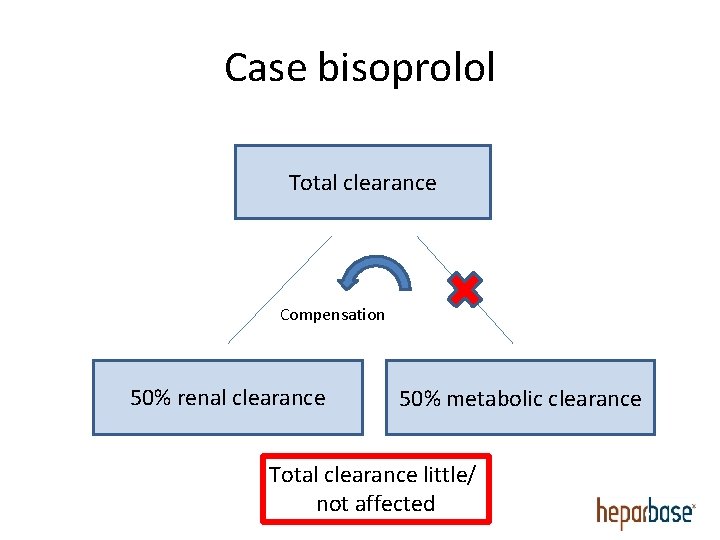
Case bisoprolol Total clearance Compensation 50% renal clearance 50% metabolic clearance Total clearance little/ not affected
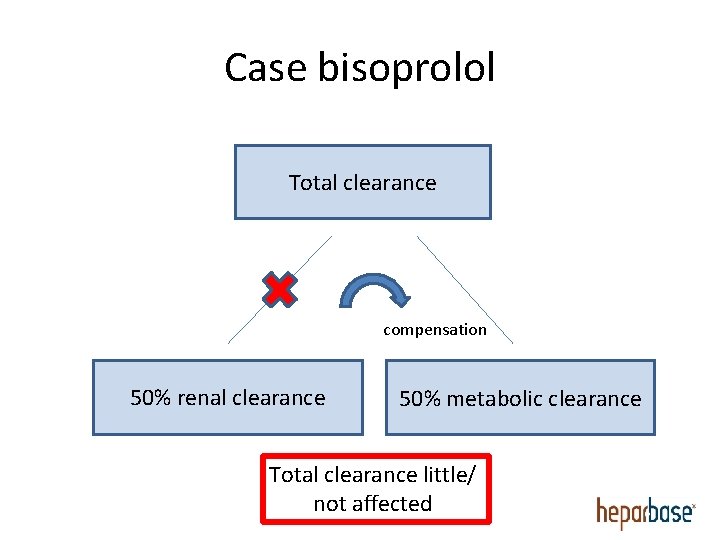
Case bisoprolol Total clearance compensation 50% renal clearance 50% metabolic clearance Total clearance little/ not affected
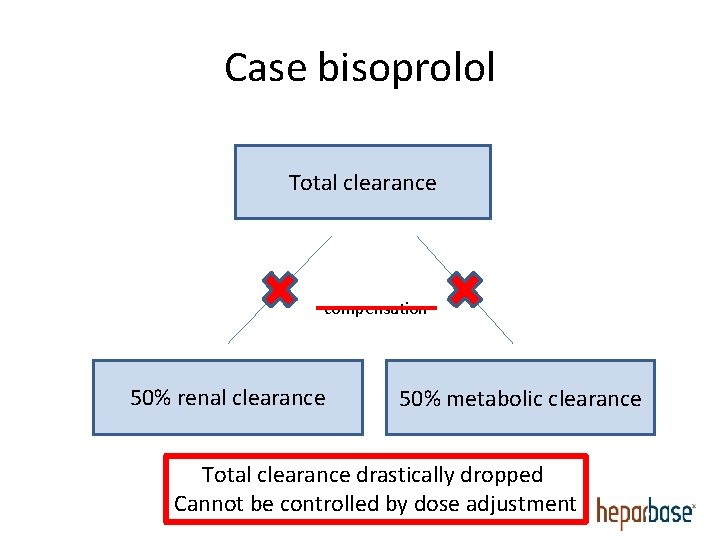
Case bisoprolol Total clearance compensation 50% renal clearance 50% metabolic clearance Total clearance drastically dropped Cannot be controlled by dose adjustment
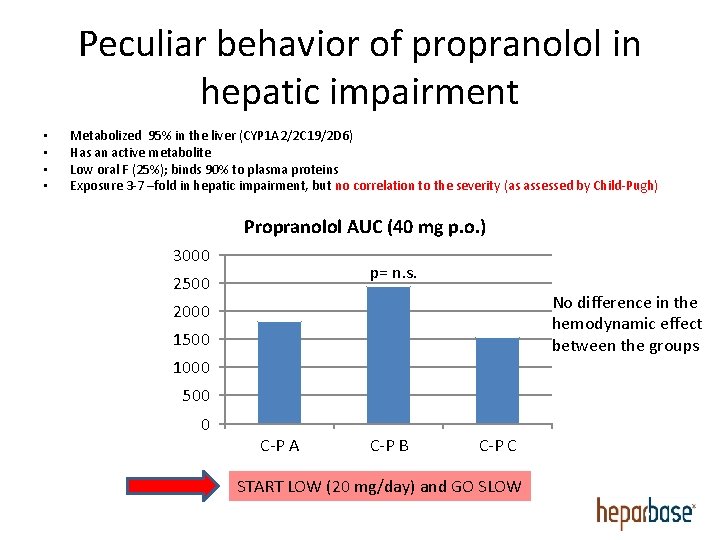
Peculiar behavior of propranolol in hepatic impairment • • Metabolized 95% in the liver (CYP 1 A 2/2 C 19/2 D 6) Has an active metabolite Low oral F (25%); binds 90% to plasma proteins Exposure 3 -7 –fold in hepatic impairment, but no correlation to the severity (as assessed by Child-Pugh) Propranolol AUC (40 mg p. o. ) 3000 p= n. s. 2500 No difference in the hemodynamic effect between the groups 2000 1500 1000 500 0 C-P A C-P B C-P C START LOW (20 mg/day) and GO SLOW
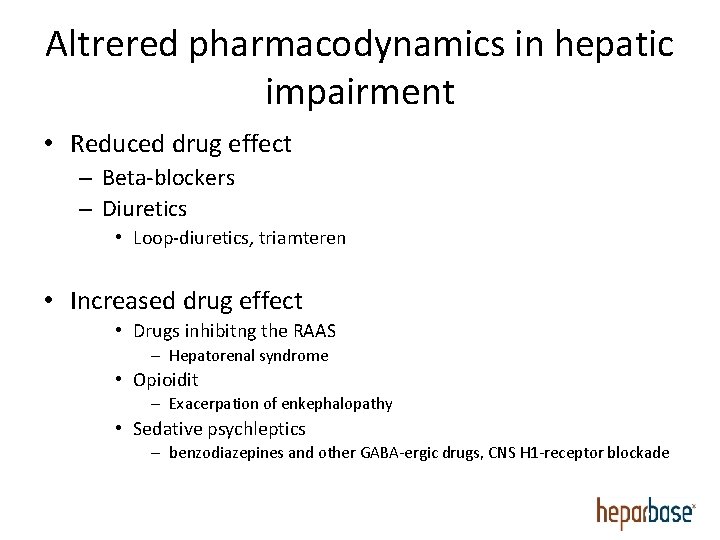
Altrered pharmacodynamics in hepatic impairment • Reduced drug effect – Beta-blockers – Diuretics • Loop-diuretics, triamteren • Increased drug effect • Drugs inhibitng the RAAS – Hepatorenal syndrome • Opioidit – Exacerpation of enkephalopathy • Sedative psychleptics – benzodiazepines and other GABA-ergic drugs, CNS H 1 -receptor blockade
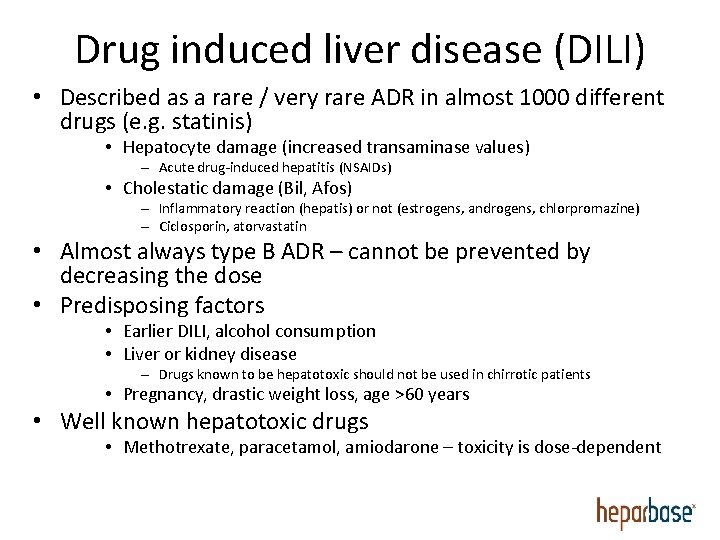
Drug induced liver disease (DILI) • Described as a rare / very rare ADR in almost 1000 different drugs (e. g. statinis) • Hepatocyte damage (increased transaminase values) – Acute drug-induced hepatitis (NSAIDs) • Cholestatic damage (Bil, Afos) – Inflammatory reaction (hepatis) or not (estrogens, androgens, chlorpromazine) – Ciclosporin, atorvastatin • Almost always type B ADR – cannot be prevented by decreasing the dose • Predisposing factors • Earlier DILI, alcohol consumption • Liver or kidney disease – Drugs known to be hepatotoxic should not be used in chirrotic patients • Pregnancy, drastic weight loss, age >60 years • Well known hepatotoxic drugs • Methotrexate, paracetamol, amiodarone – toxicity is dose-dependent
Ideas for functionality of portal • Child-Pugh – calculator needed for determining the degree of hepatic impairment • Search functionality with both generic and trade names • Possibility to see the whole drug (ATC) group at one glance to find the best alternative • Severe hepatic impairment is often associated with reduced kidney function: • Inter-functionality between heparbase and renbase – Warning to check also renal function when the patient’s Child. Pugh score is >9 and there are dosage modification recommendations in renbase – Link to drug’s renbase article
Advice for drug dosing in hepatic impairment • There are great differences between drugs even within a given therapeutic group in: • Need for dosage adjustment (kinetics, differences in metabolism) • Documentation of the need of dosage adjustment • Risk of hepatotoxicity and other tolarability issues • Studies and medical evidence are based on. Child-Pugh –clasification and by use of Child-Pugh –calculator a reliable dosing adjustment can be made from heparbase • Sometimes dosing can be eased by alternative choice of dosage form, e. g. changing p. o. dosing to suppository, transdermal or parenteral dosage form by -passing the first-pass metabolism
Advice for drug dosing in hepatic impairment • Avoid pro-drugs (reduced/abolished efficacy) • Reduced GFR associated with severe hepatic impairment is a therapeutic challenge • e. GFR should be calculated and aim to select a drug which is not a risk drug in hepatorenal syndrome (risk drugs are pointed out in the additional information text of heparbase) • Recommendations on dose adjustments are based on the isolated effect of hepatic impairment on drug exposure – the initial dose (where the %-reduction is made from) is the dose that you would give to the patient if he had a normal liver function
- Slides: 20