
Drug Therapy During Pregnancy and BreastFeeding 1 Clinical
Drug Therapy During Pregnancy and Breast-Feeding 1
Clinical Goal Provide effective treatment for mother while avoiding harm to fetus or nursing infant 2
Basic Considerations ● Availability of data ● Drug use during pregnancy ● To treat or not treat conditions in the mother ● Avoid drug therapy if at all possible 3
Physiological Changes during Pregnancy • Renal blood flow • Hepatic metabolism • Tone & motility of the bowel 4
Example • Seizure disorder – can the mother go without controlling the condition? – No, unsafe • Which drug to use? Least teratogenic – carbamazepine • What are the pharmacokinetic considerations for achieving therapeutic effects? – Hepatic metabolism increased (enzyme induction) – Increased plasma vol = lower concentrations 5

Placental Drug Transfer • Same pharmacokinetics as before – if lipid soluble, cross easily – If ionized, highly polar, cross with difficulty • Assume that any drug taken during pregnancy will reach the fetus 6
Adverse Reactions during Pregnancy Examples – if woman is on: Pain relievers - resp in neonate ASA – can suppress contractions in labor; risk of bleeding Dependence-producing drugs – infant will go through withdrawal syndrome Heparin – causes osteoporosis • Greatest concern - teratogenesis 7
Teratogenesis • Incidence and causes of congenital anomalies • Gross malformations, behavioral and biochemical anomalies • Teratogenesis and stage of development – Preimplantation/presomite (conception – wk 2) – Embryonic (wk 3 – wk 8) – Fetal period (wk 9 – term) • Identification of teratogens 8

Figure 9 -1 Effects of teratogens at various stages of development of the fetus. (From Moore KL: The Developing Human: Clinically Oriented Embryology, 5 th ed. Philadelphia: WB Saunders Company, 1993. With permission. ) 9

Teratogenesis Identification of teratogens Why so difficult? – page 89 Classification of a teratogen 10

FDA pregnancy risk categories The FDA has established five categories (A, B, C, D, and X) to indicate a drug's potential for causing teratogenicity. A - Controlled studies in women fail to demonstrate a risk to the fetus in the first trimester, and the possibility of fetal harm appears remote. B - Animal studies do not indicate a risk to the fetus and there are no controlled human studies, or animal studies do show an adverse effect on the fetus but well-controlled studies in pregnant women have failed to demonstrate a risk to the fetus. C - Studies have’ shown that the drug exerts animal teratogenic or embryocidal effects, but there are no controlled studies in women, or no studies are available in either animals or women. D - Positive evidence of human fetal risk exists, but benefits in certain situations (e. g. , life-threatening situations or serious diseases for which safer drugs cannot be used or are ineffective) may make use of the drug acceptable despite its risks. X - Studies in animals or humans have demonstrated fetal abnormalities or there is evidence of fetal risk based on human experience, or both, and the risk dearly outweighs any possible benefit. 11

Teratogenesis • Minimizing the risk of teratogenesis • Responding to teratogen exposure 12
Case Sherri - 28 y/o F. At primary care for referral to antepartum care. Positive home pregnancy test, LMP 6 weeks ago. • PMH: seasonal asthma, hypothyroidism, depression. • Medications: – Thyroid hormone, 125 mcg daily, for hypothyroid – Albuterol MDI, 1 -2 puffs PRN for asthma – Flovent (fluticasone) MDI, 1 puff/day for asthma – Zoloft (sertraline) 150 mg/d for depression – Ibuprofen, 400 mg, PRN, for headache 13
Drug Therapy During Breast-Feeding • Extent of drug entry into breast milk varies • If drugs need to be used: – Dose immediately after breast-feeding – Avoid drugs that have a long half-life 14
Principles of Therapy During Breastfeeding • Is the drug therapy necessary? • What is the safest option for the infant? • If there’s the possibility of harm, monitor infant blood levels of the drug. • Minimize infant exposure. – American Academy of Pediatrics 15
Examples to consider • Immune suppressants (e. g. , cyclosporine. methotrexate) • Amiodarone & antithyroid drugs • Benzodiazepines, anticonvulsants, antihistamine – watch for sedation • Caffeine – high infant exposure = irritability 16
Drug Therapy in Pediatric Patients 17
Pediatric Patients Respond differently to drugs Drug sensitivity results from organ system immaturity Why insufficient drug info? 18
Pharmacokinetics: Neonates and Infants • Drug levels differ between infants and adults • • Absorption Distribution Hepatic metabolism Renal excretion 19
Pharmacokinetics: Neonates and Infants • Absorption – Oral administration • Gastric emptying time • Gastric acidity – Intramuscular administration – Percutaneous absorption 20
Pharmacokinetics: Neonates and Infants • Distribution – Protein binding – Blood-brain barrier • Hepatic metabolism • Renal excretion 21
Pharmacokinetics: Children Aged 1 Year and Older 22
Adverse Drug Reactions 23
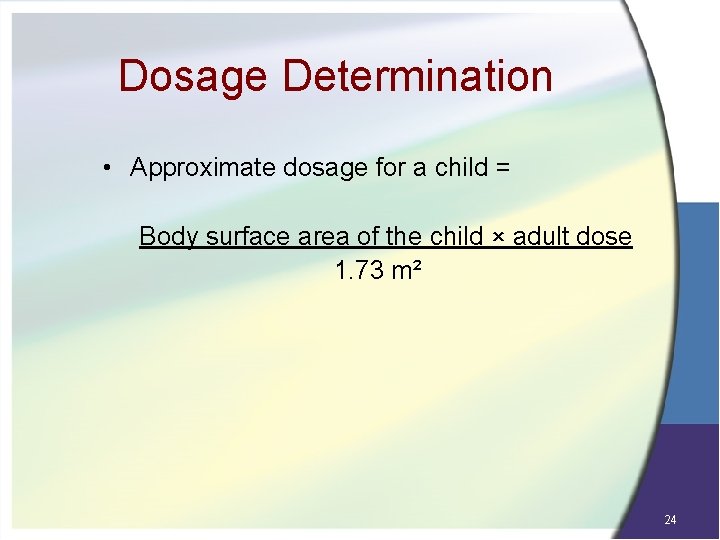
Dosage Determination • Approximate dosage for a child = Body surface area of the child × adult dose 1. 73 m² 24
Promoting Adherence Effective education is critical. The following issues should be addressed: • • • Administration timing and dose Administration route and technique Treatment duration Drug storage Nature and time course of desired responses • Nature and time course of adverse responses 25
- Slides: 25