
Drug regulation and quality assurance WHO normative functions
- Slides: 36
Drug regulation and quality assurance: WHO normative functions in the field of pharmaceuticals Technical Briefing Seminar 19 September 2006 Sabine Kopp, Ph. D Quality Assurance and Safety: Medicines Department of Medicines Policy and Standards TBS 2005
Main points addressed n n TBS 2006 2 WHO role and function WHO standard setting process WHO international guidelines, standards and norms in the area of quality assurance WHO's operational strategies
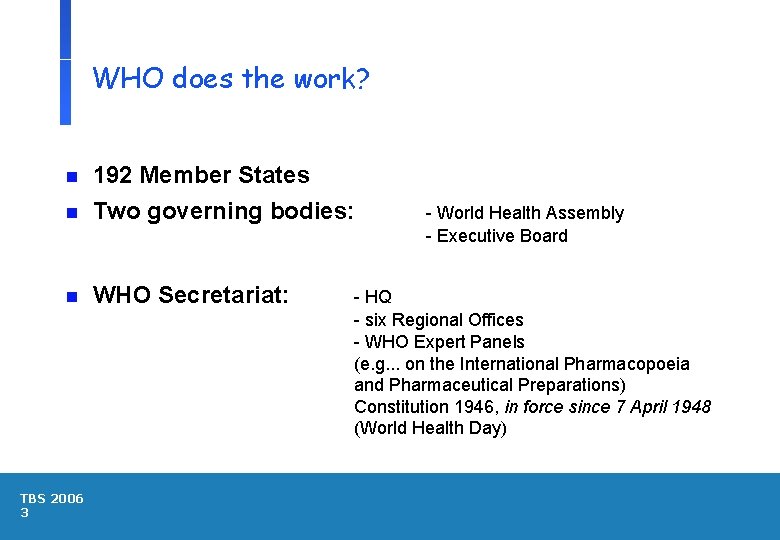
WHO does the work? n 192 Member States Two governing bodies: n WHO Secretariat: n TBS 2006 3 - World Health Assembly - Executive Board - HQ - six Regional Offices - WHO Expert Panels (e. g. . . on the International Pharmacopoeia and Pharmaceutical Preparations) Constitution 1946, in force since 7 April 1948 (World Health Day)
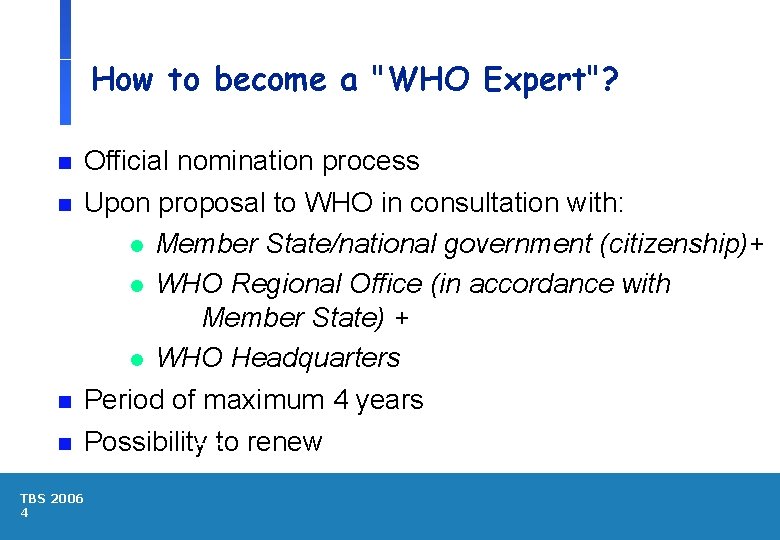
How to become a "WHO Expert"? n Official nomination process n Upon proposal to WHO in consultation with: l Member State/national government (citizenship)+ l WHO Regional Office (in accordance with Member State) + l WHO Headquarters Period of maximum 4 years Possibility to renew n n TBS 2006 4
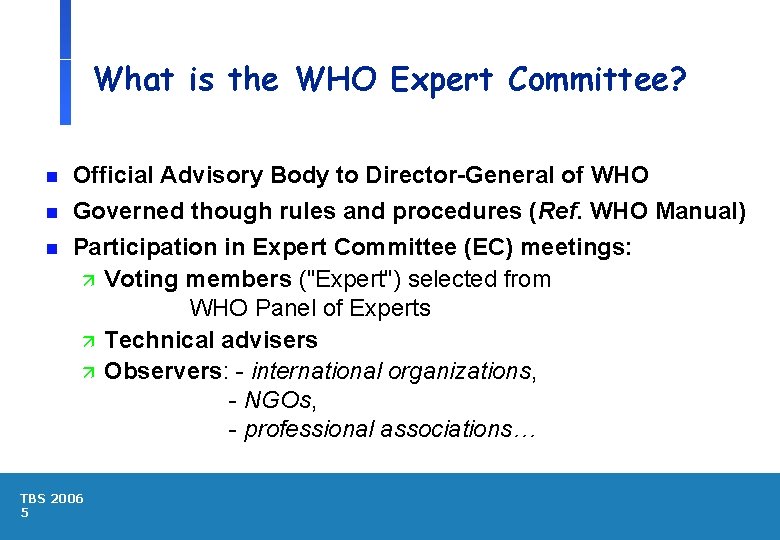
What is the WHO Expert Committee? n n n Official Advisory Body to Director-General of WHO Governed though rules and procedures (Ref. WHO Manual) Participation in Expert Committee (EC) meetings: ä Voting members ("Expert") selected from WHO Panel of Experts ä Technical advisers ä Observers: - international organizations, - NGOs, - professional associations… TBS 2006 5
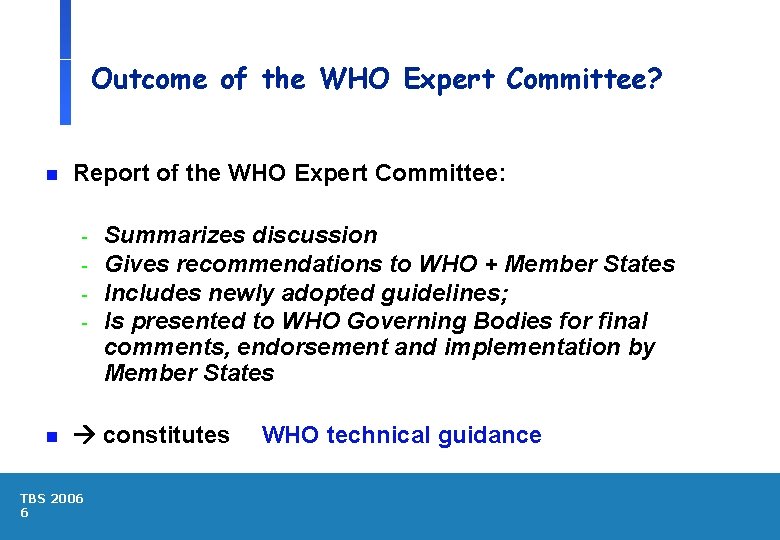
Outcome of the WHO Expert Committee? n Report of the WHO Expert Committee: - n Summarizes discussion Gives recommendations to WHO + Member States Includes newly adopted guidelines; Is presented to WHO Governing Bodies for final comments, endorsement and implementation by Member States constitutes TBS 2006 6 WHO technical guidance
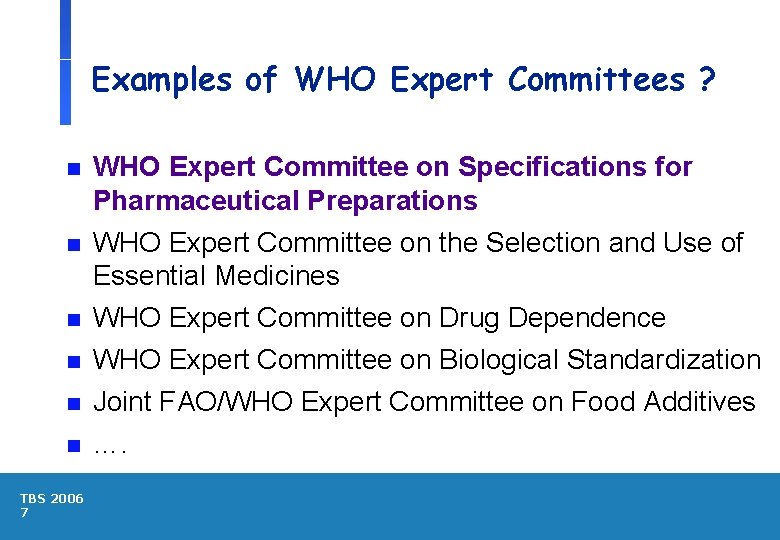
Examples of WHO Expert Committees ? n WHO Expert Committee on Specifications for Pharmaceutical Preparations n WHO Expert Committee on the Selection and Use of Essential Medicines WHO Expert Committee on Drug Dependence WHO Expert Committee on Biological Standardization n n TBS 2006 7 Joint FAO/WHO Expert Committee on Food Additives ….
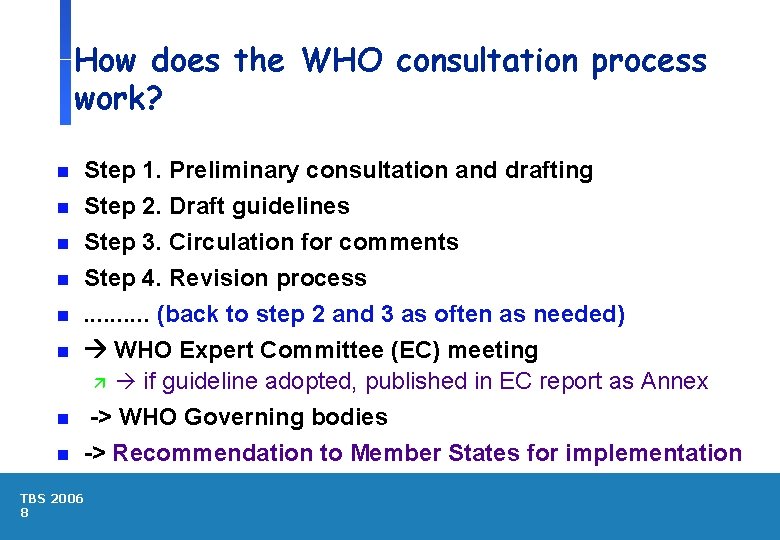
How does the WHO consultation process work? n n n n TBS 2006 8 Step 1. Preliminary consultation and drafting Step 2. Draft guidelines Step 3. Circulation for comments Step 4. Revision process. . (back to step 2 and 3 as often as needed) WHO Expert Committee (EC) meeting ä if guideline adopted, published in EC report as Annex -> WHO Governing bodies -> Recommendation to Member States for implementation
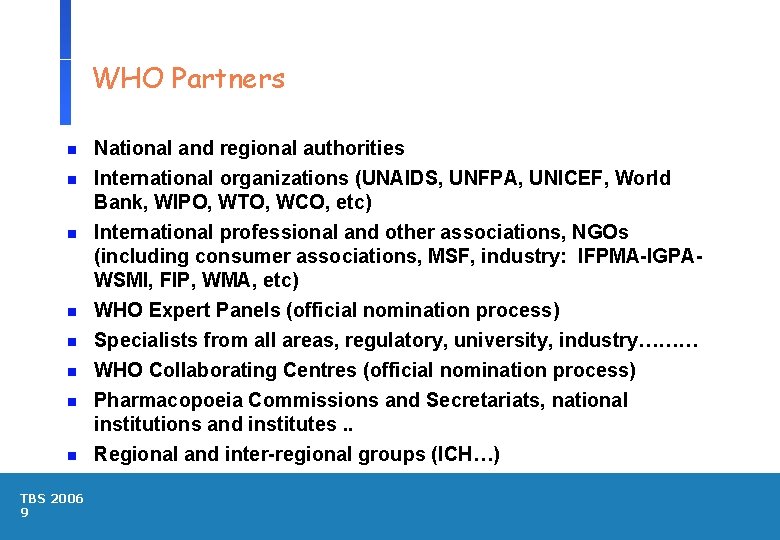
WHO Partners n n n n TBS 2006 9 National and regional authorities International organizations (UNAIDS, UNFPA, UNICEF, World Bank, WIPO, WTO, WCO, etc) International professional and other associations, NGOs (including consumer associations, MSF, industry: IFPMA-IGPAWSMI, FIP, WMA, etc) WHO Expert Panels (official nomination process) Specialists from all areas, regulatory, university, industry……… WHO Collaborating Centres (official nomination process) Pharmacopoeia Commissions and Secretariats, national institutions and institutes. . Regional and inter-regional groups (ICH…)
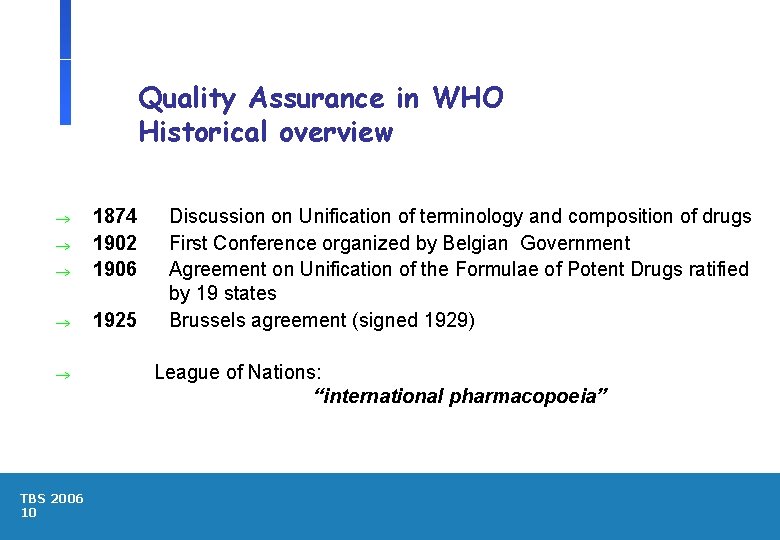
Quality Assurance in WHO Historical overview ® 1874 1902 1906 ® 1925 ® ® ® TBS 2006 10 Discussion on Unification of terminology and composition of drugs First Conference organized by Belgian Government Agreement on Unification of the Formulae of Potent Drugs ratified by 19 states Brussels agreement (signed 1929) League of Nations: “international pharmacopoeia”
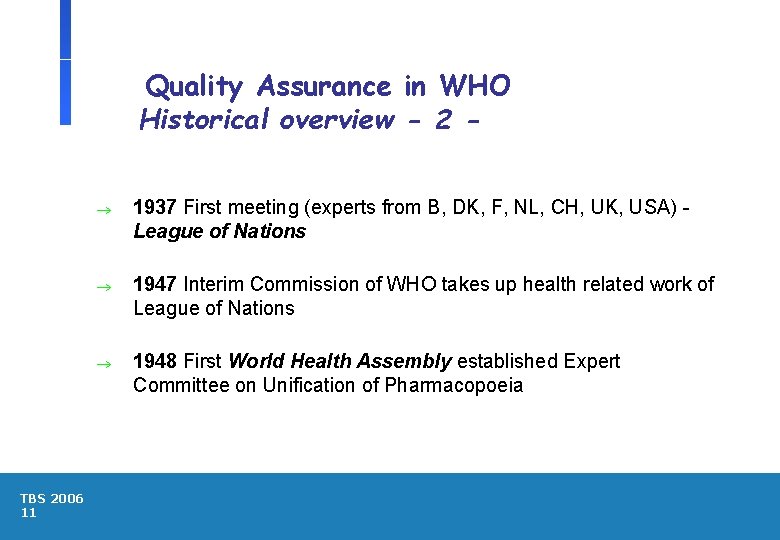
Quality Assurance in WHO Historical overview - 2 - TBS 2006 11 ® 1937 First meeting (experts from B, DK, F, NL, CH, UK, USA) League of Nations ® 1947 Interim Commission of WHO takes up health related work of League of Nations ® 1948 First World Health Assembly established Expert Committee on Unification of Pharmacopoeia
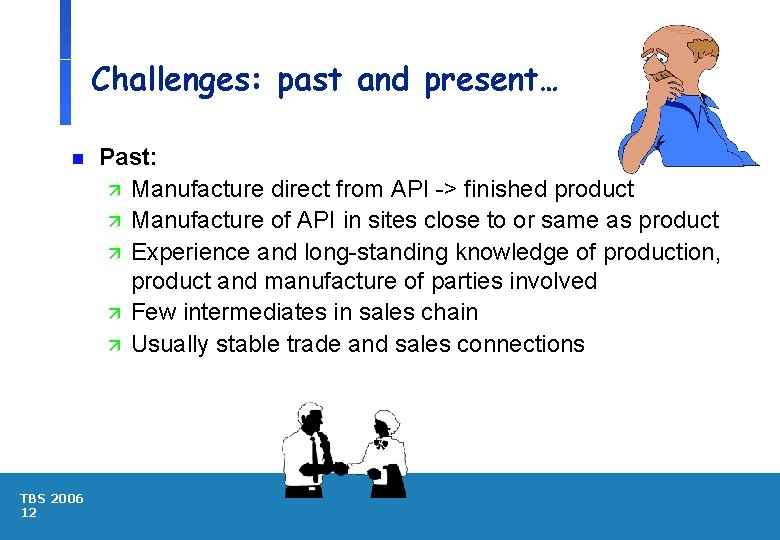
Challenges: past and present… n TBS 2006 12 Past: ä Manufacture direct from API -> finished product ä Manufacture of API in sites close to or same as product ä Experience and long-standing knowledge of production, product and manufacture of parties involved ä Few intermediates in sales chain ä Usually stable trade and sales connections
Challenges: past and present… n TBS 2006 13 Present: ä Rationalization of drug production ä Contracting-out of many steps in manufacture ä Many intermediates in trade and sales chain ä Trade, shipping, long distances involved ä Increase of risks… ä Increase of requirements and documentation ä Increase of national control mechanisms
Global challenges … n National vs international requirements Number of requirements n Application and interpretation of requirements n Import vs export control on national level Quality assurance systems applied Knowledge of product by parties involved in manufacture n n Cross-border promotion and sale n Free trade zones TBS 2006 14
Global challenges… n Number of national and international inspections by same party Number of inspections in same site by different parties Applicability of new technologies in different settings Contracts, agreements, eg Mutual Recognition Agreements Risks of mistakes, accidents, human errors etc n Counterfeit drugs n …. . . n n TBS 2006 15
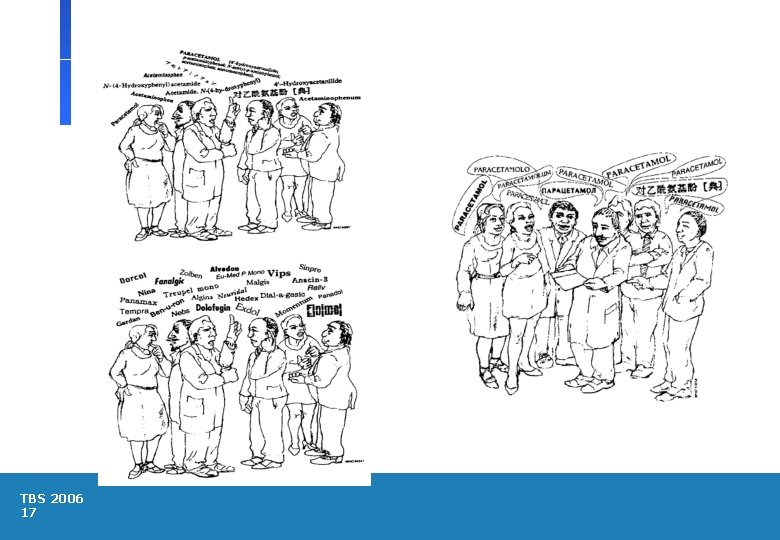
WHO’s global guidelines and strategies n n n TBS 2006 16 Requirements for drug registration and model legislation Networking among and with regulatory authorities International alerts Counterfeit network Global norms and standards and nomenclature (INN) …. .
INNs TBS 2006 17
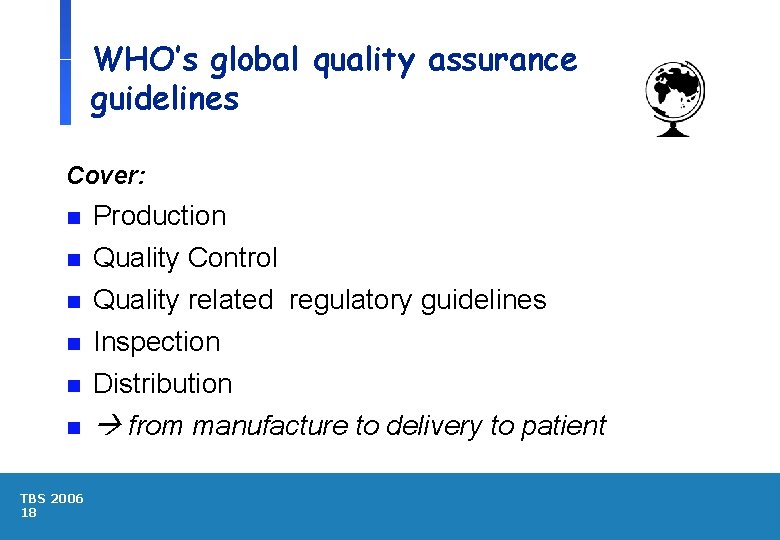
WHO’s global quality assurance guidelines Cover: n Production n Quality Control n Quality related regulatory guidelines Inspection Distribution from manufacture to delivery to patient n n n TBS 2006 18
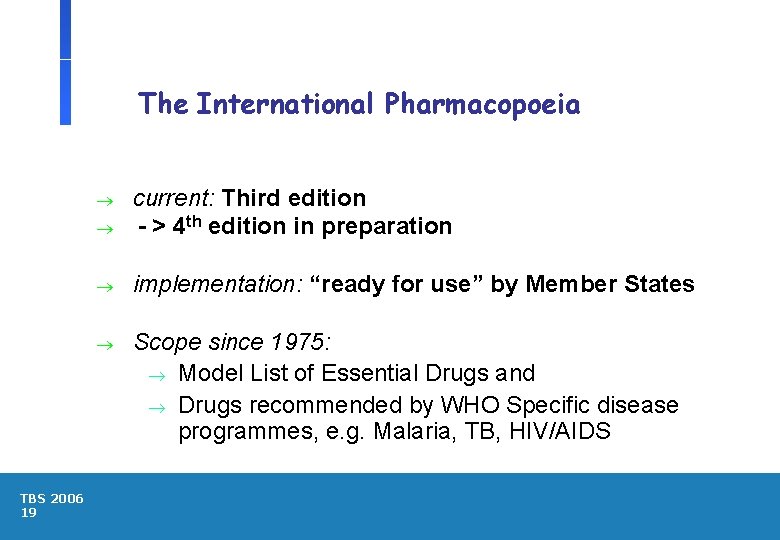
The International Pharmacopoeia ® current: Third edition - > 4 th edition in preparation ® implementation: “ready for use” by Member States ® Scope since 1975: ® Model List of Essential Drugs and ® Drugs recommended by WHO Specific disease programmes, e. g. Malaria, TB, HIV/AIDS ® TBS 2006 19
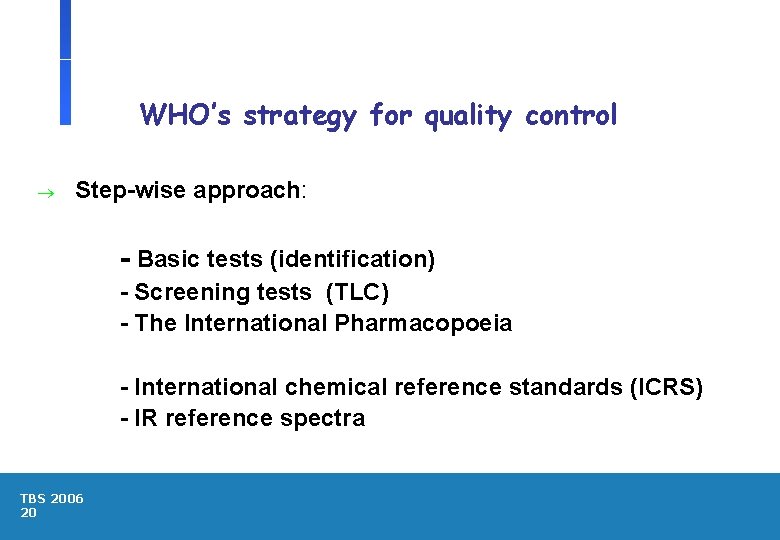
WHO’s strategy for quality control ® Step-wise approach: l l l TBS 2006 20 - Basic tests (identification) - Screening tests (TLC) - The International Pharmacopoeia - International chemical reference standards (ICRS) - IR reference spectra
Links to other partners and programmes ® Establishment of specifications for antiretrovirals, HIV/AIDS medicines l l l TBS 2006 21 - Collaboration with other pharmacopoeias, including PDG, Ph. Eur. , USP, JP, IP, Ch. Ph - Collaboration with manufacturers - Collaboration with suppliers (also agencies) for HIV drugs
WHO’s global guidelines - quality control - ä ä TBS 2006 22 International specifications (Int. Ph. , screening tests. . ) WHO Model Certificate of Analysis (COA) Considerations for requesting analysis of samples Quality control laboratories: v Good practices for national control labs v List of equipment v External qc assessment scheme for labs
External Quality Assessment Scheme for National Drug Quality Control Laboratories ® Capacity building ® Third phase Series of 5 tests 42 participating laboratories, including WHO Collaborating Centres In all 6 WHO regions ® ® ® TBS 2006 23
WHO’s global guidelines - distribution v WHO Certification Scheme for Products Moving in International Commerce v SMACS new scheme for pharmaceutical starting materials: - model certificate, when inspected by national authority v - WHO model for self-assessment for manufacture of pharmaceutical starting materials n Good Distribution and Trading Practices for pharmaceutical starting materials (GTDP) Good Distribution Practices (GDP) (for products) n Good Storage Practices (GSP) n TBS 2006 24
WHO’s global guidelines - production n Good Manufacturing Practices (GMP) …. . 1. Main principles for pharmaceutical products n 2. … for starting materials, including n ä ä n 3. … for specific pharmaceutical products: ä ä ä TBS 2006 25 active pharmaceutical ingredients pharmaceutical excipients Sterile pharmaceutical products Biological products Investigational pharmaceutical products for clinical trials in humans Herbal medicines Radiopharmaceuticals
WHO’s global guidelines - production (2) n New additional GMP texts (adopted in 2004+2005): n 1. Main principles for pharmaceutical products +++ ä ä n requirement for the sampling of starting materials (amendment) water for pharmaceutical use heating, ventilation and air-conditioning (HVAC) systems Validation 3. … for specific pharmaceutical products: +++ ä Herbal medicines (revised) TBS 2006 26
WHO’s global guidelines - inspection n Inspection of…. . n pharmaceutical manufacturers ä drug distribution channels (products) Guidelines for pre-approval inspection Quality systems requirements for national GMP inspectorates ä n n n TBS 2006 27 Model GMP certificate Model report for inspections
WHO’s global guidelines and strategies risk analysis n TBS 2006 28 Application of risk analysis to production of pharmaceuticals (adopted in 2001)
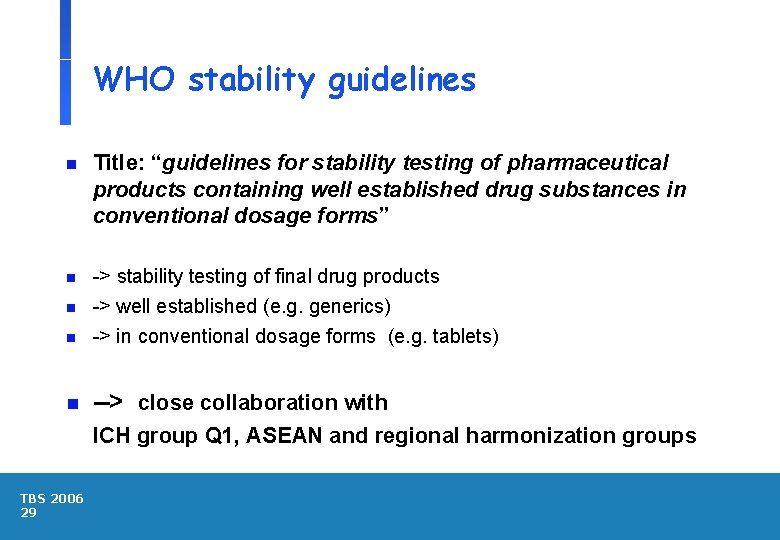
WHO stability guidelines n Title: “guidelines for stability testing of pharmaceutical products containing well established drug substances in conventional dosage forms” n n -> stability testing of final drug products -> well established (e. g. generics) -> in conventional dosage forms (e. g. tablets) n --> close collaboration with n ICH group Q 1, ASEAN and regional harmonization groups TBS 2006 29
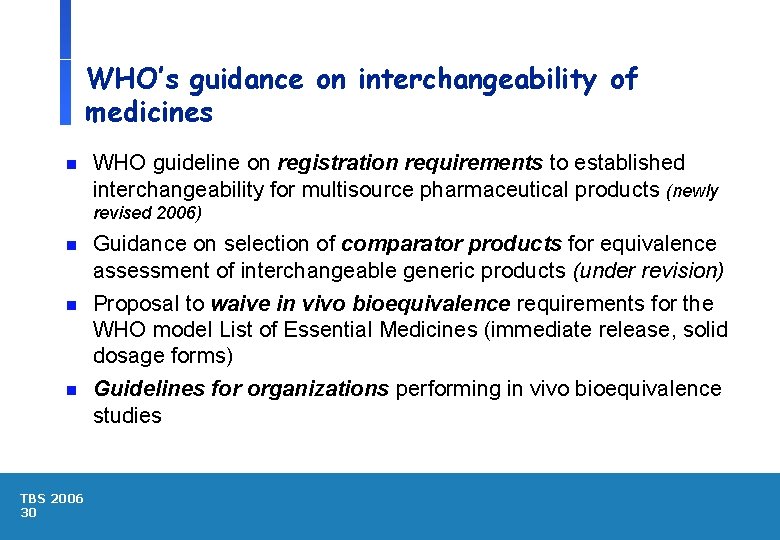
WHO’s guidance on interchangeability of medicines n WHO guideline on registration requirements to established interchangeability for multisource pharmaceutical products (newly revised 2006) n n n TBS 2006 30 Guidance on selection of comparator products for equivalence assessment of interchangeable generic products (under revision) Proposal to waive in vivo bioequivalence requirements for the WHO model List of Essential Medicines (immediate release, solid dosage forms) Guidelines for organizations performing in vivo bioequivalence studies
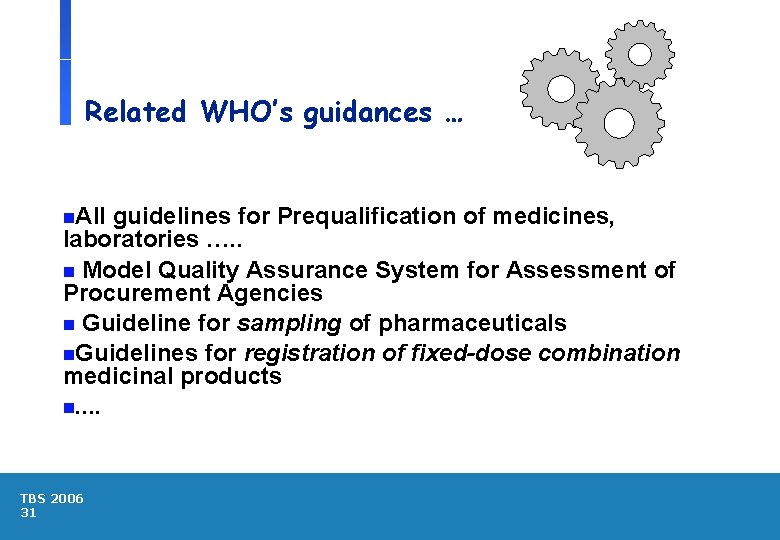
Related WHO’s guidances … n. All guidelines for Prequalification of medicines, laboratories …. . n Model Quality Assurance System for Assessment of Procurement Agencies n Guideline for sampling of pharmaceuticals n. Guidelines for registration of fixed-dose combination medicinal products n. . TBS 2006 31
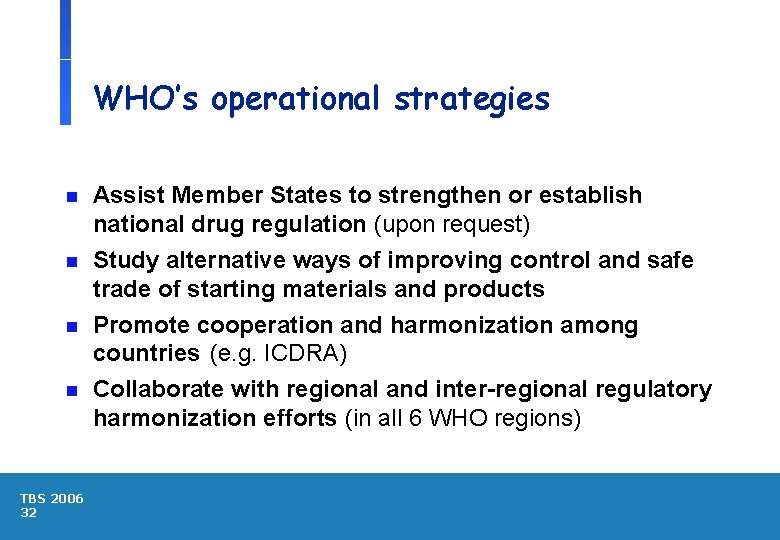
WHO’s operational strategies n n TBS 2006 32 Assist Member States to strengthen or establish national drug regulation (upon request) Study alternative ways of improving control and safe trade of starting materials and products Promote cooperation and harmonization among countries (e. g. ICDRA) Collaborate with regional and inter-regional regulatory harmonization efforts (in all 6 WHO regions)
WHO’s operational strategies -2 v v v TBS 2006 33 Work with interested parties and countries to combat counterfeit and substandard drugs (IMPACT) Assistance in establishing and evaluation of national and regional quality control laboratories Training of drug regulatory staff (e. g. in registration of HIV/AIDS medicines) Development of “how to” manuals and tools Responding to national and international requests in area of quality assurance for medicines (e. g. for Global Fund)
WHO efforts aim to improve access to quality medicines n n TBS 2006 34 Provide standards and norms in area of quality assurance of medicines Pre-qualification project for UN procurement Provide assistance in regulatory area Promote logical order of actions: ä Priority setting (ABC first … ) ä Capacity building ä Collaboration and co-operation
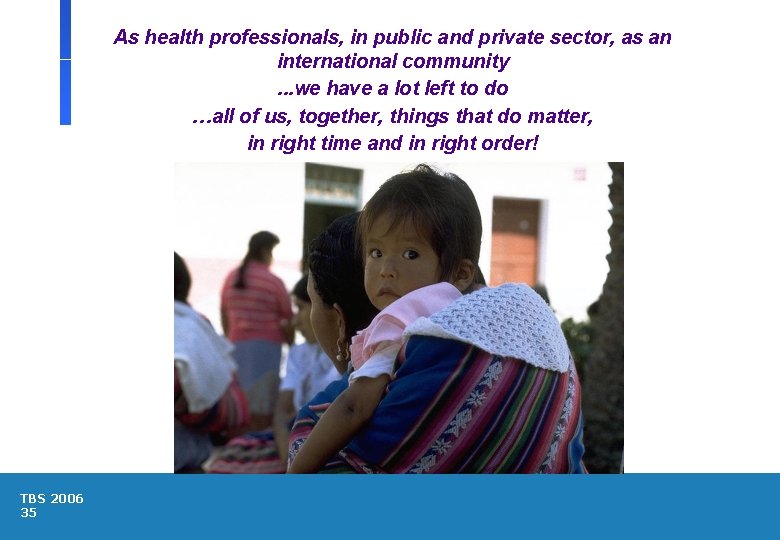
As health professionals, in public and private sector, as an international community. . . we have a lot left to do …all of us, together, things that do matter, in right time and in right order! TBS 2006 35
WHO Medicines Quality Assurance website: http: //www. who. int/medicines/areas/quality_safety/quality_assurance