
Drug Prescribing in Pregnancy and Lactation Dr Saed
Drug Prescribing in Pregnancy and Lactation Dr. Saed M. Aldalaen Mut’ah University, Jordan, 20018
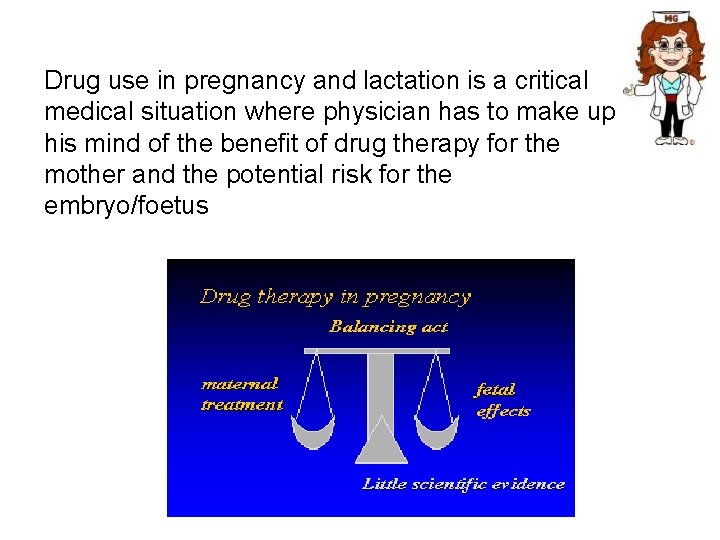
Drug use in pregnancy and lactation is a critical medical situation where physician has to make up his mind of the benefit of drug therapy for the mother and the potential risk for the embryo/foetus
Maternal pharmacokinetic change in pregnancy: l. Absorption: l l Decreased gastrointestinal motility and tone (probably from increased progesterone production), and HCL formation in the stomach. So, delay absorption of drugs in the small intestine. Peripheral vasodilatation, so increase absorption of drugs administrated parenterally l. Distribution: l l Increased plasma volume and body fluids Decreased plasma albumin, resulting in reduction in the available binding sites of drugs In conclusion, the net result of increased plasma volume and decreased plasma protein binding sites is unaltered free drug concentration for many (but not all) drugs
l Metabolism: l l Estradiol and progesterone levels are increased, these affect drugs biotransformation on hepatic enzymes. They induce metabolism of some drugs and inhibition of others. The biliary excretion of certain drugs is slowed due to estradiol induced cholestasis Elimination: l Renal blood flow and glomerular filtration rate are increased, so increase the elimination of drugs that normally are excreted easily
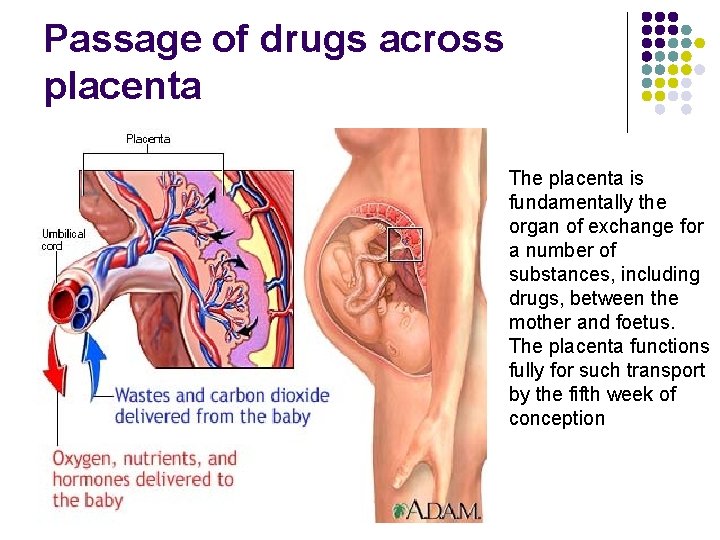
Passage of drugs across placenta The placenta is fundamentally the organ of exchange for a number of substances, including drugs, between the mother and foetus. The placenta functions fully for such transport by the fifth week of conception

Factors affecting placental drug transfer l l l Lipid solubility Size of the molecule Blood flow Protein binding Effect of ph Placental metabolism
l Lipid solubility: l Lipid soluble drugs diffuse readily and enter the fetal circulation, e. g. thiopental (cesarean section)
l Molecular size: l Molecular weight (M. W) influences rate of transfer and amount of drug transferred across placenta l Drugs with M. W of 250 -500 D cross easily l Drugs with M. W of 500 -1000 D cross with more difficulty l Those with M. W >1000 D not cross (e. g. : heparin, insulin)
l Blood flow: l l l Increased during gestation Placental rate of drugs transfer is determined by blood flow for most lipophylic compounds Changes in blood flow may occur as a result of pathophysiologic condition (e. g. maternal hypertension)
l Protein binding: l l Albumin concentration in maternal blood is low, so unbound drug concentration are higher during gestation, making more drug available to cross the placenta E. g. drugs highly protein bound are: propranolol, salycilate, diazepam
l Effect of p. H: l l l Fetal blood is more acid (p. H=7. 3) than maternal blood (p. H=7. 4) Weakly acidic and weakly basic drugs tend to rapidly diffuse across the placental membrane Highly ionized drugs e. g. succinylcholine and tubocurarine, cross placenta slowly, not significant concentrations in the fetus

l Placental metabolism: l Human placenta has the capacity to biotransformation many xenobiotics and endogenous substances, hence the nature of the compound reaching the foetal circulation

The timing of embryo/foetus exposure to drug determines its: l. Drugs can have harmful effects on the fetus at any time during pregnancy l l l During first trimester (T 1)drugs may produce congenital abnormalities (teratogenesis) The period of greatest risk is from 3 -12 th week During second and third trimesters (T 2, T 3) drugs may affect growth and functional development of the fetus (e. g. brain development) Teratogenic effects include: loss of pregnancy, structural abnormalities, growth impairment, functional loss and behavioural changes.
Some drugs associated with teratogenicity l (T 1): l l l Thalidomide: phocomelia Cytotoxic drugs: multiple congenital malformations Vitamin A derivates (isotretinoin): craniofacial defects Lithium: ebstein anomaly of tricuspid valve Steroids: cleft lip and or cleft palate Warfarin: skeletal abnormalities

Phocomelia
l T 2 and T 3: l l l l Tetracycline: tooth and bone defects Chloramphenicol: Grey baby syndrome, intra-uterine foetal death Aminoglycoside: ototoxicity Fluoroquinolone: interference with cartilage growth Phenytoin: craniofacial defect, mental deficiency warfarin: CNS malformations ACE inhibitors: irreversible renal damage Tobacco smoking: retarded fetal growth

Tetracycline-Induced Discoloration of Teeth
Selection of drugs during pregnancy l l Selecting drugs that have been used for the longest period with safety Whenever possible the selected drugs should be given in the lower end of the dosing range to minimize foetal drug exposure Pregnant women are discouraged from self medication and encouraged to consult their health care provide A commonly used source of information about drug safety in pregnancy is the classification of drugs according to the degree of their potential risk during pregnancy by the FDA:
l l l Category A: controlled studies in animals and pregnancy women have not shown risk of foetal abnormalities Category B: animal studies have not shown risk but there no controlled studies in pregnancy women (e. g. paracetamol, β-lactams, erythromycins, α-methyldopa, NSAIDs) Category C: animal studies may have shown risk but studies in pregnancy women have not done (anti-psychotics, tricyclic anti-depressants, H 1 antihistamines, most cardiac medicines, laxatives, steroids, metronidazole) Category D: positive evidence of some human risk, but benefit may outweigh risk in some circumstances (e. g. anti-epileptics, alcohol, BDZs, lithium, warfarin, ACE inhibitors, tetracyclines, chloramphenicol, aminoglycosides) Category X: highly teratogenic. Too dangerous for prescribing (e. g. cytotoxic drugs, vitamin A analogues, thalidomide)
Drugs Used During Lactation l l l The route of maternal drug administration, dose, Pk, the type of medication, etc…, have influence on breast milk drug concentration A drug taken 30 -60 minutes after breast feeding, and 3 -4 hours before next feeding, reduced the amount of drug in baby blood The baby’s age and maturity level, the frequency and volume of feeding (the baby who is nursing once or twice a day, will receive less of a drug than the baby who is totally breastfed and may nurse 10 -12 times a day)
l l l In deciding which drug to be prescribed, physician should always look at the situation from a risk/benefit perspective The benefits of breastfeeding are well know and undisputed, so doctors should recommend a mother wean only when there is scientific documentation that a drug will be harmful to her infant If a drug that is contraindicated with lactation has to be used, and there is no available alternatives, the nursing mother should use an electric pump to maintain her milk supply during the period of weaning
Factors affecting drug breastfeeding transfer l l l Medication enters the breast mainly via passive diffusion or sometimes via active transport. The passage of drugs to milk is directly proportional to the maternal plasma concentration The p. H of breast milk is slightly more acid (p. H=7. 2) than plasma (p. H=7. 4), therefore, basic drugs are more un-ionizable (more lipid soluble) in blood than in milk Lipophilic drugs that pass to breast milk get more ionized farction ( due to higher acidity of milk) and trapped in milk
l Drugs which are more lipophilic tends to concentrate in the hind-milk than in the foremilk which has less lipid content. l l Note: Hind-milk is released in the last few minutes of nursing, fore-milk is released from beginning until the last few minutes of the nursing Plasma ratio indicates the drug passage into brest milk from the maternal plasma. The ratio 1 indicates that the concentration in milk is the same as that in plasma
Some drugs Should be Avoided During Lactation Drug Effect Aspirin Reye’s syndrome Chloramphenicol Bone marrow suppression Cancer chemotherapy (cytotoxic drugs) Radioactive iodine anti-cancer activity, damage normal tissue Thyroid suppression Tetracycline Permanent discoloration of teeth (yellow)
General guidelines for taking drugs while nursing l l l Only take a medication if it is really needed Consider alternative, non-drug therapy if possible If there is a choice, delay starting the drug until the baby is older (a drug which might cause problems for a newborn may be fine for an older, large, more mature infant) Use the lowest possible dose for the shortest possible time Schedule the doses so that the lowest amount gets into the milk (take it soon after a feeding, preferably a night feeding, rather then right before nursing) Watch for baby’s reactions such as sleepiness, rashes, diarrhoea, colic, etc.
- Slides: 25