
Drug Penetration into the Genital Tract Implications for






- Slides: 82
Drug Penetration into the Genital Tract: Implications for Sexual Transmission Dr Steve Taylor, FRCP, Ph. D Consultant Physician Sexual Health HIV Medicine Lead Consultant HIV Service Directorate of Infection
Disclaimer: Dr Taylor has received educational and/or travel grants, speaker engagements and/or advisory meetings with the following pharmaceutical companies: Abbott, Boehringer, BMS, GSK, Gilead, Jansen, Merck, Roche, Vii. V,
ww. sexualhealthbirmingham. co. uk Presentations
Personalised Clinic Posters Available
Advocates required please
Genital Drug penetrations , does it matterrs. . . or what ? Yea , but no , but yea but, no but. . .
Definitely. . Maybe. . . • Does it matter on a population level • Probably not • Does it matter on an individual level ? • Maybe it does. . . • What do we know re the pharmacology of ARV’s in the male and female genital tract? • Explore some implications : • MICROBICIDES • PEPSE • PREP
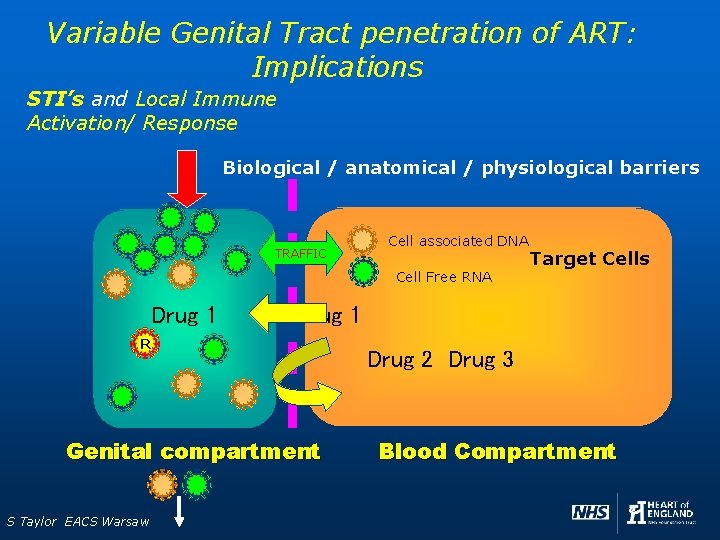
Variable Genital Tract penetration of ART: Implications STI’s and Local Immune Activation/ Response Biological / anatomical / physiological barriers TRAFFIC Cell associated DNA Cell Free RNA Drug 1 R Genital compartment S Taylor EACS Warsaw Target Cells Drug 2 Drug 3 Blood Compartment
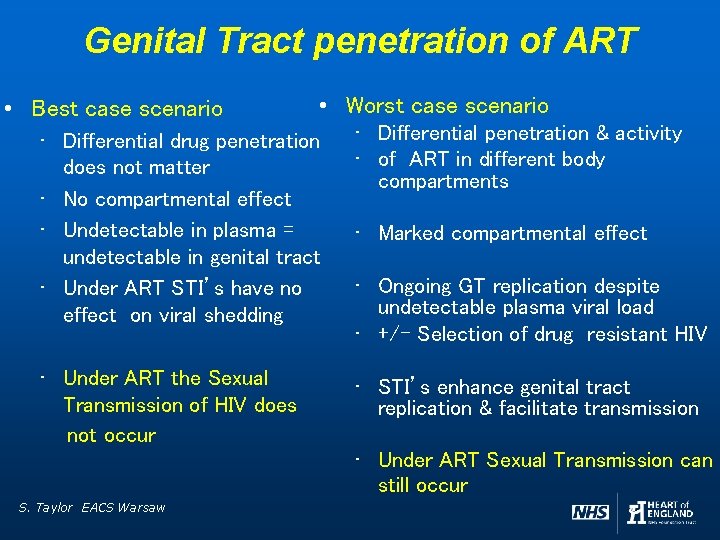
Genital Tract penetration of ART • Best case scenario • Worst case scenario • Differential drug penetration does not matter • No compartmental effect • Undetectable in plasma = undetectable in genital tract • Under ART STI’s have no effect on viral shedding • Differential penetration & activity • of ART in different body compartments • Under ART the Sexual Transmission of HIV does not occur • STI’s enhance genital tract replication & facilitate transmission • Marked compartmental effect • Ongoing GT replication despite undetectable plasma viral load • +/- Selection of drug resistant HIV • Under ART Sexual Transmission can still occur S. Taylor EACS Warsaw
There a lot of parallels with the brain and genital tract and the questions raised regarding drug penetration
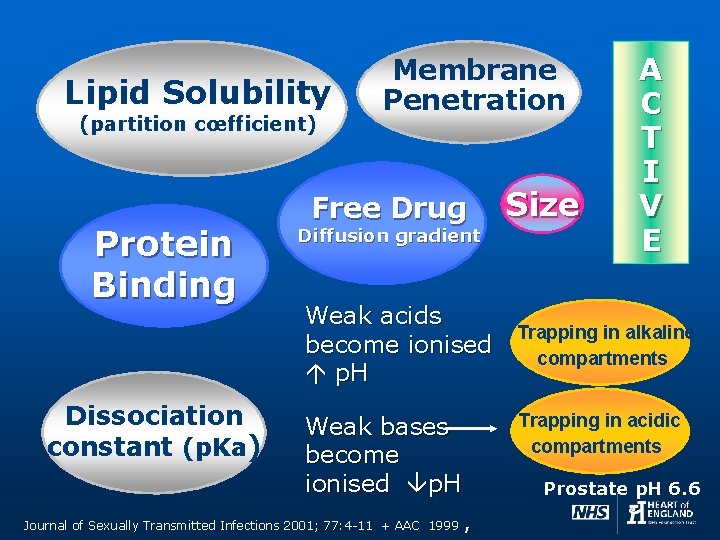
Lipid Solubility (partition cœfficient) Protein Binding Dissociation constant (p. Ka) Membrane Penetration Free Drug Diffusion gradient Size A C T I V E Weak acids Trapping in alkaline become ionised compartments p. H Weak bases become ionised p. H Journal of Sexually Transmitted Infections 2001; 77: 4 -11 + AAC 1999 , Trapping in acidic compartments Prostate p. H 6. 6
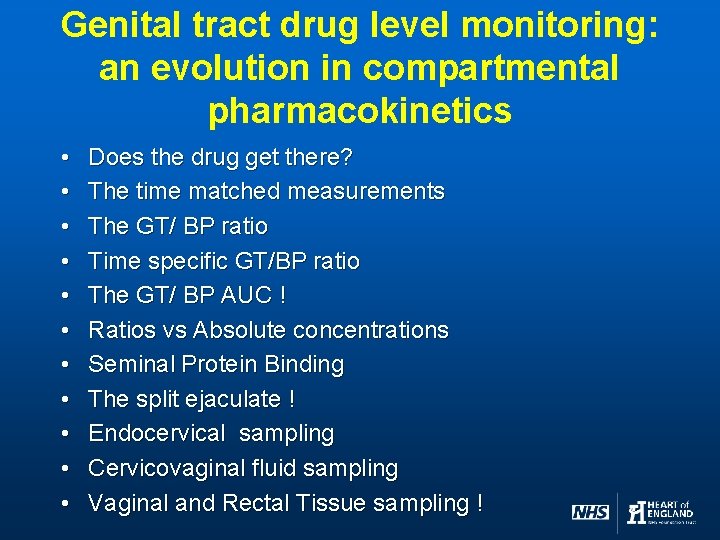
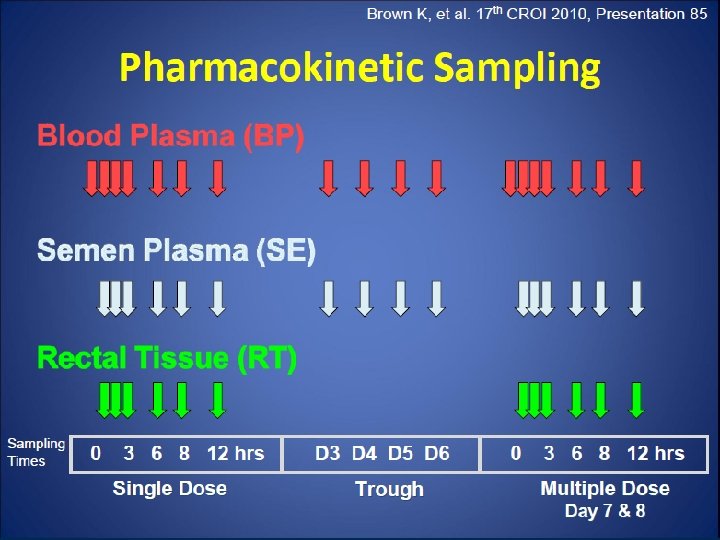
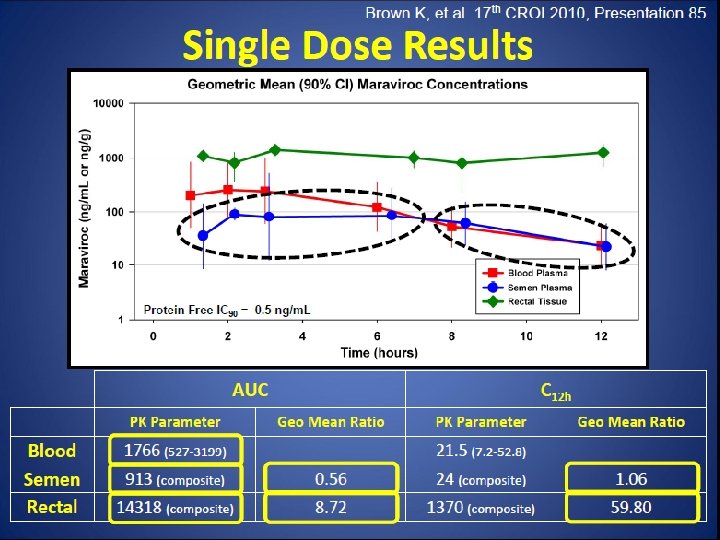
Genital tract drug level monitoring: an evolution in compartmental pharmacokinetics • • • Does the drug get there? The time matched measurements The GT/ BP ratio Time specific GT/BP ratio The GT/ BP AUC ! Ratios vs Absolute concentrations Seminal Protein Binding The split ejaculate ! Endocervical sampling Cervicovaginal fluid sampling Vaginal and Rectal Tissue sampling !
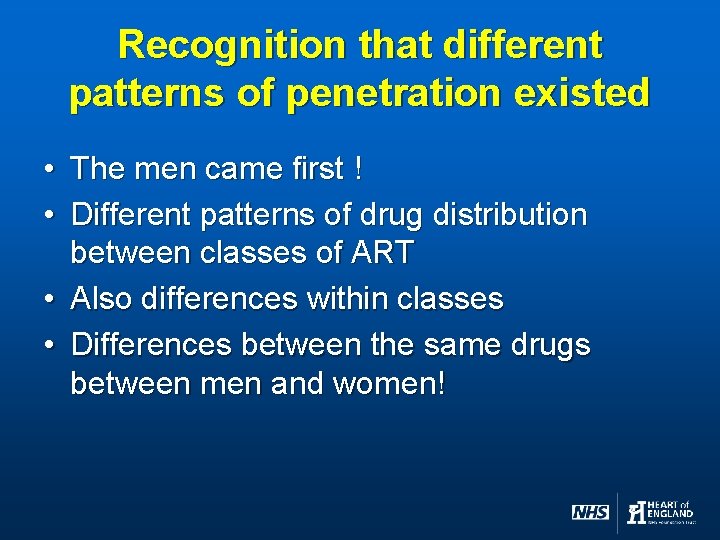
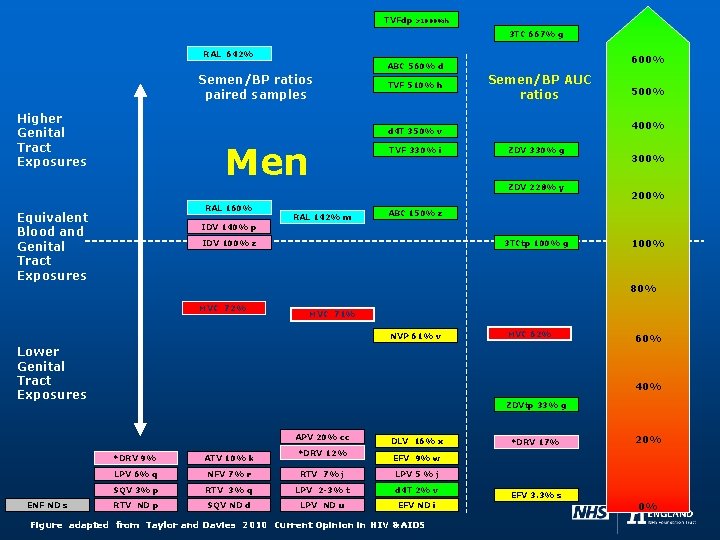
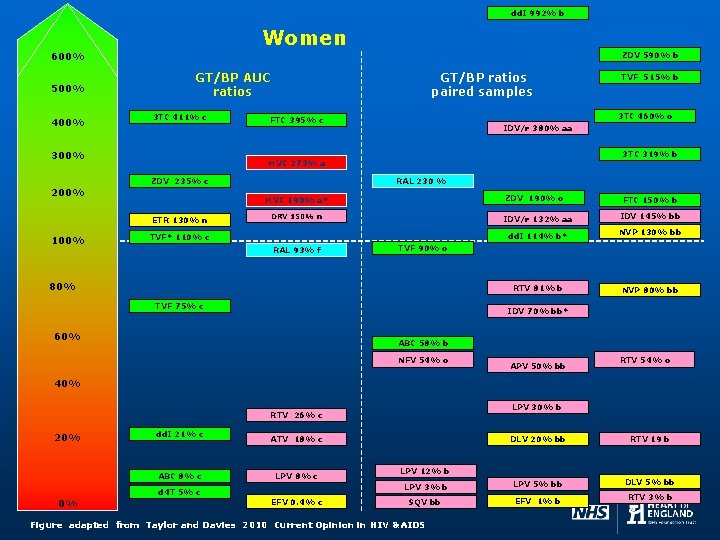
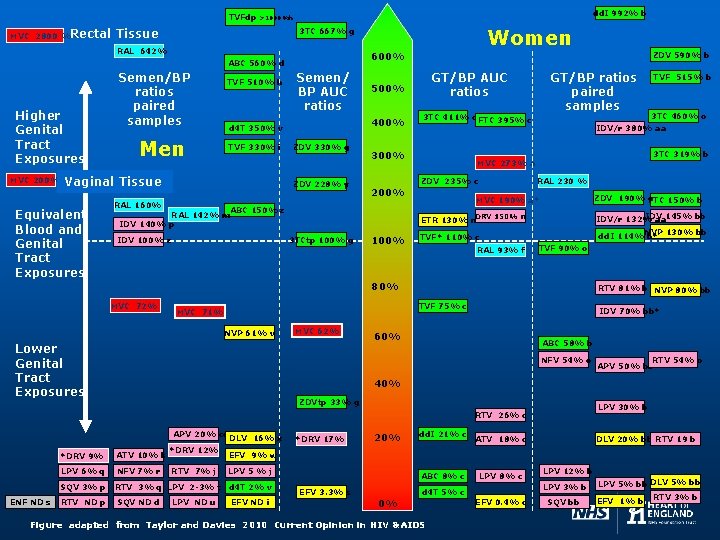
Recognition that different patterns of penetration existed • The men came first ! • Different patterns of drug distribution between classes of ART • Also differences within classes • Differences between the same drugs between men and women!
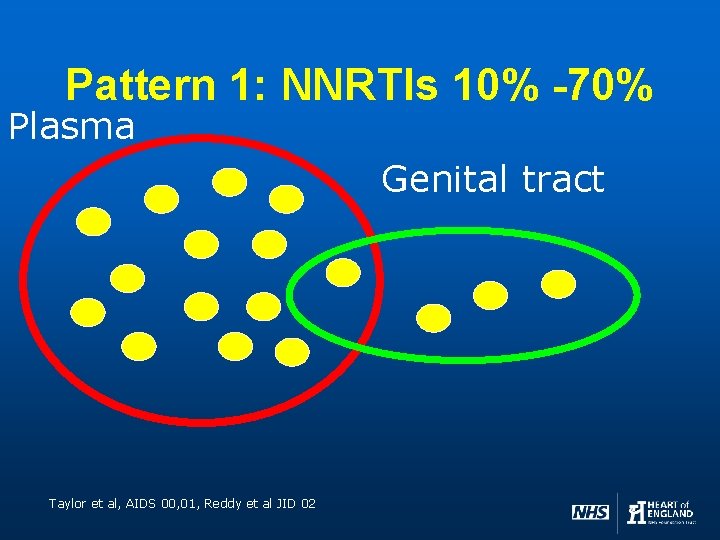
Pattern 1: NNRTIs 10% -70% Plasma Genital tract Taylor et al, AIDS 00, 01, Reddy et al JID 02
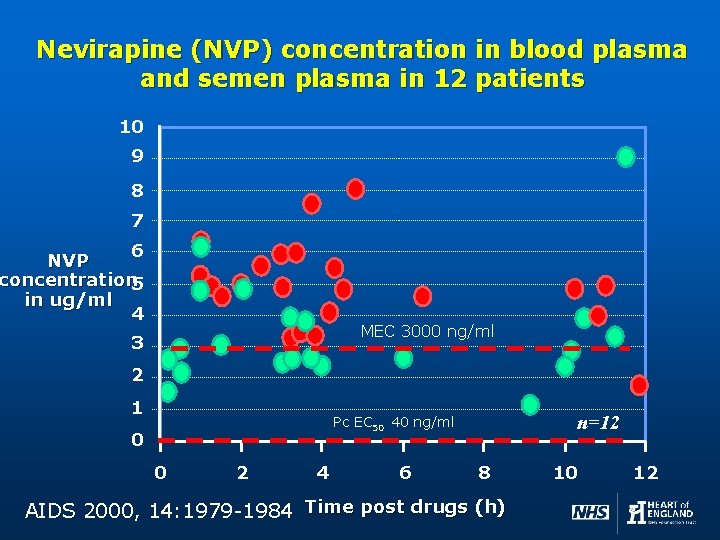
Nevirapine (NVP) concentration in blood plasma and semen plasma in 12 patients 10 9 8 7 6 NVP concentration 5 in ug/ml 4 MEC 3000 ng/ml 3 2 1 n=12 Pc EC 50 40 ng/ml 0 0 2 4 6 8 AIDS 2000, 14: 1979 -1984 Time post drugs (h) 10 12
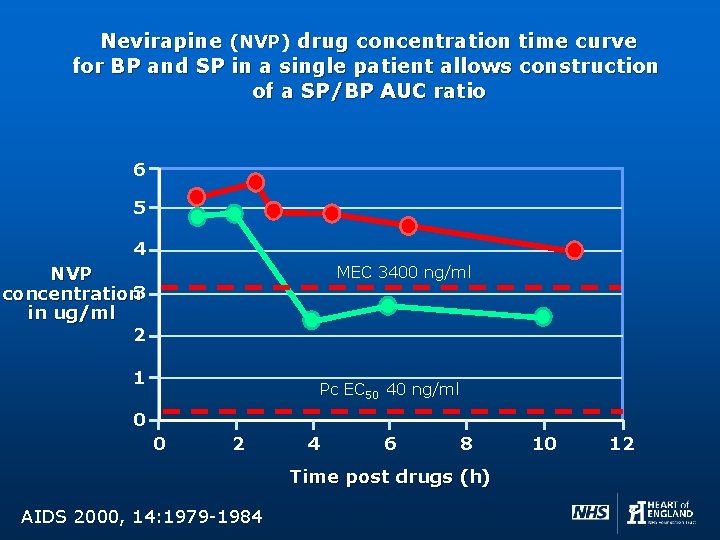
Nevirapine (NVP) drug concentration time curve for BP and SP in a single patient allows construction of a SP/BP AUC ratio 6 5 4 MEC 3400 ng/ml NVP concentration 3 in ug/ml 2 1 Pc EC 50 40 ng/ml 0 0 2 4 6 8 Time post drugs (h) AIDS 2000, 14: 1979 -1984 10 12
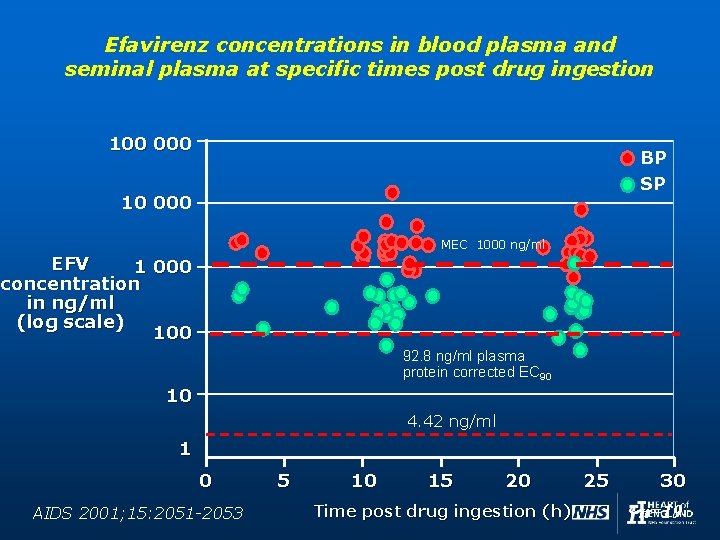
Efavirenz concentrations in blood plasma and seminal plasma at specific times post drug ingestion 100 000 BP SP 10 000 MEC 1000 ng/ml EFV 1 000 concentration in ng/ml (log scale) 100 92. 8 ng/ml plasma protein corrected EC 90 10 4. 42 ng/ml 1 0 AIDS 2001; 15: 2051 -2053 5 10 15 20 Time post drug ingestion (h) 25 30 n=19
The Masturbatorium at Birmingham Heartlands
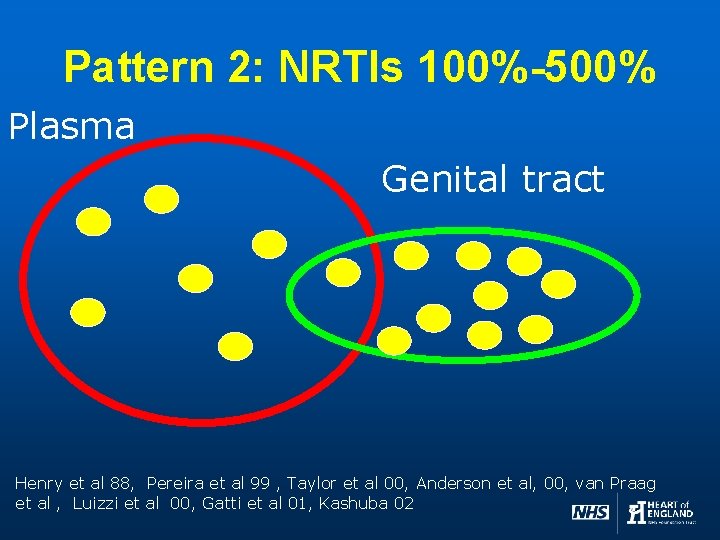
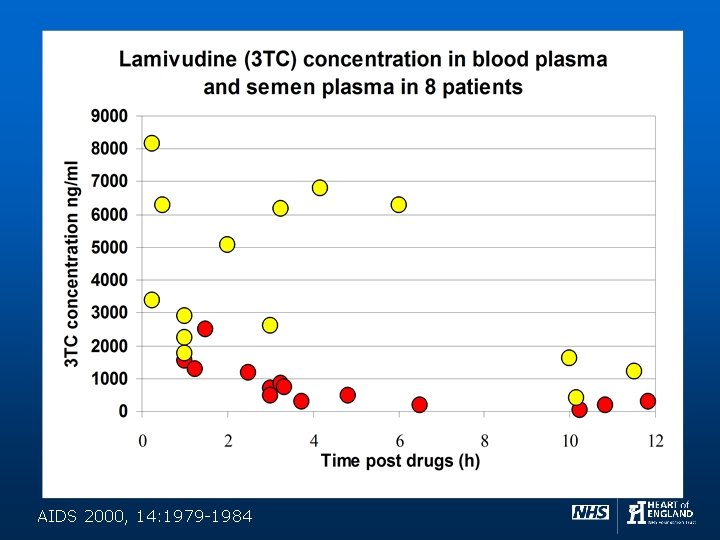
Pattern 2: NRTIs 100%-500% Plasma Genital tract Henry et al 88, Pereira et al 99 , Taylor et al 00, Anderson et al, 00, van Praag et al , Luizzi et al 00, Gatti et al 01, Kashuba 02
AIDS 2000, 14: 1979 -1984
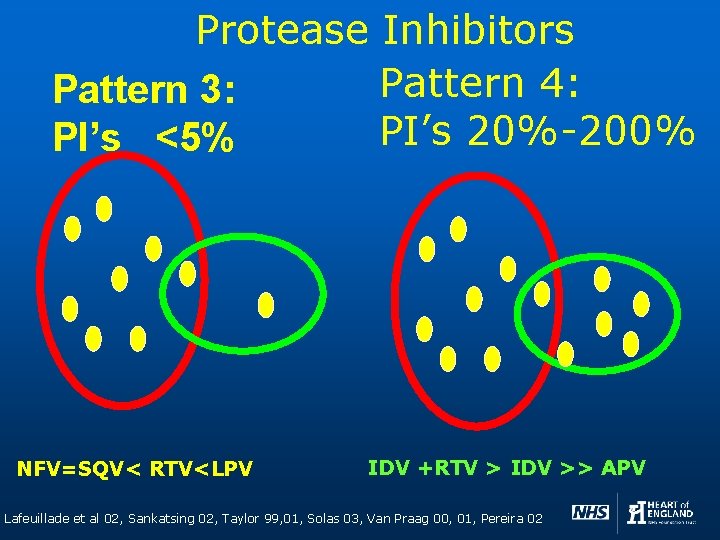
Protease Inhibitors Pattern 4: Pattern 3: PI’s 20%-200% PI’s <5% NFV=SQV< RTV<LPV IDV +RTV > IDV >> APV Lafeuillade et al 02, Sankatsing 02, Taylor 99, 01, Solas 03, Van Praag 00, 01, Pereira 02
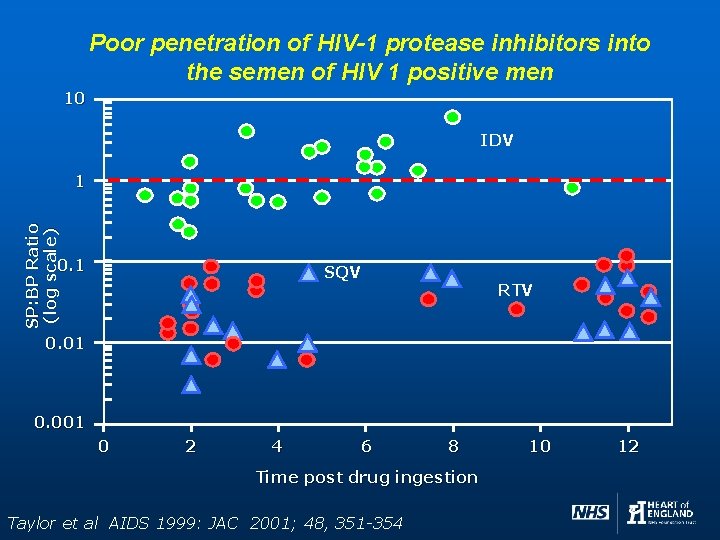
Poor penetration of HIV-1 protease inhibitors into the semen of HIV 1 positive men 10 IDV SP: BP Ratio (log scale) 1 0. 1 SQV RTV 0. 01 0. 001 0 2 4 6 8 Time post drug ingestion Taylor et al AIDS 1999: JAC 2001; 48, 351 -354 10 12
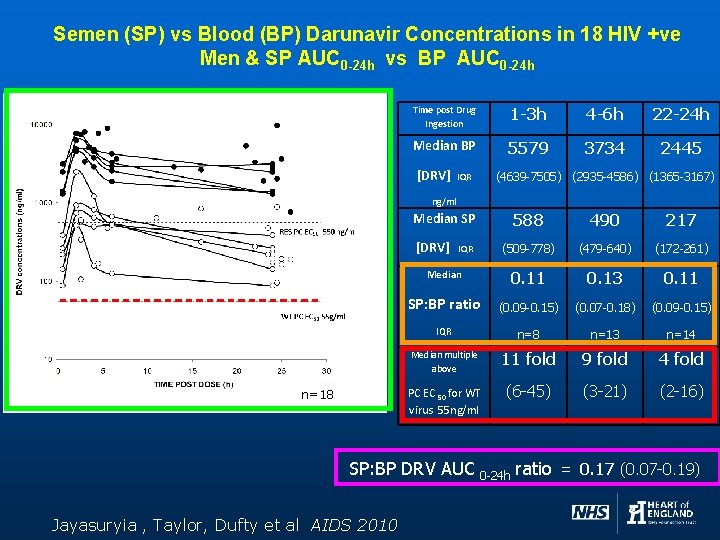
Semen (SP) vs Blood (BP) Darunavir Concentrations in 18 HIV +ve Men & SP AUC 0 -24 h vs BP AUC 0 -24 h Time post Drug Ingestion 1 -3 h 4 -6 h 22 -24 h Median BP 5579 3734 2445 [DRV] (4639 -7505) (2935 -4586) (1365 -3167) IQR ng/ml Median SP 588 490 217 (509 -778) (479 -640) (172 -261) Median 0. 11 0. 13 0. 11 SP: BP ratio (0. 09 -0. 15) (0. 07 -0. 18) (0. 09 -0. 15) IQR n=8 n=13 n=14 Median multiple above 11 fold 9 fold 4 fold PC EC 50 for WT virus 55 ng/ml (6 -45) (3 -21) (2 -16) [DRV] n=18 IQR SP: BP DRV AUC Jayasuryia , Taylor, Dufty et al AIDS 2010 0 -24 h ratio = 0. 17 (0. 07 -0. 19)
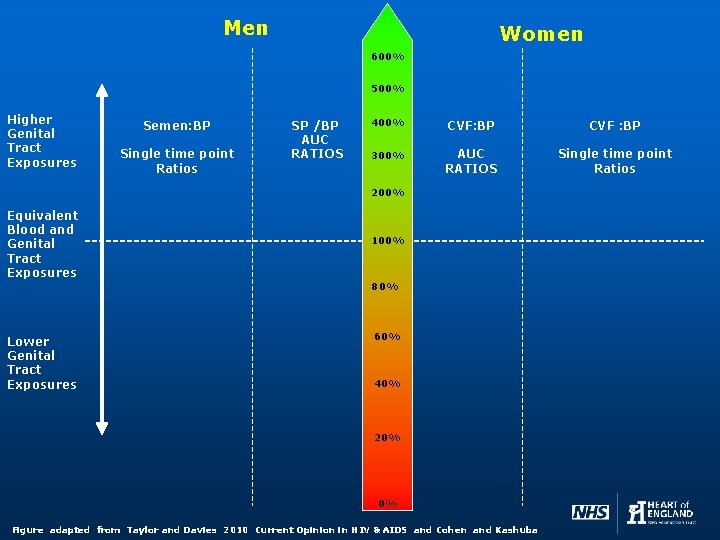
Men Women 600% 500% Higher Genital Tract Exposures Semen: BP Single time point Ratios SP /BP AUC RATIOS 400% CVF: BP CVF : BP 300% AUC RATIOS Single time point Ratios 200% Equivalent Blood and Genital Tract Exposures Lower Genital Tract Exposures 100% 80% 60% 40% 20% 0% Figure adapted from Taylor and Davies 2010 Current Opinion in HIV &AIDS and Cohen and Kashuba
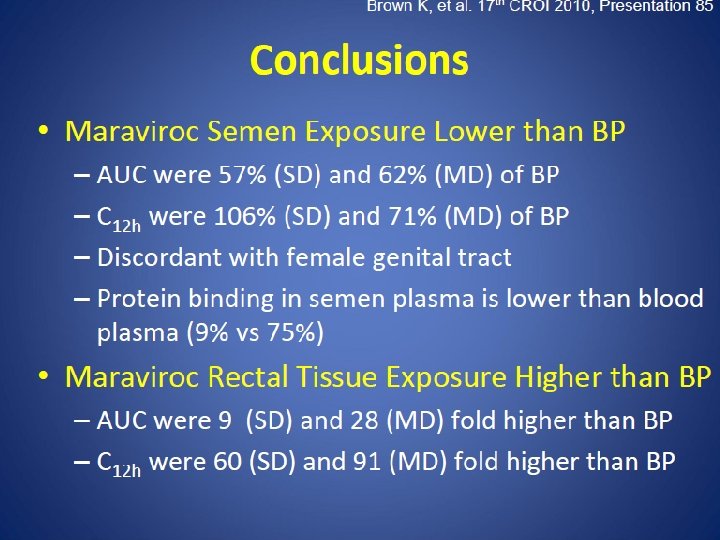
TVFdp >1000%h 3 TC 667% g RAL 642% 600% ABC 560% d Semen/BP ratios paired samples Higher Genital Tract Exposures TVF 510% h Semen/BP AUC ratios 400% d 4 T 350% v Men TVF 330% i Equivalent Blood and Genital Tract Exposures IDV 140% p ZDV 330% g ZDV 228% y RAL 160% RAL 142% m 500% 300% 200% ABC 150% z IDV 100% z 3 TCtp 100% g 100% 80% MVC 72% MVC 71% NVP 61% v Lower Genital Tract Exposures 60% 40% ZDVtp 33% g APV 20% cc ENF ND s MVC 62% *DRV 12% DLV 16% x *DRV 9% ATV 10% k LPV 6% q NFV 7% r RTV 7% j LPV 5 % j SQV 3% p RTV 3% q LPV 2 -3% t d 4 T 2% v RTV ND p SQV ND d LPV ND u EFV ND i *DRV 17% 20% EFV 9% w Figure adapted from Taylor and Davies 2010 Current Opinion in HIV &AIDS EFV 3. 3% s 0%
dd. I 992% b Women ZDV 590% b 600% 500% 400% GT/BP AUC ratios 3 TC 411% c 300% GT/BP ratios paired samples IDV/r 380% aa 3 TC 319% b RAL 230 % ZDV 235% c ZDV 190% o MVC 190% a* ETR 130% n 100% 3 TC 460% o FTC 395% c MVC 273% a 200% TVF 515% b DRV 150% n TVF* 110% c RAL 93% f FTC 150% b IDV/r 132% aa IDV 145% bb dd. I 114% b* NVP 130% bb RTV 81% b NVP 80% bb TVF 90% o 80% TVF 75% c IDV 70% bb* 60% ABC 58% b NFV 54% o APV 50% bb RTV 54% o 40% LPV 30% b RTV 26% c 20% dd. I 21% c ABC 8% c d 4 T 5% c 0% DLV 20% bb RTV 19 b LPV 3% b LPV 5% bb DLV 5% bb SQV bb EFV 1% b RTV 3% b ATV 18% c LPV 8% c EFV 0. 4% c LPV 12% b Figure adapted from Taylor and Davies 2010 Current Opinion in HIV &AIDS
TVFdp MVC 2800 %Rectal * dd. I 992% b >1000%h Tissue RAL 642% Semen/BP ratios paired samples Semen/ BP AUC ratios TVF 330% i Tissue ZDV 330% g ZDV 228% y GT/BP AUC ratios 500% 400% d 4 T 350% v Men MVC 200% *Vaginal Equivalent Blood and Genital Tract Exposures TVF 510% h ZDV 590% b 600% ABC 560% d Higher Genital Tract Exposures Women 3 TC 667% g 3 TCtp 100% g RAL 230 % ZDV 235% c MVC 190% a* ZDV 190% o FTC 150% b ETR 130% n DRV 150% n IDV/r 132% aa 145% bb TVF* 110% c dd. I 114%NVP b* 130% bb RAL 160% IDV 100% z 100% 3 TC 319% b MVC 273% a 200% RAL 93% f TVF 90% o 80% MVC 72% RTV 81% b NVP 80% bb TVF 75% c MVC 71% NVP 61% v Lower Genital Tract Exposures MVC 62% IDV 70% bb* 60% ABC 58% b NFV 54% o RTV 54% o APV 50% bb 40% ZDVtp 33% g LPV 30% b RTV 26% c APV 20% cc ENF ND s TVF 515% b 3 TC 460% o IDV/r 380% aa 3 TC 411% c FTC 395% c 300% ABC 150% z RAL 142% m IDV 140% p GT/BP ratios paired samples *DRV 12% DLV 16% x *DRV 9% ATV 10% k LPV 6% q NFV 7% r SQV 3% p RTV 3% q LPV 2 -3% t d 4 T 2% v RTV ND p SQV ND d RTV 7% j LPV ND u *DRV 17% 20% dd. I 21% c DLV 20% bb RTV 19 b ATV 18% c EFV 9% w LPV 5 % j EFV ND i ABC 8% c EFV 3. 3% s d 4 T 5% c 0% Figure adapted from Taylor and Davies 2010 Current Opinion in HIV &AIDS LPV 8% c LPV 12% b LPV 3% b EFV 0. 4% c SQV bb LPV 5% bb DLV 5% bb EFV 1% b RTV 3% b
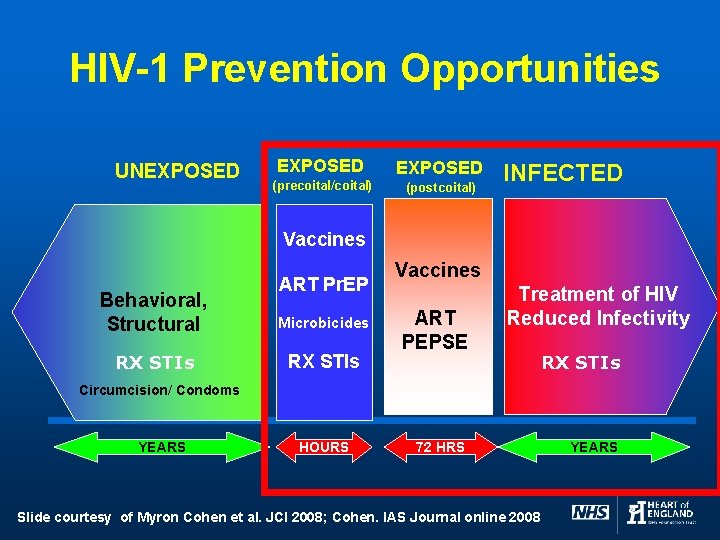
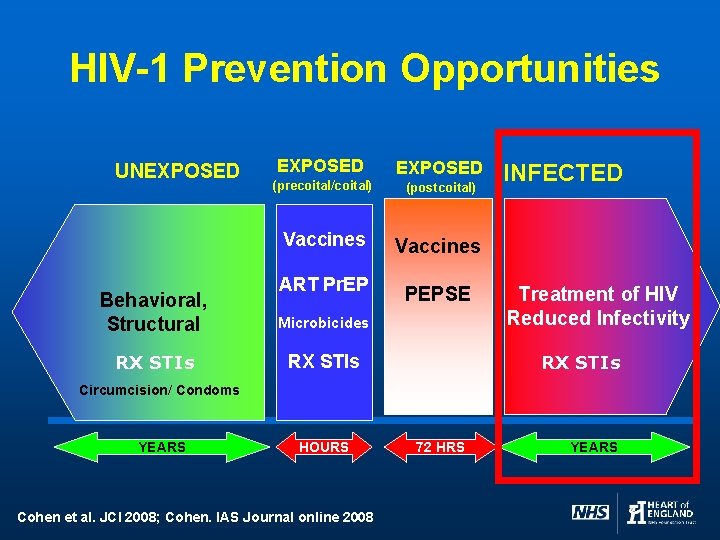
HIV-1 Prevention Opportunities UNEXPOSED (precoital/coital) (postcoital) INFECTED Vaccines ART Pr. EP Behavioral, Structural Microbicides RX STIs Vaccines ART PEPSE Treatment of HIV Reduced Infectivity RX STIs Circumcision/ Condoms YEARS HOURS 72 HRS Slide courtesy of Myron Cohen et al. JCI 2008; Cohen. IAS Journal online 2008 YEARS
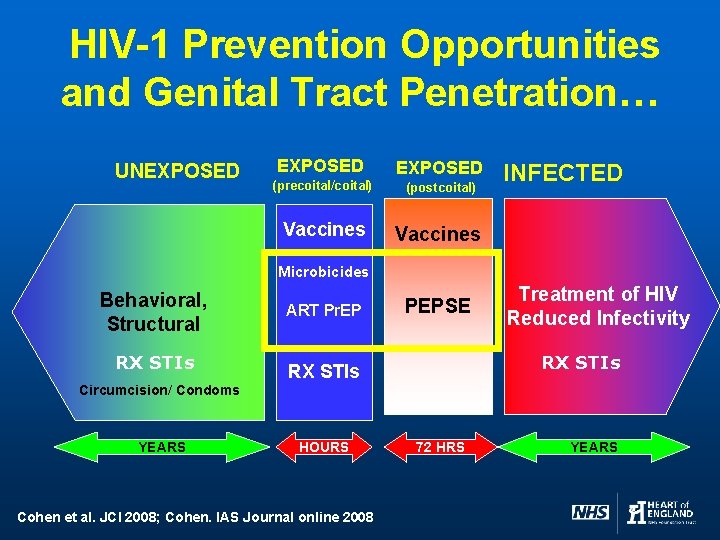
HIV-1 Prevention Opportunities and Genital Tract Penetration… UNEXPOSED (precoital/coital) (postcoital) Vaccines INFECTED Microbicides Behavioral, Structural RX STIs ART Pr. EP PEPSE Treatment of HIV Reduced Infectivity RX STIs Circumcision/ Condoms YEARS HOURS Cohen et al. JCI 2008; Cohen. IAS Journal online 2008 72 HRS YEARS
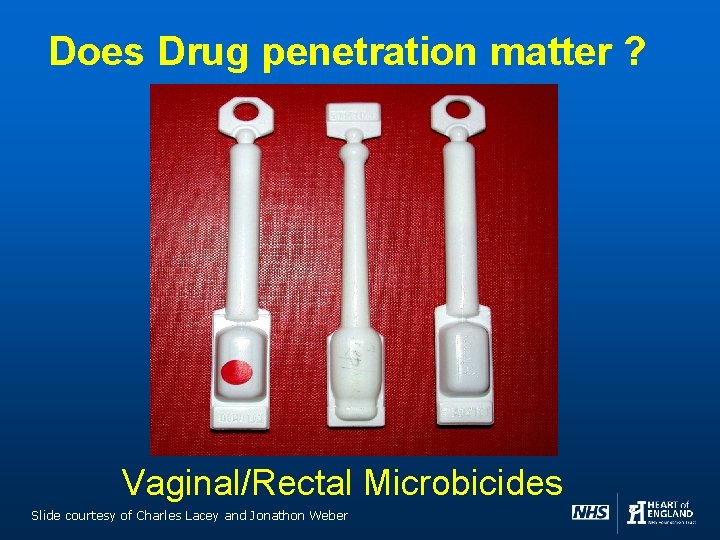
Does Drug penetration matter ? Single use microbicides Vaginal/Rectal Microbicides Slide courtesy of Charles Lacey and Jonathon Weber
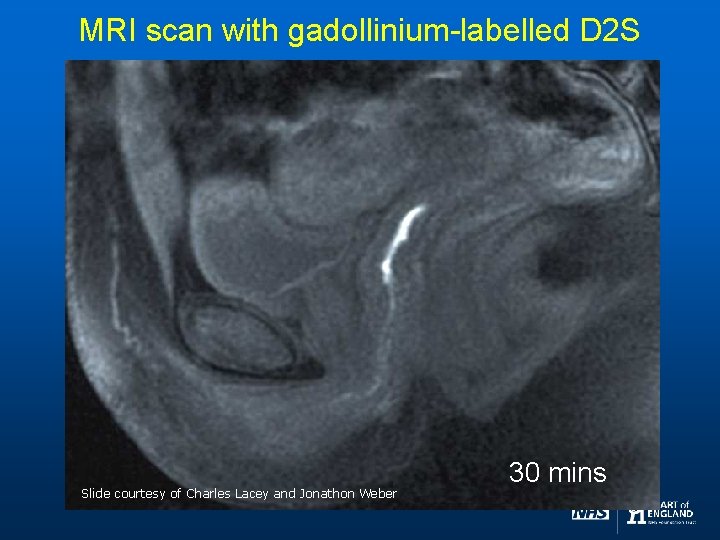
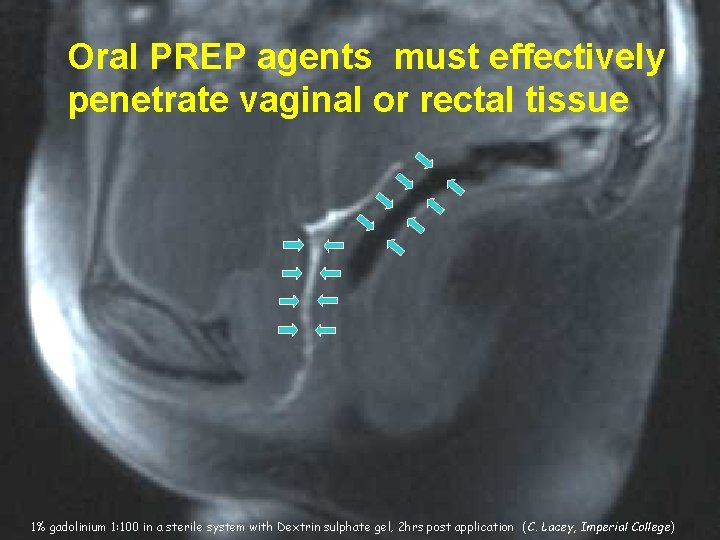
MRI scan with gadollinium-labelled D 2 S Slide courtesy of Charles Lacey and Jonathon Weber 30 mins
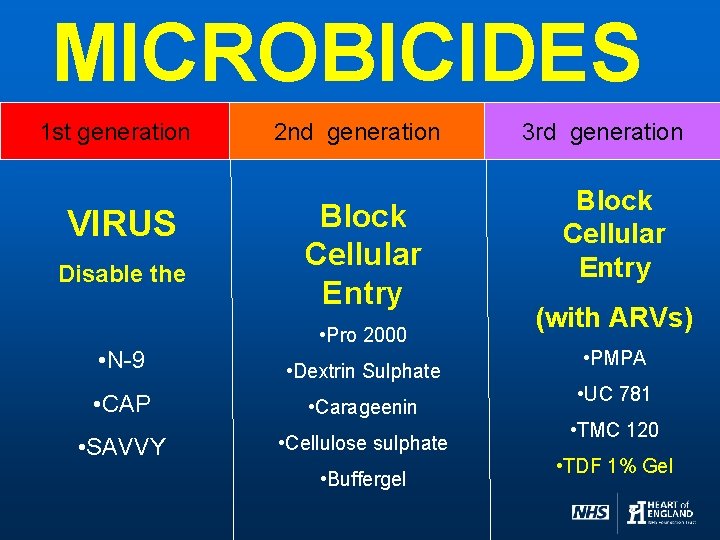
MICROBICIDES 1 st generation VIRUS Disable the 2 nd generation Block Cellular Entry • Pro 2000 • N-9 • Dextrin Sulphate • CAP • Carageenin • SAVVY • Cellulose sulphate • Buffergel Post-entry 3 rd generation Block Cellular Entry (with ARVs) • PMPA • UC 781 • TMC 120 • TDF 1% Gel
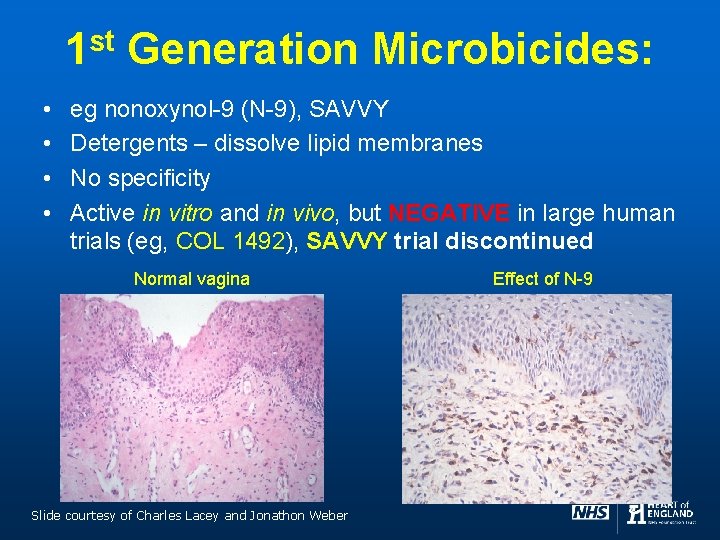
st 1 • • Generation Microbicides: eg nonoxynol-9 (N-9), SAVVY Detergents – dissolve lipid membranes No specificity Active in vitro and in vivo, but NEGATIVE in large human trials (eg, COL 1492), SAVVY trial discontinued Normal vagina Slide courtesy of Charles Lacey and Jonathon Weber Effect of N-9
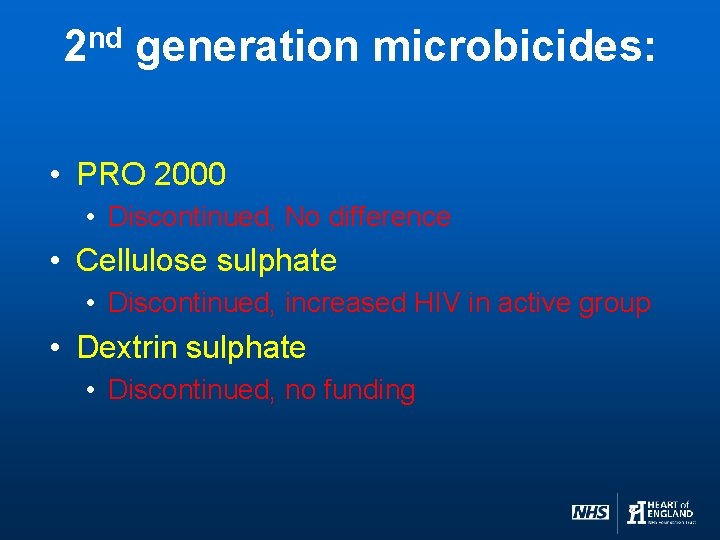
2 nd generation microbicides: • PRO 2000 • Discontinued, No difference • Cellulose sulphate • Discontinued, increased HIV in active group • Dextrin sulphate • Discontinued, no funding
CAPRISA 004: 1% Tenofovir Microbicide Gel for Prevention of HIV in Women • Randomized, placebo-controlled, double-blind, proof-of-concept study conducted at 2 sites in South Africa HIV-uninfected women, at high risk of HIV, ≥ 2 vaginal sex acts within 30 days of screening (N = 889)* 1% Tenofovir Gel† (n = 445) Placebo Gel† (n = 444) Abdool Karim Q, et al. Science DOI: 10. 1126/science. 1193748. Abdool Karim Q, et al. AIDS 2010. Abstract TUSS 0202. Study continued until 92 HIV infections observed
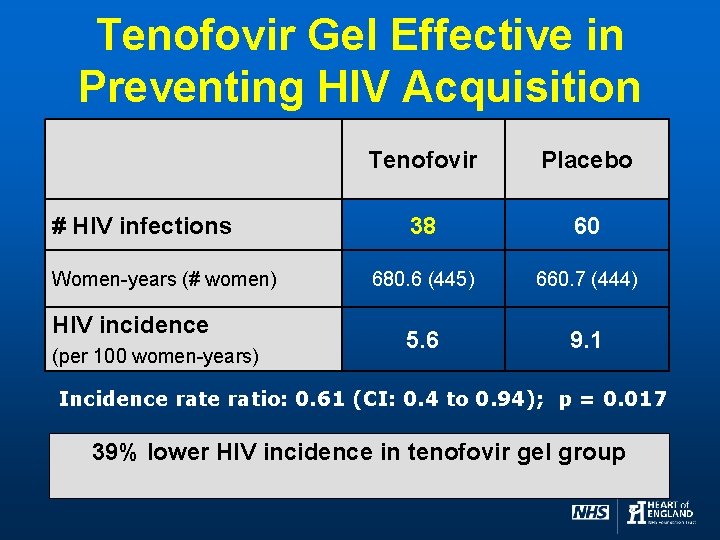
Tenofovir Gel Effective in Preventing HIV Acquisition # HIV infections Women-years (# women) HIV incidence (per 100 women-years) Tenofovir Placebo 38 60 680. 6 (445) 660. 7 (444) 5. 6 9. 1 Incidence ratio: 0. 61 (CI: 0. 4 to 0. 94); p = 0. 017 39% lower HIV incidence in tenofovir gel group
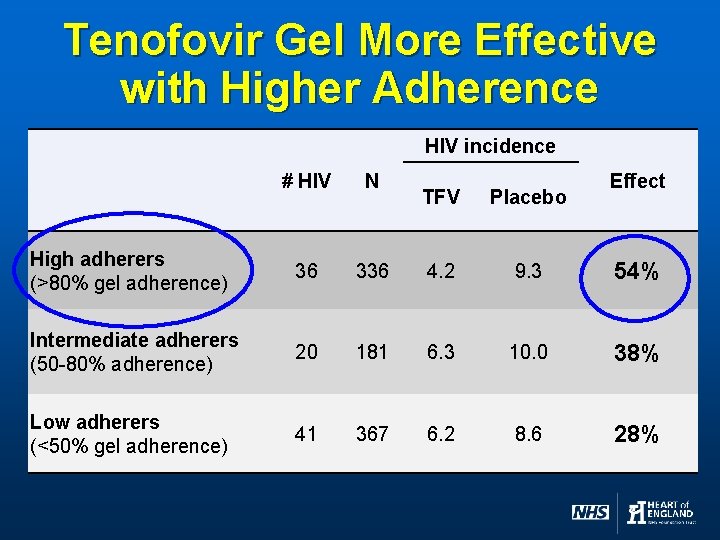
Tenofovir Gel More Effective with Higher Adherence HIV incidence # HIV N High adherers (>80% gel adherence) 36 Intermediate adherers (50 -80% adherence) Low adherers (<50% gel adherence) Effect TFV Placebo 336 4. 2 9. 3 54% 20 181 6. 3 10. 0 38% 41 367 6. 2 8. 6 28%
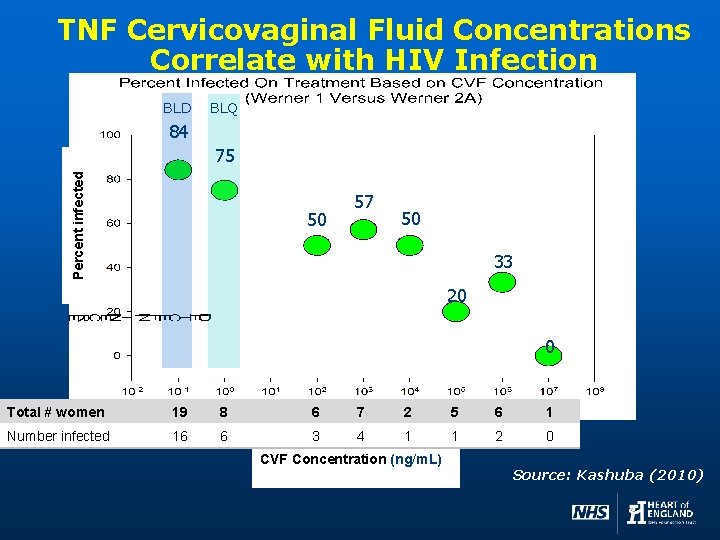
TNF Cervicovaginal Fluid Concentrations Correlate with HIV Infection BLD BLQ 84 Percent infected 75 50 57 50 33 20 0 Total # women 19 8 6 7 2 5 6 1 Number infected 16 6 3 4 1 1 2 0 CVF Concentration (ng/m. L) Source: Kashuba (2010)
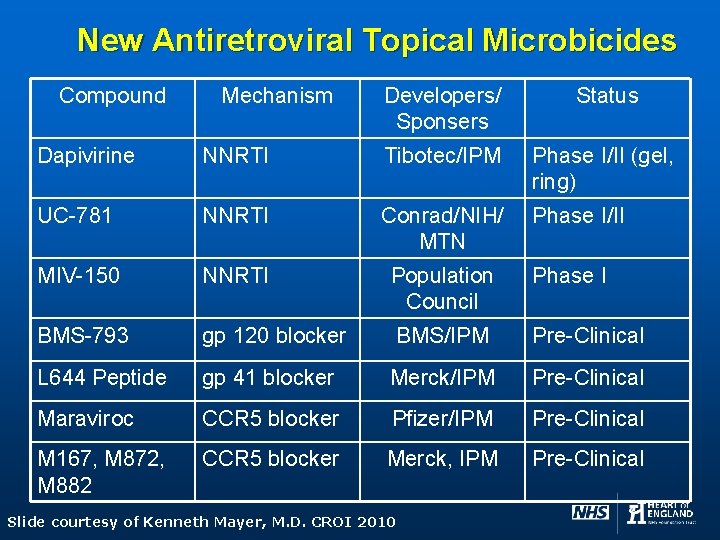
New Antiretroviral Topical Microbicides Compound Mechanism Developers/ Sponsers Status Dapivirine NNRTI Tibotec/IPM Phase I/II (gel, ring) UC-781 NNRTI Conrad/NIH/ MTN Phase I/II MIV-150 NNRTI Population Council Phase I BMS-793 gp 120 blocker BMS/IPM Pre-Clinical L 644 Peptide gp 41 blocker Merck/IPM Pre-Clinical Maraviroc CCR 5 blocker Pfizer/IPM Pre-Clinical M 167, M 872, M 882 CCR 5 blocker Merck, IPM Pre-Clinical Slide courtesy of Kenneth Mayer, M. D. CROI 2010
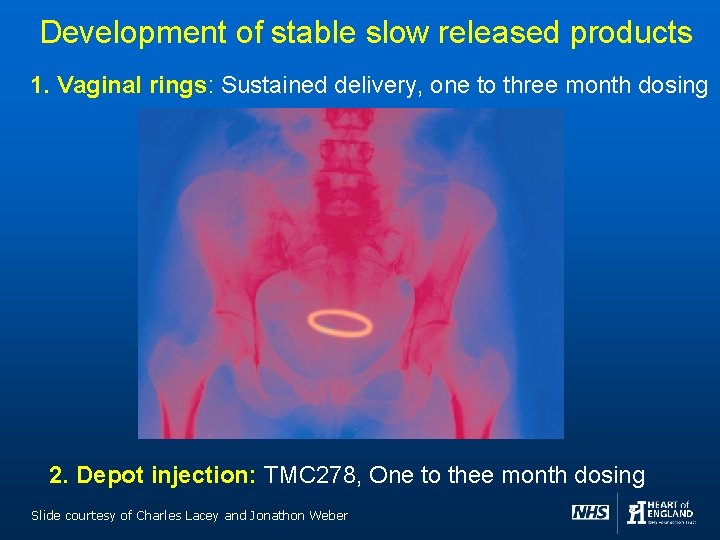
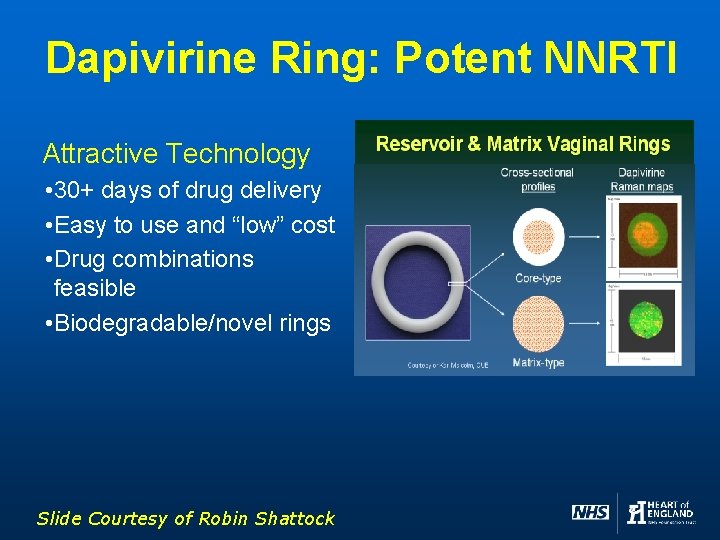
Development of stable slow released products 1. Vaginal rings: Sustained delivery, one to three month dosing 2. Depot injection: TMC 278, One to thee month dosing Slide courtesy of Charles Lacey and Jonathon Weber
Dapivirine Ring: Potent NNRTI Attractive Technology • 30+ days of drug delivery • Easy to use and “low” cost • Drug combinations feasible • Biodegradable/novel rings Slide Courtesy of Robin Shattock
E Does genital tract penetration matter ? Does Genital Tract Penetration Matter ?
THE IDEAL DRUGS for PEPSE. . . • Non toxic • Achieves high levels in genital tissues quickly after a single dose • Rectum, Vagina, Tonsils • Is active against sexually transmitted variants (R 5) • Is unlikely to cause resistance in the recipient if found to be HIV positive
Oral PREP agents must effectively penetrate vaginal or rectal tissue 1% gadolinium 1: 100 in a sterile system with Dextrin sulphate gel, 2 hrs post application (C. Lacey, Imperial College)
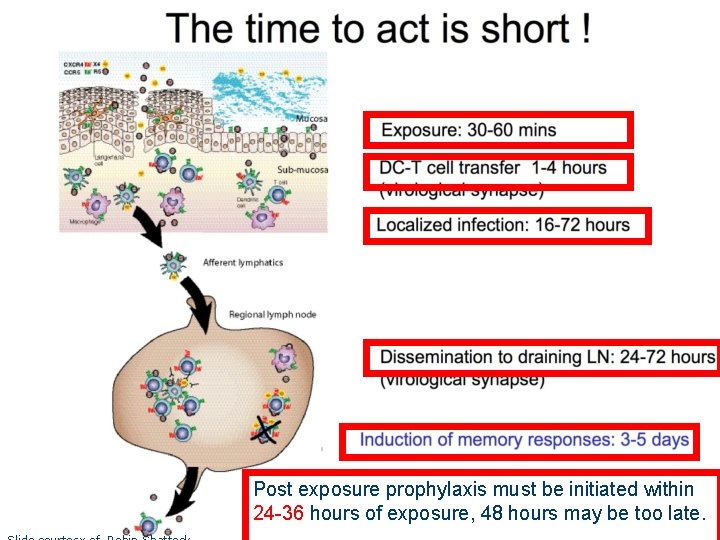
Post exposure prophylaxis must be initiated within 24 -36 hours of exposure, 48 hours may be too late.
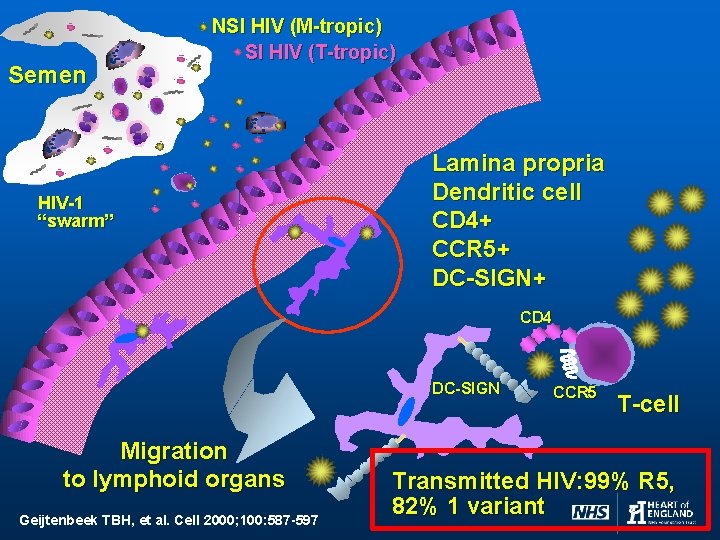
Semen NSI HIV (M-tropic) SI HIV (T-tropic) HIV-1 “swarm” Lamina propria Dendritic cell CD 4+ CCR 5+ DC-SIGN+ CD 4 DC-SIGN Migration to lymphoid organs Geijtenbeek TBH, et al. Cell 2000; 100: 587 -597 CCR 5 T-cell Transmitted HIV: 99% R 5, 82% 1 variant
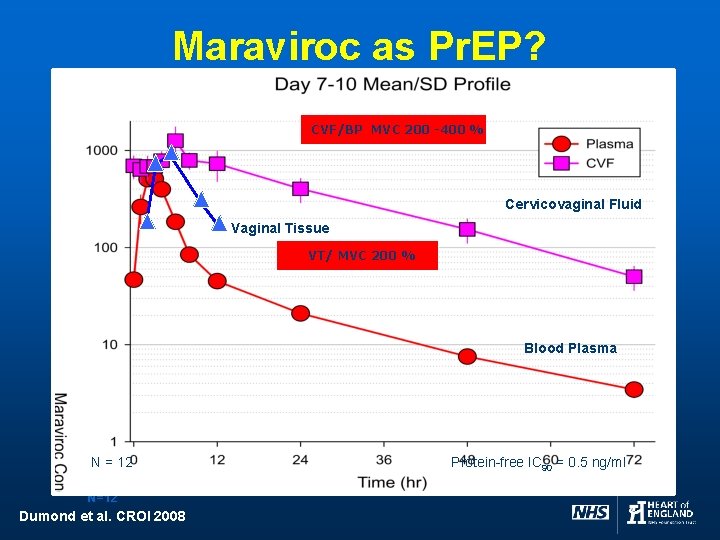
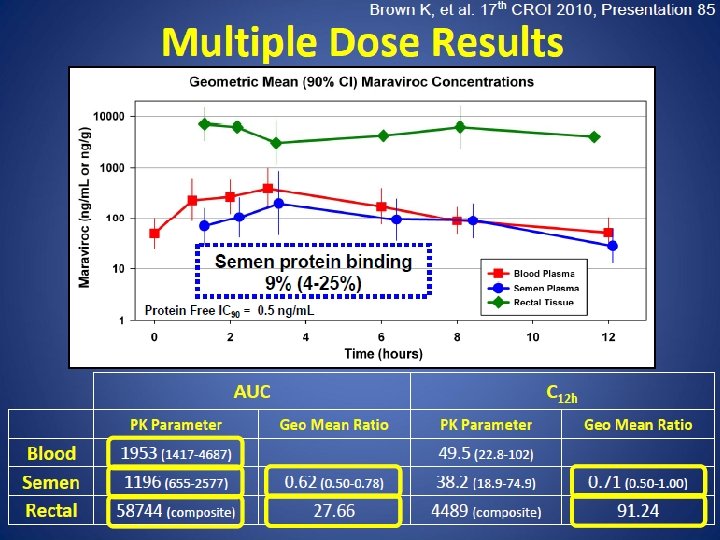
Maraviroc as Pr. EP? CVF/BP MVC 200 -400 % Cervicovaginal Fluid Vaginal Tissue VT/ MVC 200 % Blood Plasma N = 12 N=12 Dumond et al. CROI 2008 Protein-free IC 90 = 0. 5 ng/ml
Angela Kashuba et al. UNC Bob Coombs et al. Seattle Charles Hendrix et al. Boston Developed a New Sport Science “Extreme Sampling”
PRE EXPOSURE PROPHYLAXIS (PREP) Does genital tract drug penetration matter ? Slide courtesy of Robin Shattock
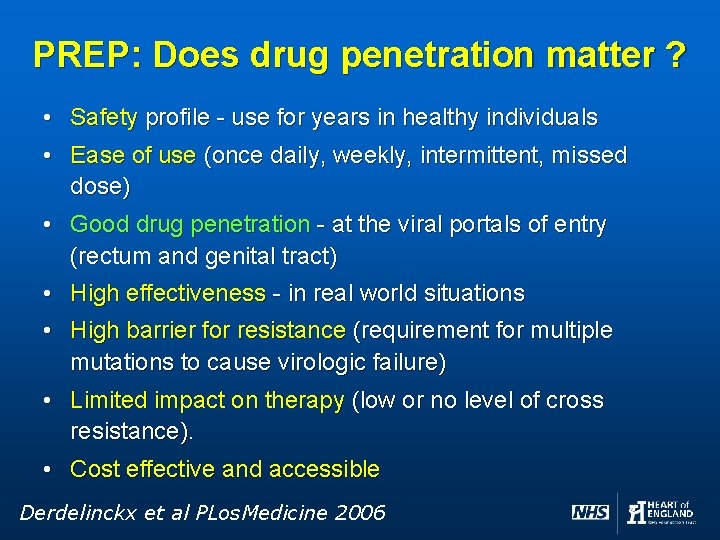
PREP: Does drug penetration matter ? • Safety profile - use for years in healthy individuals • Ease of use (once daily, weekly, intermittent, missed dose) • Good drug penetration - at the viral portals of entry (rectum and genital tract) • High effectiveness - in real world situations • High barrier for resistance (requirement for multiple mutations to cause virologic failure) • Limited impact on therapy (low or no level of cross resistance). • Cost effective and accessible Derdelinckx et al PLos. Medicine 2006
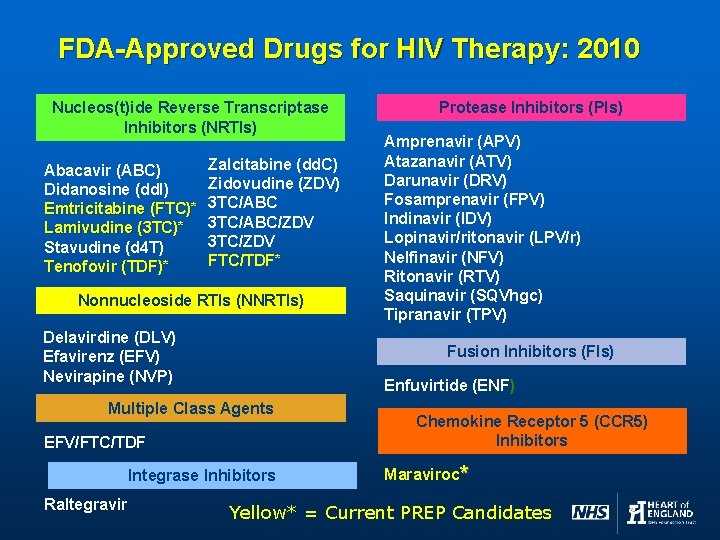
FDA-Approved Drugs for HIV Therapy: 2010 Nucleos(t)ide Reverse Transcriptase Inhibitors (NRTIs) Abacavir (ABC) Didanosine (dd. I) Emtricitabine (FTC)* Lamivudine (3 TC)* Stavudine (d 4 T) Tenofovir (TDF)* Zalcitabine (dd. C) Zidovudine (ZDV) 3 TC/ABC/ZDV 3 TC/ZDV FTC/TDF* Nonnucleoside RTIs (NNRTIs) Delavirdine (DLV) Efavirenz (EFV) Nevirapine (NVP) Amprenavir (APV) Atazanavir (ATV) Darunavir (DRV) Fosamprenavir (FPV) Indinavir (IDV) Lopinavir/ritonavir (LPV/r) Nelfinavir (NFV) Ritonavir (RTV) Saquinavir (SQVhgc) Tipranavir (TPV) Fusion Inhibitors (FIs) Enfuvirtide (ENF) Multiple Class Agents EFV/FTC/TDF Integrase Inhibitors Raltegravir Protease Inhibitors (PIs) Chemokine Receptor 5 (CCR 5) Inhibitors Maraviroc* Yellow* = Current PREP Candidates
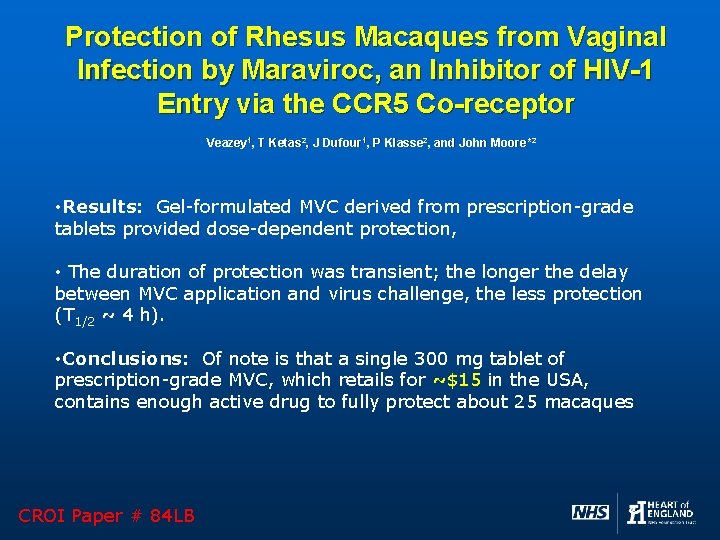
Protection of Rhesus Macaques from Vaginal Infection by Maraviroc, an Inhibitor of HIV-1 Entry via the CCR 5 Co-receptor Veazey 1, T Ketas 2, J Dufour 1, P Klasse 2, and John Moore* 2 • Results: Gel-formulated MVC derived from prescription-grade tablets provided dose-dependent protection, • The duration of protection was transient; the longer the delay between MVC application and virus challenge, the less protection (T 1/2 ~ 4 h). • Conclusions: Of note is that a single 300 mg tablet of prescription-grade MVC, which retails for ~$15 in the USA, contains enough active drug to fully protect about 25 macaques CROI Paper # 84 LB
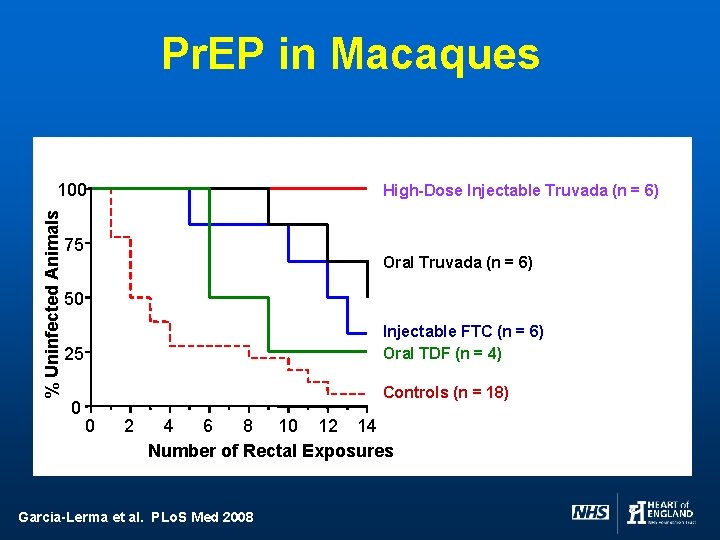
Pr. EP in Macaques % Uninfected Animals 100 High-Dose Injectable Truvada (n = 6) 75 Oral Truvada (n = 6) 50 Injectable FTC (n = 6) Oral TDF (n = 4) 25 0 Controls (n = 18) 0 2 4 6 8 10 12 14 Number of Rectal Exposures Garcia-Lerma et al. PLo. S Med 2008
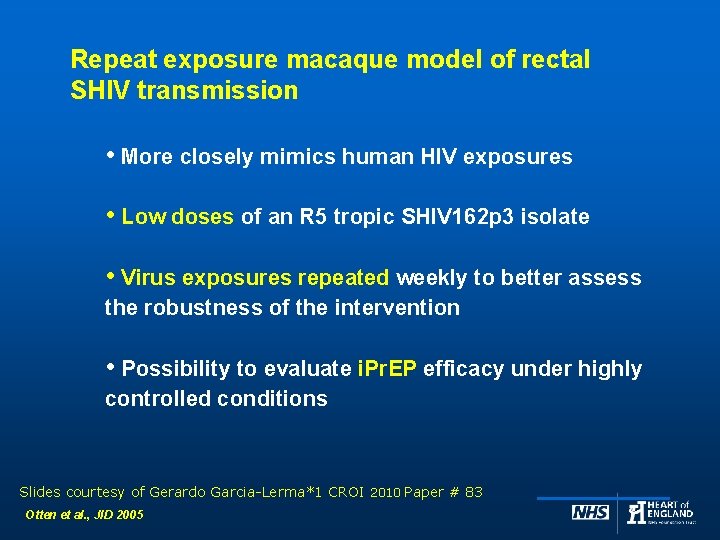
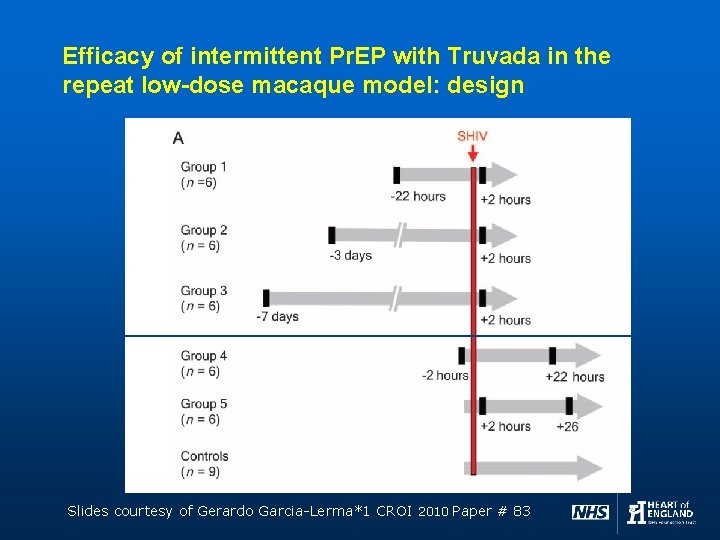
Repeat exposure macaque model of rectal SHIV transmission • More closely mimics human HIV exposures • Low doses of an R 5 tropic SHIV 162 p 3 isolate • Virus exposures repeated weekly to better assess the robustness of the intervention • Possibility to evaluate i. Pr. EP efficacy under highly controlled conditions Slides courtesy of Gerardo Garcia-Lerma*1 CROI 2010 Paper # 83 Otten et al. , JID 2005
Efficacy of intermittent Pr. EP with Truvada in the repeat low-dose macaque model: design Slides courtesy of Gerardo Garcia-Lerma*1 CROI 2010 Paper # 83
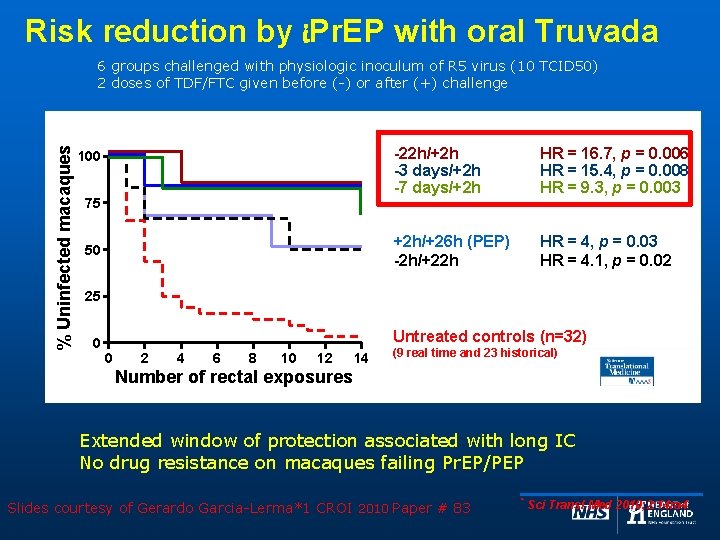
Risk reduction by i. Pr. EP with oral Truvada % Uninfected macaques 6 groups challenged with physiologic inoculum of R 5 virus (10 TCID 50) 2 doses of TDF/FTC given before (-) or after (+) challenge 100 75 50 -22 h/+2 h -3 days/+2 h -7 days/+2 h HR = 16. 7, p = 0. 006 HR = 15. 4, p = 0. 008 HR = 9. 3, p = 0. 003 +2 h/+26 h (PEP) -2 h/+22 h HR = 4, p = 0. 03 HR = 4. 1, p = 0. 02 25 Untreated controls (n=32) 0 0 2 4 6 8 10 12 14 (9 real time and 23 historical) Number of rectal exposures Extended window of protection associated with long IC No drug resistance on macaques failing Pr. EP/PEP Slides courtesy of Gerardo Garcia-Lerma*1 CROI 2010 Paper # 83 * Sci Transl Med 2010; 2: 14 ra 4
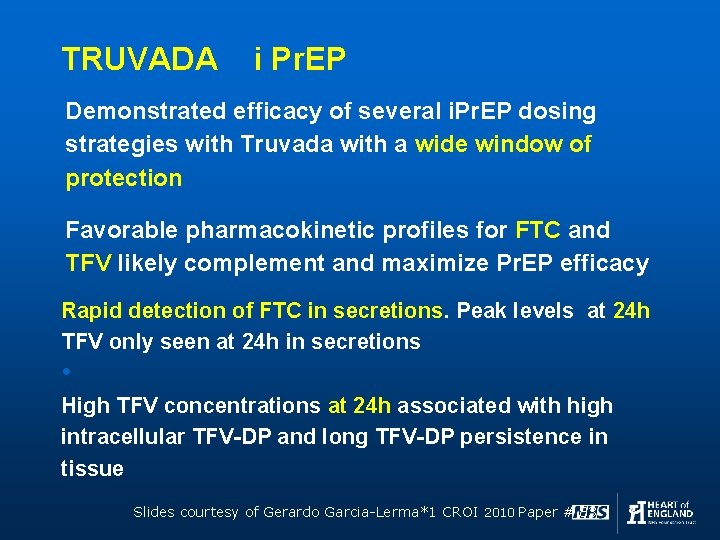
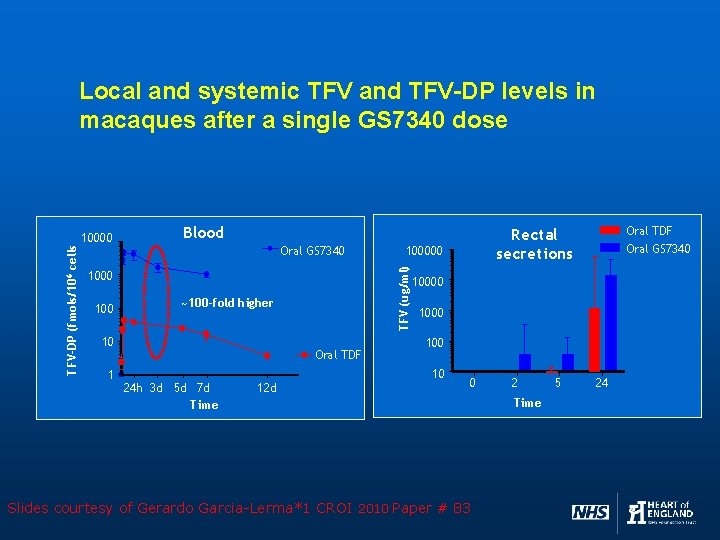
TRUVADA i Pr. EP Demonstrated efficacy of several i. Pr. EP dosing strategies with Truvada with a wide window of protection Favorable pharmacokinetic profiles for FTC and TFV likely complement and maximize Pr. EP efficacy Rapid detection of FTC in secretions. Peak levels at 24 h TFV only seen at 24 h in secretions • High TFV concentrations at 24 h associated with high intracellular TFV-DP and long TFV-DP persistence in tissue Slides courtesy of Gerardo Garcia-Lerma*1 CROI 2010 Paper # 83
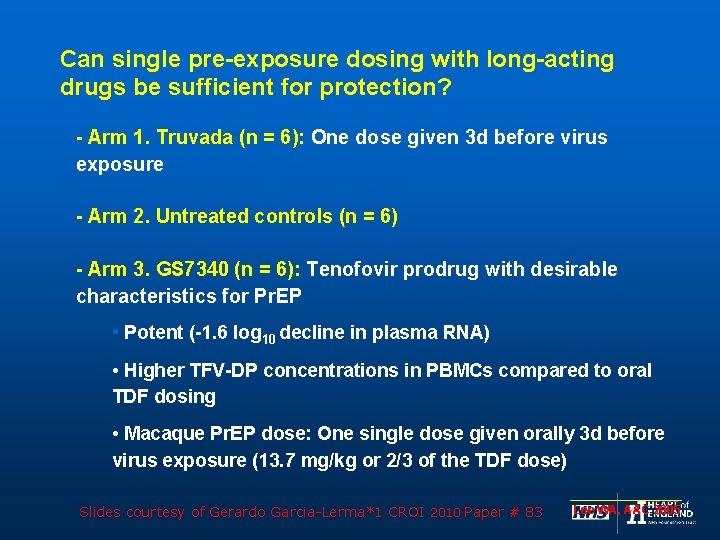
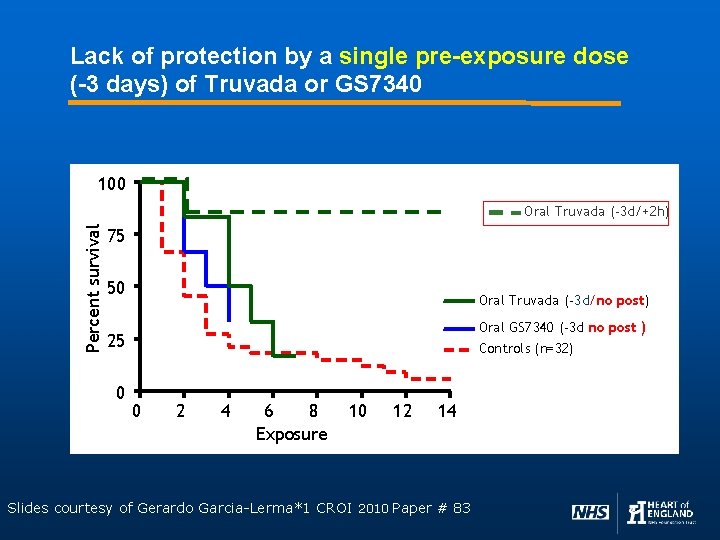
Can single pre-exposure dosing with long-acting drugs be sufficient for protection? - Arm 1. Truvada (n = 6): One dose given 3 d before virus exposure - Arm 2. Untreated controls (n = 6) - Arm 3. GS 7340 (n = 6): Tenofovir prodrug with desirable characteristics for Pr. EP • Potent (-1. 6 log 10 decline in plasma RNA) • Higher TFV-DP concentrations in PBMCs compared to oral TDF dosing • Macaque Pr. EP dose: One single dose given orally 3 d before virus exposure (13. 7 mg/kg or 2/3 of the TDF dose) Slides courtesy of Gerardo Garcia-Lerma*1 CROI 2010 Paper # 83 Lee WA, AAC 2005
Lack of protection by a single pre-exposure dose (-3 days) of Truvada or GS 7340 100 Percent survival Oral Truvada (-3 d/+2 h) 75 50 Oral Truvada (-3 d/no post) Oral GS 7340 (-3 d no post ) Controls (n=32) 25 0 0 2 4 6 8 Exposure 10 12 14 Slides courtesy of Gerardo Garcia-Lerma*1 CROI 2010 Paper # 83
Local and systemic TFV and TFV-DP levels in macaques after a single GS 7340 dose Blood Oral GS 7340 100 ~100 -fold higher 10 1 Oral TDF 24 h 3 d 5 d 7 d Time 12 d Oral TDF Oral GS 7340 Rectal secretions 100000 TFV (ug/ml) TFV-DP (fmols/106 cells 10000 1000 10 0 Slides courtesy of Gerardo Garcia-Lerma*1 CROI 2010 Paper # 83 2 Time 5 24
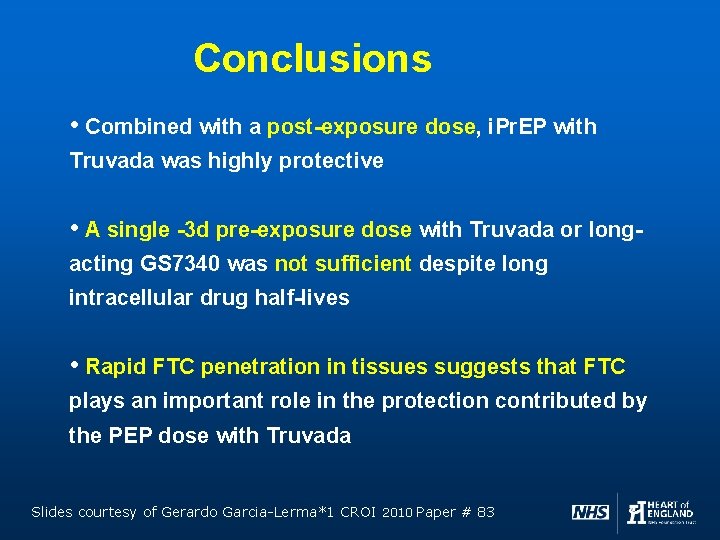
Conclusions • Combined with a post-exposure dose, i. Pr. EP with Truvada was highly protective • A single -3 d pre-exposure dose with Truvada or longacting GS 7340 was not sufficient despite long intracellular drug half-lives • Rapid FTC penetration in tissues suggests that FTC plays an important role in the protection contributed by the PEP dose with Truvada Slides courtesy of Gerardo Garcia-Lerma*1 CROI 2010 Paper # 83
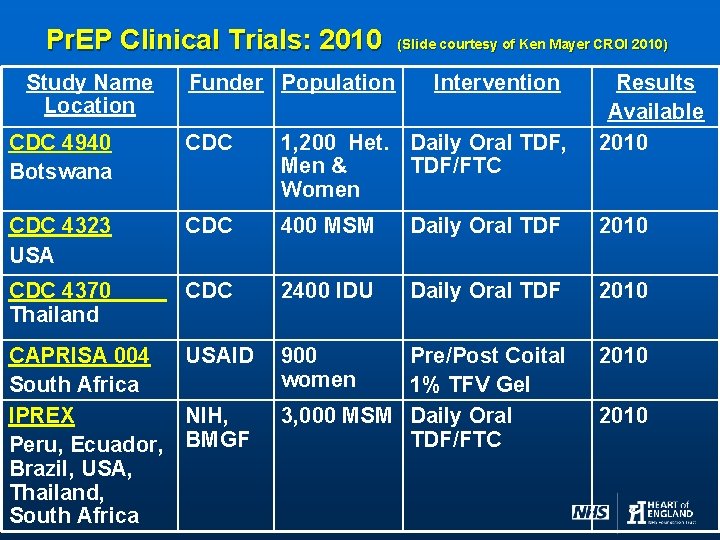
Pr. EP Clinical Trials: 2010 Study Name Location Funder Population (Slide courtesy of Ken Mayer CROI 2010) Intervention Results Available 2010 CDC 4940 Botswana CDC 1, 200 Het. Daily Oral TDF, Men & TDF/FTC Women CDC 4323 USA CDC 400 MSM Daily Oral TDF 2010 CDC 4370 Thailand CDC 2400 IDU Daily Oral TDF 2010 Pre/Post Coital 1% TFV Gel 3, 000 MSM Daily Oral TDF/FTC 2010 CAPRISA 004 USAID South Africa IPREX NIH, Peru, Ecuador, BMGF Brazil, USA, Thailand, South Africa 900 women 2010
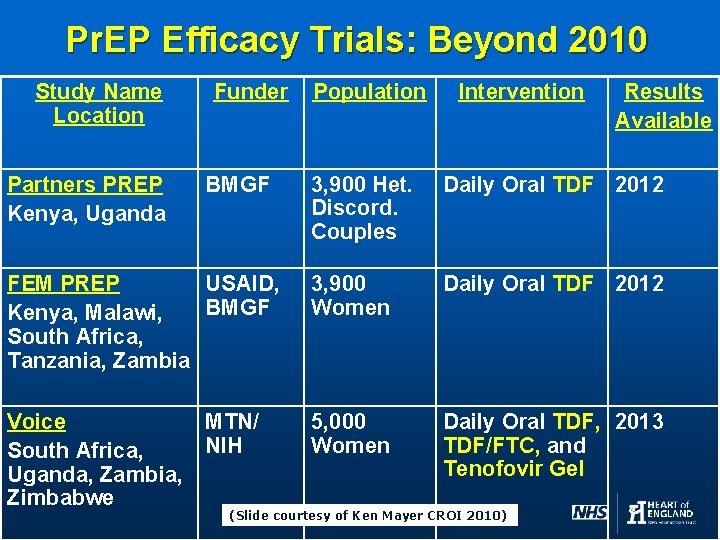
Pr. EP Efficacy Trials: Beyond 2010 Study Name Location Partners PREP Kenya, Uganda Funder BMGF Population Intervention Results Available 3, 900 Het. Discord. Couples Daily Oral TDF 2012 FEM PREP USAID, BMGF Kenya, Malawi, South Africa, Tanzania, Zambia 3, 900 Women Daily Oral TDF 2012 Voice South Africa, Uganda, Zambia, Zimbabwe 5, 000 Women Daily Oral TDF, 2013 TDF/FTC, and Tenofovir Gel MTN/ NIH (Slide courtesy of Ken Mayer CROI 2010)
HIV-1 Prevention Opportunities UNEXPOSED (precoital/coital) (postcoital) Vaccines ART Pr. EP PEPSE Behavioral, Structural Microbicides RX STIs INFECTED Treatment of HIV Reduced Infectivity RX STIs Circumcision/ Condoms YEARS HOURS Cohen et al. JCI 2008; Cohen. IAS Journal online 2008 72 HRS YEARS
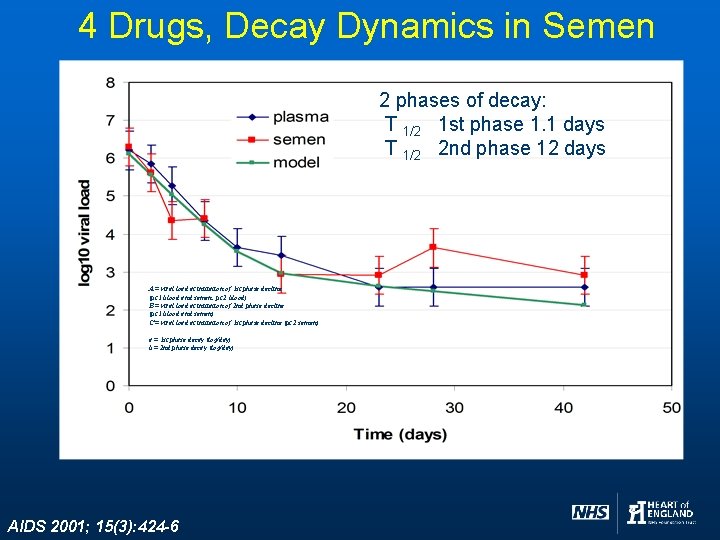
4 Drugs, Decay Dynamics in Semen 2 phases of decay: T 1/2 1 st phase 1. 1 days T 1/2 2 nd phase 12 days A = viral load at initiation of 1 st phase decline (pt 1 blood and semen: pt 2 blood) B = viral load at initiation of 2 nd phase decline (pt 1 blood and semen) C = viral load at initiation of 1 st phase decline (pt 2 semen) a = 1 st phase decay (log/day) b = 2 nd phase decay (log/day) AIDS 2001; 15(3): 424 -6
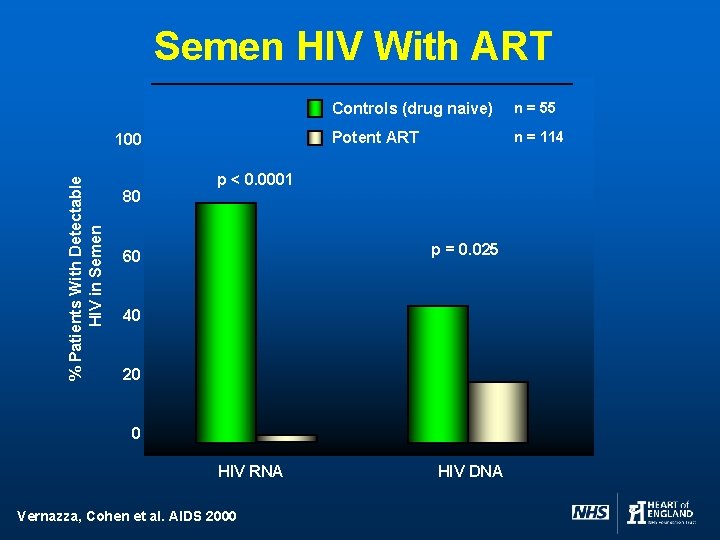
Semen HIV With ART % Patients With Detectable HIV in Semen 100 80 Controls (drug naive) n = 55 Potent ART n = 114 p < 0. 0001 p = 0. 025 60 40 20 0 HIV RNA Vernazza, Cohen et al. AIDS 2000 HIV DNA
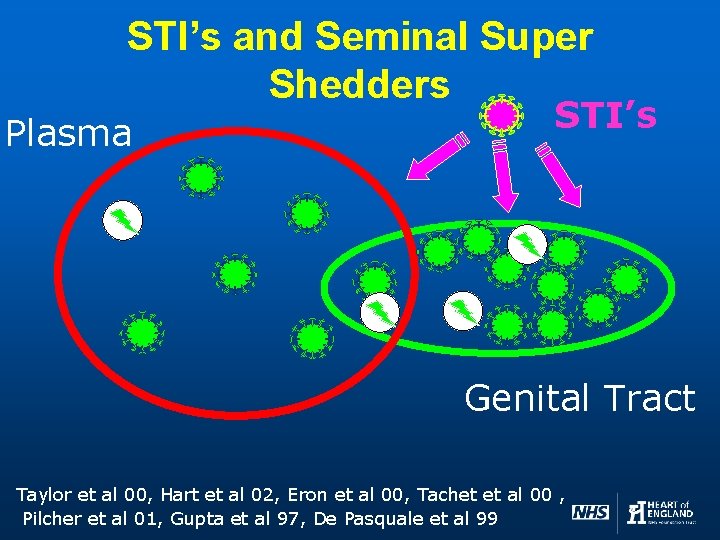
STI’s and Seminal Super Shedders Plasma STI’s Genital Tract Taylor et al 00, Hart et al 02, Eron et al 00, Tachet et al 00 , Pilcher et al 01, Gupta et al 97, De Pasquale et al 99
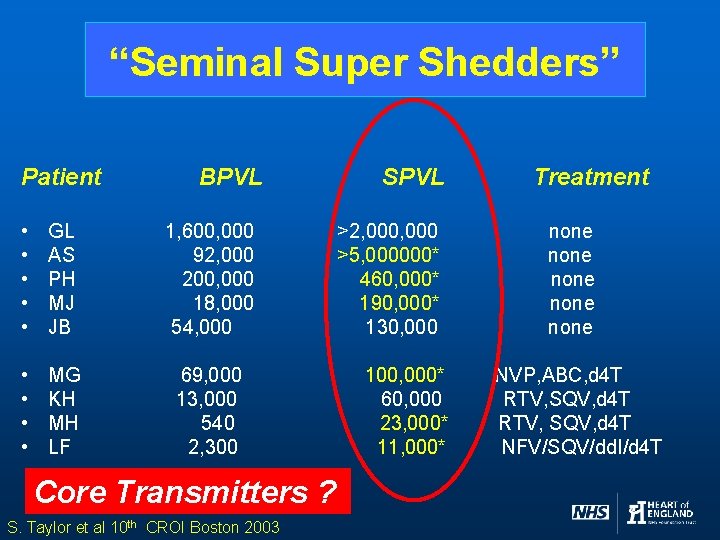
“Seminal Super Shedders” Patient BPVL • • • GL AS PH MJ JB 1, 600, 000 92, 000 200, 000 18, 000 54, 000 • • MG KH MH LF 69, 000 13, 000 540 2, 300 Core Transmitters ? S. Taylor et al 10 th CROI Boston 2003 SPVL >2, 000 >5, 000000* 460, 000* 190, 000* 130, 000 100, 000* 60, 000 23, 000* 11, 000* Treatment none none NVP, ABC, d 4 T RTV, SQV, d 4 T NFV/SQV/dd. I/d 4 T
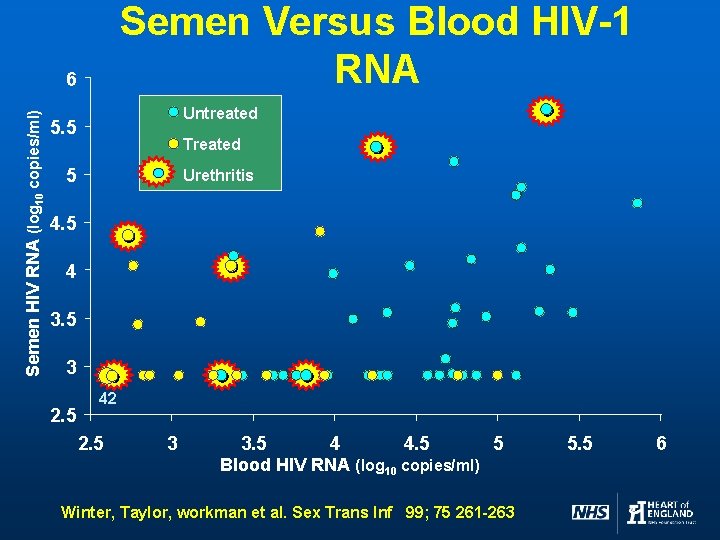
Semen Versus Blood HIV-1 RNA Semen HIV RNA (log 10 copies/ml) 6 Untreated 5. 5 Treated 5 Urethritis 4. 5 4 3. 5 3 2. 5 42 2. 5 3 3. 5 4 4. 5 5 Blood HIV RNA (log 10 copies/ml) Winter, Taylor, workman et al. Sex Trans Inf 99; 75 261 -263 5. 5 6
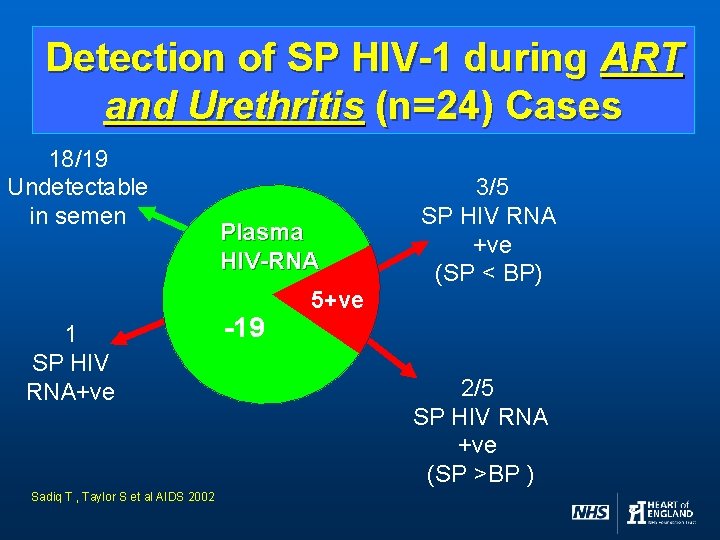
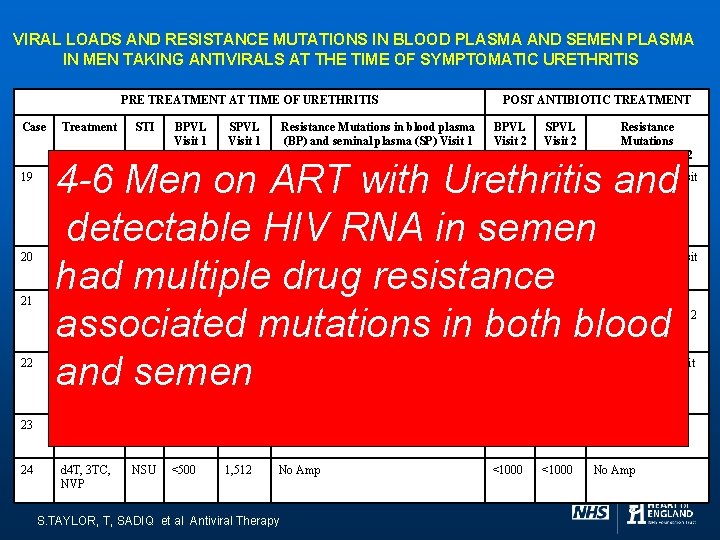
Detection of SP HIV-1 during ART and Urethritis (n=24) Cases 18/19 Undetectable in semen 1 SP HIV RNA+ve Sadiq T , Taylor S et al AIDS 2002 Plasma HIV-RNA -19 3/5 SP HIV RNA +ve (SP < BP) 5+ve 2/5 SP HIV RNA +ve (SP >BP )
VIRAL LOADS AND RESISTANCE MUTATIONS IN BLOOD PLASMA AND SEMEN PLASMA IN MEN TAKING ANTIVIRALS AT THE TIME OF SYMPTOMATIC URETHRITIS PRE TREATMENT AT TIME OF URETHRITIS Case 19 Treatment STI BPVL Visit 1 SPVL Visit 1 Resistance Mutations in blood plasma (BP) and seminal plasma (SP) Visit 1 POST ANTIBIOTIC TREATMENT BPVL Visit 2 SPVL Visit 2 Resistance Mutations BP and SP Visit 2 4 -6 Men on ART with Urethritis and detectable HIV RNA in semen had multiple drug resistance associated mutations in both blood and semen dd. I, ABC, NFV, SQV GC 13, 913 6412 RT: M 41 L, L 74 V, V 118 I, M 184 V, T 215 Y PR: L 10 I, K 20 I, l 24 I, M 36 I, M 46 L, 154 V, L 63 P, A 71 V, T 74 S, V 82 A 11, 249 4, 012 No change from Visit 1 AZT, 3 TC, dd. C GC 98, 882 15, 770 RT: M 41 L, A 98 G, M 184 V, L 210 W/L, T 215 Y 85, 262 23, 786 No change from Visit 1 AZT, 3 TC, dd. I GC 85, 470 26, 422 RT: M 41 L, E 44 A, D 67 N, K 70 R, M 184 V, T 215 Y, K 219 E, PR: . L 10 I, L 63 P, I 93 L 26, 422 21, 916 No change except V 77 I, in SP at Visit 2 d 4 T, ABC, NVP GC 69, 000 100, 000 RT: K 65 R, K 103 N, Y 181 C 49, 000 4, 300 No change from visit 1 SP No Amp 23 d 4 T, 3 TC, NFV, SQV GC 713 5, 928 No Amp 986 <1000 No Amp 24 d 4 T, 3 TC, NVP NSU <500 1, 512 No Amp <1000 No Amp 20 21 22 S. TAYLOR, T, SADIQ et al Antiviral Therapy
A few more questions. . . • What about PI monotherapy? • What about i. PREP for discordant couples wishing to conceive? • What about the Swiss Statement? • What about viral shedding in women on ART?
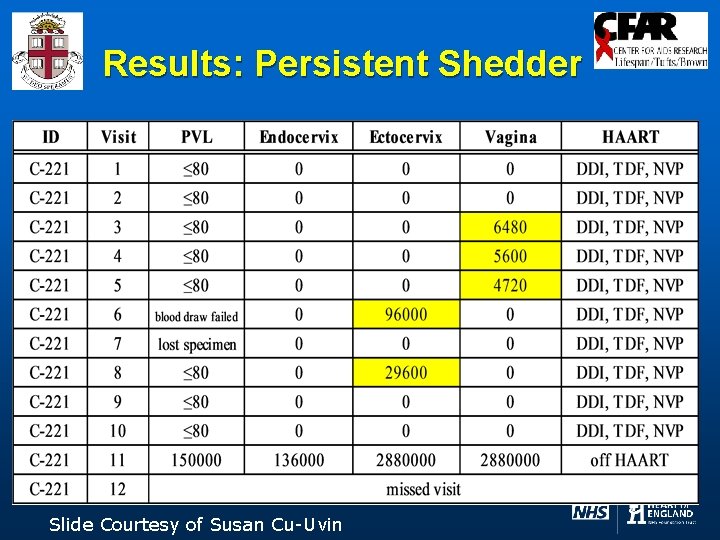
Genital Tract HIV-1 RNA Shedding among Women with Below Detectable Plasma Viral Load Susan Cu-Uvin, Allison De. Long, Joseph Harwell, Joseph Hogan, Jessica Ingersoll, Stacey Chapman, Joselyn Cerezo, Carla Moreira, Jaclyn Kurpewski, Heather Burtwell, Angela Caliendo
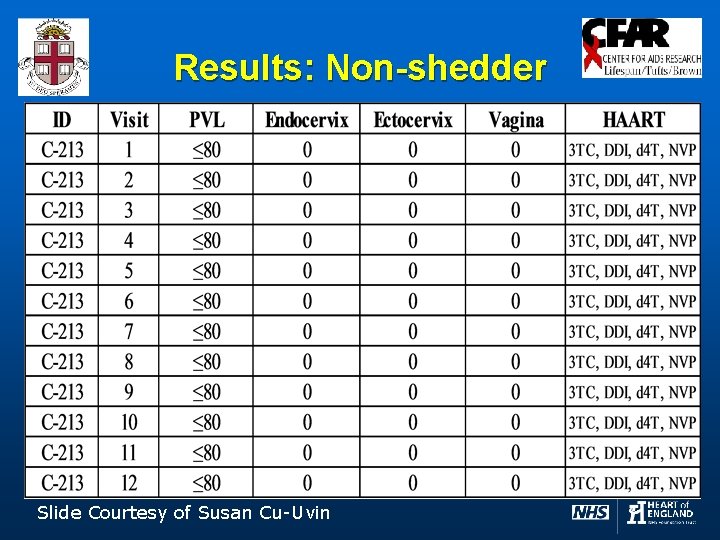
Results: Non-shedder Slide Courtesy of Susan Cu-Uvin
Results: Persistent Shedder Slide Courtesy of Susan Cu-Uvin
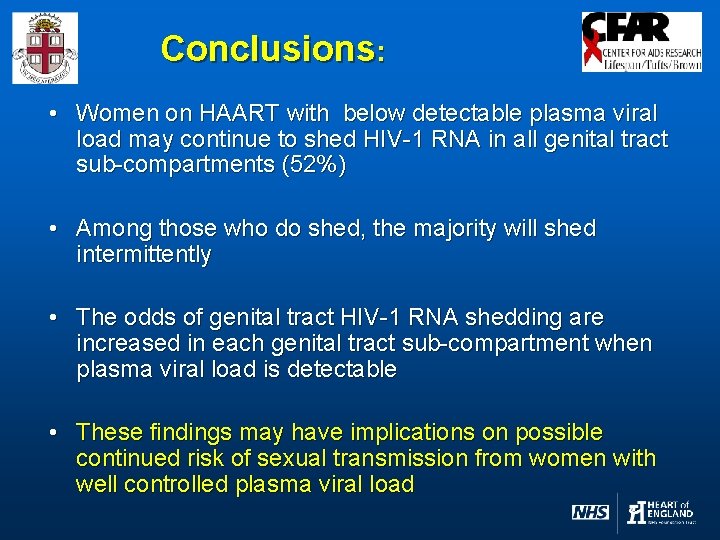
Conclusions: • Women on HAART with below detectable plasma viral load may continue to shed HIV-1 RNA in all genital tract sub-compartments (52%) • Among those who do shed, the majority will shed intermittently • The odds of genital tract HIV-1 RNA shedding are increased in each genital tract sub-compartment when plasma viral load is detectable • These findings may have implications on possible continued risk of sexual transmission from women with well controlled plasma viral load
Genital Drug penetrations , does it matterrs. . . or what ? YEAH WHAT EVVVAAR. . . .
Acknowledgements Slides: Robin Shattock, Myron Cohen, Angela Kashuba, Pietro Vernazza Bob Coombs, Gerado Garcia Lerma, Charles Lacey, Chris Pilcher, Jonathon Weber, Ken Mayer, Debbie Flanigan, and John Watson “PATIENTS: on going contributions” HPA Birmingham Heartlands HIV Service UK University of Birmingham UK. Sophia Davies, Ashini Jayasuria Ngozi Dufty, Ras Smit , Maxine Owen, MIDRU Gerry Gilleran and team UCL Ian Weller, Deenan Pillay St Georges: Tariq Sadiq, Ras Smit , , Judith Workman, Daina Ratcliffe, Li Xu, HPA Collindale Pat Cane Department of Pharmacy and Pharmacology Slotervaart Hospital, Netherlands. Rolf van Heeswijk Department of Pharmacology and Therapeutics University of Liverpool, UK Richard Hoetelmans David Back, Saye Khoo Sara Gibbons, Helen Reynolds