
DRUG EXCRETION CLEARANCE Dr Naila Abrar Learning Objectives
DRUG EXCRETION & CLEARANCE Dr. Naila Abrar

Learning Objectives At the end of lecture you should be able to know: Ø various organs and routes of excretion; Ø renal processes involved in excretion; Ø excretion of acidic and basic drugs; Ø concept of clearance; and Ø significance of clearance.
The drugs are excreted from the body ØUnchanged drug ØMetabolites v Polar & ionized
ROUTES OF EXCRETION 1. KIDNEYS 2. BILE & FAECES 3. OTHER ROUTES • • Lungs Saliva, sweat, tears Hair & Skin Breast milk

RENAL EXCRETION • Kidneys are the most important organs for excretion of drugs and their metabolites. • Involves 3 processes: • 1 - Glomerular filtration • 2 - Active tubular secretion • 3 - Passive tubular reabsorption.
GLOMERULAR FILTRATION • Only the free drug in the plasma is cleared by filtration • The bound drug remains in the circulation. • The amount of drug filtered is dependent upon: ØPlasma protein binding ØGFR: (125/min. ) ØRenal Blood Flow • Lipid solubility and p. H do not influence the passage of drugs into the glomerular filtrate.
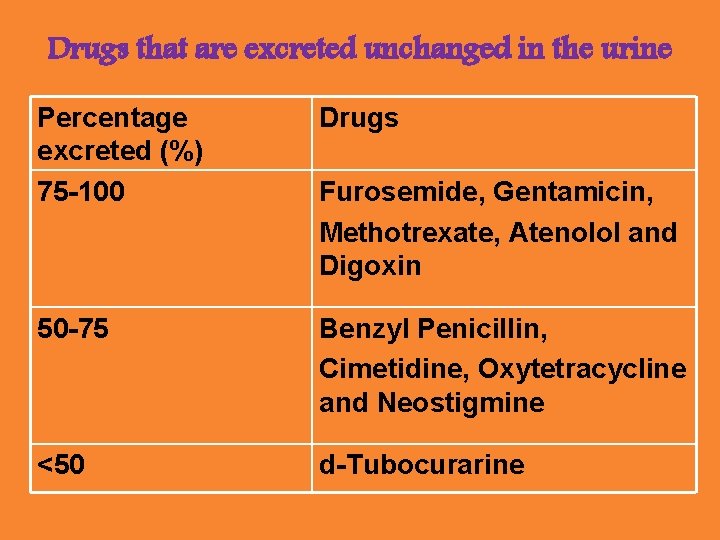
Drugs that are excreted unchanged in the urine Percentage excreted (%) 75 -100 Drugs 50 -75 Benzyl Penicillin, Cimetidine, Oxytetracycline and Neostigmine <50 d-Tubocurarine Furosemide, Gentamicin, Methotrexate, Atenolol and Digoxin
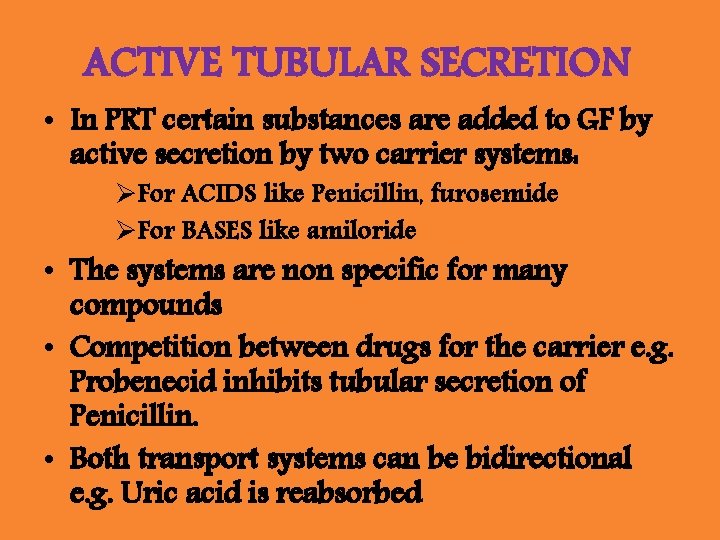
ACTIVE TUBULAR SECRETION • In PRT certain substances are added to GF by active secretion by two carrier systems: ØFor ACIDS like Penicillin, furosemide ØFor BASES like amiloride • The systems are non specific for many compounds • Competition between drugs for the carrier e. g. Probenecid inhibits tubular secretion of Penicillin. • Both transport systems can be bidirectional e. g. Uric acid is reabsorbed
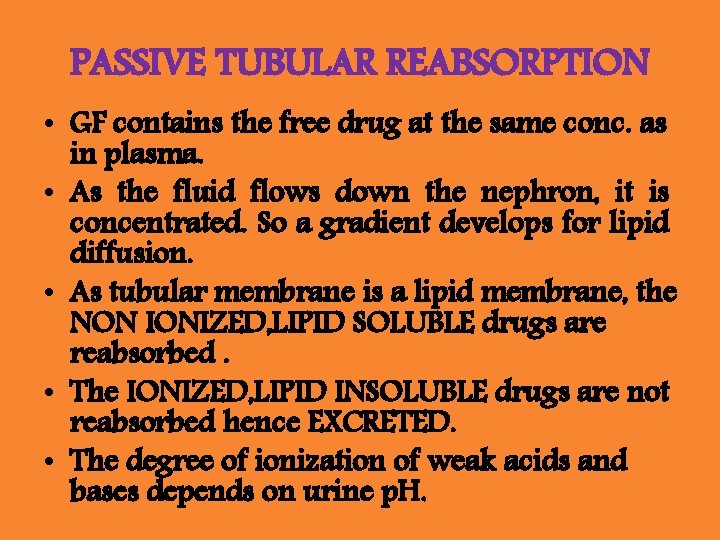
PASSIVE TUBULAR REABSORPTION • GF contains the free drug at the same conc. as in plasma. • As the fluid flows down the nephron, it is concentrated. So a gradient develops for lipid diffusion. • As tubular membrane is a lipid membrane, the NON IONIZED, LIPID SOLUBLE drugs are reabsorbed. • The IONIZED, LIPID INSOLUBLE drugs are not reabsorbed hence EXCRETED. • The degree of ionization of weak acids and bases depends on urine p. H.
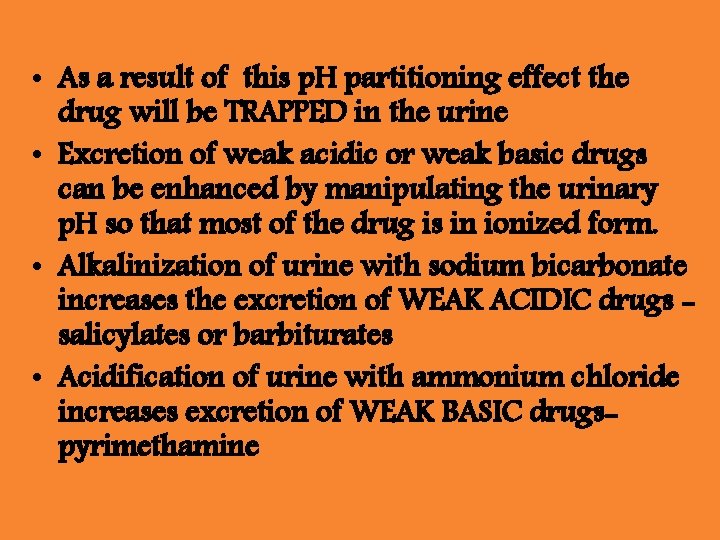
• As a result of this p. H partitioning effect the drug will be TRAPPED in the urine • Excretion of weak acidic or weak basic drugs can be enhanced by manipulating the urinary p. H so that most of the drug is in ionized form. • Alkalinization of urine with sodium bicarbonate increases the excretion of WEAK ACIDIC drugs salicylates or barbiturates • Acidification of urine with ammonium chloride increases excretion of WEAK BASIC drugspyrimethamine
METABOLITES OF DRUGS: The metabolism of drugs converts them in to conjugates, which are Ionized, polar, water soluble, lipid insoluble and can not diffuse back out of the tubular lumen, hence they are excreted in the urine RENAL EXCRETION OF DRUGS MAY DECREASE IN IMPAIRED RENAL FUNCTION DUE TO: Ø Renal disease Ø Old age Example: Streptomycin, Gentamicin
BILE ØIn the liver there are 3 carrier systems for active transport of drugs/metabolites in to the bile: -For transport of anions including glucuronides -For transport of cations -For transport of steroids and related compounds • Small metabolites are absorbed by bile canaliculi • Compounds with MW 300 – 600 are excreted in to the intestine. e. g. Novobiocin& erythromycin
• Many drug metabolites of drugs formed in the liver are excreted in the bile. These metabolites may be • Excreted in to the feces • Absorbed into the blood and excreted in the urine • Undergo ENTERO HEPATIC CIRCULATION
ENTERO HEPATIC CIRCULATION ØThere is enzymatic hydrolysis of glucuronide conjugate and liberation of parent drug which is reabsorbed from the jejunum and goes to liver. It is again conjugated and excreted in the bile into the intestine. This may be repeated e. g. Phenolphthalein, Estrogens. ØEnterohepatic circulation prolongs the duration of action of drug.
FEACAL EXCRETION OF DRUGS The drugs excreted in feaces are • Unabsorbed drugs taken orally (neomycin) • Remainder of drugs that are partially absorbed. • Drug metabolites excreted in bile (erythromycin) • Drugs excreted in the large intestine (anthracene purgatives, heavy metals) • Drugs excreted in saliva (lead, iodides) • Drugs diffused from blood in to the gut
OTHER ROUTES OF EXCRETION LUNGS • Main route for excretion of Volatile GA • Alcohol, paraldehyde excreted partially & gives odor to breath • Lipid soluble drug may diffuse through the epithelial cells of the glands and it is p. H dependent • Alveolar transfer of gas/vapor depends on its partial pressure in the blood
SALIVA, SWEAT & TEARS • Lipid soluble drug may diffuse through the epithelial cells of the glands and it is p. H dependent. • Iodides & metallic salts excreted in saliva lead compounds may deposit as lead sulphide on gums forming a blue line. • Rifampicin may impart orange color to sweat& tears
SKIN& HAIR • Forensic significance • Arsenic& mercury BREAST MILK: • Most drugs appear to some extent in milk. Important for suckling. Because metabolic & eliminating enzymes are immature • Milk is more acidic than plasma so weak bases more concentrated in the milk, than plasma. • Non electrolytes like urea and alcohol same conc. as in plasmas
DRUG ELIMINATION Sum total of metabolic inactivation and excretion
KINETICS OF ELIMINATION • FIRST ORDER KINETICS • ZERO ORDER KINETICS
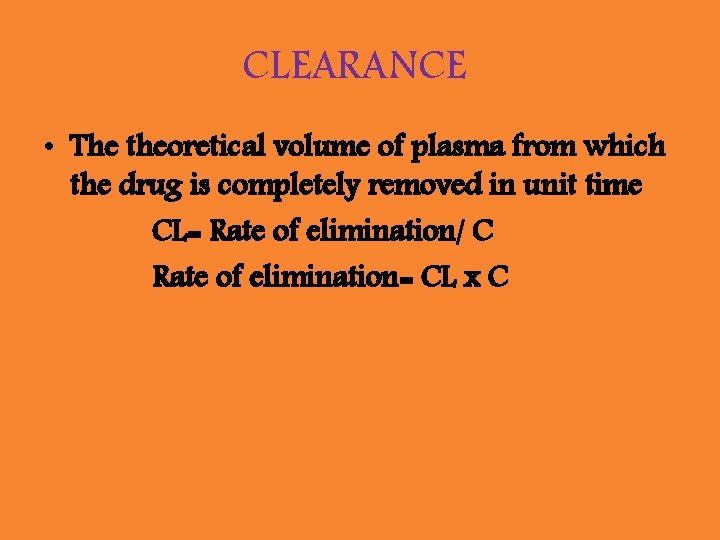
CLEARANCE • The theoretical volume of plasma from which the drug is completely removed in unit time CL= Rate of elimination/ C Rate of elimination= CL x C
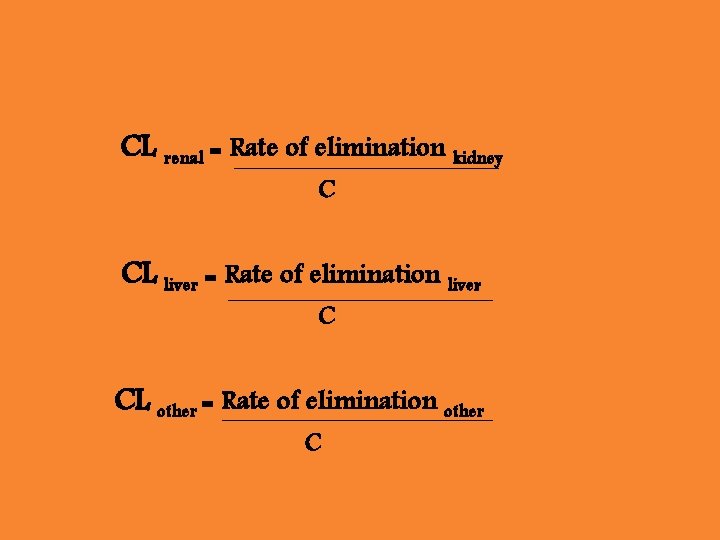
CL renal = Rate of elimination kidney C CL liver = Rate of elimination liver C CL other = Rate of elimination other C
Clearance depends upon capacity of excretory organ and blood flow to the organ – Capacity dependent elimination – Flow dependent elimination
Capacity-limited Elimination • Clearance will vary depending on the concentration achieved. • Drug elimination pathways become saturated if dose is high.
Flow dependent Elimination • Clearance depends on the blood supply to that organ • High extraction drugs - Imipramine - Isoniazid - Lidocaine
SIGNIFICANCE • Dosing rate = Clearance x C • Four parameters are important for adjustment of dosing rate ØBioavailability ØHalf life ØVolume of distribution ØClearance • Decrease in clearance (toxicity)

THANK YOU!
- Slides: 27