
Drug Classification Lesson 1 Psychopharmacology Study of drugs
![Example: Valium n chemical 7 -chloro--1 -methyl-5 -phenyl-3 H-1, 4 benzodiazepin-2[1 H]-one n generic](https://slidetodoc.com/presentation_image/5d48145b5dc9208097e23b53f3a4bad9/image-8.jpg "Example: Valium n chemical 7 -chloro--1 -methyl-5 -phenyl-3 H-1, 4 benzodiazepin-2[1 H]-one n generic")
- Slides: 20
Drug Classification Lesson 1
Psychopharmacology Study of drugs that affect nervous system n Study effects of the drug l e. g. prenatal methamphetamine n Drugs as tools to study functions of nervous system l e. g. , cocaine & reward systems ~ n
My Interests Prenatal & postnatal consequenses l Drugs of abuse l Environmental teratogens n Prenatal l effects on neural development l Postnatal behavior n Postnatal l Addiction ~ n
Drug effects are variable! n Course Goal: Understanding factors that produce variability 1. Pharmacological 2. Neurophysiological 3. Psychological 4. Survey of specific drugs ~
Psychoactive Drugs n Drug l Biologically Active l chemically alters cell structure/function l n Exclude: Natural Foods/Water Alters function of nervous system l Consciousness l Emotions l Perceptions l Behavior ~
Drug Names n 1. 2. 3. n At least 3 names Chemical name l describes molecular structure Generic name l official legal name Trade name l brand name Street name ~
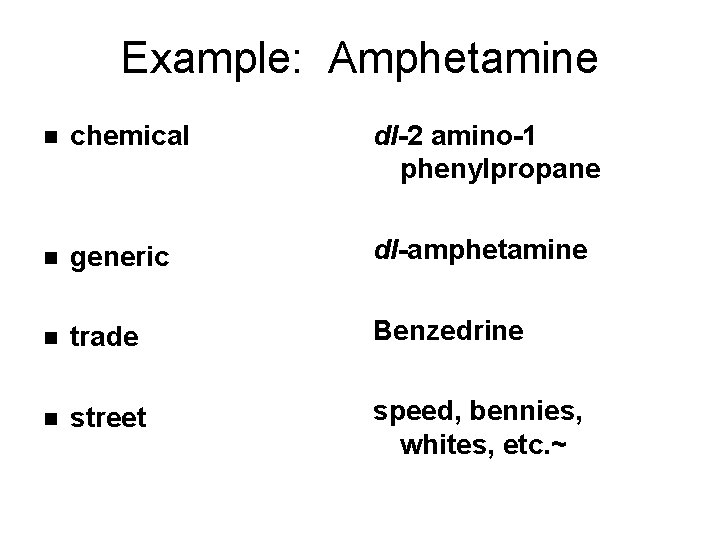
Example: Amphetamine n chemical dl-2 amino-1 phenylpropane n generic dl-amphetamine n trade Benzedrine n street speed, bennies, whites, etc. ~
Example: Valium n chemical 7 -chloro--1 -methyl-5 -phenyl-3 H-1, 4 benzodiazepin-2[1 H]-one n generic diazepam n trade valium n street tranks, downers, blues, yellows
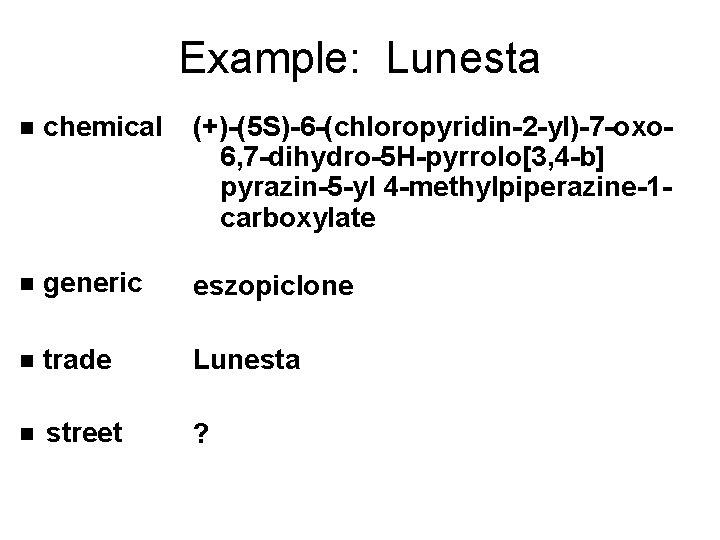
Example: Lunesta n chemical (+)-(5 S)-6 -(chloropyridin-2 -yl)-7 -oxo 6, 7 -dihydro-5 H-pyrrolo[3, 4 -b] pyrazin-5 -yl 4 -methylpiperazine-1 carboxylate n generic eszopiclone n trade Lunesta n street ?
Drug Equivalence Important to know when prescribing n Chemical equivalence l identical chemical compounds l e. g. , Miltown & Equanil (meprobamate) n Biological equivalence l different chemical compounds l affect the same systems in same way l e. g. , Prozac vs. Zoloft ~ n
Drug Equivalence n Clinical equivalence l same behavioral effect l different chemical compounds affecting different systems l e. g. , thorazine vs. lithium ~
Drug Classification Several schemes l use depends on goals n Not easy to classify l each drug wide range of properties n Psychopharmacology: u. CNS & Behavioral ~ n
Text: CNS & Behavioral Effects CNS Stimulants l Cocaine, amphetamine n CNS Depressants l Barbiturates, alcohol n Analgesics l Morphine, codeine n Hallucinogens l Mescaline, LSD, psilocybin n Psychotherapeutics l Prozac, thorazine ~ n
Drug laws & legal classification Controlled Substances Act of 1970 n 5 schedules l abuse potential l medicinal value n Schedule I l high abuse potential l no accepted medicinal value ~ n
Drug laws & legal classification Schedule II l high abuse potential l accepted medicinal value n Schedule III l moderate abuse potential n Schedule IV - low abuse potential n Schedule V - abuse potential < IV ~ n
Drug Schedules & Regulation Schedule I l Cannot be prescribed l Research: tightly regulated n Schedule II l Can prescribe, but no refills l Research: yearly registration n Schedule III, IV, V l Prescribe up to 5 refills over 6 months ~ n
Classification Problems Alcohol effects l General nervous system depressant n Effects depend on dose l Low dose behavioral excitation l High dose behavioral inhibition n What are the effects of alcohol? n It depends! ~
Another Example n Attention Deficit Hyperactive Disorder uhyperkinesis n Treatment: Ritalin u. Methylphenidate classified as a sedative? n No, a stimulant ~ l
No Magic Bullets! n n Drug delivered into system l Affects all cells that have receptors Desired effect = therapeutic effect All other effects = side effects All drugs have multiple effects ~
What are a drug’s effects? IT DEPENDS l Many sources of variability l A focus of this course n Deciding to use a drug l weigh benefits vs. risks l there always risks ~ n