
Drug Analysis Forensic ScienceCSI Foster How would you
- Slides: 17
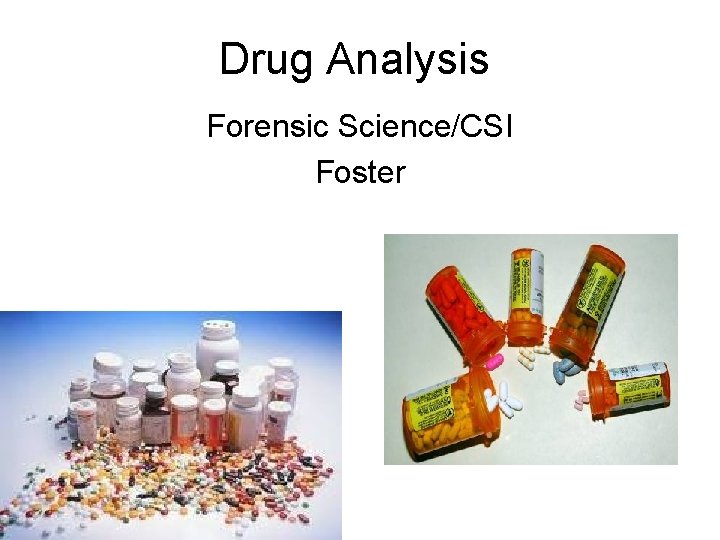
Drug Analysis Forensic Science/CSI Foster
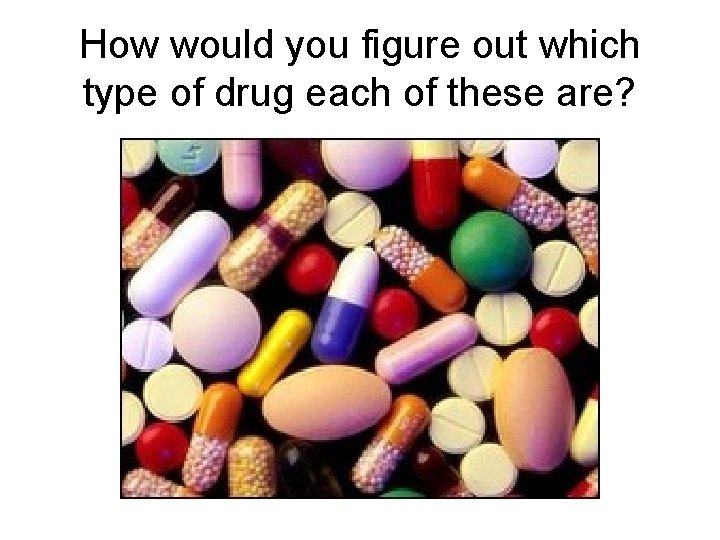
How would you figure out which type of drug each of these are?
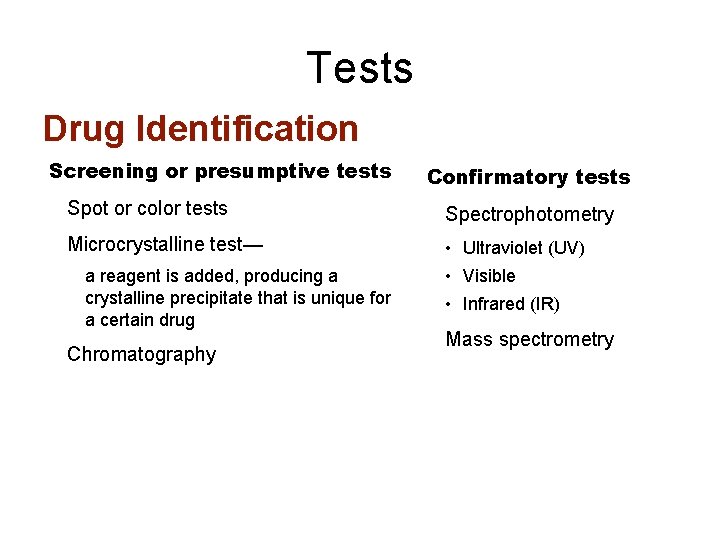
Tests Drug Identification Screening or presumptive tests Confirmatory tests Spot or color tests Spectrophotometry Microcrystalline test— • Ultraviolet (UV) a reagent is added, producing a crystalline precipitate that is unique for a certain drug Chromatography • Visible • Infrared (IR) Mass spectrometry
Forensics Unit 3 Notes Drug- a natural or synthetic substance designed to affect the subject psychologically or physiologically Controlled Drugs- material whose possession is controlled by law (Controlled Substances Act)
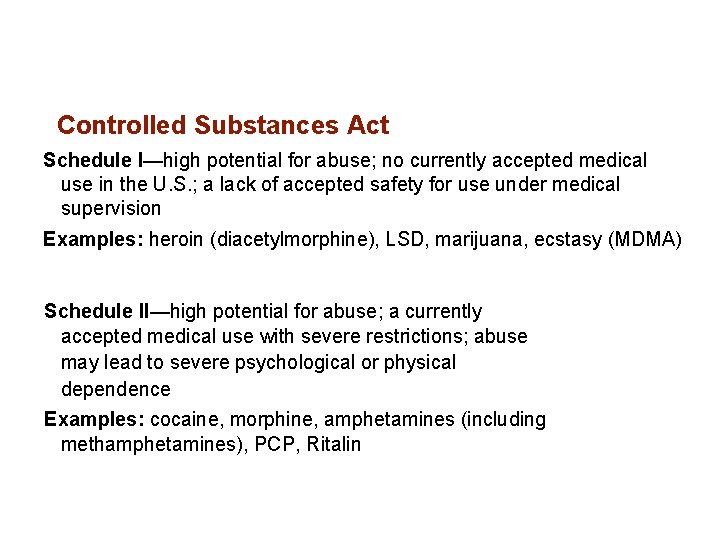
Controlled Substances Act Schedule I—high potential for abuse; no currently accepted medical use in the U. S. ; a lack of accepted safety for use under medical supervision Examples: heroin (diacetylmorphine), LSD, marijuana, ecstasy (MDMA) Schedule II—high potential for abuse; a currently accepted medical use with severe restrictions; abuse may lead to severe psychological or physical dependence Examples: cocaine, morphine, amphetamines (including methamphetamines), PCP, Ritalin
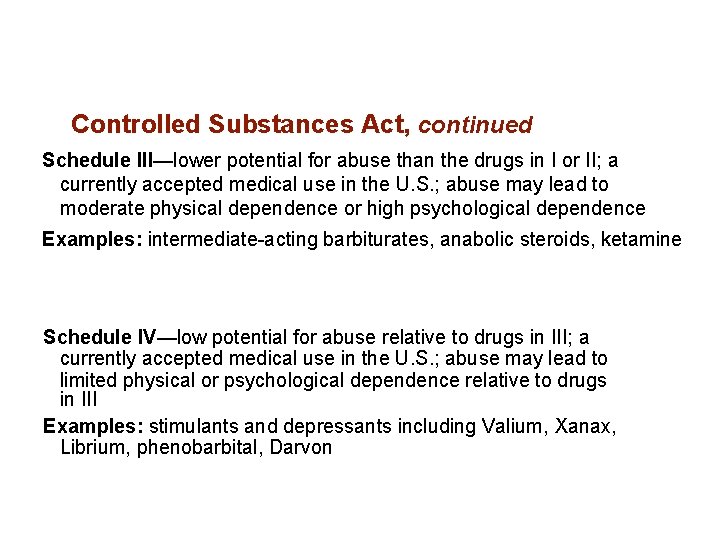
Controlled Substances Act, continued Schedule III—lower potential for abuse than the drugs in I or II; a currently accepted medical use in the U. S. ; abuse may lead to moderate physical dependence or high psychological dependence Examples: intermediate-acting barbiturates, anabolic steroids, ketamine Schedule IV—low potential for abuse relative to drugs in III; a currently accepted medical use in the U. S. ; abuse may lead to limited physical or psychological dependence relative to drugs in III Examples: stimulants and depressants including Valium, Xanax, Librium, phenobarbital, Darvon
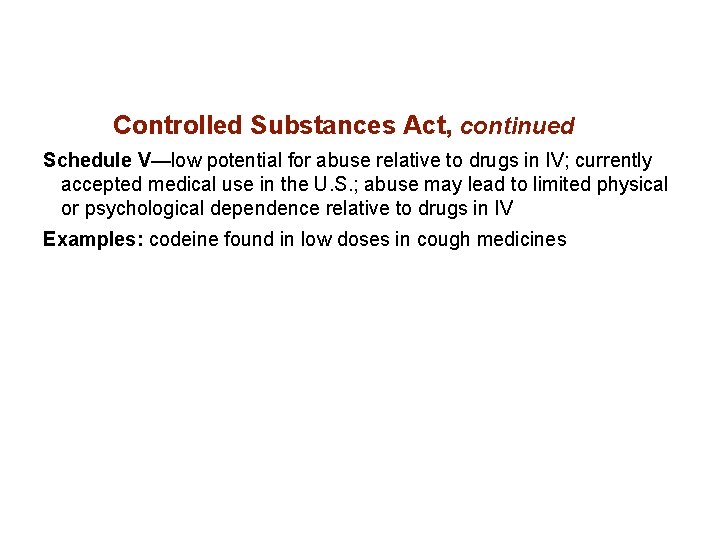
Controlled Substances Act, continued Schedule V—low potential for abuse relative to drugs in IV; currently accepted medical use in the U. S. ; abuse may lead to limited physical or psychological dependence relative to drugs in IV Examples: codeine found in low doses in cough medicines
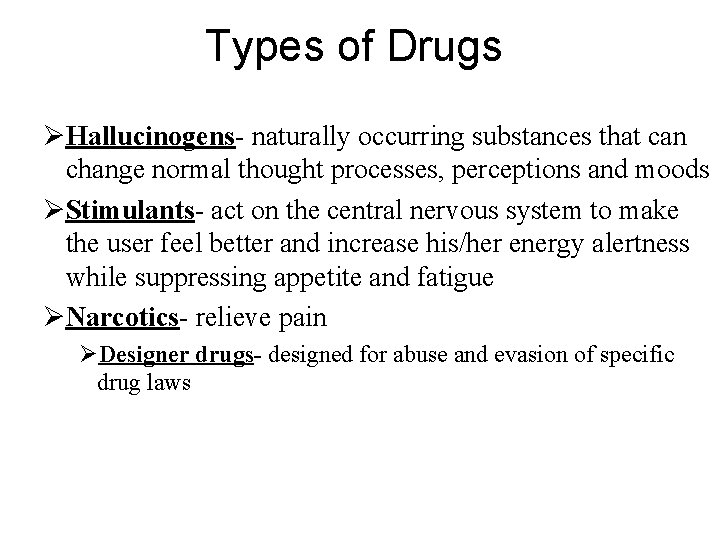
Types of Drugs ØHallucinogens- naturally occurring substances that can change normal thought processes, perceptions and moods ØStimulants- act on the central nervous system to make the user feel better and increase his/her energy alertness while suppressing appetite and fatigue ØNarcotics- relieve pain ØDesigner drugs- designed for abuse and evasion of specific drug laws
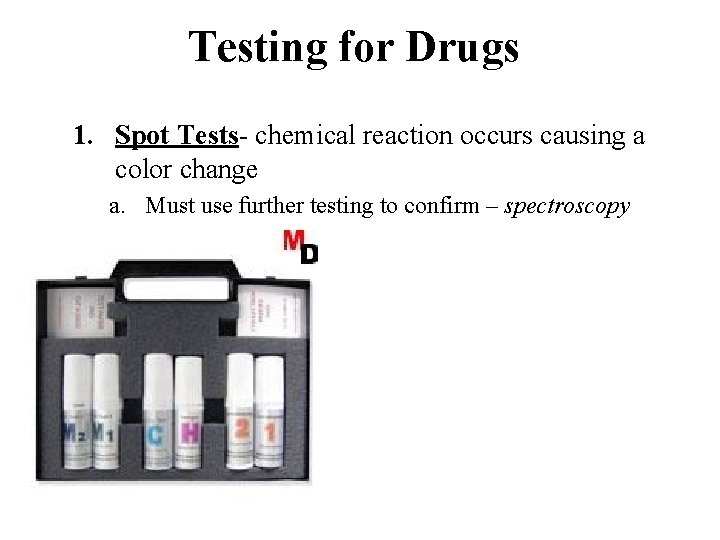
Testing for Drugs 1. Spot Tests- chemical reaction occurs causing a color change a. Must use further testing to confirm – spectroscopy
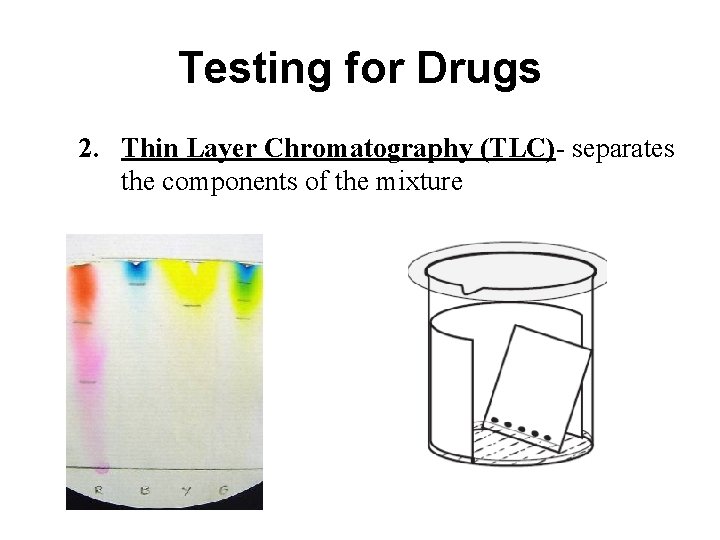
Testing for Drugs 2. Thin Layer Chromatography (TLC)- separates the components of the mixture
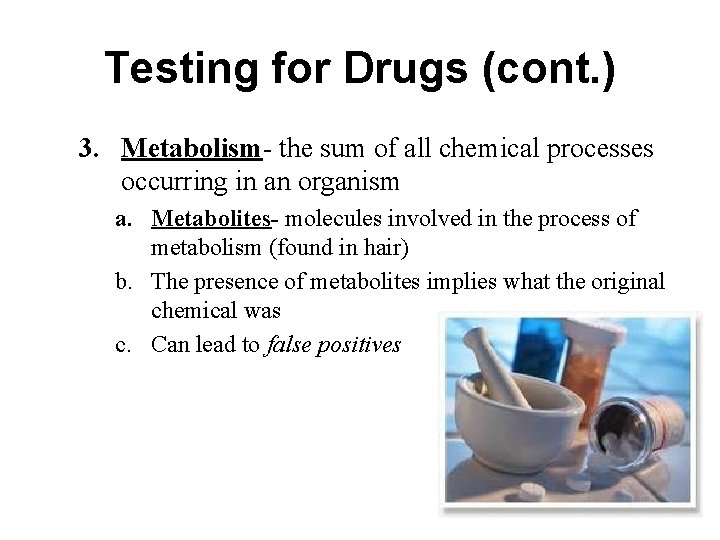
Testing for Drugs (cont. ) 3. Metabolism- the sum of all chemical processes occurring in an organism a. Metabolites- molecules involved in the process of metabolism (found in hair) b. The presence of metabolites implies what the original chemical was c. Can lead to false positives
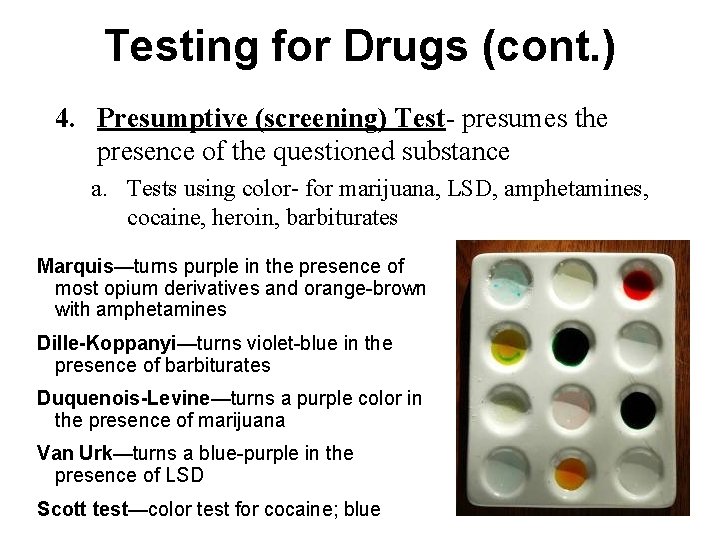
Testing for Drugs (cont. ) 4. Presumptive (screening) Test- presumes the presence of the questioned substance a. Tests using color- for marijuana, LSD, amphetamines, cocaine, heroin, barbiturates Marquis—turns purple in the presence of most opium derivatives and orange-brown with amphetamines Dille-Koppanyi—turns violet-blue in the presence of barbiturates Duquenois-Levine—turns a purple color in the presence of marijuana Van Urk—turns a blue-purple in the presence of LSD Scott test—color test for cocaine; blue
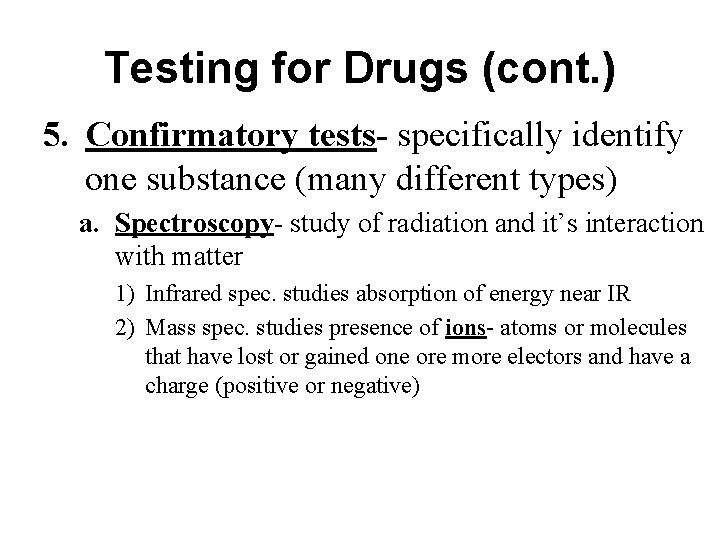
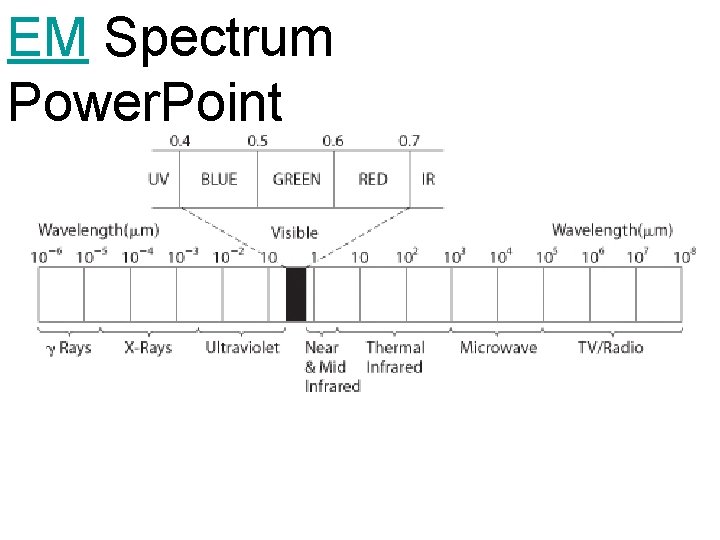
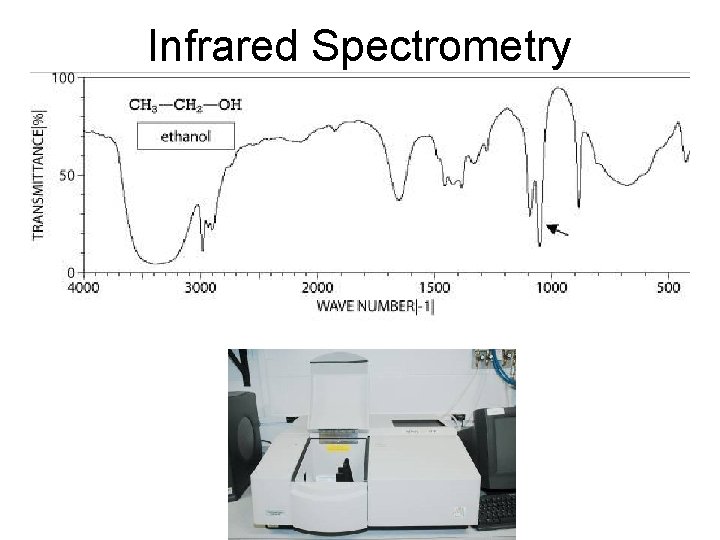
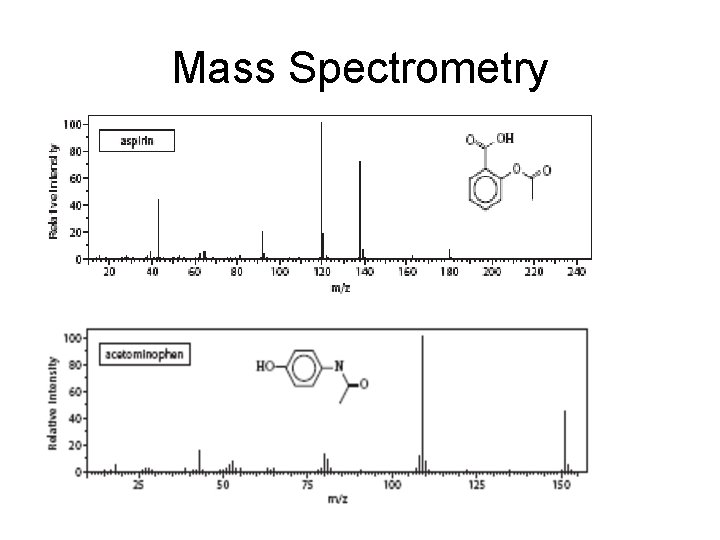
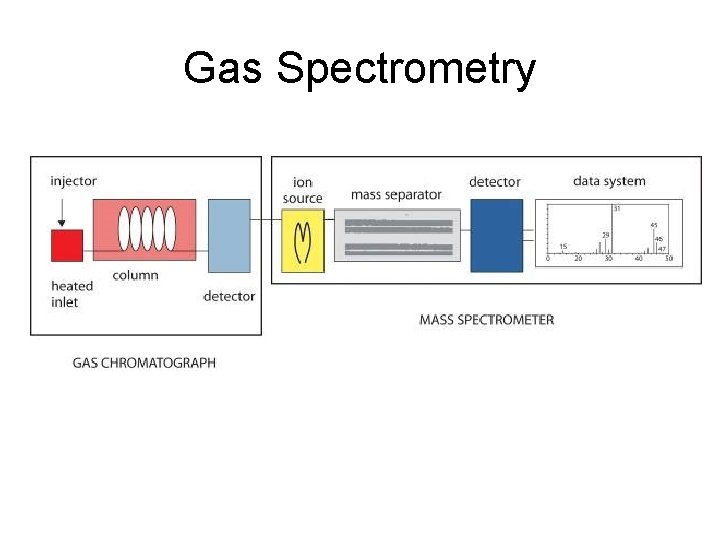
Testing for Drugs (cont. ) 5. Confirmatory tests- specifically identify one substance (many different types) a. Spectroscopy- study of radiation and it’s interaction with matter 1) Infrared spec. studies absorption of energy near IR 2) Mass spec. studies presence of ions- atoms or molecules that have lost or gained one ore more electors and have a charge (positive or negative)
EM Spectrum Power. Point
Infrared Spectrometry
Mass Spectrometry
Gas Spectrometry