
Drug administration and absorption Objectives Know the meaning

Drug administration and absorption *ﻣﻘﺘﺒﺲ ﻣﻦ ﺗﻴﻢ ٤٣٥ Objectives: • Know the meaning of pharmacology and its branches. • Discuss the different routes of drug administration. • Identify the advantages and disadvantages of various routes of drug administration. • Know the various mechanisms of drug absorption. • List different factors affecting drug absorption. • Define bioavailability and factors affecting it. Titles Very important Extra information Terms The roots of education are bitter, but the fruit is sweet Contact us : Pharma 436@outlook. com @Pharma 436 1
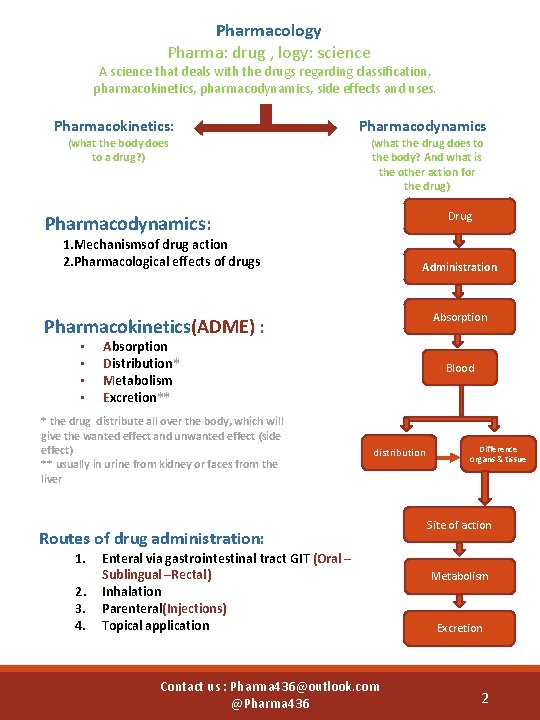
Pharmacology Pharma: drug , logy: science A science that deals with the drugs regarding classification, pharmacokinetics, pharmacodynamics, side effects and uses. Pharmacokinetics: (what the body does to a drug? ) Pharmacodynamics (what the drug does to the body? And what is the other action for the drug) Drug Pharmacodynamics: 1. Mechanismsof drug action 2. Pharmacological effects of drugs Administration Absorption Pharmacokinetics(ADME) : • • Absorption Distribution* Metabolism Excretion** * the drug distribute all over the body, which will give the wanted effect and unwanted effect (side effect) ** usually in urine from kidney or faces from the liver Blood distribution Routes of drug administration: 1. 2. 3. 4. Enteral via gastrointestinal tract GIT (Oral – Sublingual –Rectal) Inhalation Parenteral(Injections) Topical application Contact us : Pharma 436@outlook. com @Pharma 436 Difference organs & tissue Site of action Metabolism Excretion 2
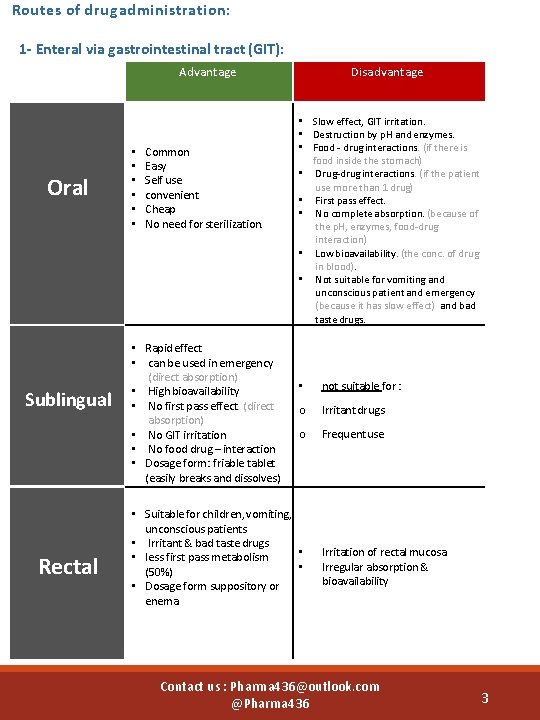
Routes of drug administration: 1 - Enteral via gastrointestinal tract (GIT): Advantage Oral Sublingual Rectal • • • Common Easy Self use convenient Cheap No need for sterilization. • Rapid effect • can be used in emergency (direct absorption) • High bioavailability • No first pass effect. (direct absorption) • No GIT irritation • No food drug – interaction • Dosage form: friable tablet (easily breaks and dissolves) Disadvantage • Slow effect, GIT irritation. • Destruction by p. H and enzymes. • Food - drug interactions. (if there is food inside the stomach) • Drug-drug interactions. (if the patient use more than 1 drug) • First pass effect. • No complete absorption. (because of the p. H, enzymes, food-drug interaction) • Low bioavailability. (the conc. of drug in blood). • Not suitable for vomiting and unconscious patient and emergency (because it has slow effect) and bad taste drugs. • not suitable for : o Irritant drugs o Frequent use • Suitable for children, vomiting, unconscious patients • Irritant & bad taste drugs • • less first pass metabolism • (50%) • Dosage form suppository or enema Irritation of rectal mucosa Irregular absorption & bioavailability Contact us : Pharma 436@outlook. com @Pharma 436 3
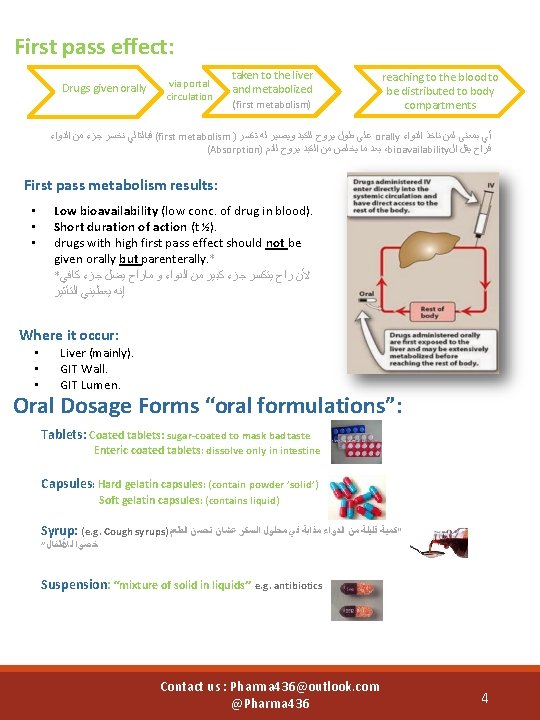
First pass effect: Drugs given orally via portal circulation taken to the liver and metabolized (first metabolism) reaching to the blood to be distributed to body compartments ( ﻓﺒﺎﻟﺘﺎﻟﻲ ﻧﺨﺴﺮ ﺟﺰﺀ ﻣﻦ ﺍﻟﺪﻭﺍﺀ first metabolism ) ﻋﻠﻰ ﻃﻮﻝ ﻳﺮﻭﺡ ﻟﻠﻜﺒﺪ ﻭﻳﺼﻴﺮ ﻟﻪ ﺗﻜﺴﺮ orally ﺃﻲ ﺑﻤﻌﻨﻰ ﻟﻤﻦ ﻧﺎﺧﺬ ﺍﻟﺪﻭﺍﺀ (Absorption) ﺑﻌﺪ ﻣﺎ ﻳﺨﻠﺺ ﻣﻦ ﺍﻟﻜﺒﺪ ﻳﺮﻭﺡ ﻟﻠﺪﻡ ،bioavailability ﻓﺮﺍﺡ ﻳﻘﻞ ﺍﻝ First pass metabolism results: • • • Low bioavailability (low conc. of drug in blood). Short duration of action (t ½). drugs with high first pass effect should not be given orally but parenterally. * * ﻷﻦ ﺭﺍﺡ ﻳﺘﻜﺴﺮ ﺟﺰﺀ ﻛﺒﻴﺮ ﻣﻦ ﺍﻟﺪﻭﺍﺀ ﻭ ﻣﺎﺭﺍﺡ ﻳﻀﻞ ﺟﺰﺀ ﻛﺎﻓﻲ ﺇﻧﻪ ﻳﻌﻄﻴﻨﻲ ﺍﻟﺘﺄﺜﻴﺮ Where it occur: • • • Liver (mainly). GIT Wall. GIT Lumen. Oral Dosage Forms “oral formulations”: Tablets: Coated tablets: sugar-coated to mask bad taste Enteric coated tablets: dissolve only in intestine Capsules: Hard gelatin capsules: (contain powder ’solid’) Soft gelatin capsules: (contains liquid) Syrup: (e. g. Cough syrups) "ﻛﻤﻴﺔ ﻗﻠﻴﻠﺔ ﻣﻦ ﺍﻟﺪﻭﺍﺀ ﻣﺬﺍﺑﺔ ﻓﻲ ﻣﺤﻠﻮﻝ ﺍﻟﺴﻜﺮ ﻋﺸﺎﻥ ﺗﺤﺴﻦ ﺍﻟﻄﻌﻢ ” ﺧﺼﻮﺍ ﻟﻸﻄﻔﺎﻝ Suspension: “mixture of solid in liquids’’ e. g. antibiotics Contact us : Pharma 436@outlook. com @Pharma 436 4

Routes of drug administration: 2 - Inhalation: Inhalation Advantage Disadvantage • Rapid absorption (due to large surface area) • Immediate Effects • limited systemic effect (because it is in one place or Local Effect) • Ideal For Gases • Effective • Local action • Dose Can Be Titrated • Suitable For Emergency • Fewer Side Effects • No first pass effect • Dosage form: • volatile gases e. g. anesthetics • liquids given by aerosol, nebulizer for asthma treatment • addictive route • patients may have difficulty using inhalers • patients may have difficulty regulating dose • Not suitable for irritant drugs • Only few drugs can be used 3 - Parenteral (injection): Advantage Parenteral Disadvantage • No first-pass metabolism • Have Highest Bioavailability • No food-drug / drug-drug interaction • No gastric irritation • Suitable for Vomiting, unconscious , Irritant & bad taste drugs. • Need skill • Pain, tissue necrosis or abscess (I. M) • Anaphylactic reaction (I. V) Type of Parenteral: Intradermal Subcutaneous (I. D) (into skin) (S. C) (Under skin) Intra-arterial Intrathecal (I. A) (into arteries) (I. T) (cerebrospinal fluids) Intramuscular Intravenous (I. M) (into muscle) (I. V) (into veins) Intraperitoneal Intra-articular (I. P) (peritoneal cavity) Contact us : Pharma 436@outlook. com @Pharma 436 (Synovial fluids) 5
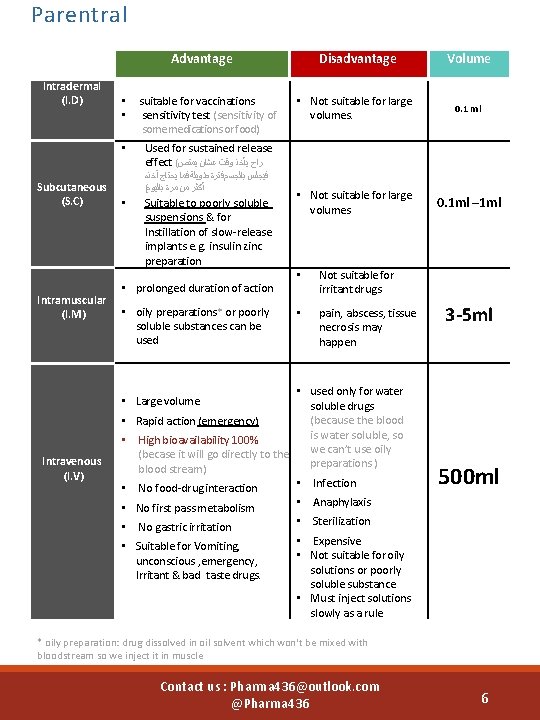
Parentral Advantage Intradermal (I. D) Subcutaneous (S. C) Intramuscular (I. M) • • suitable for vaccinations sensitivity test (sensitivity of some medications or food) • Used for sustained release effect ( ﺭﺍﺡ ﻳﺄﺨﺬ ﻭﻗﺖ ﻋﺸﺎﻥ ﻳﻤﺘﺺ ﻓﻴﺠﻠﺲ ﺑﺎﻟﺠﺴﻢ ﻓﺘﺮﺓ ﻃﻮﻳﻠﺔ ﻓﻤﺎ ﻳﺤﺘﺎﺝ آﺨﺬﻩ ( ﺃﻜﺜﺮ ﻣﻦ ﻣﺮﺓ ﺑﺎﻟﻴﻮﻡ • Suitable to poorly soluble suspensions & for Instillation of slow-release implants e. g. insulin zinc preparation • prolonged duration of action • oily preparations* or poorly soluble substances can be used Disadvantage Volume • Not suitable for large volumes. 0. 1 ml • Not suitable for large volumes 0. 1 ml – 1 ml • Not suitable for irritant drugs • pain, abscess, tissue necrosis may happen • used only for water soluble drugs (because the blood • Rapid action (emergency) is water soluble, so • High bioavailability 100% we can’t use oily (becase it will go directly to the preparations ) blood stream) 3 -5 ml • Large volume Intravenous (I. V) • No food-drug interaction • No first pass metabolism • No gastric irritation • Suitable for Vomiting, unconscious , emergency, Irritant & bad taste drugs. • Infection 500 ml • Anaphylaxis • Sterilization • Expensive • Not suitable for oily solutions or poorly soluble substance • Must inject solutions slowly as a rule * oily preparation: drug dissolved in oil solvent which won't be mixed with bloodstream so we inject it in muscle Contact us : Pharma 436@outlook. com @Pharma 436 6
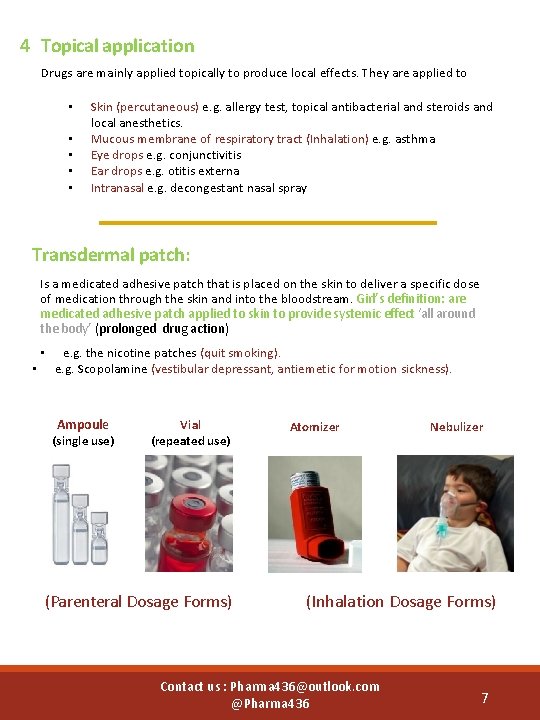
4 Topical application Drugs are mainly applied topically to produce local effects. They are applied to • • • Skin (percutaneous) e. g. allergy test, topical antibacterial and steroids and local anesthetics. Mucous membrane of respiratory tract (Inhalation) e. g. asthma Eye drops e. g. conjunctivitis Ear drops e. g. otitis externa Intranasal e. g. decongestant nasal spray Transdermal patch: Is a medicated adhesive patch that is placed on the skin to deliver a specific dose of medication through the skin and into the bloodstream. Girl’s definition: are medicated adhesive patch applied to skin to provide systemic effect ‘all around the body’ (prolonged drug action) • • e. g. the nicotine patches (quit smoking). e. g. Scopolamine (vestibular depressant, antiemetic for motion sickness). Ampoule (single use) Vial (repeated use) (Parenteral Dosage Forms) Atomizer Nebulizer (Inhalation Dosage Forms) Contact us : Pharma 436@outlook. com @Pharma 436 7
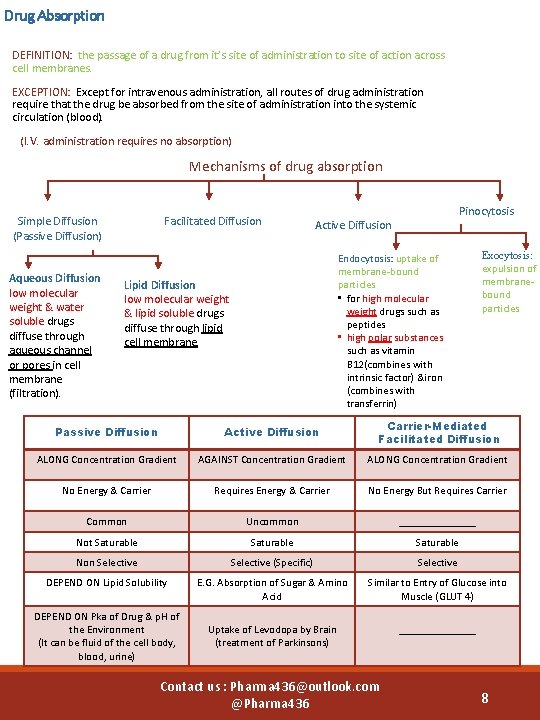
Drug Absorption DEFINITION: the passage of a drug from it’s site of administration to site of action across cell membranes. EXCEPTION: Except for intravenous administration, all routes of drug administration require that the drug be absorbed from the site of administration into the systemic circulation (blood). (I. V. administration requires no absorption) Mechanisms of drug absorption Facilitated Diffusion Simple Diffusion (Passive Diffusion) Aqueous Diffusion low molecular weight & water soluble drugs diffuse through aqueous channel or pores in cell membrane (filtration). Pinocytosis Active Diffusion Endocytosis: uptake of membrane-bound particles • for high molecular weight drugs such as peptides • high polar substances such as vitamin B 12(combines with intrinsic factor) &iron (combines with transferrin) Lipid Diffusion low molecular weight & lipid soluble drugs diffuse through lipid cell membrane. Exocytosis: expulsion of membranebound particles Passive Diffusion Active Diffusion Carrier-Mediated Facilitated Diffusion ALONG Concentration Gradient AGAINST Concentration Gradient ALONG Concentration Gradient No Energy & Carrier Requires Energy & Carrier No Energy But Requires Carrier Common Uncommon _______ Not Saturable Non Selective (Specific) Selective DEPEND ON Lipid Solubility E. G. Absorption of Sugar & Amino Acid Similar to Entry of Glucose into Muscle (GLUT 4) Uptake of Levodopa by Brain (treatment of Parkinsons) _______ DEPEND ON Pka of Drug & p. H of the Environment (It can be fluid of the cell body, blood, urine) Contact us : Pharma 436@outlook. com @Pharma 436 8
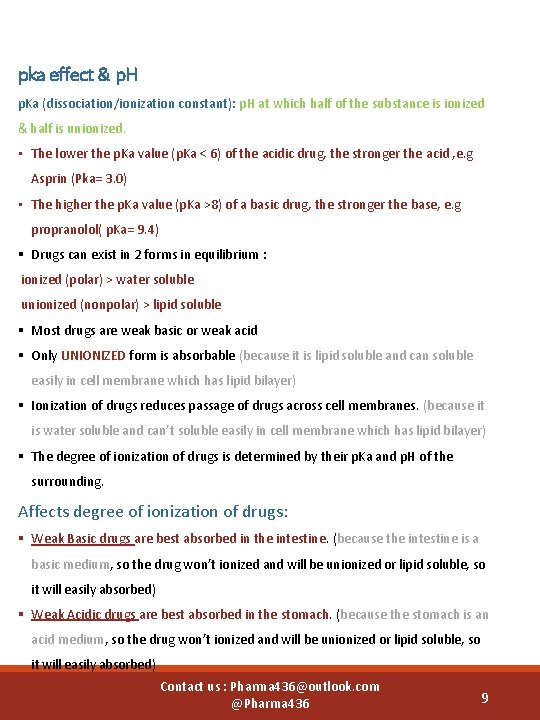
pka effect & p. H p. Ka (dissociation/ionization constant): p. H at which half of the substance is ionized & half is unionized. • The lower the p. Ka value (p. Ka < 6) of the acidic drug, the stronger the acid , e. g Asprin (Pka= 3. 0) • The higher the p. Ka value (p. Ka >8) of a basic drug, the stronger the base, e. g propranolol( p. Ka= 9. 4) § Drugs can exist in 2 forms in equilibrium : ionized (polar) > water soluble unionized (nonpolar) > lipid soluble § Most drugs are weak basic or weak acid § Only UNIONIZED form is absorbable (because it is lipid soluble and can soluble easily in cell membrane which has lipid bilayer) § Ionization of drugs reduces passage of drugs across cell membranes. (because it is water soluble and can’t soluble easily in cell membrane which has lipid bilayer) § The degree of ionization of drugs is determined by their p. Ka and p. H of the surrounding. Affects degree of ionization of drugs: § Weak Basic drugs are best absorbed in the intestine. (because the intestine is a basic medium, so the drug won’t ionized and will be unionized or lipid soluble, so it will easily absorbed) § Weak Acidic drugs are best absorbed in the stomach. (because the stomach is an acid medium, so the drug won’t ionized and will be unionized or lipid soluble, so it will easily absorbed) Contact us : Pharma 436@outlook. com @Pharma 436 9
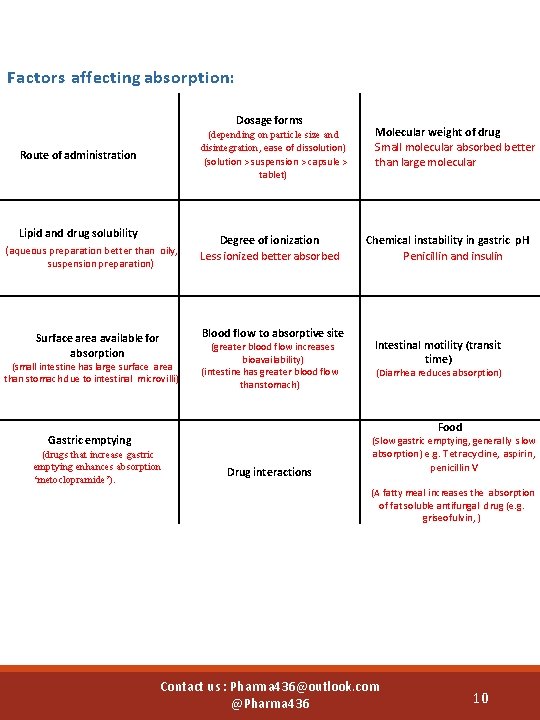
Factors affecting absorption: Dosage forms (depending on particle size and disintegration, ease of dissolution) (solution > suspension > capsule > tablet) Route of administration Lipid and drug solubility (aqueous preparation better than oily, suspension preparation) Degree of ionization Less ionized better absorbed Blood flow to absorptive site Surface area available for absorption (small intestine has large surface area than stomach due to intestinal microvilli) (greater blood flow increases bioavailability) (intestine has greater blood flow than stomach) Molecular weight of drug Small molecular absorbed better than large molecular Chemical instability in gastric p. H Penicillin and insulin Intestinal motility (transit time) (Diarrhea reduces absorption) Food Gastric emptying (drugs that increase gastric emptying enhances absorption ‘metoclopramide’). emptying enhance absorption (metoclopramide)) Drug interactions (Slow gastric emptying, generally slow absorption ) e. g. Tetracycline, aspirin, penicillin V (A fatty meal increases the absorption of fat soluble antifungal drug (e. g. griseofulvin, ) Contact us : Pharma 436@outlook. com @Pharma 436 10
Quick quiz Videos : The First Pass Effect of the Liver Bioavailability Contact us : Pharma 436@outlook. com @Pharma 436 11
- Slides: 12