
Drug addiction as a social problem Project work
Drug addiction as a social problem Project work of Ableev Semen pupil of 7 a form School № 113 Scientific curator and teacher of English: Dudina Oksana Aleksandrovna
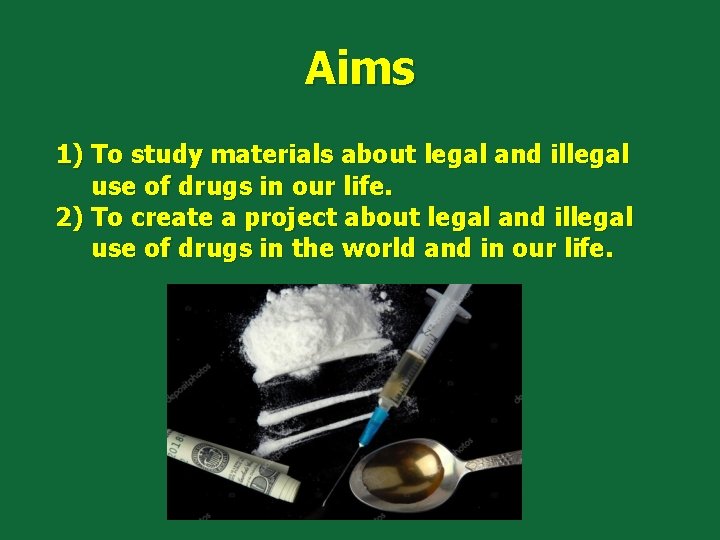
Aims 1) To study materials about legal and illegal use of drugs in our life. 2) To create a project about legal and illegal use of drugs in the world and in our life.
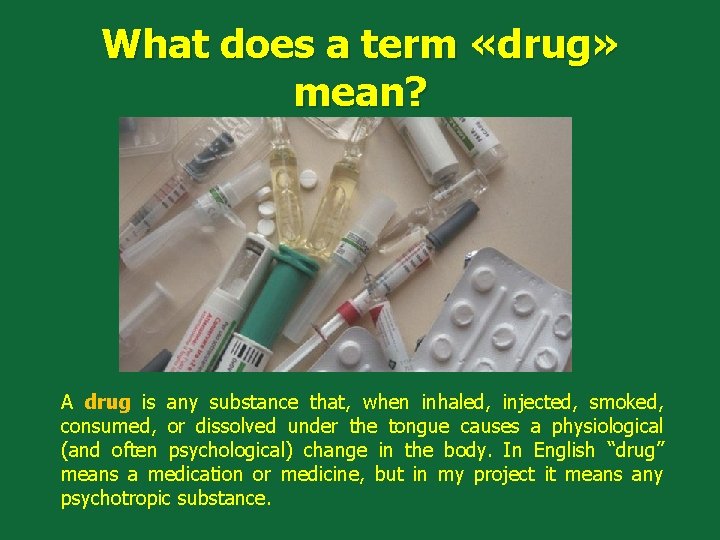
What does a term «drug» mean? A drug is any substance that, when inhaled, injected, smoked, consumed, or dissolved under the tongue causes a physiological (and often psychological) change in the body. In English “drug” means a medication or medicine, but in my project it means any psychotropic substance.
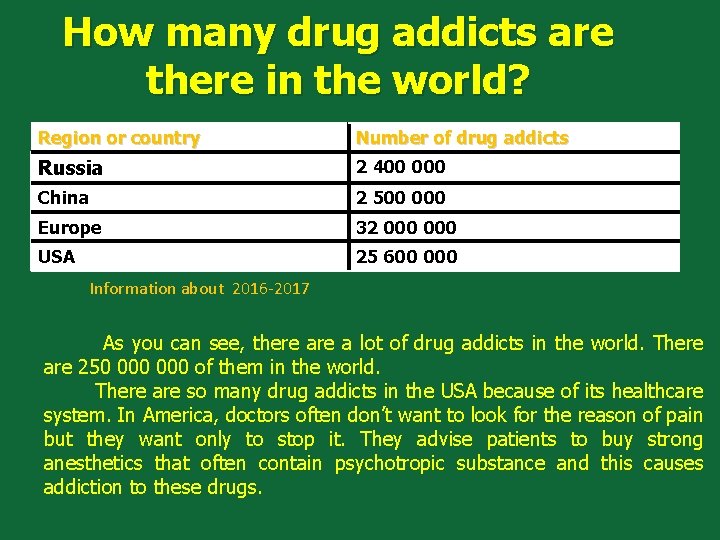
How many drug addicts are there in the world? Region or country Number of drug addicts Russia 2 400 000 China 2 500 000 Europe 32 000 USA 25 600 000 Information about 2016 -2017 As you can see, there a lot of drug addicts in the world. There are 250 000 of them in the world. There are so many drug addicts in the USA because of its healthcare system. In America, doctors often don’t want to look for the reason of pain but they want only to stop it. They advise patients to buy strong anesthetics that often contain psychotropic substance and this causes addiction to these drugs.

Effects of drug abuse Drug abuse causes a lot of diseases and health problems. For example, when drug addicts don’t get enough of psychotropic substance, they fall into depression or become very aggressive. They can also contract HIV, cancer and other terrible diseases. Drug users often have hallucinations and mental disorder.
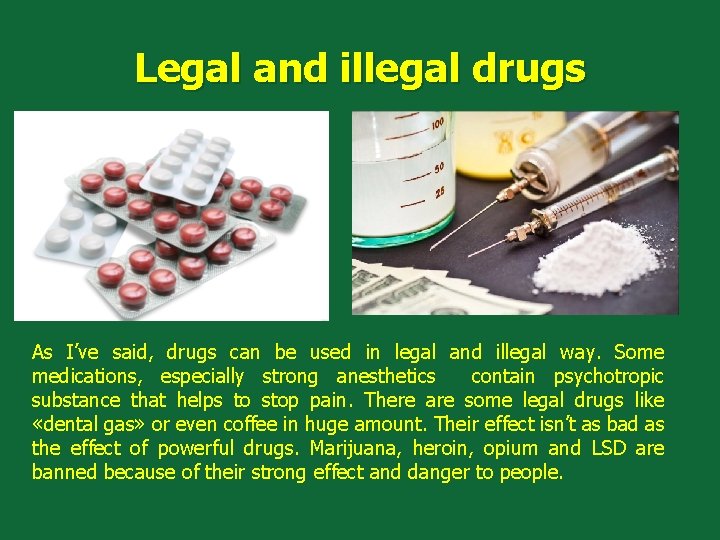
Legal and illegal drugs As I’ve said, drugs can be used in legal and illegal way. Some medications, especially strong anesthetics contain psychotropic substance that helps to stop pain. There are some legal drugs like «dental gas» or even coffee in huge amount. Their effect isn’t as bad as the effect of powerful drugs. Marijuana, heroin, opium and LSD are banned because of their strong effect and danger to people.
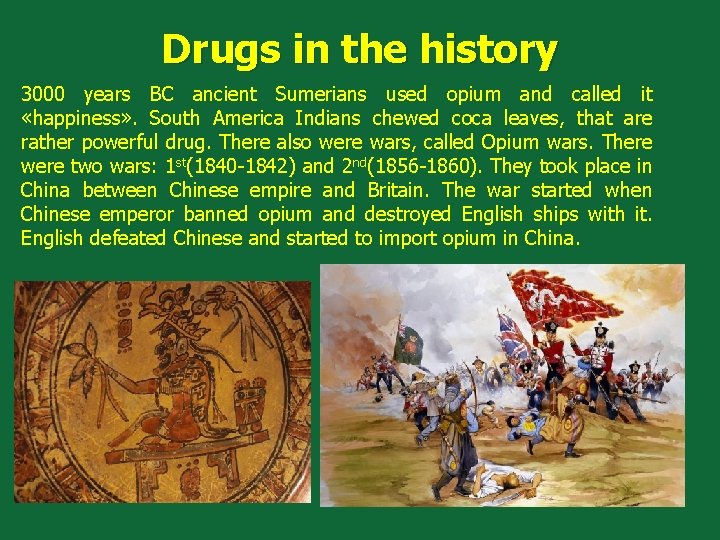
Drugs in the history 3000 years BC ancient Sumerians used opium and called it «happiness» . South America Indians chewed coca leaves, that are rather powerful drug. There also were wars, called Opium wars. There were two wars: 1 st(1840 -1842) and 2 nd(1856 -1860). They took place in China between Chinese empire and Britain. The war started when Chinese emperor banned opium and destroyed English ships with it. English defeated Chinese and started to import opium in China.
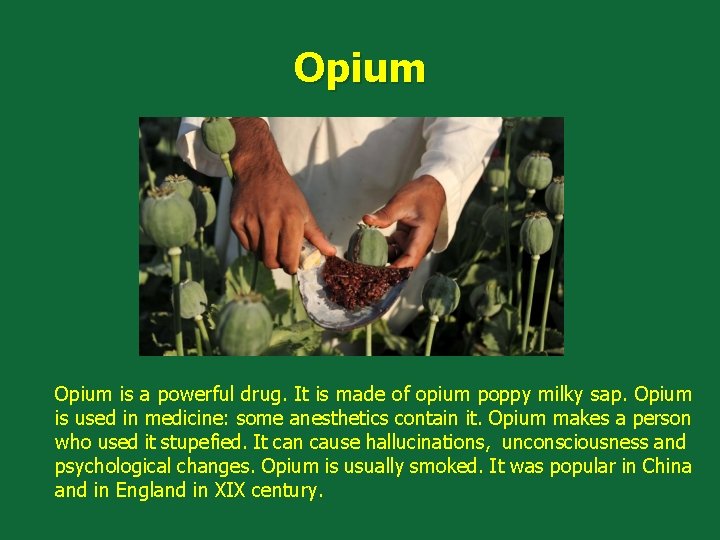
Opium is a powerful drug. It is made of opium poppy milky sap. Opium is used in medicine: some anesthetics contain it. Opium makes a person who used it stupefied. It can cause hallucinations, unconsciousness and psychological changes. Opium is usually smoked. It was popular in China and in England in XIX century.
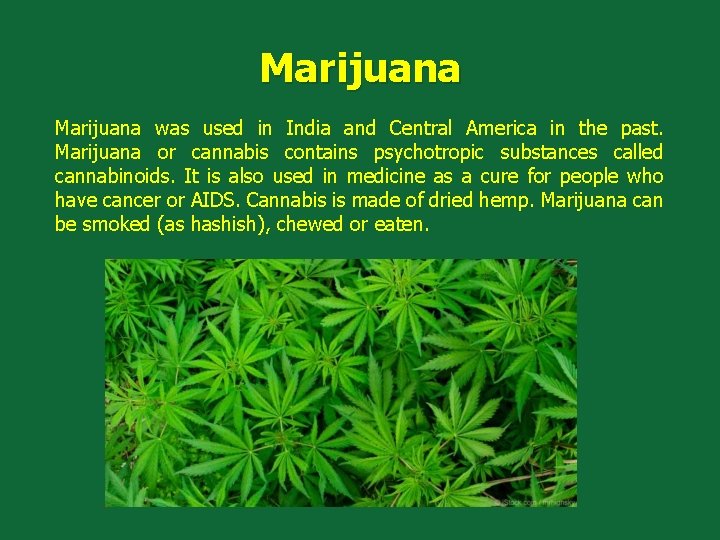
Marijuana was used in India and Central America in the past. Marijuana or cannabis contains psychotropic substances called cannabinoids. It is also used in medicine as a cure for people who have cancer or AIDS. Cannabis is made of dried hemp. Marijuana can be smoked (as hashish), chewed or eaten.
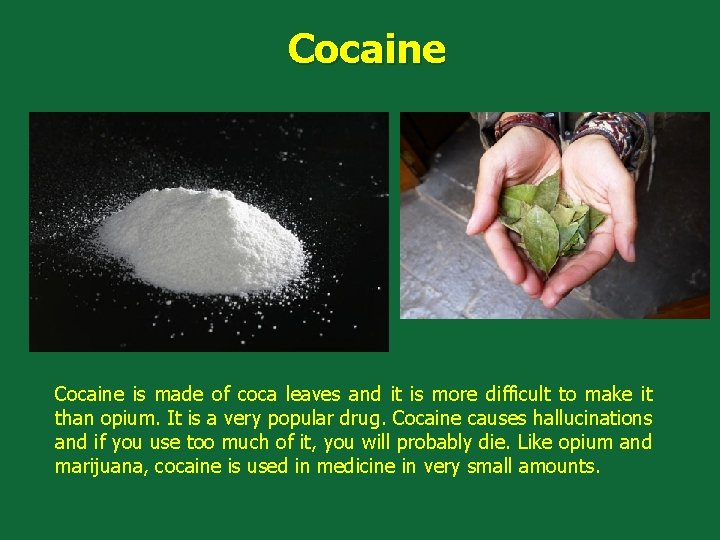
Cocaine is made of coca leaves and it is more difficult to make it than opium. It is a very popular drug. Cocaine causes hallucinations and if you use too much of it, you will probably die. Like opium and marijuana, cocaine is used in medicine in very small amounts.
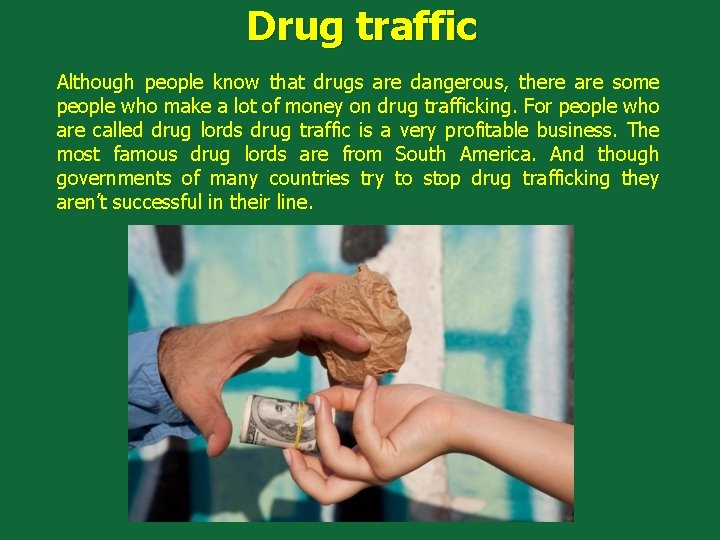
Drug traffic Although people know that drugs are dangerous, there are some people who make a lot of money on drug trafficking. For people who are called drug lords drug traffic is a very profitable business. The most famous drug lords are from South America. And though governments of many countries try to stop drug trafficking they aren’t successful in their line.
Struggle with drugs in some countries Some countries have special services that fight drug trafficking. In Russia it is Federal Drug Control Service and in the USA it’s Drug Enforcement Administration (DEA). In China it is the police responsibility to catch the drug lords. The Chinese authorities punish them very severely. Usually they sentence drug lords to execution.

Thank you for your attention!
- Slides: 13