
Drug Absorption Lesson 4 Organs Tissues Blood T
Drug Absorption Lesson 4
Organs & Tissues Blood T Brain Drug A C T Z

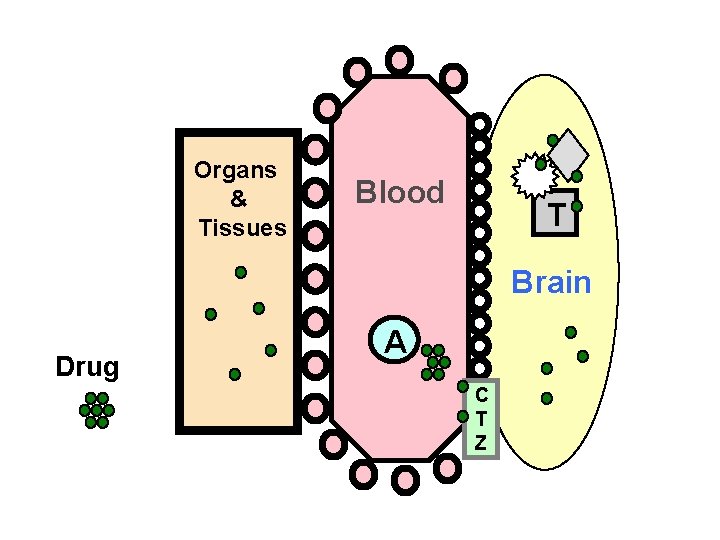
Absorption Movement from administration site into circulatory system n Complete when. . . l concentration at target equals l site of administration n Controlled by membranes l cell l capillary walls l blood-brain barrier l placental barrier ~ n
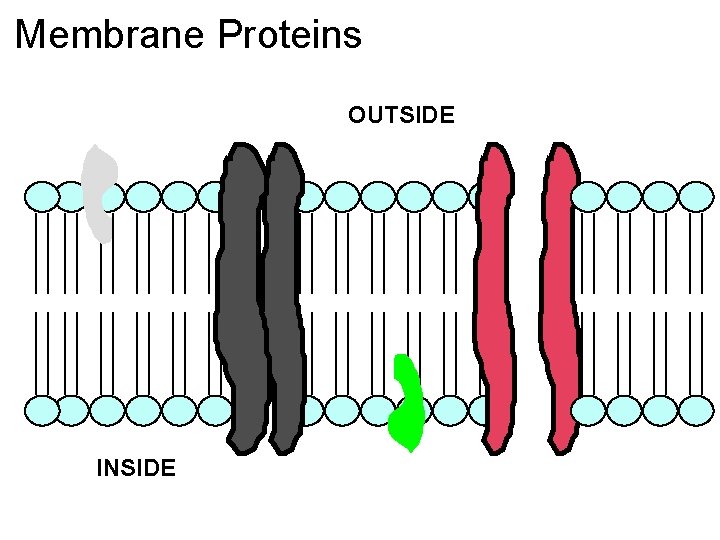
Cell Membranes Lipid bilayer l semipermeable n Fluid Mosaic Model l Phospholipids l Proteins ~ n
Membrane Proteins OUTSIDE INSIDE
Movement Across Membrane Passive diffusion l thru un-gated channels n Carrier assisted transport l diffuse through gated channels n Active transport l requires energy ~ n
Capillaries Exchange of materials l b/n blood and cells n Capillary walls one cell thick l Pores l Spaces between cells l materials can move in/out ~ n
Blood-Brain Barrier (BBB) Barrier b/n circulatory system & brain l peripheral vs. CNS blood supply n Capillaries l cells in wall tightly packed n astrocytes l glia l wrap around capillaries l tight seal ~ n
BBB: Function Maintains stable brain environment l large fluctuations in periphery n Barrier l to poisons l Retains NTs & other chemicals n Regulates nutrient supplies l glucose levels l active transport ~ n
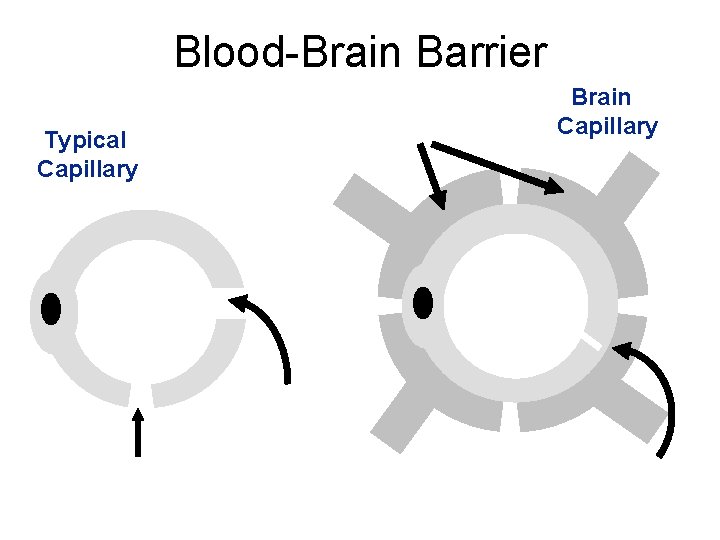
Blood-Brain Barrier Typical Capillary Brain Capillary
BBB: Development Incomplete at birth l up to 2 yrs old l vulnerable during pregnancy n Weakening of BBB l trauma l infection n l aging ~
Chemical Trigger Zone (CTZ) Area Postrema in brainstem l BBB weaker n Substances can enter brain l safety mechanism l neurons monitor blood l rapid in blood concentration triggers vomiting l dopaminergic neurons ~ n
Placental Membrane Exchange nutrients & wastes w/ mother n Less selective than BBB l all lipid soluble substances n Fetus is vulnerable l incomplete BBB l lack enzymes for metabolism ~ n
Placental Membrane Teratogens l chemicals that cause birth defects l alcohol, nicotine, cocaine, etc. n Smoking CO l reduced O 2 levels brain damage ~ n
Solubility Ability to dissolve in a medium n water-soluble n lipid-soluble l easily crosses membranes l also BBB n Molecular size l small absorbed easily ~ n
Solubility: Ionization decreases solubility l ion = charged particle n Lipid-soluble little ionization n Water-soluble ionizes easily l requires carrier assisted or active transport ~ n
Solubility: Polarization Polarity l positive & negative poles l H 2 O n Polar hydrophilic l tend to ionize l will not cross membrane n Non-polar hydrophobic l crosses membrane easily ~ n
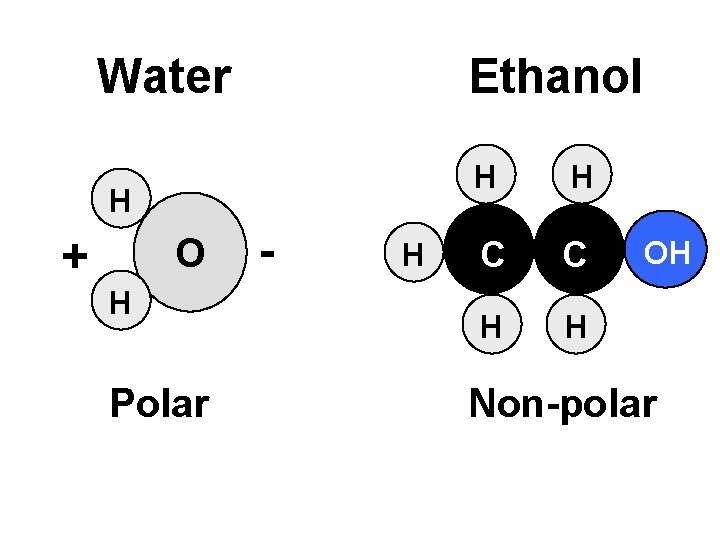
Water Ethanol H + O H Polar - H H H C C H H OH Non-polar
Solubility: p. H scale: 0 -14 n Drugs in solution can ionize l H 2 O H+ and OHn # of H+ in solution relative to OHl High % H+ = acidic l Low % H+ = basic (alkaline) ~ n
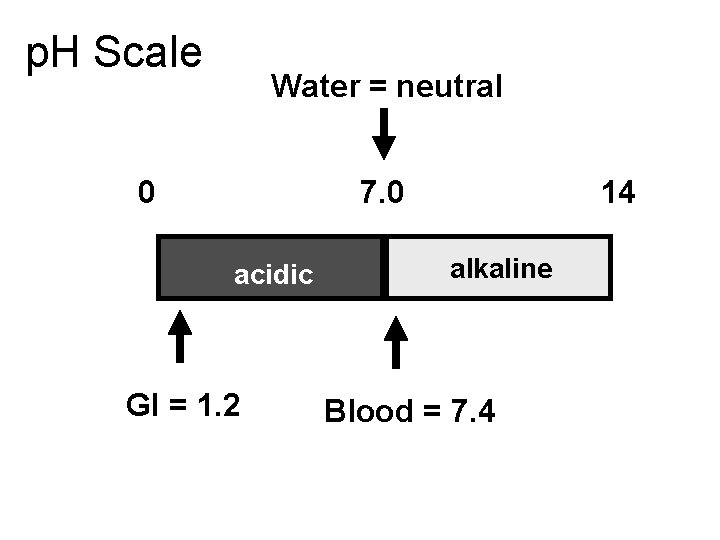
p. H Scale Water = neutral 0 7. 0 acidic GI = 1. 2 14 alkaline Blood = 7. 4
Ion Trapping Drug & p. H important n Ionization decreases solubility l acidic drug in alkaline ionize l alkaline drug in acidic ionize n Per Os ? l acidic drug best ~ n
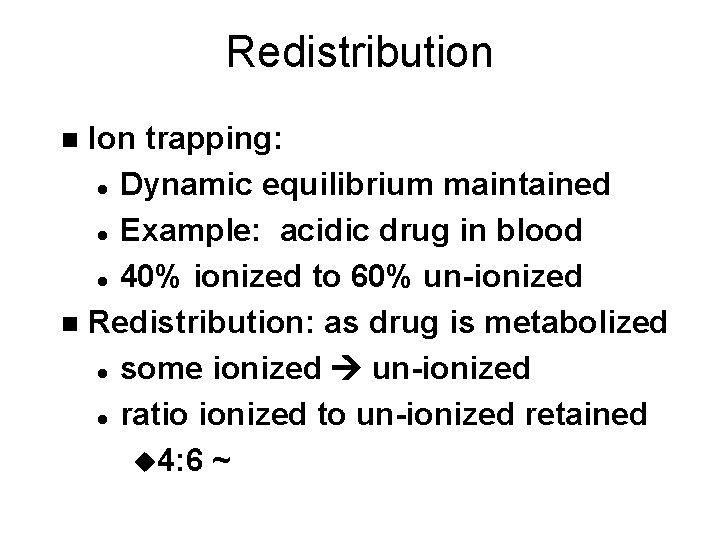
Redistribution Ion trapping: l Dynamic equilibrium maintained l Example: acidic drug in blood l 40% ionized to 60% un-ionized n Redistribution: as drug is metabolized l some ionized un-ionized l ratio ionized to un-ionized retained u 4: 6 ~ n
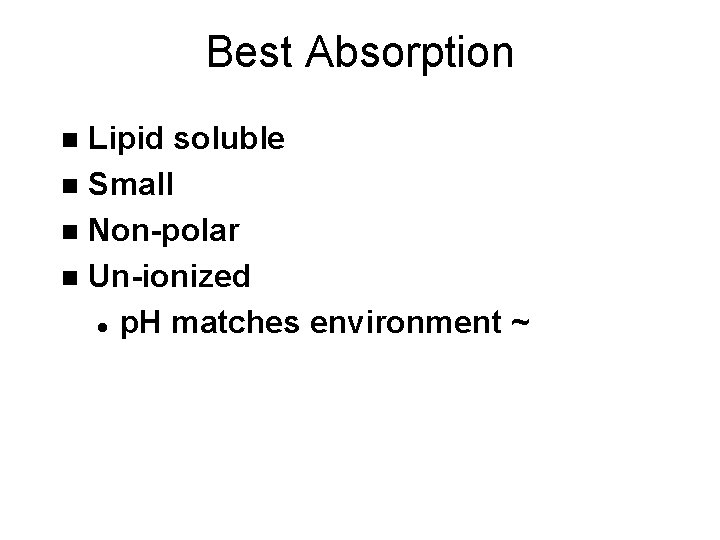
Best Absorption Lipid soluble n Small n Non-polar n Un-ionized l p. H matches environment ~ n
- Slides: 23