
Drs Sven Van Laere NOMENCLATURES IN EHEALTH Personal


- Slides: 51
Drs. Sven Van Laere NOMENCLATURES IN E-HEALTH
Personal • Sven VAN LAERE • 4 rd year Ph. D – Research in nomenclatures in e. Health systems in Belgium related to pharmacy Promotor: Prof. Dr. M. Nyssen • Previous – MSc in Engineering: Computer Science (2013) – Professional Bachelor in Applied Informatics (2010)
Content Table • Definition • Clinical ideas • History • Nomenclatures in e-health • “Coding”
Definition • Nomenclature – Nomen – Calare - name - to call • Definition – A system of names used in a science, as of anatomical structures or biological organisms
Clinical idea • Clinical idea comprise everything we think we know about health, illness, prevention, investigation, and treatment • Clinical ideas are the building blocks of a personal health record • Connected clinical ideas are essential for a connected health service
Clinical idea? • • Diseases Organisms Operations Procedures Devices Drugs Part of the body …
Working with clinical ideas • Anyone involved in delivering healthcare • Recognition, manipulation and interconnection of clinical ideas is a necessary part of the practice of any clinical discipline • Growth of knowledge requires new clinical ideas to be developed, expressed and tested • Effective delivery of high-quality health care requires clinical ideas to be shared in ways that… – Enhance the quality of the patient care – Facilitate the growth of clinical knowledge – Demonstrably deliver value to money
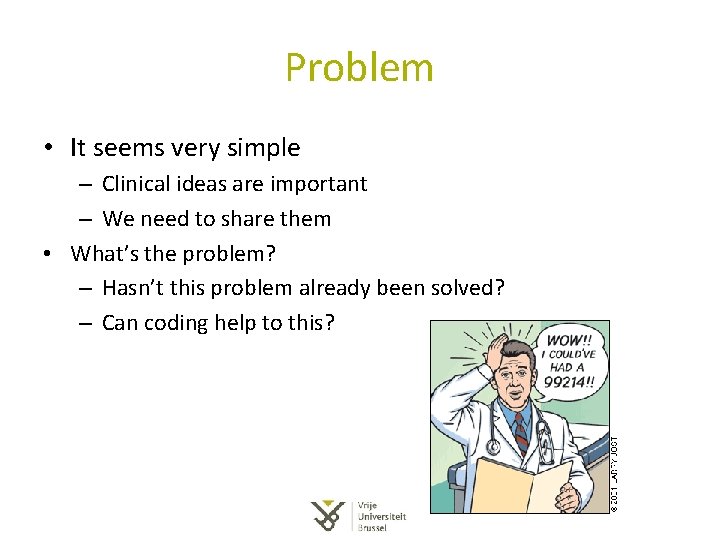
Problem • It seems very simple – Clinical ideas are important – We need to share them • What’s the problem? – Hasn’t this problem already been solved? – Can coding help to this?
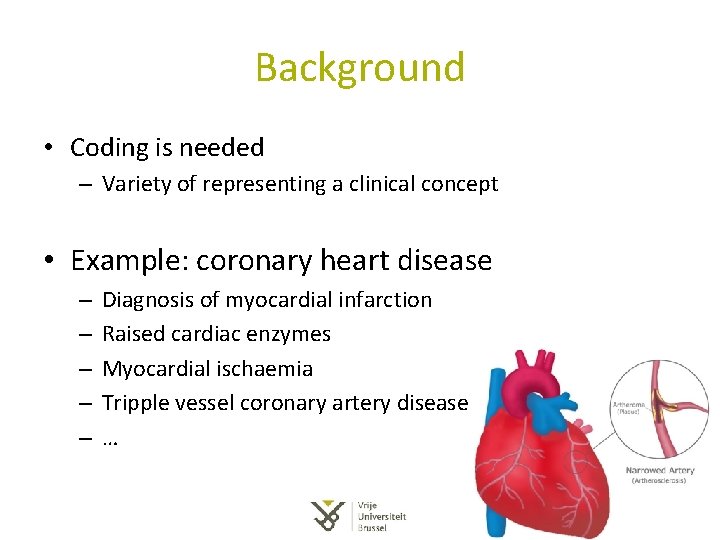
Background • Coding is needed – Variety of representing a clinical concept • Example: coronary heart disease – – – Diagnosis of myocardial infarction Raised cardiac enzymes Myocardial ischaemia Tripple vessel coronary artery disease …
Why • Need for a uniform way of expressing – Audit – NLP has not reached the point where free text can be automatically turned into codes – Scientific research – Clinical decision support –…
History – Text based records • 1970 – floppy disk invented – IBM introduced a pilot system in GP practice in Exeter, UK • 1976 – inktjet printer invented, VHS video tape introduced – ICL launched GP system in Otterly St Mary, Exeter, UK – 1980: Text based patient records stored on mainframe computer • expensive pilot project – Patient records linked by landlines – Free text allowed users to express clinical ideas • Easy for data entry • Problem with retrieval
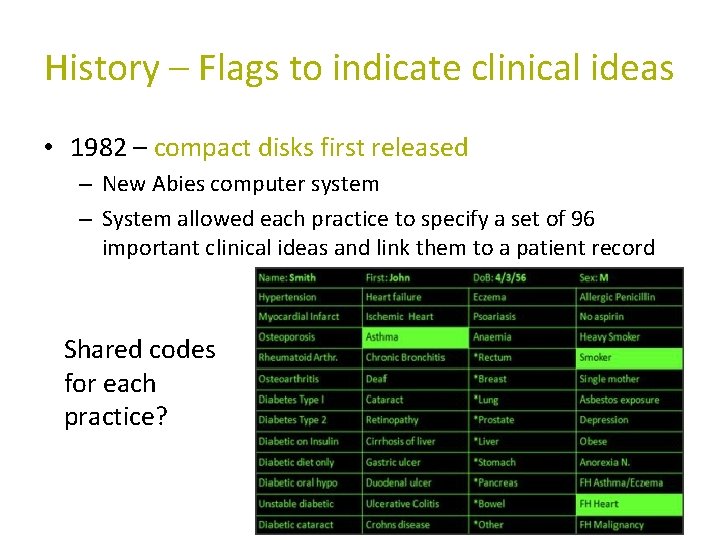
History – Flags to indicate clinical ideas • 1982 – compact disks first released – New Abies computer system – System allowed each practice to specify a set of 96 important clinical ideas and link them to a patient record Shared codes for each practice?
History – Coding clinical ideas • 1983 – Lotus 1 -2 -3 spreadsheet arrived – Memory got a bit cheaper – Dated coded entries are added to the system – The codes are symple mnemonics with no structure Links between similar ideas? => Still hard to query the data
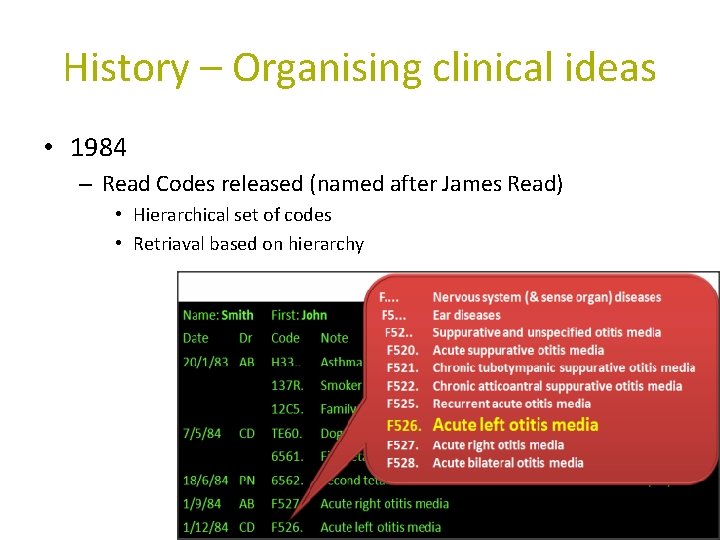
History – Organising clinical ideas • 1984 – Read Codes released (named after James Read) • Hierarchical set of codes • Retriaval based on hierarchy
History – Organising clinical ideas • 1986 – late 1990’s there was a wider use of clinical systems using coded data – Read codes in the UK, SNOMED in the US, ICD-9 classification codes in several countries – The scope of coverage was broadening according to scientific improvements – Codes served a useful purpose and continued to be used – However growing awareness of limitations in simple approaches to codes and hierarchies
History – Organising clinical ideas • 1986 – late 1990’s there was a wider use of clinical systems using coded data – Read codes in the UK, SNOMED in the US, ICD-9 classification codes in several countries – The scope of coverage was broadening according to scientific improvements – Codes served a useful purpose and continued to be used – However growing awareness of limitations in simple approaches to codes and hierarchies
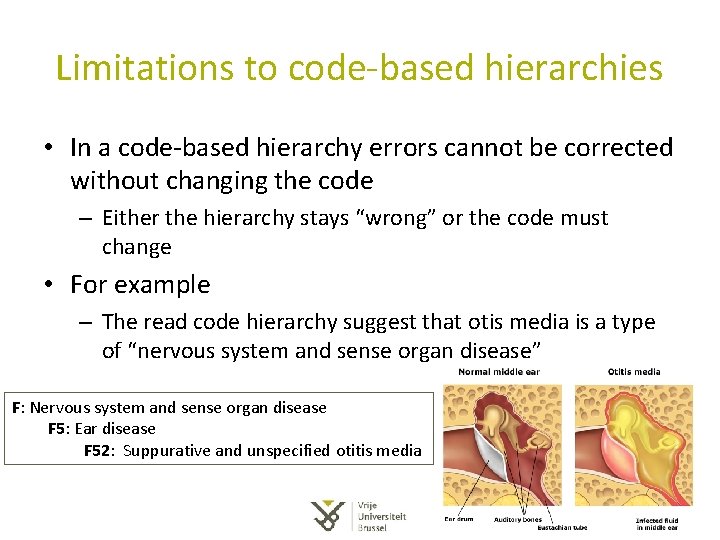
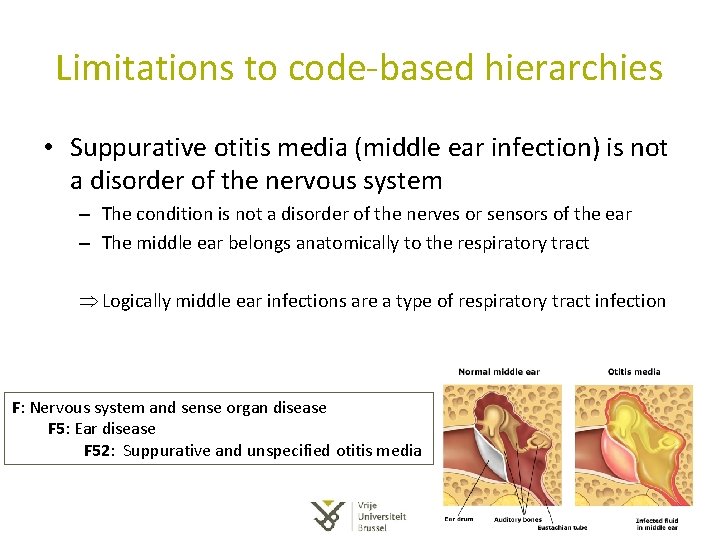
Limitations to code-based hierarchies • In a code-based hierarchy errors cannot be corrected without changing the code – Either the hierarchy stays “wrong” or the code must change • For example – The read code hierarchy suggest that otis media is a type of “nervous system and sense organ disease” F: Nervous system and sense organ disease F 5: Ear disease F 52: Suppurative and unspecified otitis media
Limitations to code-based hierarchies • Suppurative otitis media (middle ear infection) is not a disorder of the nervous system – The condition is not a disorder of the nerves or sensors of the ear – The middle ear belongs anatomically to the respiratory tract Þ Logically middle ear infections are a type of respiratory tract infection F: Nervous system and sense organ disease F 5: Ear disease F 52: Suppurative and unspecified otitis media
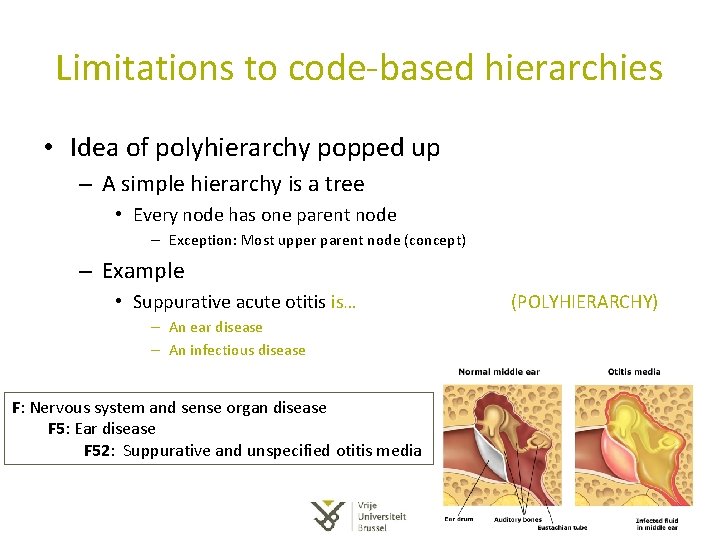
Limitations to code-based hierarchies • Idea of polyhierarchy popped up – A simple hierarchy is a tree • Every node has one parent node – Exception: Most upper parent node (concept) – Example • Suppurative acute otitis is… – An ear disease – An infectious disease F: Nervous system and sense organ disease F 5: Ear disease F 52: Suppurative and unspecified otitis media (POLYHIERARCHY)
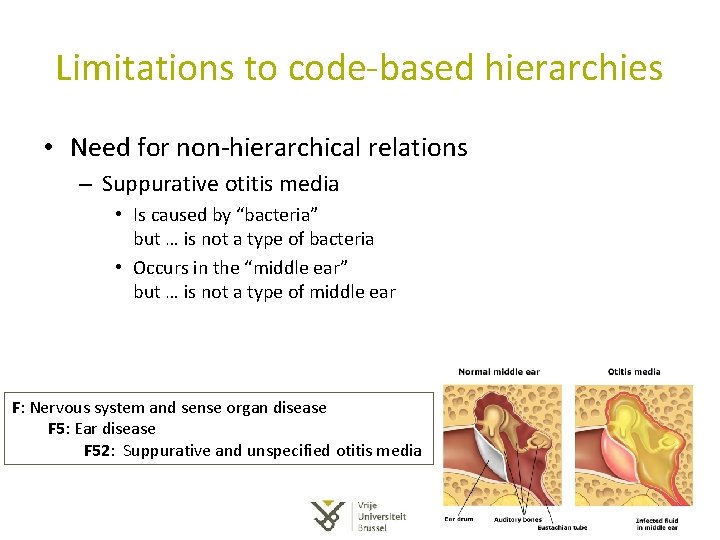
Limitations to code-based hierarchies • Need for non-hierarchical relations – Suppurative otitis media • Is caused by “bacteria” but … is not a type of bacteria • Occurs in the “middle ear” but … is not a type of middle ear F: Nervous system and sense organ disease F 5: Ear disease F 52: Suppurative and unspecified otitis media
ICPC • International Classification of Primary Care • Author: WONCA Int. Class. Committee • Two versions: – 1987: ICPC-1 – 1998: WHO (accepted within WHO)
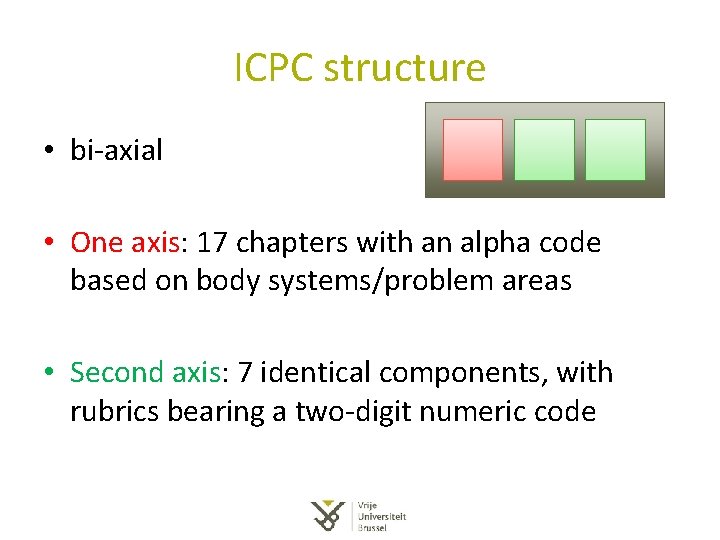
ICPC structure • bi-axial • One axis: 17 chapters with an alpha code based on body systems/problem areas • Second axis: 7 identical components, with rubrics bearing a two-digit numeric code
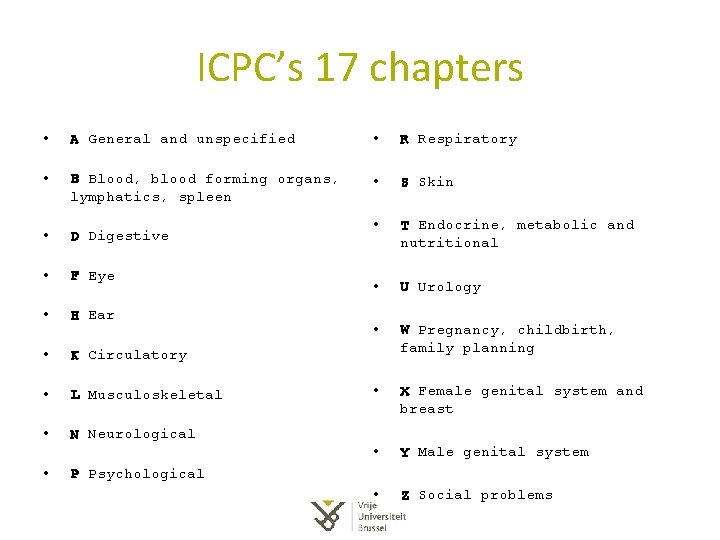
ICPC’s 17 chapters • A General and unspecified • R Respiratory • B Blood, blood forming organs, lymphatics, spleen • S Skin • D Digestive • T Endocrine, metabolic and nutritional • F Eye • U Urology • H Ear • W Pregnancy, childbirth, family planning • X Female genital system and breast • Y Male genital system • Z Social problems • K Circulatory • L Musculoskeletal • N Neurological • P Psychological
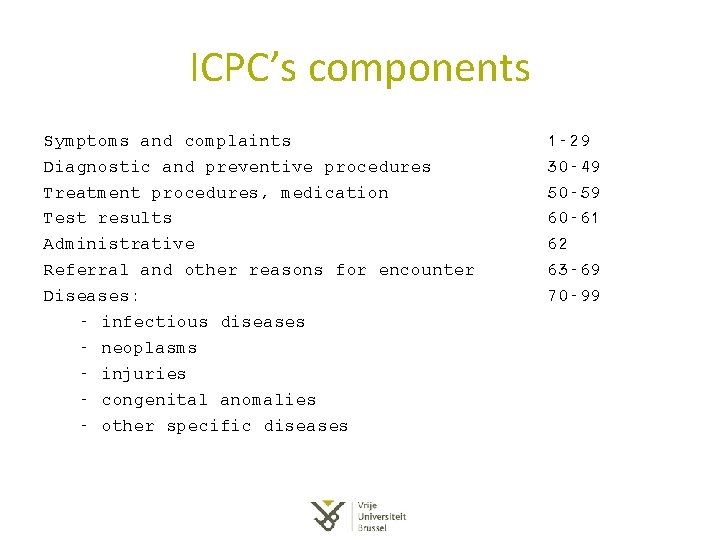
ICPC’s components Symptoms and complaints Diagnostic and preventive procedures Treatment procedures, medication Test results Administrative Referral and other reasons for encounter Diseases: - infectious diseases - neoplasms - injuries - congenital anomalies - other specific diseases 1 -29 30 -49 50 -59 60 -61 62 63 -69 70 -99
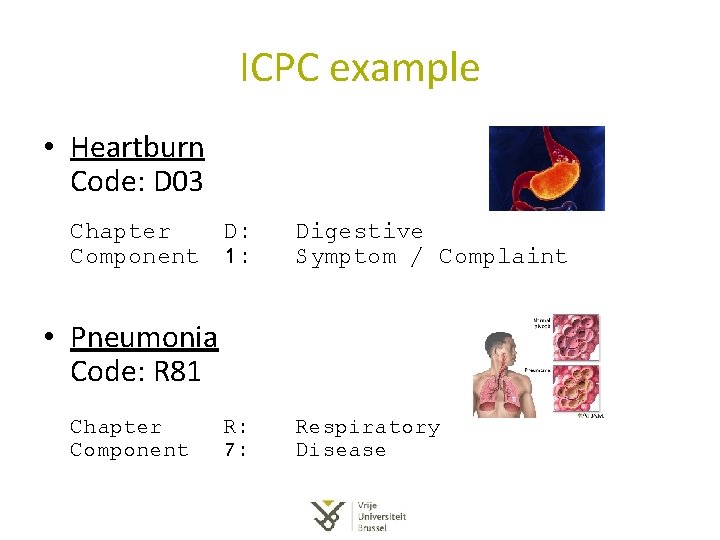
ICPC example • Heartburn Code: D 03 Chapter D: Component 1: Digestive Symptom / Complaint • Pneumonia Code: R 81 Chapter Component R: 7: Respiratory Disease
Read Codes • Set of clinical codes designed for Primary Care to record the every day care of a Patient • Used in United Kingdom • Developed by Dr James Read (GP, Loughborough) • Recognized standard for General Practice • Hierarchical structure
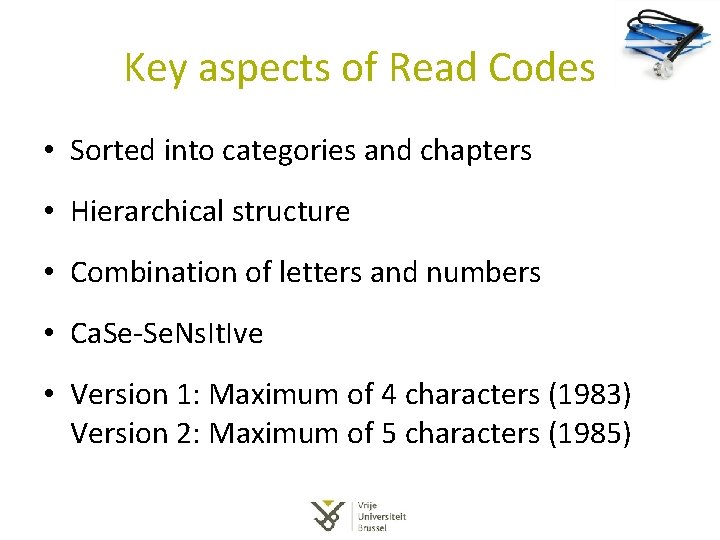
Key aspects of Read Codes • Sorted into categories and chapters • Hierarchical structure • Combination of letters and numbers • Ca. Se-Se. Ns. It. Ive • Version 1: Maximum of 4 characters (1983) Version 2: Maximum of 5 characters (1985)
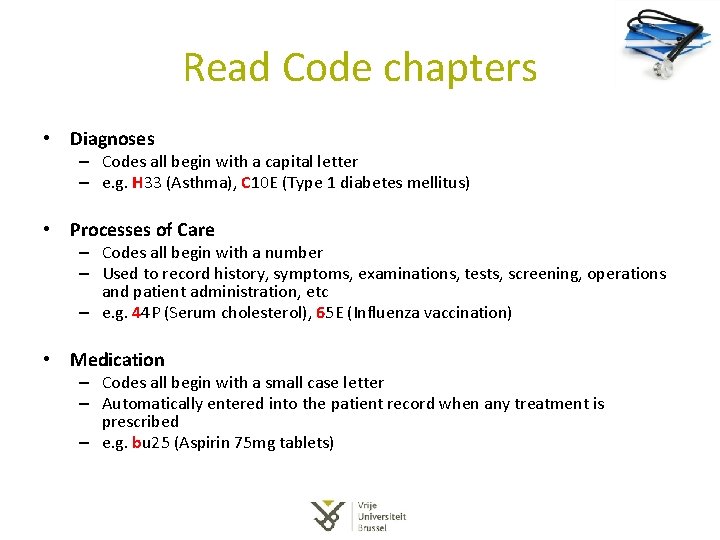
Read Code chapters • Diagnoses – Codes all begin with a capital letter – e. g. H 33 (Asthma), C 10 E (Type 1 diabetes mellitus) • Processes of Care – Codes all begin with a number – Used to record history, symptoms, examinations, tests, screening, operations and patient administration, etc – e. g. 44 P (Serum cholesterol), 65 E (Influenza vaccination) • Medication – Codes all begin with a small case letter – Automatically entered into the patient record when any treatment is prescribed – e. g. bu 25 (Aspirin 75 mg tablets)
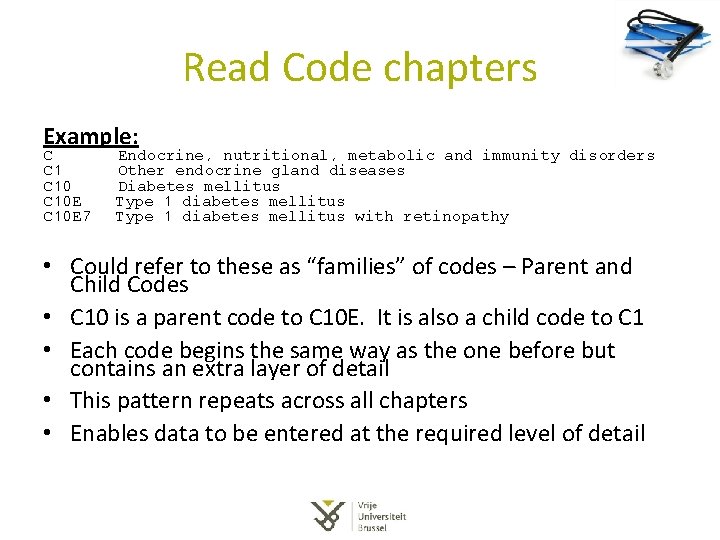
Read Code chapters Example: C C 10 E 7 Endocrine, nutritional, metabolic and immunity disorders Other endocrine gland diseases Diabetes mellitus Type 1 diabetes mellitus with retinopathy • Could refer to these as “families” of codes – Parent and Child Codes • C 10 is a parent code to C 10 E. It is also a child code to C 1 • Each code begins the same way as the one before but contains an extra layer of detail • This pattern repeats across all chapters • Enables data to be entered at the required level of detail
Read version 3, Clinical Terms • 1994: CTv 3 – Read version 3, clinical terms – Clinical Terms version 3 • Intention: develop terminology that could include specialist practice • Used in small minority in UK • Merged with SNOMED => SNOMED CT
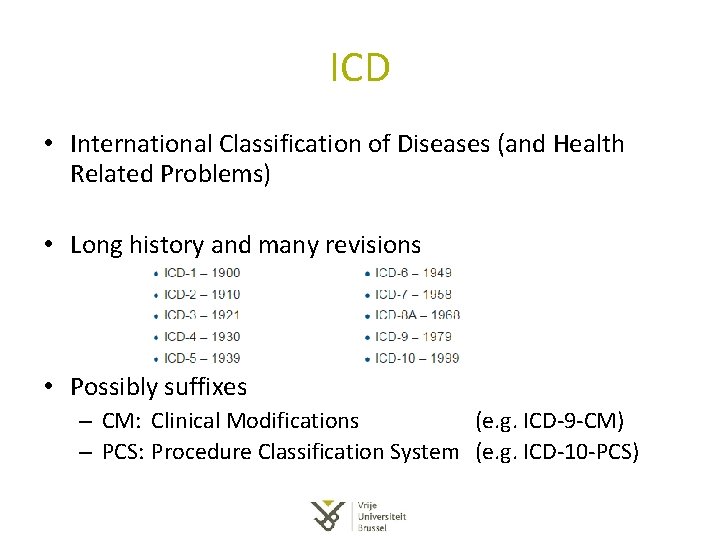
ICD • International Classification of Diseases (and Health Related Problems) • Long history and many revisions • Possibly suffixes – CM: Clinical Modifications (e. g. ICD-9 -CM) – PCS: Procedure Classification System (e. g. ICD-10 -PCS)
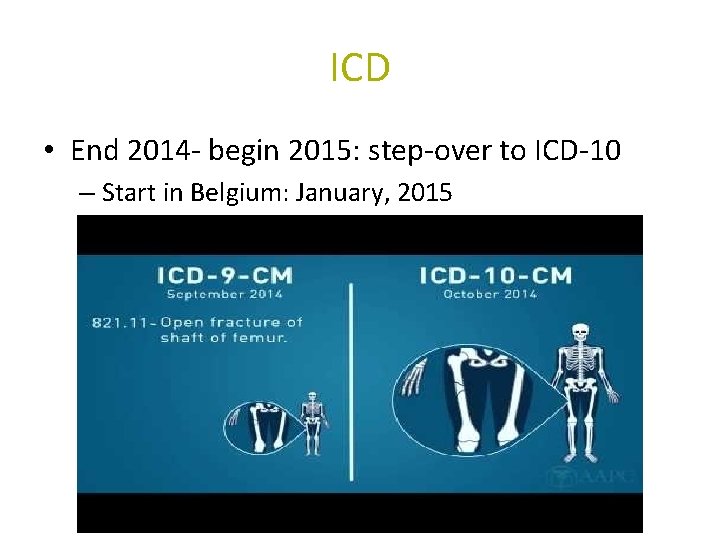
ICD • End 2014 - begin 2015: step-over to ICD-10 – Start in Belgium: January, 2015
SNOMED • In 1965 – SNOP was developed by the College of American Pathologists (USA) • Next 50 years – several changes on … • … the number of concepts • … the covered domains • … the underlying representation formalism… • Result: Systematized Nomenclature of Medicine, Clinical Terms (SNOMED CT) released in 2002
SNOMED CT • Controlled coded clinical terminology for use in Electronic Health Records • Helps in adding meaning to the EHR • SCT maintained and distributed by the IHTSDO since 2007
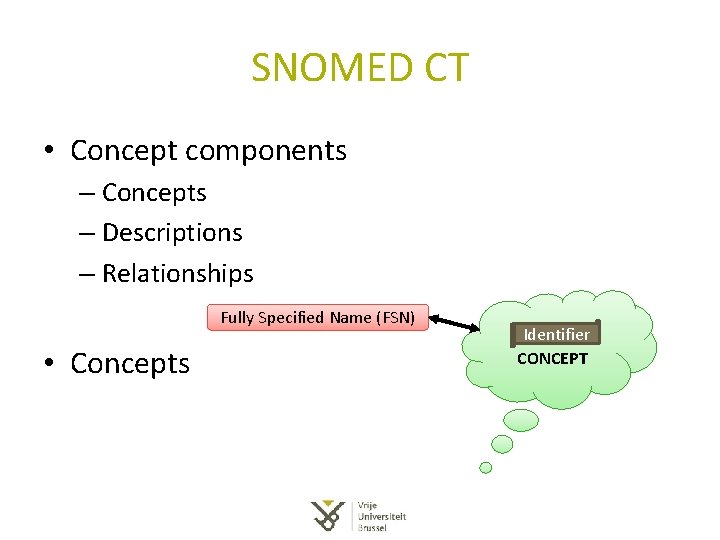
SNOMED CT • Concept components – Concepts – Descriptions – Relationships Fully Specified Name (FSN) • Concepts Identifier CONCEPT
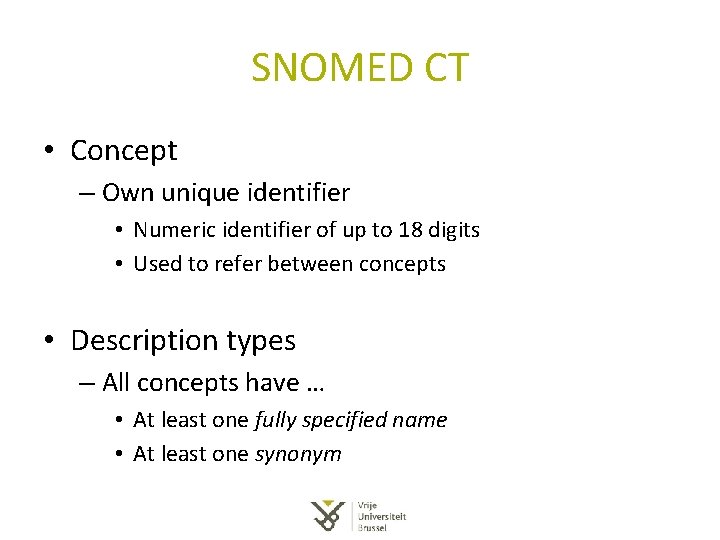
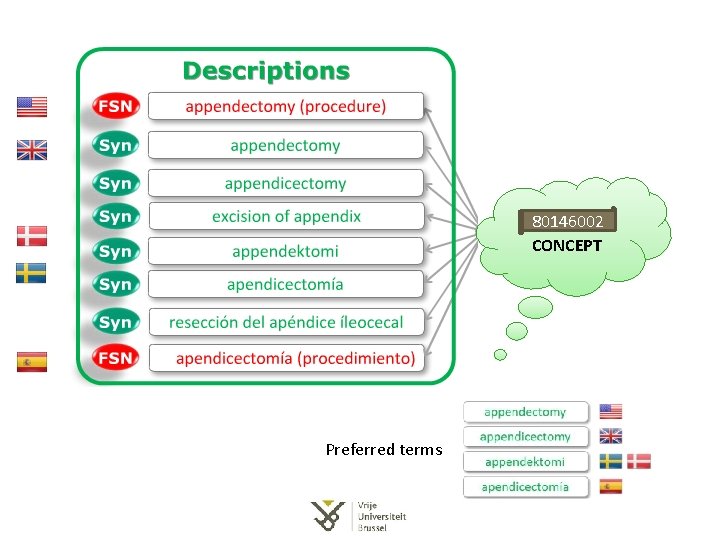
SNOMED CT • Concept – Own unique identifier • Numeric identifier of up to 18 digits • Used to refer between concepts • Description types – All concepts have … • At least one fully specified name • At least one synonym
80146002 CONCEPT Preferred terms
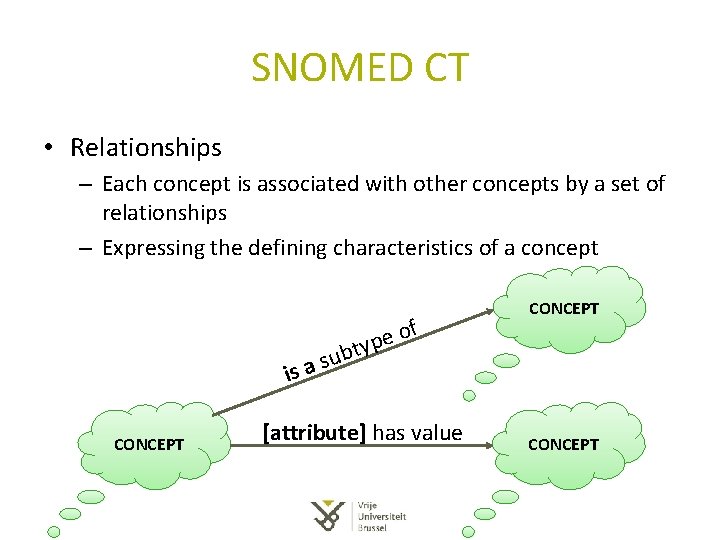
SNOMED CT • Relationships – Each concept is associated with other concepts by a set of relationships – Expressing the defining characteristics of a concept f o e typ CONCEPT b u s a is CONCEPT [attribute] has value CONCEPT
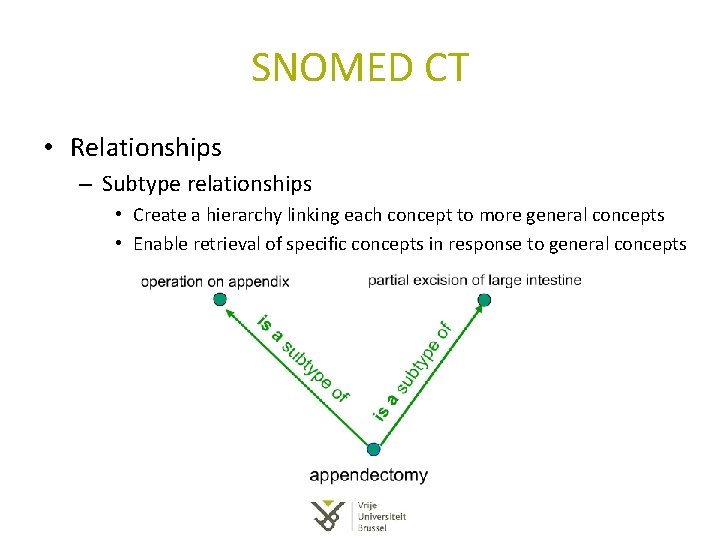
SNOMED CT • Relationships – Subtype relationships • Create a hierarchy linking each concept to more general concepts • Enable retrieval of specific concepts in response to general concepts
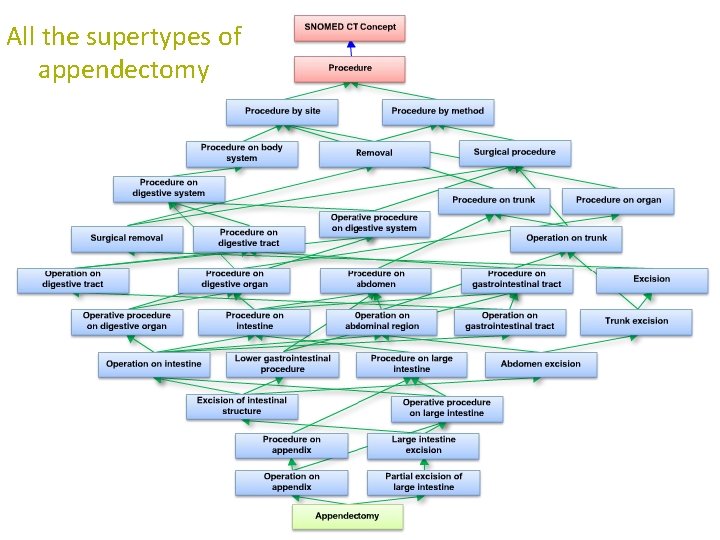
All the supertypes of appendectomy
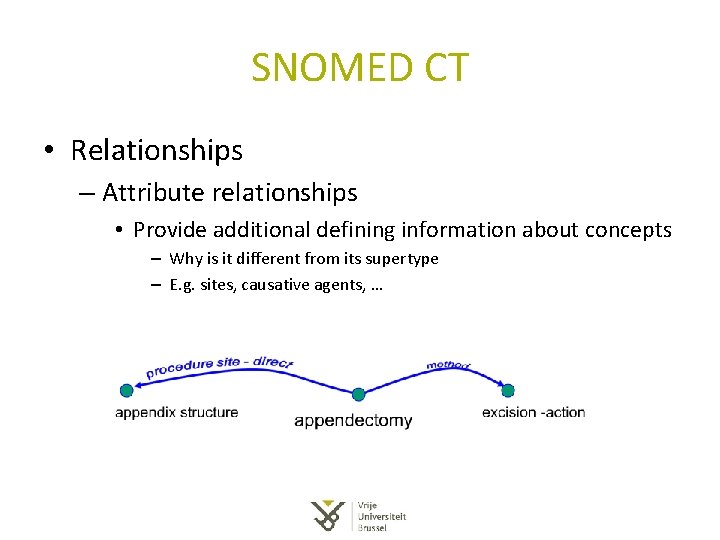
SNOMED CT • Relationships – Attribute relationships • Provide additional defining information about concepts – Why is it different from its supertype – E. g. sites, causative agents, …
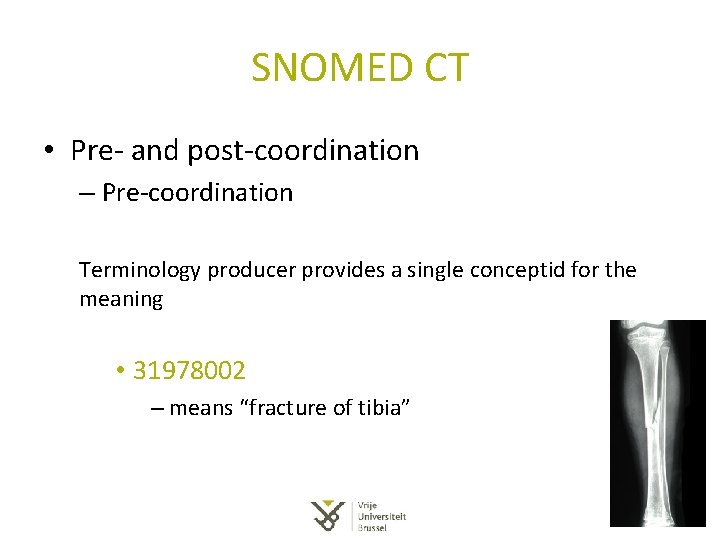
SNOMED CT • Pre- and post-coordination – Pre-coordination Terminology producer provides a single conceptid for the meaning • 31978002 – means “fracture of tibia”
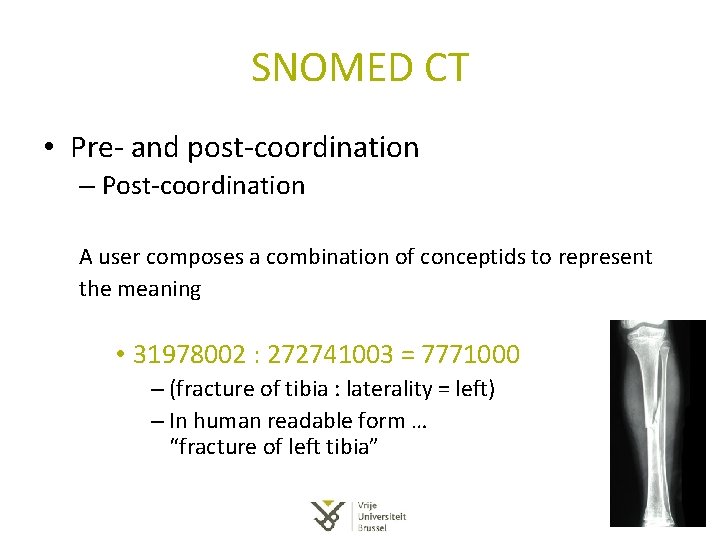
SNOMED CT • Pre- and post-coordination – Post-coordination A user composes a combination of conceptids to represent the meaning • 31978002 : 272741003 = 7771000 – (fracture of tibia : laterality = left) – In human readable form … “fracture of left tibia”
SNOMED CT • Which one is best to use? ?
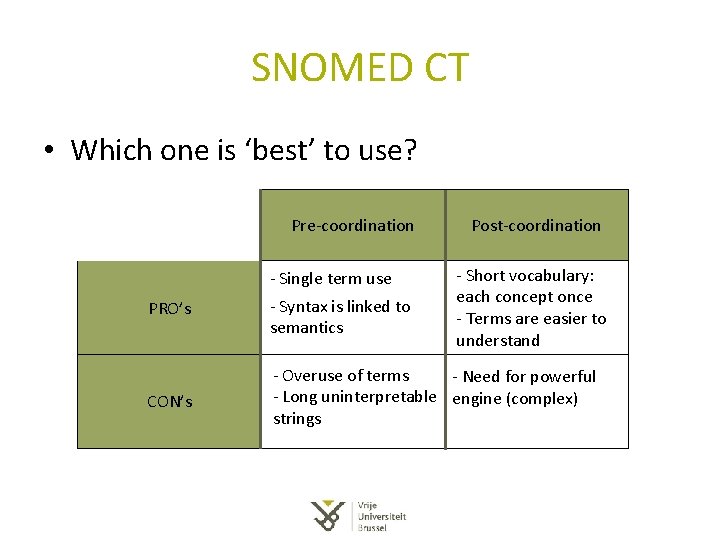
SNOMED CT • Which one is ‘best’ to use? Pre-coordination - Single term use Post-coordination - Short vocabulary: each concept once - Terms are easier to understand PRO’s - Syntax is linked to semantics CON’s - Overuse of terms - Need for powerful - Long uninterpretable engine (complex) strings
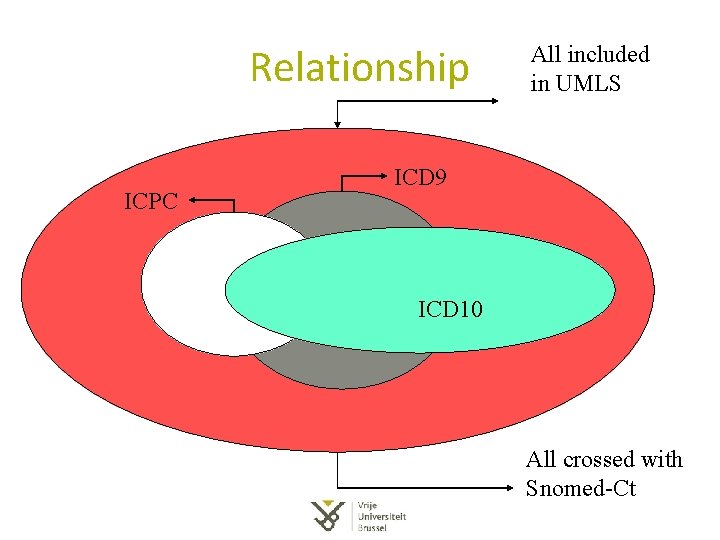
Relationship ICPC All included in UMLS ICD 9 ICD 10 All crossed with Snomed-Ct
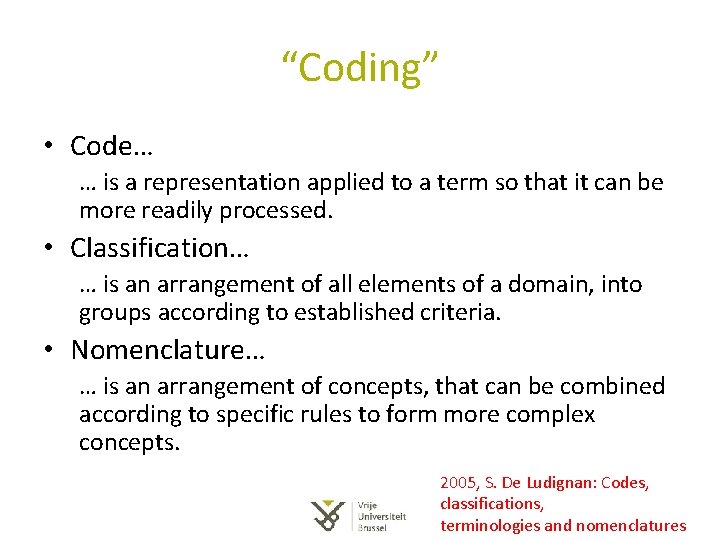
“Coding” • Code… … is a representation applied to a term so that it can be more readily processed. • Classification… … is an arrangement of all elements of a domain, into groups according to established criteria. • Nomenclature… … is an arrangement of concepts, that can be combined according to specific rules to form more complex concepts. 2005, S. De Ludignan: Codes, classifications, terminologies and nomenclatures
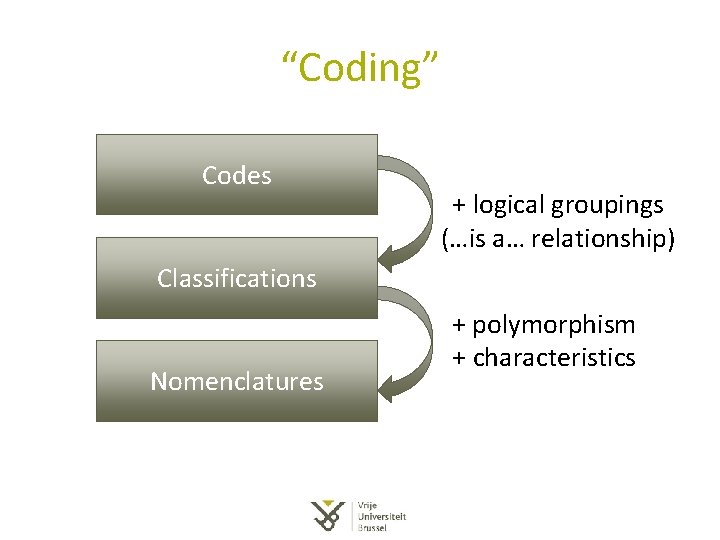
“Coding” Codes + logical groupings (…is a… relationship) Classifications Nomenclatures + polymorphism + characteristics
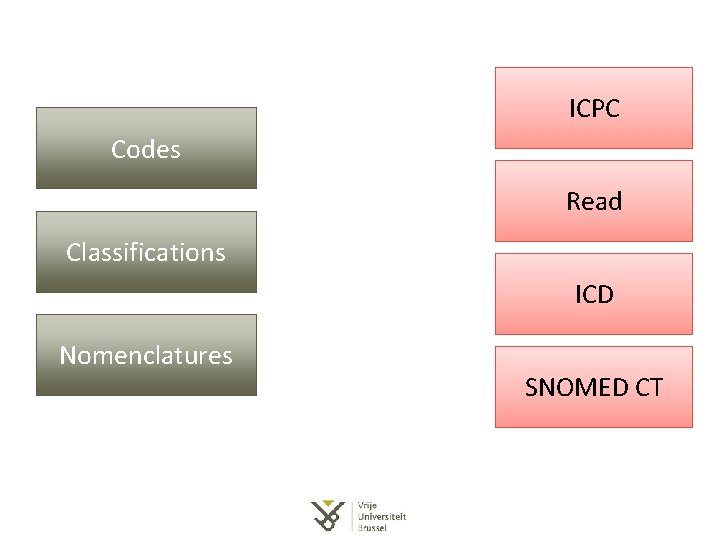
ICPC Codes Read Classifications ICD Nomenclatures SNOMED CT
Sources • Papers – 2005, S. De Ludignan: Codes, classifications, terminologies and nomenclatures – 2006, R. Cornet: A framework for characterizing terminological systems • Presentations – IHTSDO: Why Clinical Terminology Matters – Health Informatics: Terminology and classification • Videos – What is ICD 10? https: //www. youtube. com/watch? v=ZPDgt. DDTc 8 k