
Drought or no drought How is Your Longterm
- Slides: 33
Drought or no drought? How is Your Long-term Financially Feasible Water OR Efficiency Plan Coming Along? Rusty Harris-Bishop Environmental Engineer NC Div. Pollution Prevention and Environmental Assistance
HUH? WHAT? A PLAN? WHY?
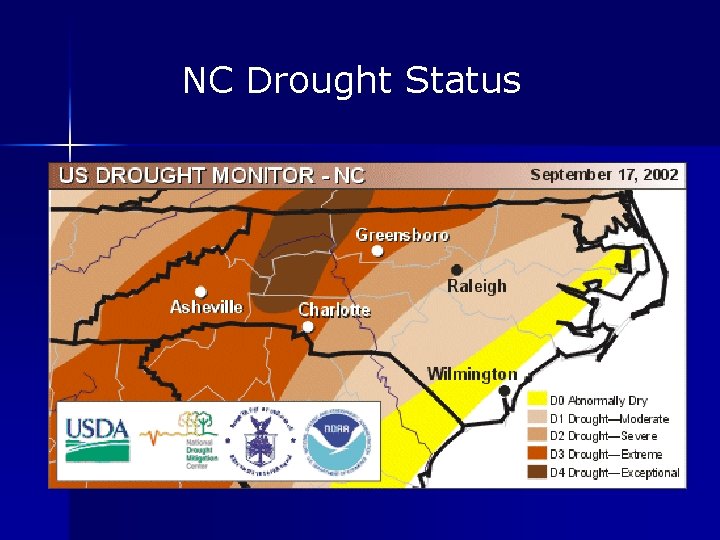
NC Drought Status
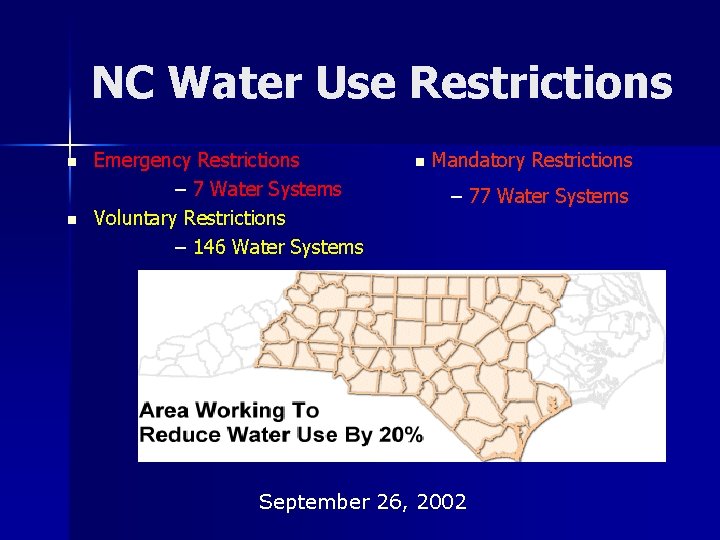
NC Water Use Restrictions n n Emergency Restrictions – 7 Water Systems Voluntary Restrictions – 146 Water Systems n Mandatory Restrictions – 77 Water Systems September 26, 2002
Executive Order #26 Water System Protection n All state government agencies discontinue “nonessential” water use until further notice n All such agencies immediately develop and begin implementing long term, financially feasible conservation measures Signed August 15, 2002
Benefits of Water Efficiency Programs n Reduces Water Demand – Generally faster, cheaper & easier n Waste and Wastewater Treatment Savings – Reduce and defers costs & pretreatment req. n Less Environmental Impact – Due to less surface and subsurface withdrawals n Sustained Water Quality – New supplies can be of lesser quality
Planning for Water Efficiency n n n n Information Collection Top management support Determine internal baselines and/or external benchmarks Determine target areas Determine best available techniques and technologies -advantages & disadvantages projects Develop Action plan with timelines & responsibilities Track & Communicate Results
Things to Ask Yourself n n n n Do we have continuing senior management commitment? Do we have the information we need? Have we established a team? Do we have an Action Plan & schedule? How are we promoting awareness? How are we encouraging employee/student participation? Are contingency plans in the works?
Establishing a Baseline n n Record incoming water and production information. Identify all points and amounts of water use (intermittent and continuous). Determine water quality requirements for each area of water use. Develop a chart of the various operations and the estimated daily water use.
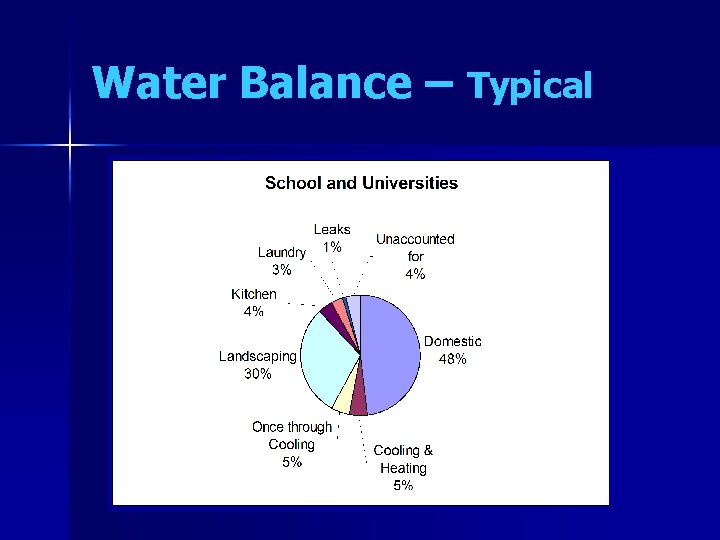
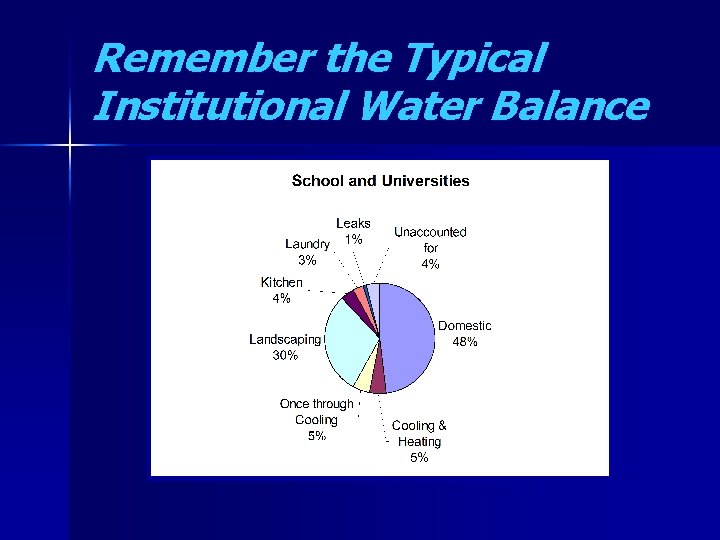
Water Balance – Typical
Low & No-Cost Measures n n n Install aerators on all faucets Put water-filled plastic bottles (milk jugs) or dams in toilet tanks Install low flow showerheads and other plumbing equipment Reduce water pressure Reduce water flow rates at lavatory faucets and at tank -less toilet valves Turn off water-using equipment when not in use n n n Reduce or eliminate oncethrough cooling water Turn off air handling and cooling towers at nights and on weekends Attach shut-off nozzles to all hand held hoses Sweep instead of using a hose to clean and implement other dry cleanup techniques Minimize garbage disposal use
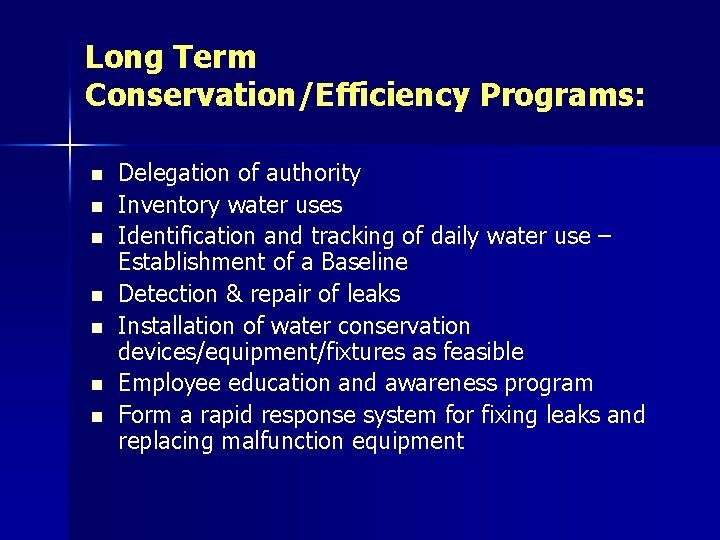
Long Term Conservation/Efficiency Programs: n n n n Delegation of authority Inventory water uses Identification and tracking of daily water use – Establishment of a Baseline Detection & repair of leaks Installation of water conservation devices/equipment/fixtures as feasible Employee education and awareness program Form a rapid response system for fixing leaks and replacing malfunction equipment
Water Management Options Sanitary/Domestic Cooling & Heating Kitchen/Food Preparation Cleaning & Rinsing Reuse Landscaping
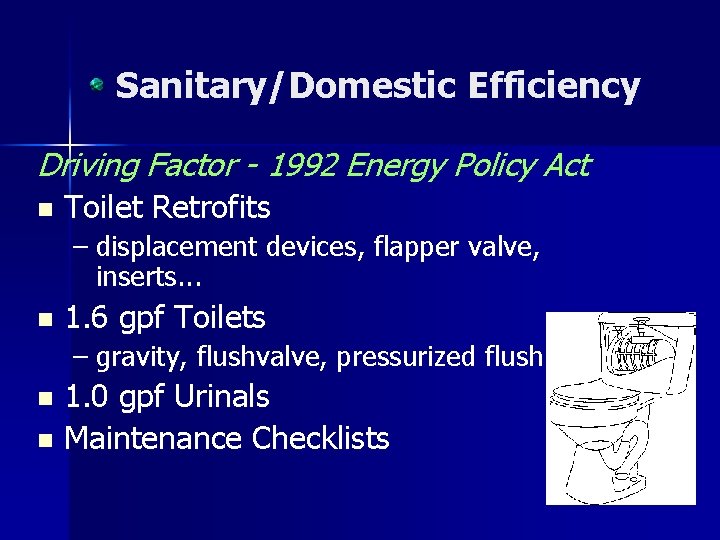
Sanitary/Domestic Efficiency Driving Factor - 1992 Energy Policy Act n Toilet Retrofits – displacement devices, flapper valve, inserts. . . n 1. 6 gpf Toilets – gravity, flushvalve, pressurized flush units 1. 0 gpf Urinals n Maintenance Checklists n
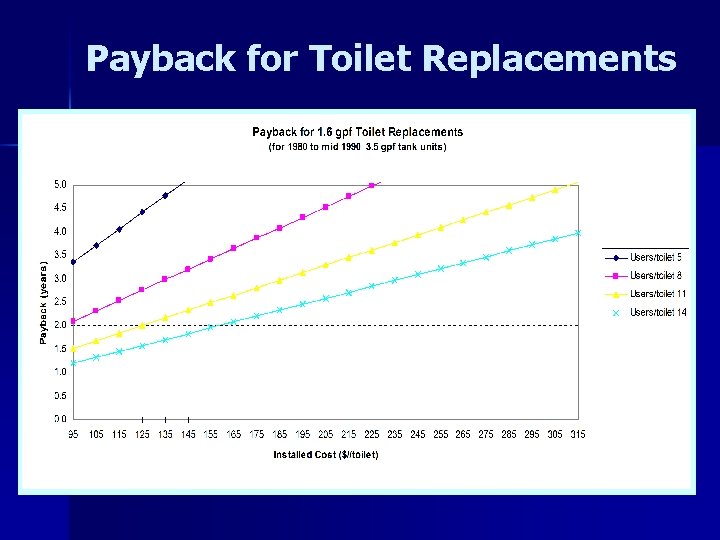
Payback for Toilet Replacements
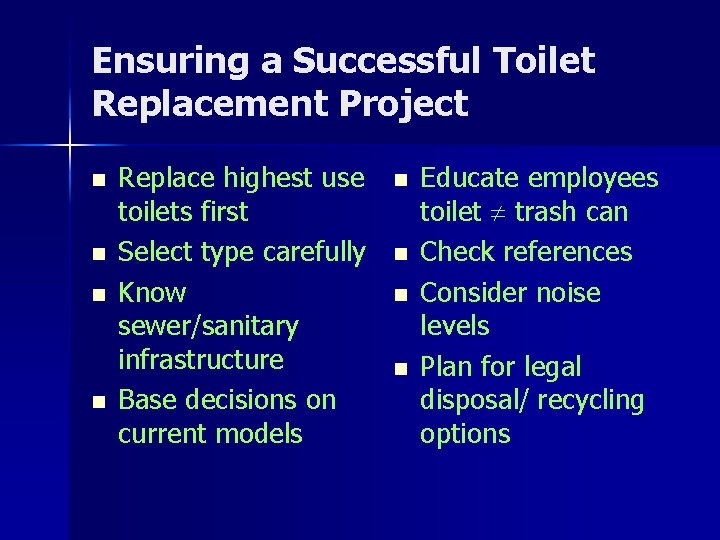
Ensuring a Successful Toilet Replacement Project n n Replace highest use toilets first Select type carefully Know sewer/sanitary infrastructure Base decisions on current models n n Educate employees toilet trash can Check references Consider noise levels Plan for legal disposal/ recycling options
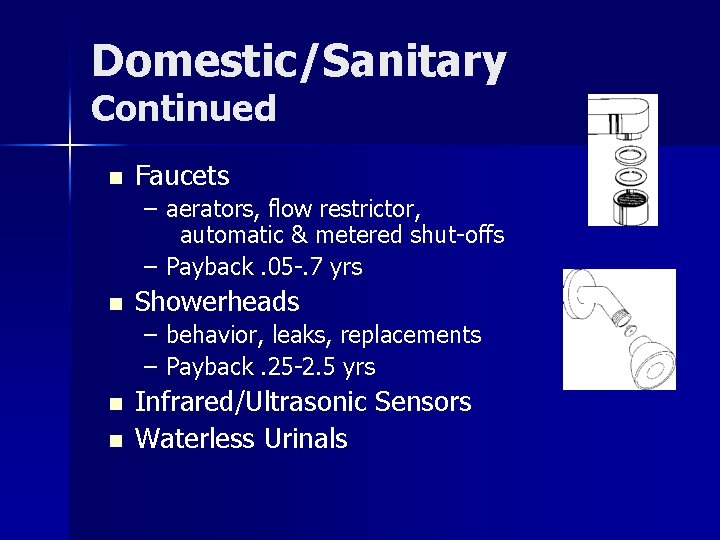
Domestic/Sanitary Continued n Faucets – aerators, flow restrictor, automatic & metered shut-offs – Payback. 05 -. 7 yrs n Showerheads – – n n behavior, leaks, replacements Payback. 25 -2. 5 yrs Infrared/Ultrasonic Sensors Waterless Urinals
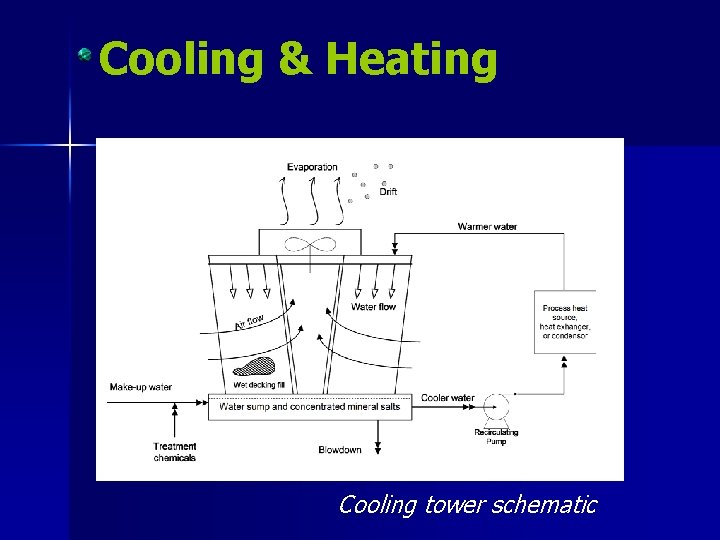
Cooling & Heating Cooling tower schematic
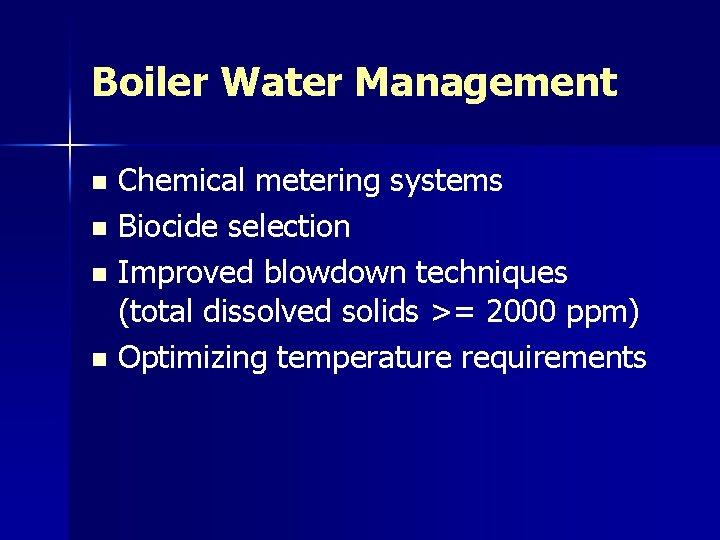
Boiler Water Management Chemical metering systems n Biocide selection n Improved blowdown techniques (total dissolved solids >= 2000 ppm) n Optimizing temperature requirements n
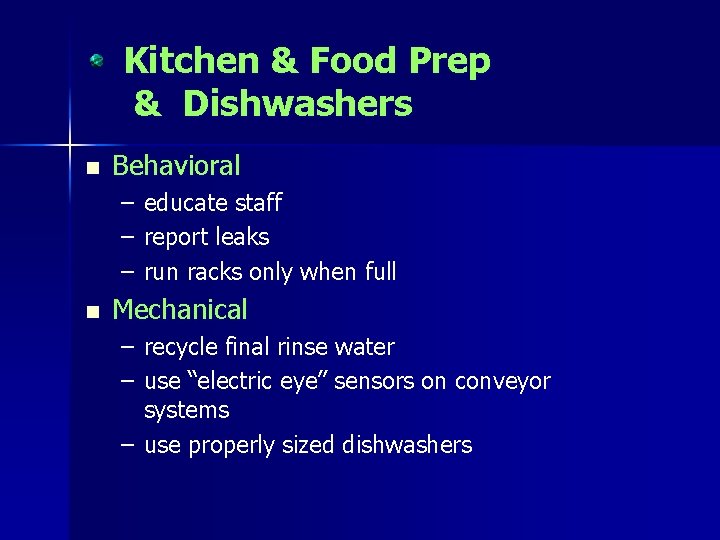
Kitchen & Food Prep & Dishwashers n Behavioral – – – n educate staff report leaks run racks only when full Mechanical – recycle final rinse water – use “electric eye” sensors on conveyor systems – use properly sized dishwashers
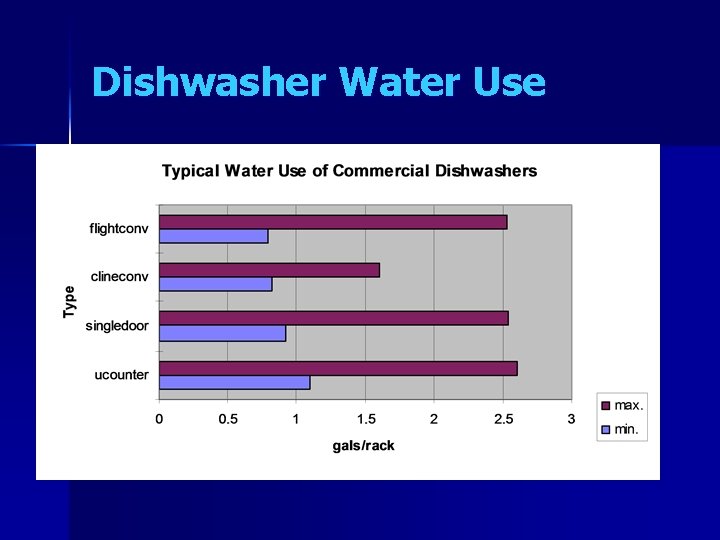
Dishwasher Water Use
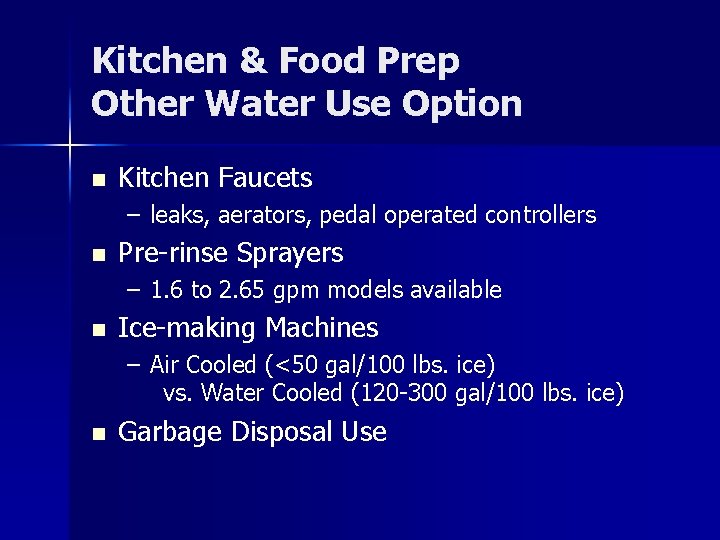
Kitchen & Food Prep Other Water Use Option n Kitchen Faucets – leaks, aerators, pedal operated controllers n Pre-rinse Sprayers – 1. 6 to 2. 65 gpm models available n Ice-making Machines – Air Cooled (<50 gal/100 lbs. ice) vs. Water Cooled (120 -300 gal/100 lbs. ice) n Garbage Disposal Use
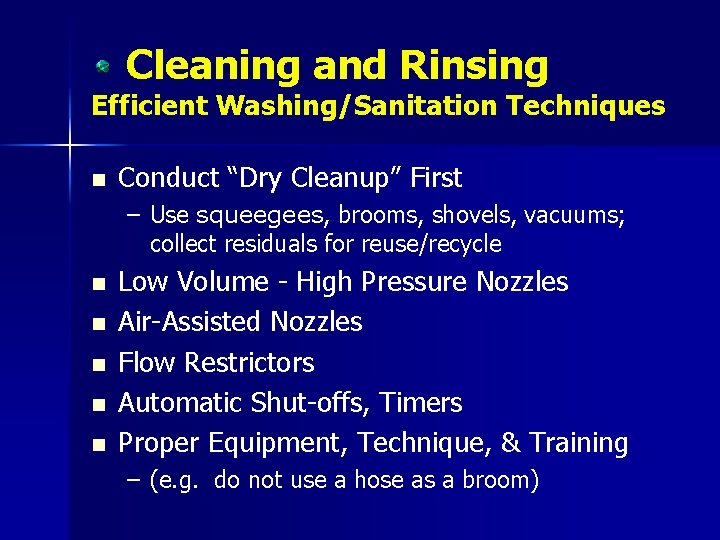
Cleaning and Rinsing Efficient Washing/Sanitation Techniques n Conduct “Dry Cleanup” First – Use squeegees, brooms, shovels, vacuums; collect residuals for reuse/recycle n n n Low Volume - High Pressure Nozzles Air-Assisted Nozzles Flow Restrictors Automatic Shut-offs, Timers Proper Equipment, Technique, & Training – (e. g. do not use a hose as a broom)
Other Process Water Reuse Measures n n n Reuse of once through, non-contact cooling water for next process bath or for pre-heat Reuse of oil/water separator filtrate for mop water or paint booth water curtains Use of reverse osmosis reject water for cooling tower make-up Condensate recovery & reuse Other ideas?
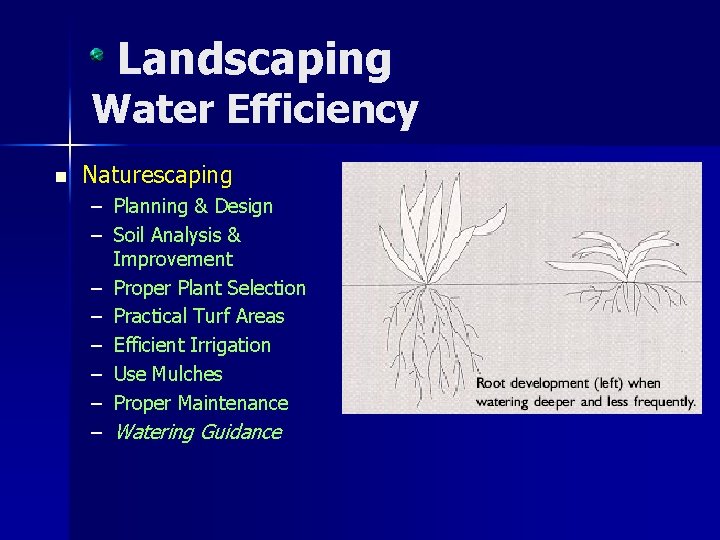
Landscaping Water Efficiency n Naturescaping – Planning & Design – Soil Analysis & Improvement – Proper Plant Selection – Practical Turf Areas – Efficient Irrigation – Use Mulches – Proper Maintenance – Watering Guidance
Remember the Typical Institutional Water Balance
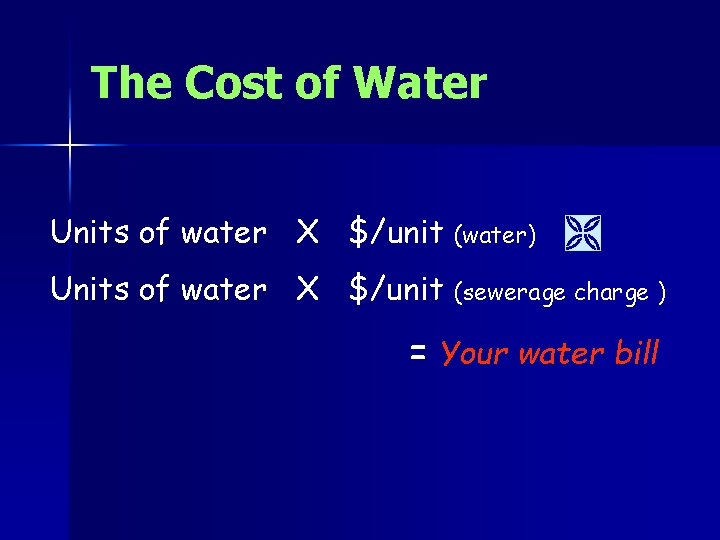
The Cost of Water Units of water X $/unit (water) Units of water X $/unit (sewerage charge ) = Your water bill
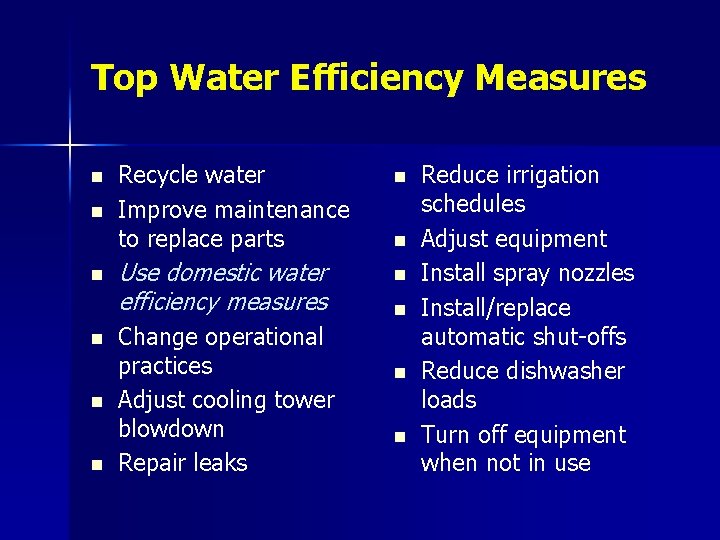
Top Water Efficiency Measures n n n Recycle water Improve maintenance to replace parts Use domestic water efficiency measures Change operational practices Adjust cooling tower blowdown Repair leaks n n n Reduce irrigation schedules Adjust equipment Install spray nozzles Install/replace automatic shut-offs Reduce dishwasher loads Turn off equipment when not in use
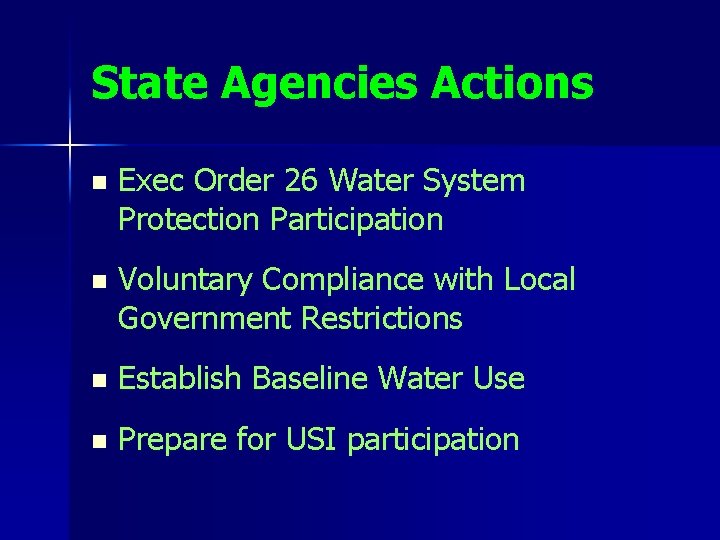
State Agencies Actions n Exec Order 26 Water System Protection Participation n Voluntary Compliance with Local Government Restrictions n Establish Baseline Water Use n Prepare for USI participation
Resources Technical Assistance & On-site Assessments -NCDPPEA – Rusty Harris-Bishop, (919) 733 -4398, rusty. harris-bishop@ncmail. net -Terry Albrecht (828) 251 -6622, terry. albrecht@ncmail. net n Fact Sheets, Checklists, Manuals, Posters www. Sustainable. NC. org/water. htm n Water Efficiency Manual http: //www. p 2 pays. org/ref/01/00692. pdf n NC Drought Information: www. ncwater. org n State Agency Mandates: www. Sustainable. NC. org n
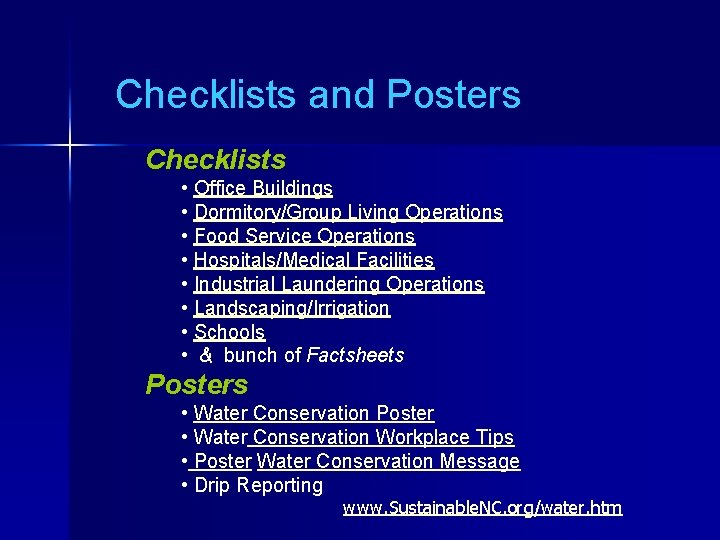
Checklists and Posters Checklists • Office Buildings • Dormitory/Group Living Operations • Food Service Operations • Hospitals/Medical Facilities • Industrial Laundering Operations • Landscaping/Irrigation • Schools • & bunch of Factsheets Posters • Water Conservation Poster • Water Conservation Workplace Tips • Poster Water Conservation Message • Drip Reporting www. Sustainable. NC. org/water. htm
"When the well is dry, we know the worth of water. " --Benjamin Franklin