
Dropping Two Balls Experiment Galileo Gravity and Momentum
Dropping Two Balls Experiment Galileo, Gravity, and Momentum Sc!Team 2. 0
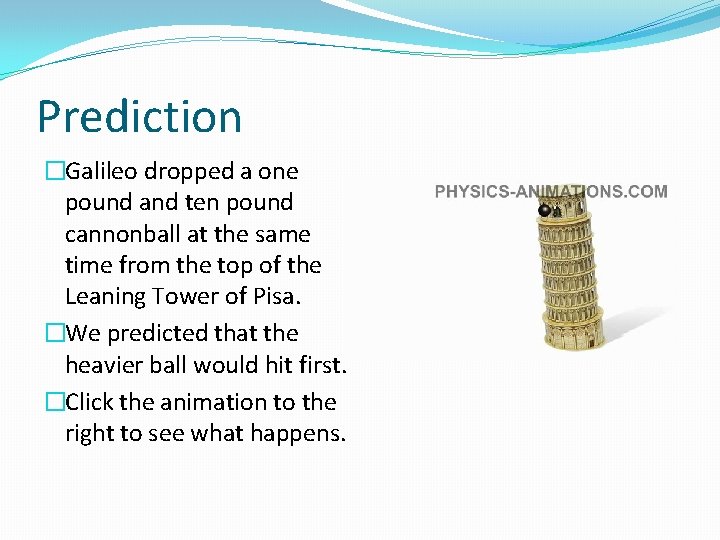
Prediction �Galileo dropped a one pound and ten pound cannonball at the same time from the top of the Leaning Tower of Pisa. �We predicted that the heavier ball would hit first. �Click the animation to the right to see what happens.
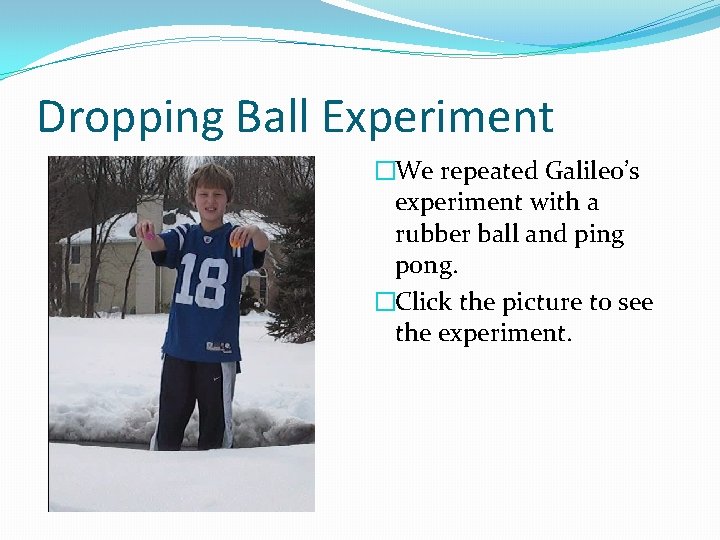
Dropping Ball Experiment �We repeated Galileo’s experiment with a rubber ball and ping pong. �Click the picture to see the experiment.
The Force of Gravity �We did research to find out why the heavier ball did not fall faster. �We found out that gravity puts the same amount of pull on all objects. This is why they fall at the same speed. �When we did the experiment, we noticed that the heavier ball made a bigger dent in the snow.
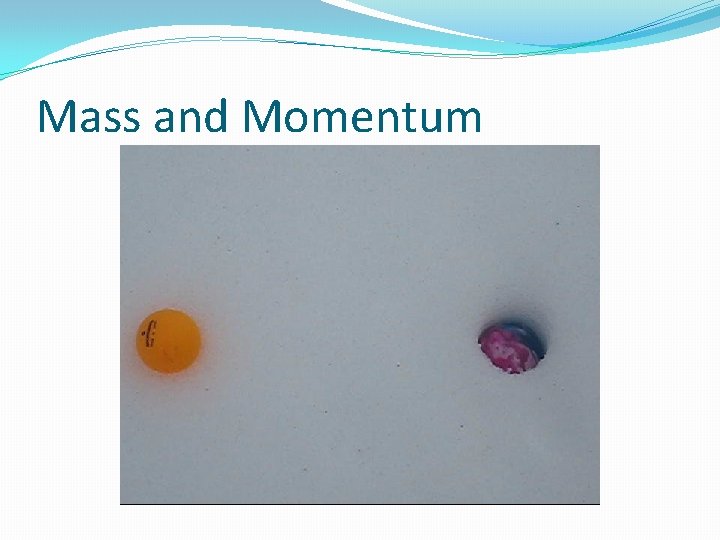
Mass and Momentum
Momentum �We researched why the heavier ball made a deeper dent in the snow. �We discovered that it was because the heavier ball had more momentum. �Momentum is mass times velocity. The velocity of the two balls is the same, but the mass of the two balls is different. �Therefore, the momentum of the heavier ball is bigger than the smaller ball and it makes a bigger dent.
Galileo’s impact �Galileo’s “drop the cannonball” experiment helped to show that gravity pulls all objects the same. �This conclusion was different from what people thought before Galileo did this experiment. �The experiment also helped us to learn the difference between velocity and momentum.
Bibliography �Carr, K. (2009). Physics for Kids. Retrieved February 20, 2010, from http: //www. historyforkids. org/scienceforkids/physics /space/gravity. htm �Computer Animations of Physical Processes. Retrieved February 20, 2010, from http: //physicsanimations. com/Physics/English/mech. htm �PBS Online (n. d. ). Galileo’s Battle for the Heavens. Retrieved February 20, 2010, from http: //www. pbs. org/wgbh/nova/galileo/
- Slides: 8