
Dropped Objects A presentation to help you understand

Dropped Objects A presentation to help you understand the hazards of dropped objects and how to approach the situation By: Andrew Smith, Nina Cotton, Patrick Espinosa, Kyle Horlacher, Dara Hutchison, Nelson Novales, Miguel Rodriguez, Nenad Vasiljevic
Objectives · Inform · Share Knowledge · Prevention
Inform · Safety and health policies procedures and goals · Functions for the safety program · Who to contact with questions/concerns · How to report a hazard, an injury or illness · What to do in an emergency · The responsibilities of the employer · Workers’ rights under the OSHA act

Knowledge · Reinforce · Train · Instruct
Awareness ● ● Instruct on how to prevent dropping situations from occurring Instruct workers with assigned roles Most common results of dropping include ○ Broken bones ○ Spinal cord injuries ○ Brain injuries ○ Death Equipment or tools once dropped could be ○ Damaged ○ Lost ○ broken
Goals of Training ● Train workers on techniques and strategies to avoid injuries due to dropping. ● Train workers on how to limit the chances of damaging or losing company equipment ● Train workers to understand recognize several hazards that can lead to dropping to take place. ● Instruct workers on ways to control hazards ● Train workers on when why, and how to wear the proper equipment
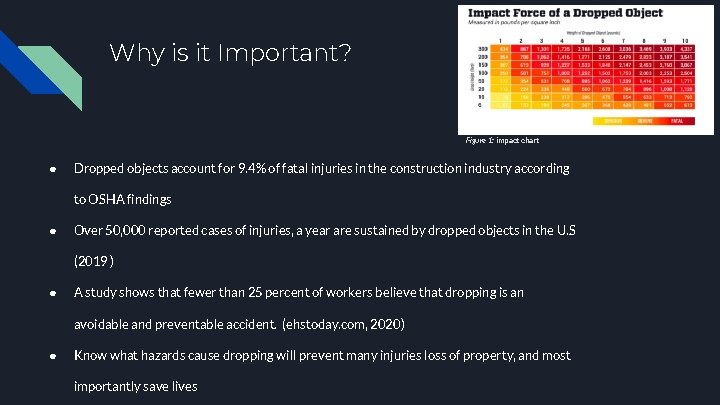
Why is it Important? Figure 1: impact chart ● Dropped objects account for 9. 4% of fatal injuries in the construction industry according to OSHA findings ● Over 50, 000 reported cases of injuries, a year are sustained by dropped objects in the U. S (2019 ) ● A study shows that fewer than 25 percent of workers believe that dropping is an avoidable and preventable accident. (ehstoday. com, 2020) ● Know what hazards cause dropping will prevent many injuries loss of property, and most importantly save lives
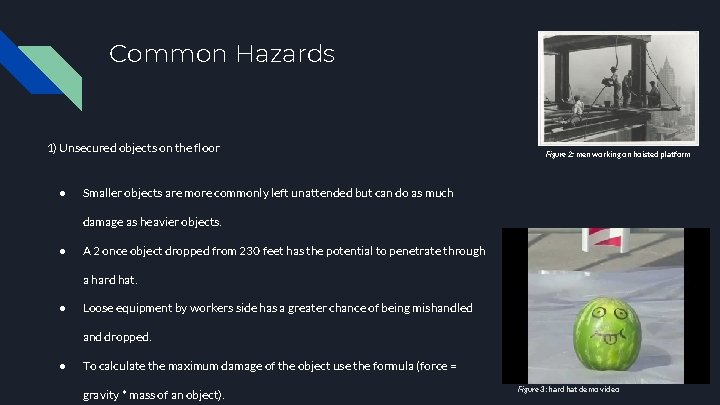
Common Hazards 1) Unsecured objects on the floor ● Figure 2: men working on hoisted platform Smaller objects are more commonly left unattended but can do as much damage as heavier objects. ● A 2 once object dropped from 230 feet has the potential to penetrate through a hard hat. ● Loose equipment by workers side has a greater chance of being mishandled and dropped. ● To calculate the maximum damage of the object use the formula (force = gravity * mass of an object). Figure 3: hard hat demo video
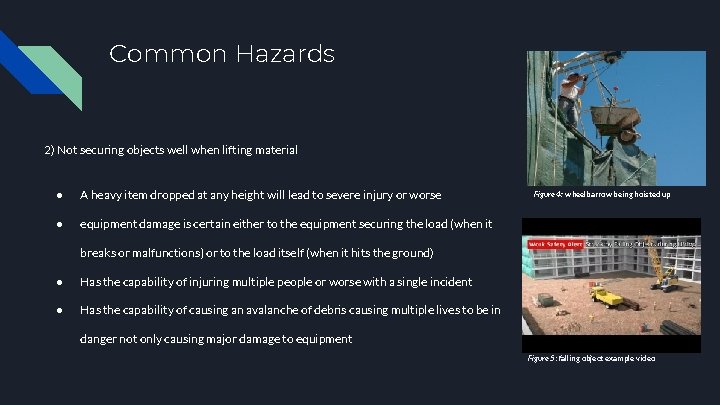
Common Hazards 2) Not securing objects well when lifting material ● A heavy item dropped at any height will lead to severe injury or worse ● equipment damage is certain either to the equipment securing the load (when it Figure 4: wheelbarrow being hoisted up breaks or malfunctions} or to the load itself (when it hits the ground) ● Has the capability of injuring multiple people or worse with a single incident ● Has the capability of causing an avalanche of debris causing multiple lives to be in danger not only causing major damage to equipment Figure 5: falling object example video
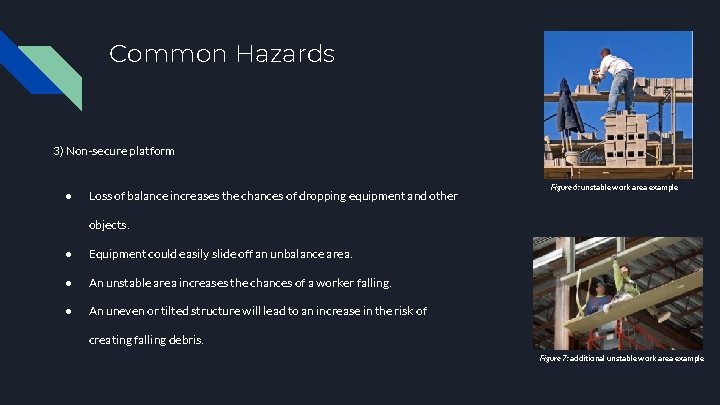
Common Hazards 3) Non-secure platform ● Loss of balance increases the chances of dropping equipment and other Figure 6: unstable work area example objects. ● Equipment could easily slide off an unbalance area. ● An unstable area increases the chances of a worker falling. ● An uneven or tilted structure will lead to an increase in the risk of creating falling debris. Figure 7: additional unstable work area example
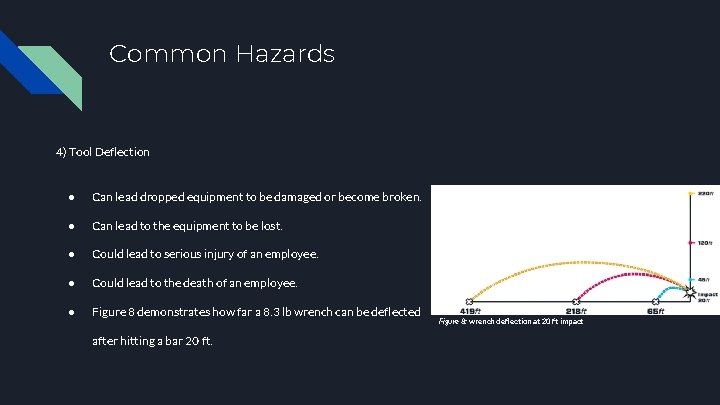
Common Hazards 4) Tool Deflection ● Can lead dropped equipment to be damaged or become broken. ● Can lead to the equipment to be lost. ● Could lead to serious injury of an employee. ● Could lead to the death of an employee. ● Figure 8 demonstrates how far a 8. 3 lb wrench can be deflected after hitting a bar 20 ft. Figure 8: wrench deflection at 20 ft impact
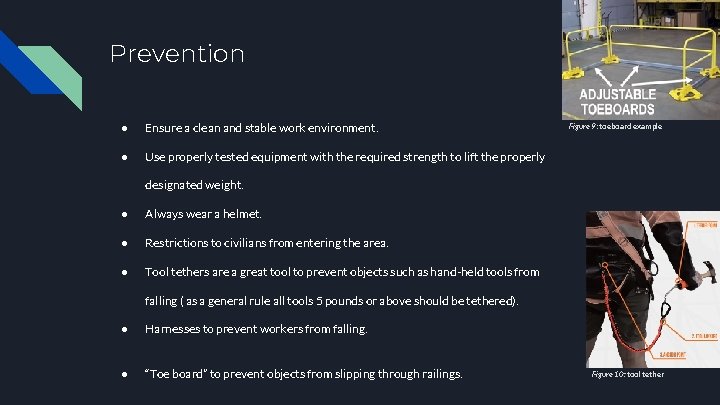
Prevention ● Ensure a clean and stable work environment. ● Use properly tested equipment with the required strength to lift the properly Figure 9: toeboard example designated weight. ● Always wear a helmet. ● Restrictions to civilians from entering the area. ● Tool tethers are a great tool to prevent objects such as hand-held tools from falling ( as a general rule all tools 5 pounds or above should be tethered). ● Harnesses to prevent workers from falling. ● “Toe board” to prevent objects from slipping through railings. Figure 10: tool tether
Prevention (continued) ● Use pedestrian walkways and exercise caution when working near heavy equipment ● Never work under a load, especially during lifting. ● Tether smaller tools to work belts to prevent dropped objects. ● Wear appropriate protective gear (safety glasses, hardhat, face shields, etc. ). ● Check condition of hard hat (patting or the shell itself could be worn or damaged) ● Net to catch falling debris.
OSHA requirements When there is a risk of falling objects: ● Employees must wear proper head protection, such as hard hats. ● Your employer must implement at least one of the following: ○ Toeboards, screens, or guard rail systems ○ Canopy structures ○ Sectioning off the area where objects may fall ● Secure tools and materials to prevent them from falling on people below. ● Barricade hazard areas and post warning signs. ● Use toe boards, screens on guardrails, or scaffolds to prevent falling objects. ● Use debris nets, catch platforms or canopies to catch, or deflect falling objects.
OSHA prevention standards 1. Falling object protection - Standard number : 1926. 759 a. “All materials, equipment, and tools, which are not in use while aloft, shall be secured against accidental displacement” b. “The controlling contractor shall bar other construction processes below steel erection unless overhead protection for the employees below is provided. ” 2. Head protection. - Standard number : 1926. 759 a. “Employees working in areas where there is a possible danger of head injury from impact, or from falling or flying objects, or from electrical shock and burns, shall be protected by protective helmets. ”
Hard hat ● An important measure in protecting the workers from the. ● Hard hats must be replaced if they show signs of damage (dents, cracks, penetration, or fatigue due to rough treatment). ● There are two components of the hard hat the suspension and the shell. ● Both components must be maintained and replaced when recommended. ● ○ The suspension is recommended to be replaced yearly. ○ The shell is recommended to be replaced every two to five years. It important to use a hard hat with that meets ANSI standards and is classified as “ANSI Z 89. 12009”. ● Must be adjustable to accommodate the size of the workers head size. ● Must meet requirement for visibility ( when adjusted properly does it hinder vision in anyway). ● Must withstand at least a 8 pound ball dropped from five feet according to ANSI standards. ● Must prove to have a maximum peak force of 1000 pounds.
What to Do When Objects Do Fall? ● Report any injuries (and call an ambulance if necessary). ● File a report on how the incident took place. ● Report to the safety manager. ● Make sure there are no injured workers and that everyone is accounted for. ● If workers are confirmed to be accounted for and not injured account for what was dropped and where it was dropped incidents that may have occurred is as follows: ○ Was equipment dropped ○ Was person property dropped (lunch box, case, ect. ) ○ Was it falling debris from the construction site ○ Was it dropped on tools or equipment
Resources Brown, B. (2016, December 7). 5 Benefits of Promoting Employee Participation. Workology. https: //workology. com/5 -benefits-of-promoting-employee-participation/. Construction Hazard Slides: ladder, fall, trench, scaffold, collapse, trash, roof , electrical, traffic - Robert Carr Construction Hazard Slides ladder fall trench scaffold collapse trash roof electrical traffic Gallery RSS. https: //myconstructionphotos. smugmug. com/Construction. Collections/Construction-Hazard-Slides/i-PTv. Tbc. G/. Department of Labor logo UNITED STATESDEPARTMENT OF LABOR. 1910. 28 - Duty to have fall protection and falling object protection. | Occupational Safety and Health Administration. https: //www. osha. gov/laws-regs/regulations/standardnumber/1910. 28. Kaczynski, A. (2013, June 30). 24 Jaw-Dropping Photos Of The Construction Of The Empire State Building. Buzz. Feed News. https: //www. buzzfeednews. com/article/andrewkaczynski/photos-fromthe-construction-of-the-empire-state.
Resources (cont. ) Rail. Guard 200 Short Adjustable Toe Board - Fits 4'-6' Rails. Cisco. https: //www. ciscoeagle. com/catalog/product/182446/railguard-200 -short-adjustable-toe-board-fits-4 -6 -rails. Socias-Morales, C. , Earnest, S. , Echt, A. , Garza, E. , & Breloff, S. (2020, October 1). Preventing Struckby Injuries in Construction. Centers for Disease Control and Prevention. https: //blogs. cdc. gov/nioshscience-blog/2020/10/01/struck-by-injuries/. UNITED STATES DEPARTMENT OF LABOR. Education and Training | Occupational Safety and Health Administration. https: //www. osha. gov/shpguidelines/education-training. html. victory electric cooperative. (2019). Hard Hat Safety Demonstration. youtube. com. https: //www. youtube. com/watch? v=Mzi. Zesbb 32 Q.
- Slides: 19