
DRONET LEARNING TO FLY BY DRIVING PAPER BY
DRONET: LEARNING TO FLY BY DRIVING PAPER BY: ANTONIO LOQUERCIO, ANA I. MAQUEDA, CARLOS R. DEL-BLANCO, AND DAVIDE SCARAMUZZA PRESENTED BY: LOGAN MURRAY
VIDEO OF DRONET IN ACTION
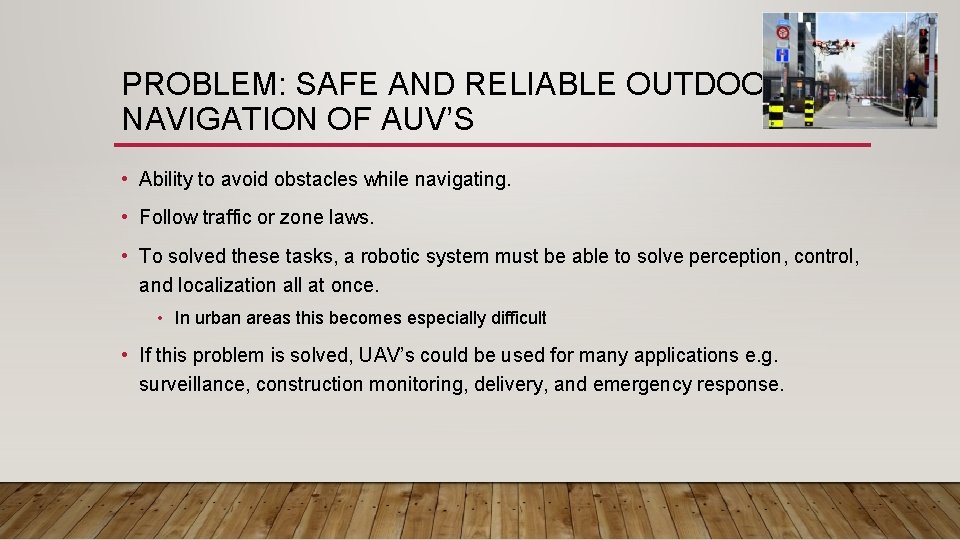
PROBLEM: SAFE AND RELIABLE OUTDOOR NAVIGATION OF AUV’S • Ability to avoid obstacles while navigating. • Follow traffic or zone laws. • To solved these tasks, a robotic system must be able to solve perception, control, and localization all at once. • In urban areas this becomes especially difficult • If this problem is solved, UAV’s could be used for many applications e. g. surveillance, construction monitoring, delivery, and emergency response.
TRADITIONAL APPROACH • Two step process of automatic localization, and computation of controls. • Localize given a map using GPS, visual and range sensors. • Control commands allow the robot to avoid obstacles while achieving the desired goal. • Problems with this model: • Advanced SLAM algorithms have issues with dynamic scenes and appearance changes. • Separating the perception and control blocks introduces challenges with inferring control commands from 3 D maps.
RECENT APPROACH • Use deep learning to couple perception and control, which greatly increases results on a large set of tasks • Problems: • Reinforcement Learning: suffers from high sample complexity • Supervised-Learning: Must have human expert flying trajectories to imitate
DRONET APPROACH • Residual Convolutional Neural Network(CNN) • Use a pre-recorded outdoor dataset recorded from cars and bikes • Collect a custom dataset of outdoor collision sequences • Real-time processing from one video camera on the UAV • Create steering angle controls and probability of collision • Have a generalized system that can adapt to unseen environments.
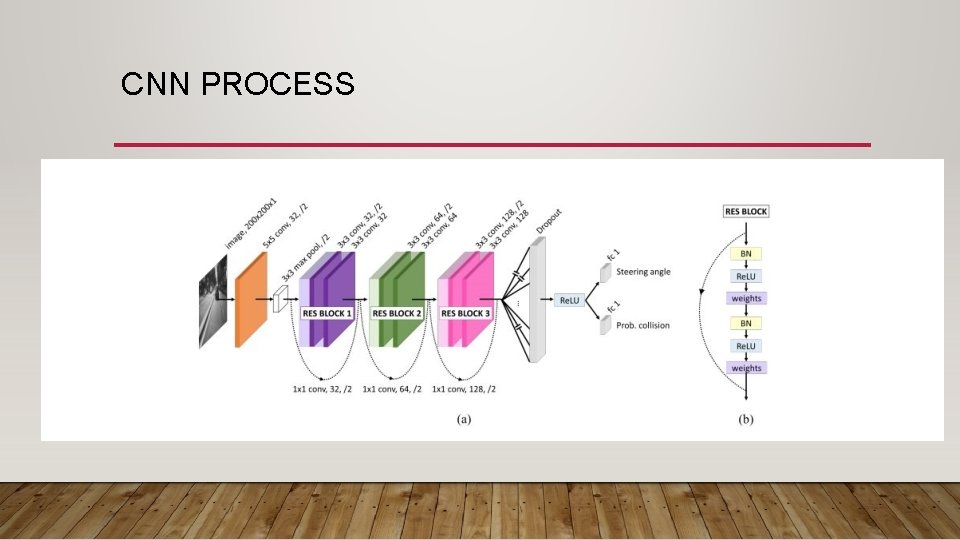
CNN PROCESS
TRAINING THE STEERING AND COLLISON PREDICTIONS • Steering: Mean-Squared Error(MSE) • Collision Prediction: Binary Cross-Entropy(BCE) • Once trained, an optimizer is used to compute both steering and collision at the same time.
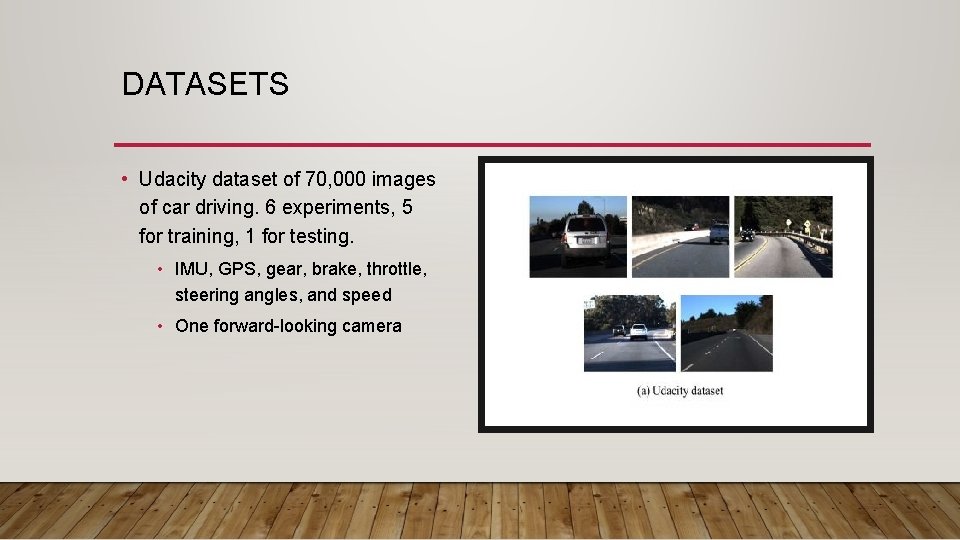
DATASETS • Udacity dataset of 70, 000 images of car driving. 6 experiments, 5 for training, 1 for testing. • IMU, GPS, gear, brake, throttle, steering angles, and speed • One forward-looking camera
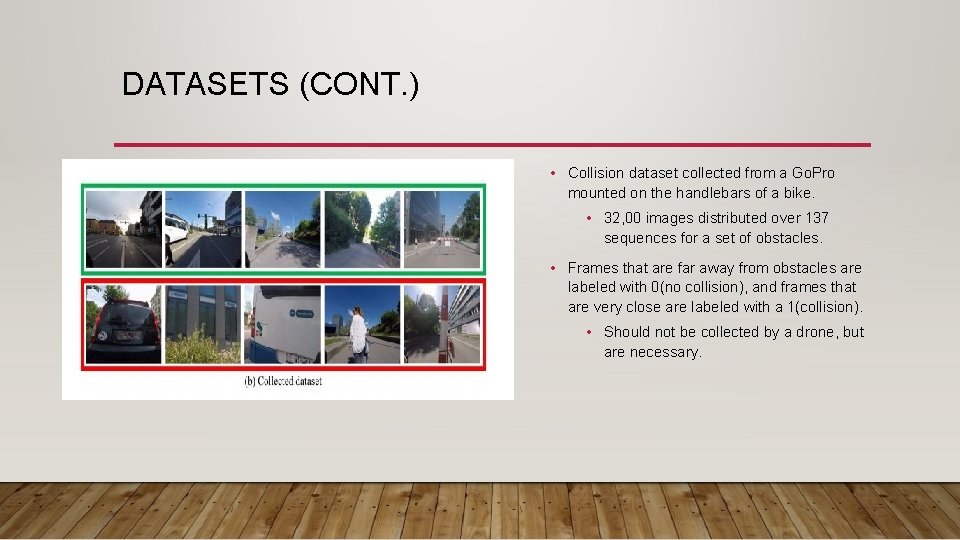
DATASETS (CONT. ) • Collision dataset collected from a Go. Pro mounted on the handlebars of a bike. • 32, 00 images distributed over 137 sequences for a set of obstacles. • Frames that are far away from obstacles are labeled with 0(no collision), and frames that are very close are labeled with a 1(collision). • Should not be collected by a drone, but are necessary.
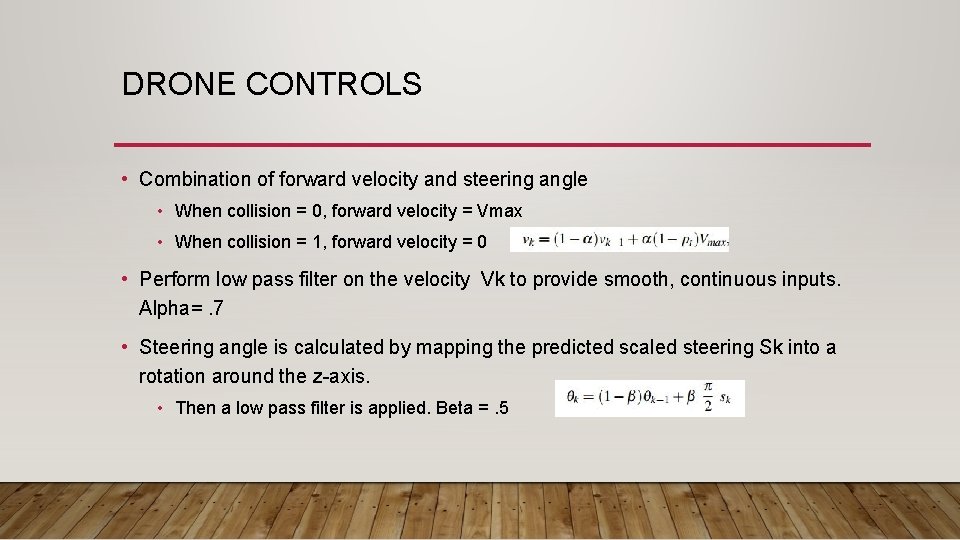
DRONE CONTROLS • Combination of forward velocity and steering angle • When collision = 0, forward velocity = Vmax • When collision = 1, forward velocity = 0 • Perform low pass filter on the velocity Vk to provide smooth, continuous inputs. Alpha=. 7 • Steering angle is calculated by mapping the predicted scaled steering Sk into a rotation around the z-axis. • Then a low pass filter is applied. Beta =. 5
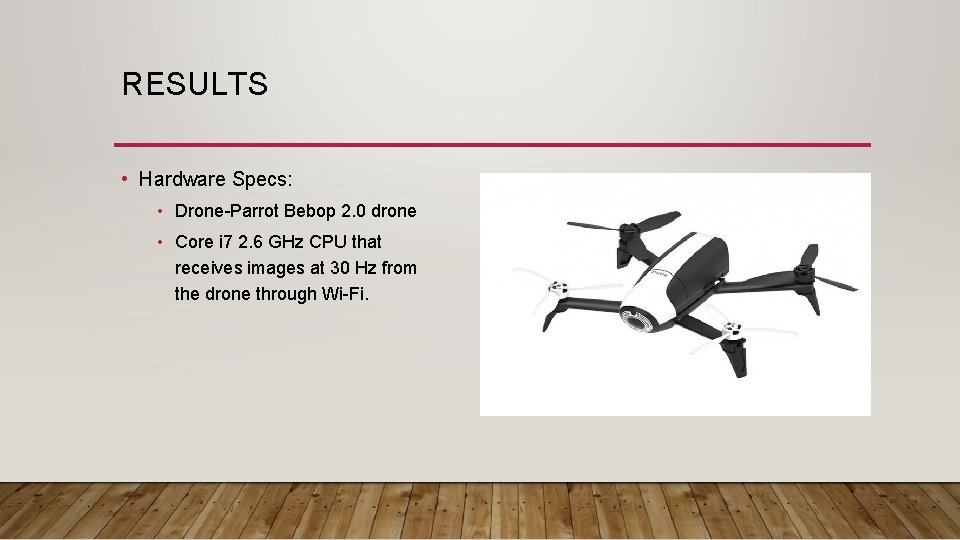
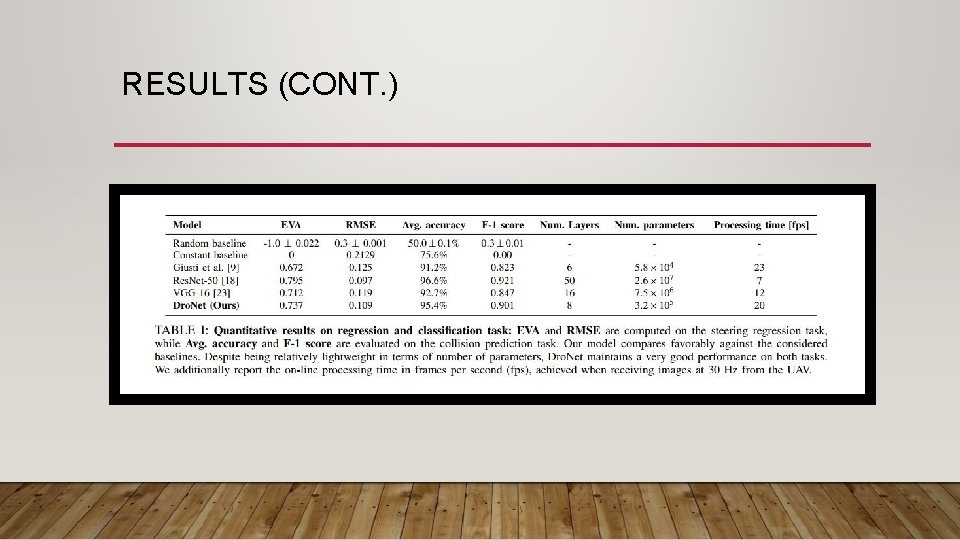
RESULTS • Hardware Specs: • Drone-Parrot Bebop 2. 0 drone • Core i 7 2. 6 GHz CPU that receives images at 30 Hz from the drone through Wi-Fi.
RESULTS (CONT. )
RESULTS (CONT. )
RESULTS(CONT. )
RESULTS(CONT. )
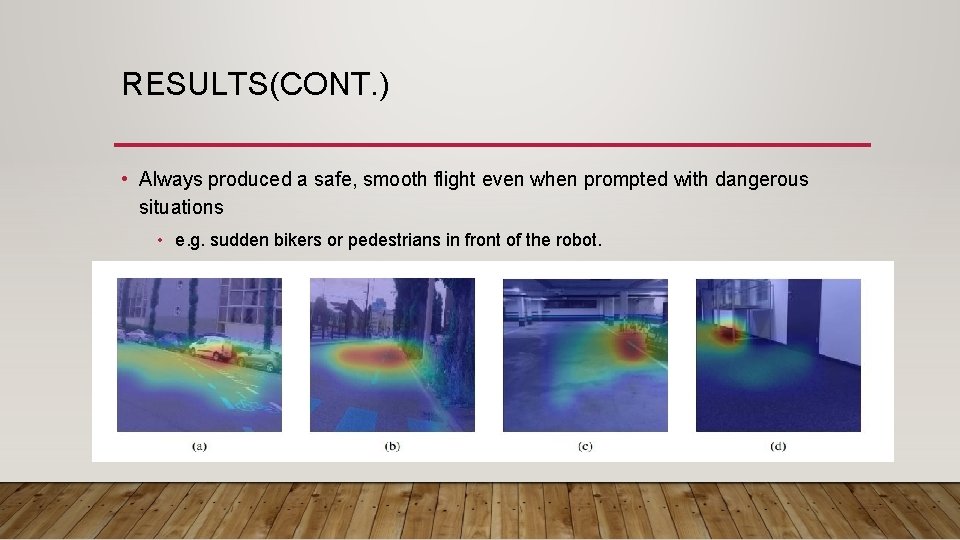
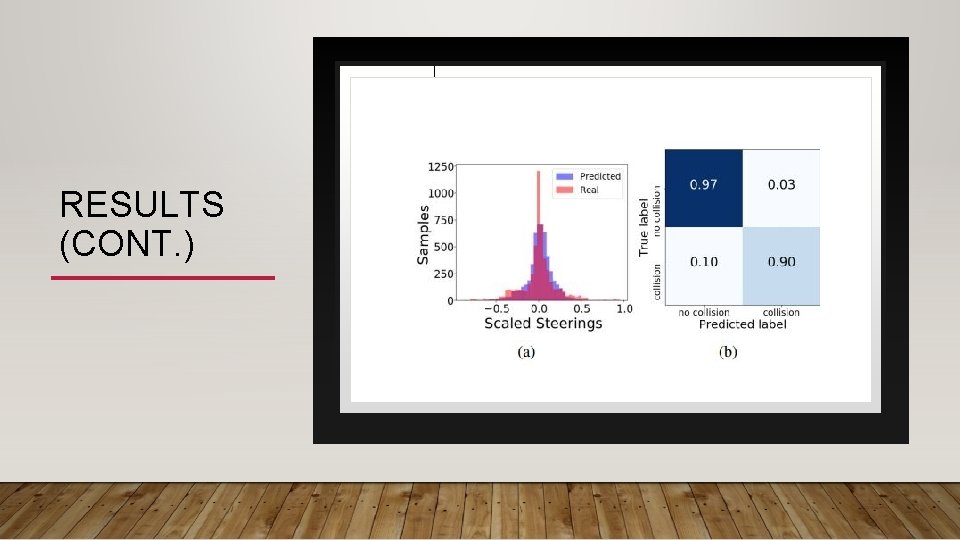
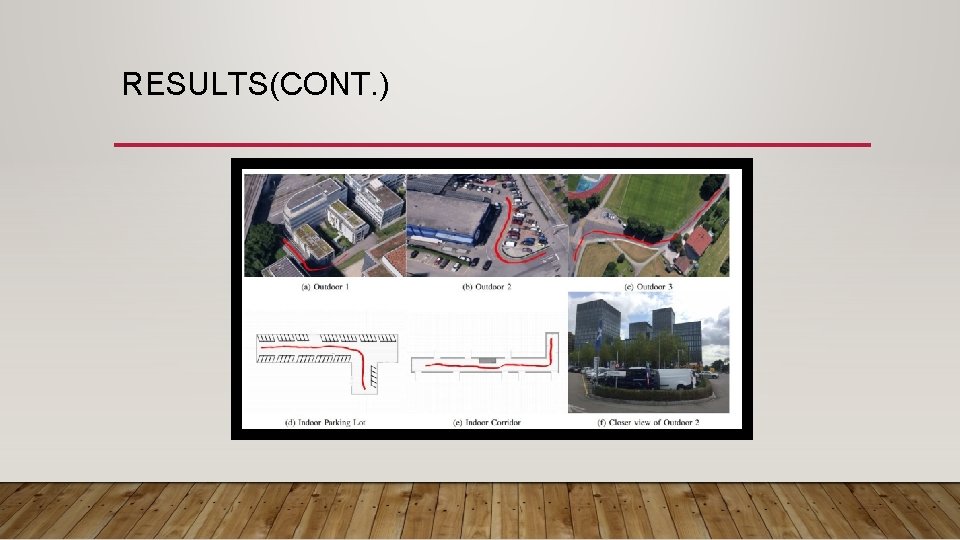
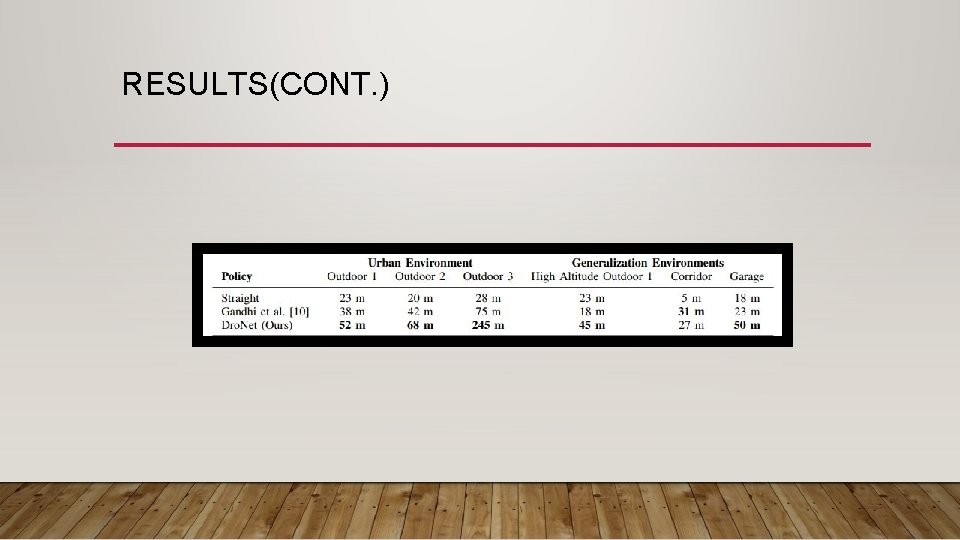
RESULTS(CONT. ) • Always produced a safe, smooth flight even when prompted with dangerous situations • e. g. sudden bikers or pedestrians in front of the robot. • Network focuses on “line-like” patterns to predict crowed or dangerous areas.
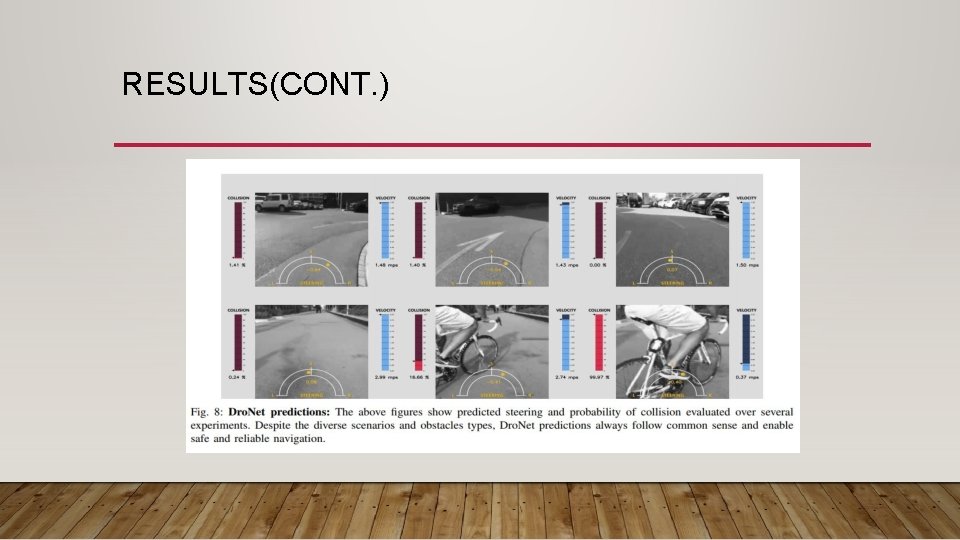
RESULTS(CONT. )
PROS VS LIMITATIONS • Pros • Drone can explore completely unseen environments with no previous knowledge • No required localization or mapping • CNN allows for high generalization capabilities • Can be applied to resource constrained platforms • Limitations • Does not fully exploit the agile movement capabilities of drones • No real way to give the robot a goal to be reached
REFERENECES • A. Loquercio, A. I. Maqueda, C. R. Del Blanco, D. Scaramuzza Dro. Net: Learning to Fly By Driving IEEE Robotics and Automation Letters (RA-L), 2018 • Deshpande, Adit. “A Beginner's Guide To Understanding Convolutional Neural Networks. ” A Beginner's Guide To Understanding Convolutional Neural Networks – Adit Deshpande – CS Undergrad at UCLA ('19), 20 July 2016, adeshpande 3. github. io/A-Beginner's-Guide-To-Understanding-Convolutional. Neural-Networks/.
- Slides: 20