
DRIVING SIMULATOR By Desy Setya Lestari Eko Pambudi
DRIVING SIMULATOR By: Desy Setya Lestari Eko Pambudi Muhimmatul Ifadah Riskiyah Siti Muzdalifatus Sundus Anisah

THE COST OF THE SYSTEM $23, 500 plus shipping and applicable taxes for the system including a non-ruggedized helmet-mounted display. Add $1, 475 plus shipping and applicable taxes for the ruggedized helmetmounted display.
TRANSMISI Pada alat driving simulator ini menyediakan transmisi otomatis, tuas perseneling sisi kanan atau kiri juga tersedia pada alat simulator mengemudi ini.
EFEK DRIVING SIMULATOR BAGI TUBUH Pada dasarnya, benda elektronika, seperti driving simulator memiliki radiasi yang dapat membahayakan tubuh manusia. Radiasi adalah suatu cara perambatan energi dari sumber energi ke lingkungannya tanpa membutuhkan panas. Monitor merupakan bagian yang memiliki radiasi paling tinggi. Radiasinya dapat menimbulkan efek, seperti sakit kepala, mual, muntah, rasa tegang pada leher dan bahu, masalah kulit dan gangguan pada mata. Dalam jangka panjang, berbagai penyakit dapat ditimbulkan seperti katarak, kanker, eritema, penuaan dini, bahkan shock. Generally. Electronics equipment like driving simulator has radiation that endangered human’s body. Radiation is a way of energy radiation from energy source to environment without heat. Monitor is a part that has the highest radiation. Its radiaton can give some effects such as headache, queasy, vomit, tight feel on the neck and the shoulder, skin’s problem and eye’s problem. For a long periode, various diseases can happen such as cataract, cancer, erythema, premature aging, even shock.
SISTEM HARDWARE BLOCK DIAGRAM
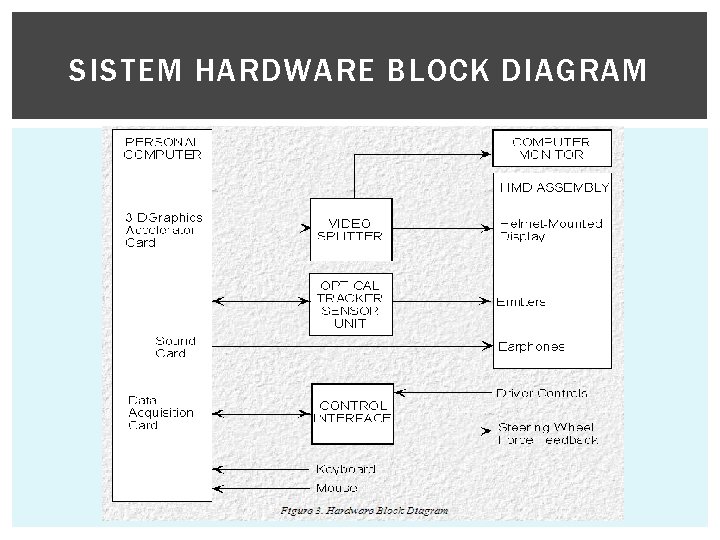
CARA KERJA DRIVING SIMULATOR Be fore the simulation exe rcise begins, the computer keyboard and mouse are used t o select the database to be used, the weather effects, the driving cond i tio ns, visibility rang e, other traffic, and distractions. Once the desired cond i tio ns are se lecte d, t he simulation exercise can begin. Durin g the simulation, the opt ical tracker monitors the driv er’s head position. To t rack the drive r’s he ad position, the optical tracker electro nics causes the four in frare d light e mittin g diodes (L ED’s) located on the helm et-mounted disp l ay to illuminate in sequence. Two sensors located abov e the steering wh ee l th en triangulate the position of each L ED and compute the position and at tit ude of the driver’s he ad. The computer also monitors the position of all drive r co ntrols via the dat a acquisition card to control progress through the simulat ion database. Using this head and vehicle position and attitude data, the com puter syste m gen erates a 3 -D image corresponding to the current head an d ve hicle position that is displayed on both the driver’s helmet-mounted disp l ay and the local mon it or. The local monitor is used for s imulation setup an d also allo ws other people to watch the progress of the si mulation. If th e driver "crash" into s omething during the simulation, the car will stop - it will n ot run through the object as in some simulations. To recover from a crash, the driver must back up and then steer around the object.
STEERING WHEEL MECHANISM The DS-100 utilizes a force feedback steering wheel to provide road feel to the driver. Effects such as running into a curb are simulated, as is the force needed to make a turn. CGSD also offers a "flight mode" steering wheel as an option. The flight mode steering wheel control mechanism can be unlocked for game applications. When unlocked, pulling back on the steering wheel causes the simulator to climb into the air and pushing forward causes the simulator to descend. Besides being an ideal feature for games, it also provides an easy-to-use interface for applications such as urban visualization or architectural walk-throughs.
- Slides: 7