
Driving question How do cows use energy to




- Slides: 37
Driving question: How do cows use energy to move? What is the hidden chemical change when cows move?
Flow chart of tracing food inside the body Food (large organic molecules) Digestive system Digestion Circulatory system Small organic molecules Biosynthesis Cells Circulatory system, lungs Cellular Respiration H 2 O & CO 2 Animal biomass (large organic molecules) Body tissues Body For animal growth For animal movement
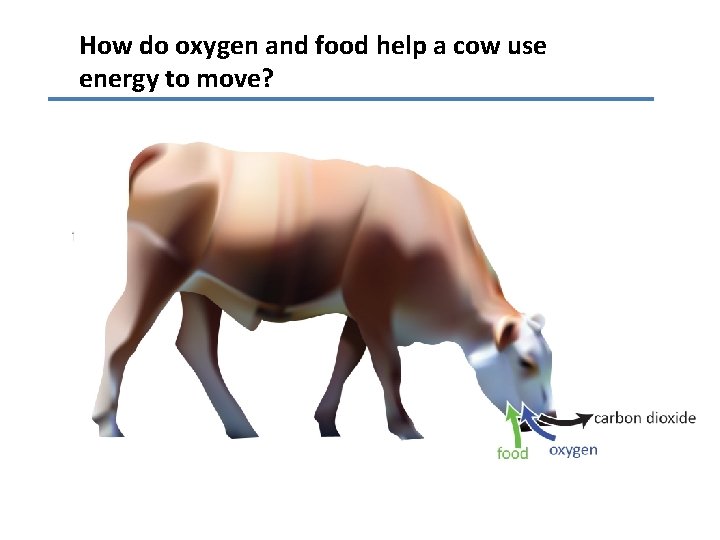
How do oxygen and food help a cow use energy to move?
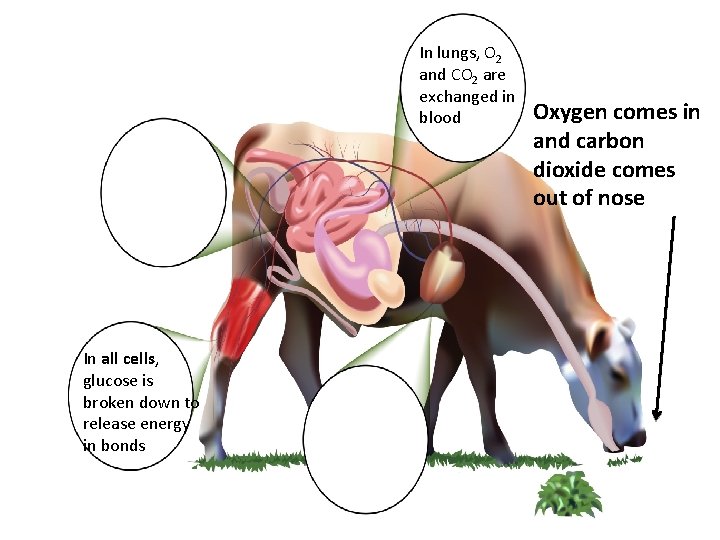
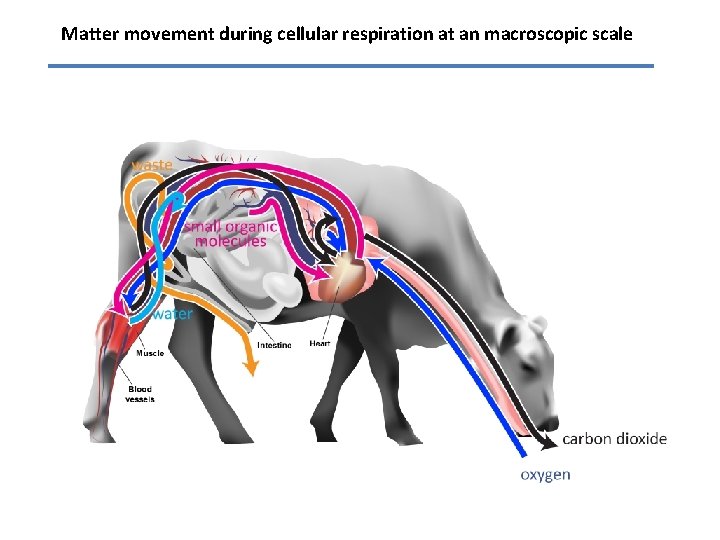
In lungs, O 2 and CO 2 are exchanged in blood In all cells, glucose is broken down to release energy in bonds Oxygen comes in and carbon dioxide comes out of nose
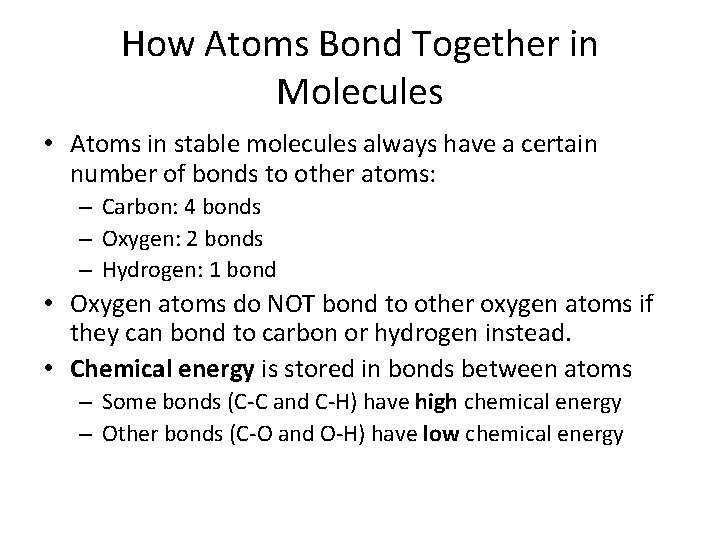
How Atoms Bond Together in Molecules • Atoms in stable molecules always have a certain number of bonds to other atoms: – Carbon: 4 bonds – Oxygen: 2 bonds – Hydrogen: 1 bond • Oxygen atoms do NOT bond to other oxygen atoms if they can bond to carbon or hydrogen instead. • Chemical energy is stored in bonds between atoms – Some bonds (C-C and C-H) have high chemical energy – Other bonds (C-O and O-H) have low chemical energy
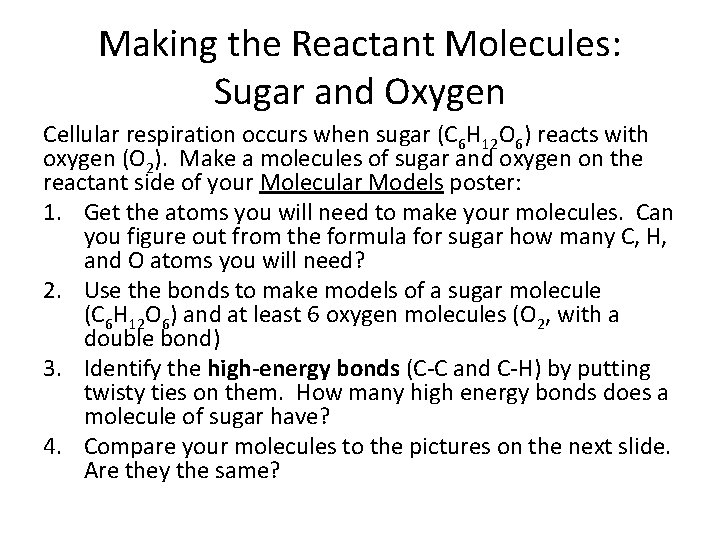
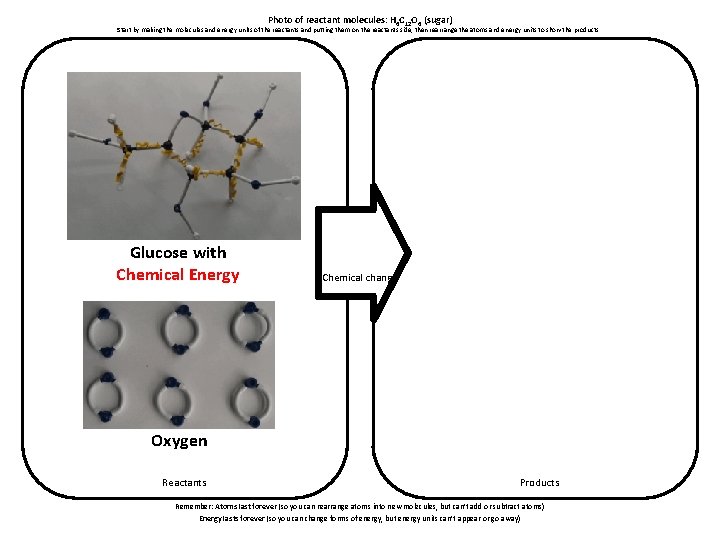
Making the Reactant Molecules: Sugar and Oxygen Cellular respiration occurs when sugar (C 6 H 12 O 6) reacts with oxygen (O 2). Make a molecules of sugar and oxygen on the reactant side of your Molecular Models poster: 1. Get the atoms you will need to make your molecules. Can you figure out from the formula for sugar how many C, H, and O atoms you will need? 2. Use the bonds to make models of a sugar molecule (C 6 H 12 O 6) and at least 6 oxygen molecules (O 2, with a double bond) 3. Identify the high-energy bonds (C-C and C-H) by putting twisty ties on them. How many high energy bonds does a molecule of sugar have? 4. Compare your molecules to the pictures on the next slide. Are they the same?
Photo of reactant molecules: H 6 C 12 O 6 (sugar) Start by making the molecules and energy units of the reactants and putting them on the reactants side, then rearrange the atoms and energy units to show the products. Glucose with Chemical Energy Chemical change Oxygen Reactants Products Remember: Atoms last forever (so you can rearrange atoms into new molecules, but can’t add or subtract atoms) Energy lasts forever (so you can change forms of energy, but energy units can’t appear or go away)
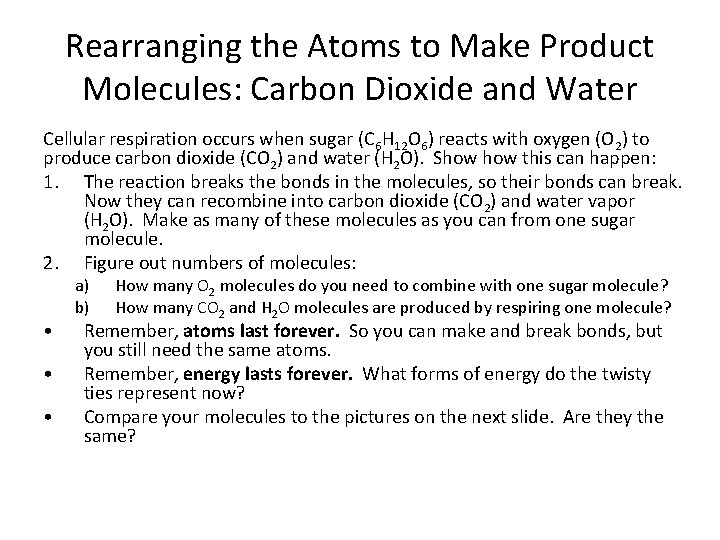
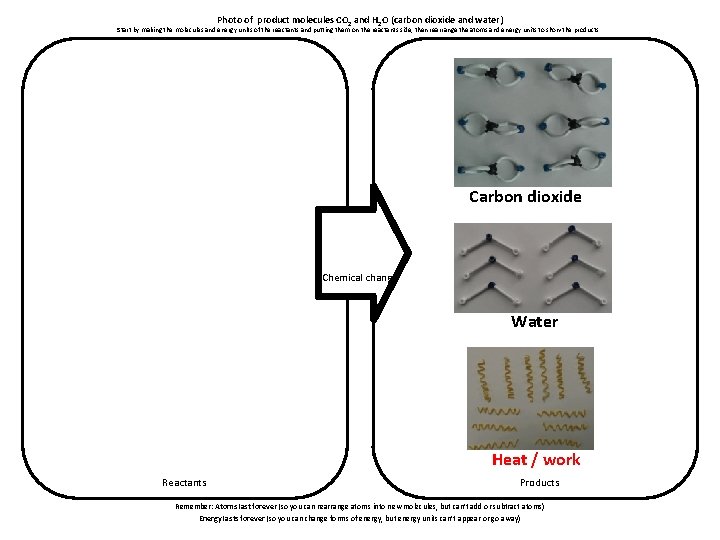
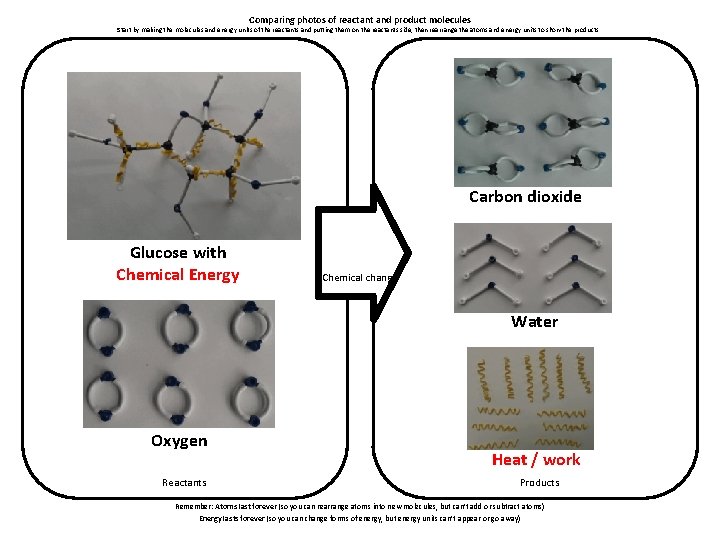
Rearranging the Atoms to Make Product Molecules: Carbon Dioxide and Water Cellular respiration occurs when sugar (C 6 H 12 O 6) reacts with oxygen (O 2) to produce carbon dioxide (CO 2) and water (H 2 O). Show this can happen: 1. The reaction breaks the bonds in the molecules, so their bonds can break. Now they can recombine into carbon dioxide (CO 2) and water vapor (H 2 O). Make as many of these molecules as you can from one sugar molecule. 2. Figure out numbers of molecules: • • • a) b) How many O 2 molecules do you need to combine with one sugar molecule? How many CO 2 and H 2 O molecules are produced by respiring one molecule? Remember, atoms last forever. So you can make and break bonds, but you still need the same atoms. Remember, energy lasts forever. What forms of energy do the twisty ties represent now? Compare your molecules to the pictures on the next slide. Are they the same?
Photo of product molecules CO 2 and H 2 O (carbon dioxide and water) Start by making the molecules and energy units of the reactants and putting them on the reactants side, then rearrange the atoms and energy units to show the products. Carbon dioxide Chemical change Water Heat / work Reactants Products Remember: Atoms last forever (so you can rearrange atoms into new molecules, but can’t add or subtract atoms) Energy lasts forever (so you can change forms of energy, but energy units can’t appear or go away)
Comparing photos of reactant and product molecules Start by making the molecules and energy units of the reactants and putting them on the reactants side, then rearrange the atoms and energy units to show the products. Carbon dioxide Glucose with Chemical Energy Chemical change Water Oxygen Reactants Heat / work Products Remember: Atoms last forever (so you can rearrange atoms into new molecules, but can’t add or subtract atoms) Energy lasts forever (so you can change forms of energy, but energy units can’t appear or go away)
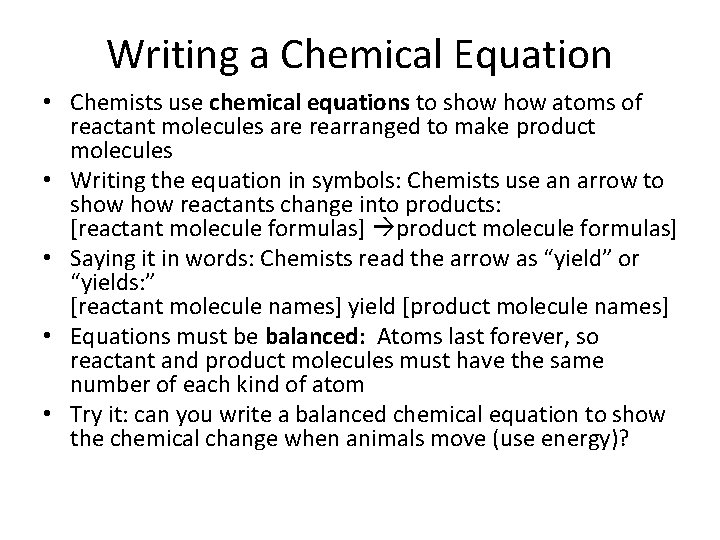
Writing a Chemical Equation • Chemists use chemical equations to show atoms of reactant molecules are rearranged to make product molecules • Writing the equation in symbols: Chemists use an arrow to show reactants change into products: [reactant molecule formulas] product molecule formulas] • Saying it in words: Chemists read the arrow as “yield” or “yields: ” [reactant molecule names] yield [product molecule names] • Equations must be balanced: Atoms last forever, so reactant and product molecules must have the same number of each kind of atom • Try it: can you write a balanced chemical equation to show the chemical change when animals move (use energy)?
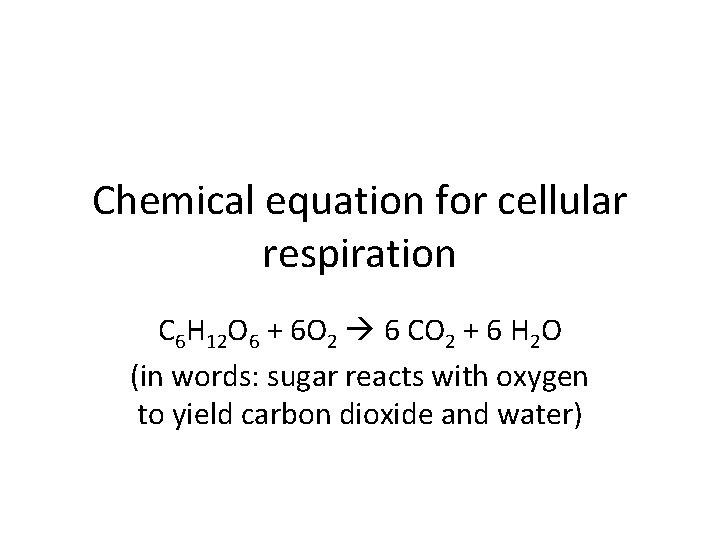
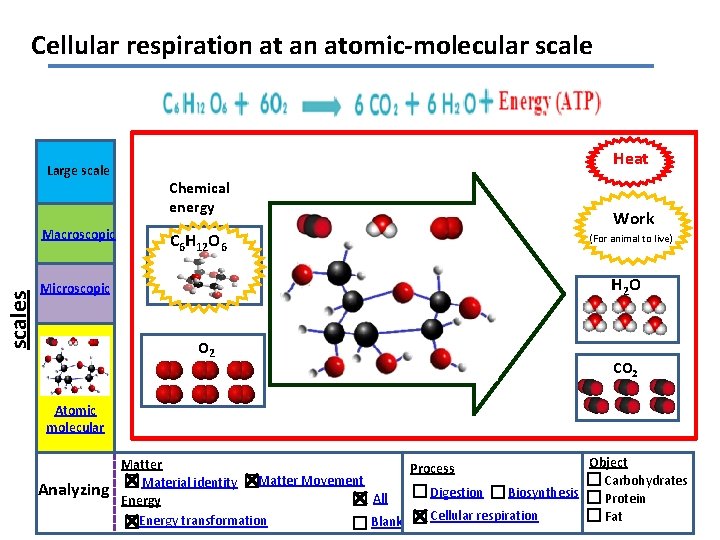
Chemical equation for cellular respiration C 6 H 12 O 6 + 6 O 2 6 CO 2 + 6 H 2 O (in words: sugar reacts with oxygen to yield carbon dioxide and water)
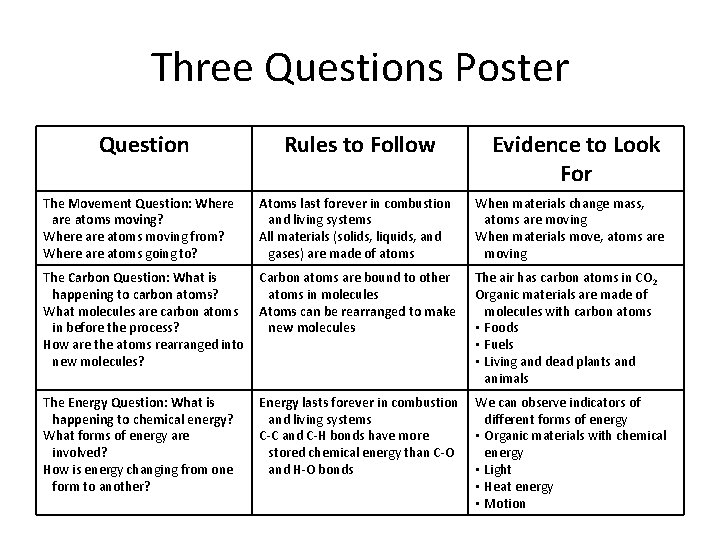
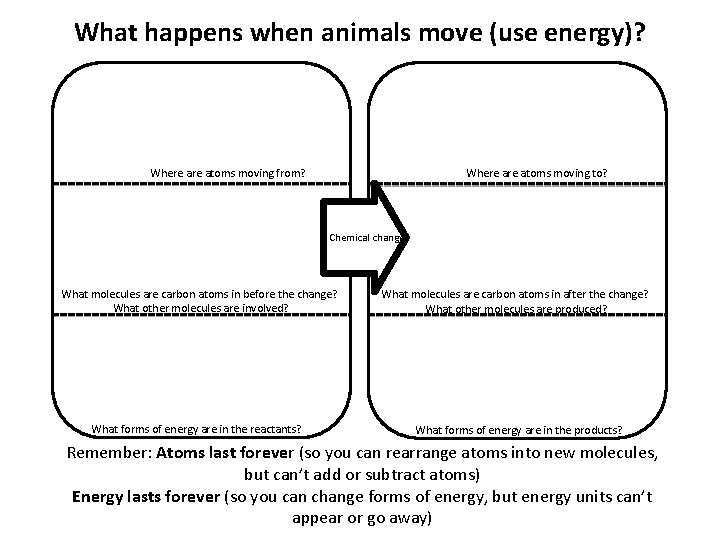
Three Questions Poster Question Rules to Follow Evidence to Look For The Movement Question: Where atoms moving? Where atoms moving from? Where atoms going to? Atoms last forever in combustion and living systems All materials (solids, liquids, and gases) are made of atoms When materials change mass, atoms are moving When materials move, atoms are moving The Carbon Question: What is happening to carbon atoms? What molecules are carbon atoms in before the process? How are the atoms rearranged into new molecules? Carbon atoms are bound to other atoms in molecules Atoms can be rearranged to make new molecules The air has carbon atoms in CO 2 Organic materials are made of molecules with carbon atoms • Foods • Fuels • Living and dead plants and animals The Energy Question: What is happening to chemical energy? What forms of energy are involved? How is energy changing from one form to another? Energy lasts forever in combustion and living systems C-C and C-H bonds have more stored chemical energy than C-O and H-O bonds We can observe indicators of different forms of energy • Organic materials with chemical energy • Light • Heat energy • Motion
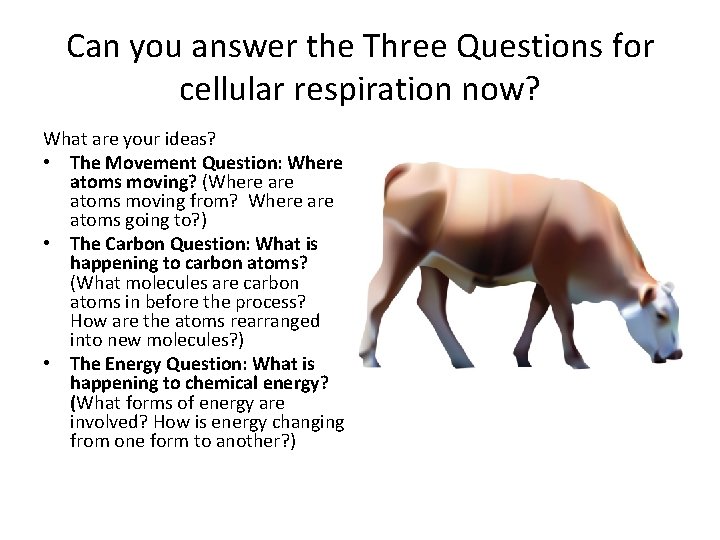
Can you answer the Three Questions for cellular respiration now? What are your ideas? • The Movement Question: Where atoms moving? (Where atoms moving from? Where atoms going to? ) • The Carbon Question: What is happening to carbon atoms? (What molecules are carbon atoms in before the process? How are the atoms rearranged into new molecules? ) • The Energy Question: What is happening to chemical energy? (What forms of energy are involved? How is energy changing from one form to another? )
What happens when animals move (use energy)? Where atoms moving to? Where atoms moving from? Chemical change What molecules are carbon atoms in before the change? What other molecules are involved? What forms of energy are in the reactants? What molecules are carbon atoms in after the change? What other molecules are produced? What forms of energy are in the products? Remember: Atoms last forever (so you can rearrange atoms into new molecules, but can’t add or subtract atoms) Energy lasts forever (so you can change forms of energy, but energy units can’t appear or go away)
The End
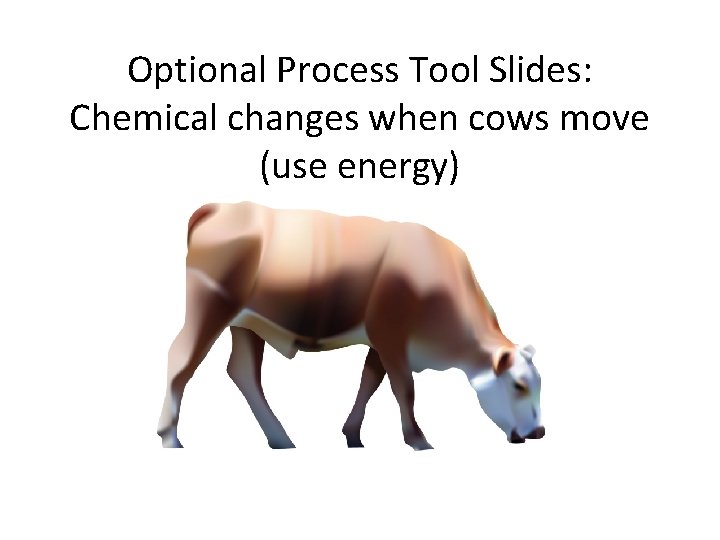
Optional Process Tool Slides: Chemical changes when cows move (use energy)
Matter movement during cellular respiration at an macroscopic scale
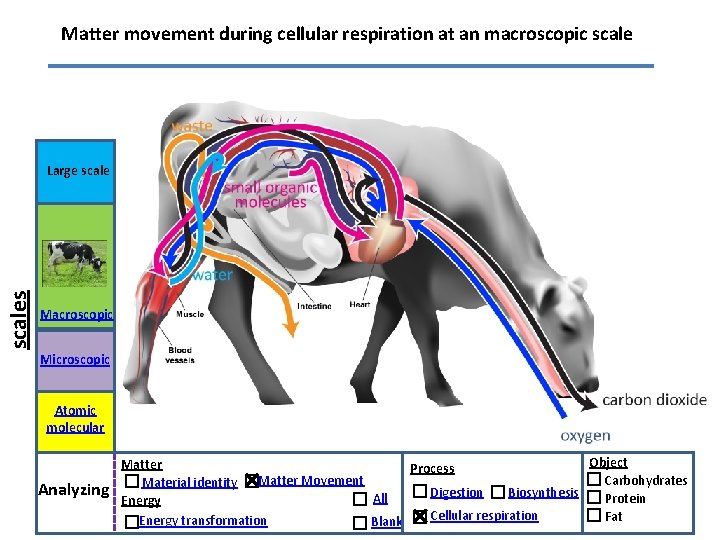
Matter movement during cellular respiration at an macroscopic scales Large scale Macroscopic Microscopic Atomic molecular Analyzing Object Matter Process Matter Movement Carbohydrates Material identity Digestion Biosynthesis All Protein Energy Cellular respiration Fat Energy transformation Blank
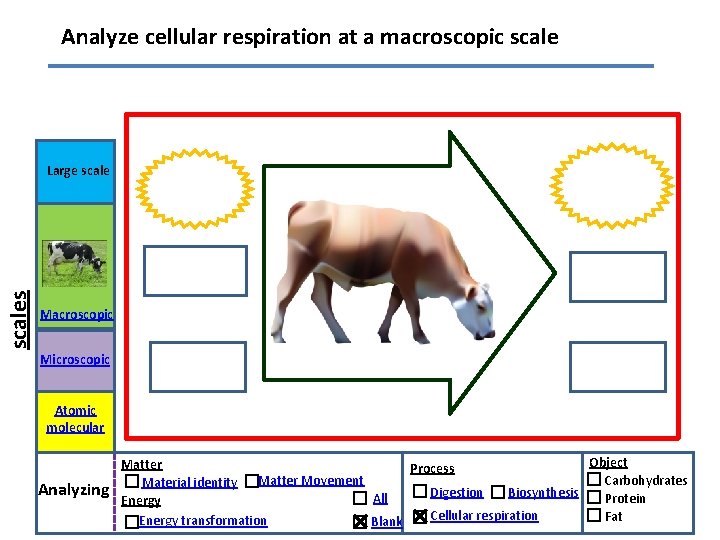
Analyze cellular respiration at a macroscopic scales Large scale Macroscopic Microscopic Atomic molecular Analyzing Object Matter Process Matter Movement Carbohydrates Material identity Digestion Biosynthesis All Protein Energy Cellular respiration Fat Energy transformation Blank
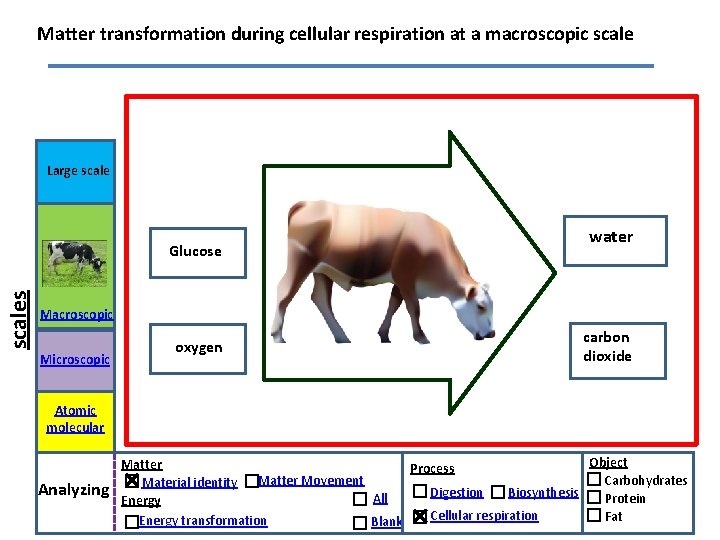
Matter transformation during cellular respiration at a macroscopic scale Large scales Glucose water Macroscopic Microscopic oxygen carbon dioxide Atomic molecular Analyzing Object Matter Process Matter Movement Carbohydrates Material identity Digestion Biosynthesis All Protein Energy Cellular respiration Fat Energy transformation Blank
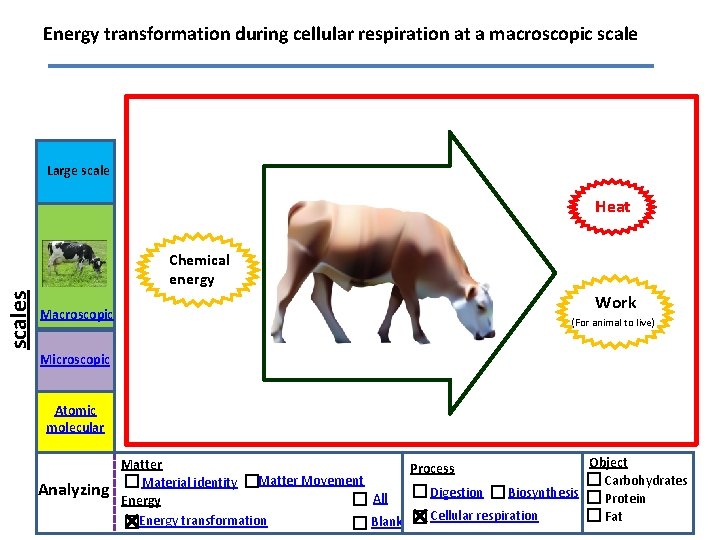
Energy transformation during cellular respiration at a macroscopic scale Large scale Heat scales Chemical energy Macroscopic Work (For animal to live) Microscopic Atomic molecular Analyzing Object Matter Process Matter Movement Carbohydrates Material identity Digestion Biosynthesis All Protein Energy Cellular respiration Fat Energy transformation Blank
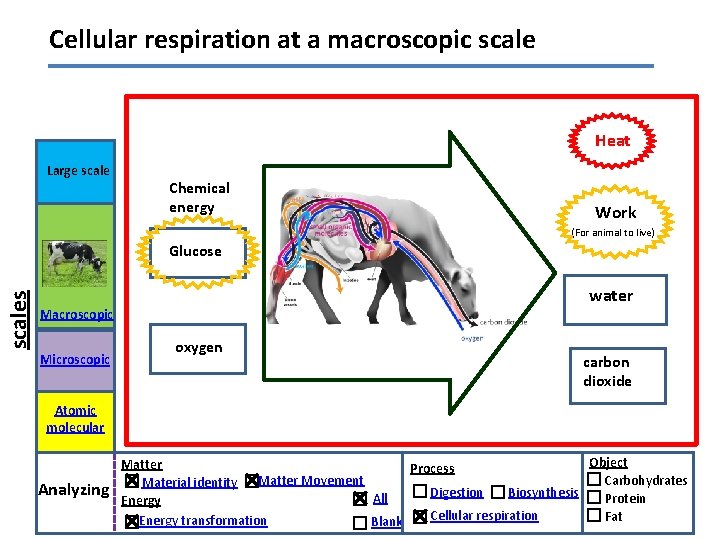
Cellular respiration at a macroscopic scale Heat Large scale Chemical energy Work (For animal to live) scales Glucose water Macroscopic Microscopic oxygen carbon dioxide Atomic molecular Analyzing Object Matter Process Matter Movement Carbohydrates Material identity Digestion Biosynthesis All Protein Energy Cellular respiration Fat Energy transformation Blank
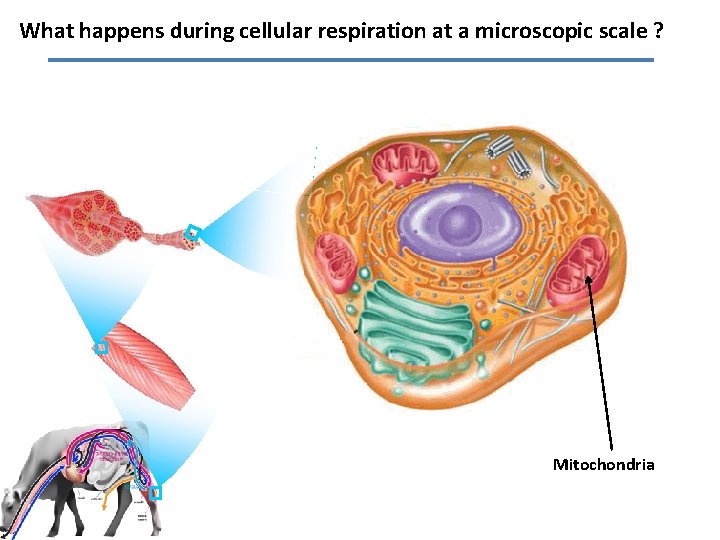
What happens during cellular respiration at a microscopic scale ? Mitochondria
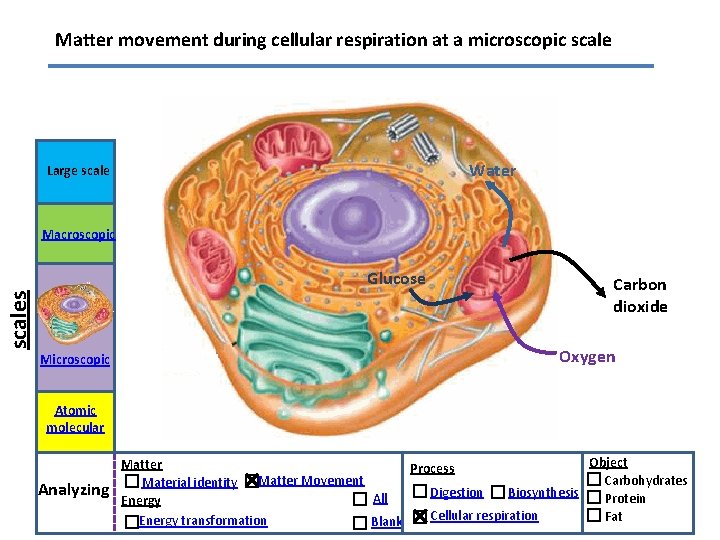
Matter movement during cellular respiration at a microscopic scale Water Large scale Macroscopic scales Glucose Microscopic Carbon dioxide Oxygen Atomic molecular Analyzing Object Matter Process Matter Movement Carbohydrates Material identity Digestion Biosynthesis All Protein Energy Cellular respiration Fat Energy transformation Blank
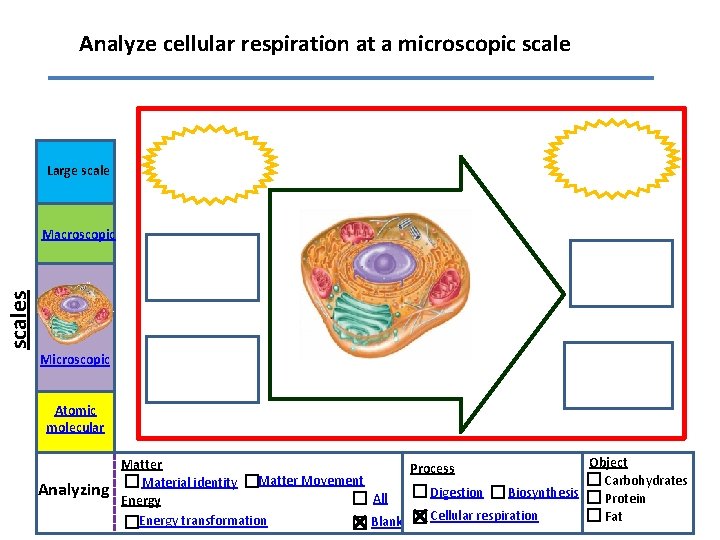
Analyze cellular respiration at a microscopic scale Large scales Macroscopic Microscopic Atomic molecular Analyzing Object Matter Process Matter Movement Carbohydrates Material identity Digestion Biosynthesis All Protein Energy Cellular respiration Fat Energy transformation Blank
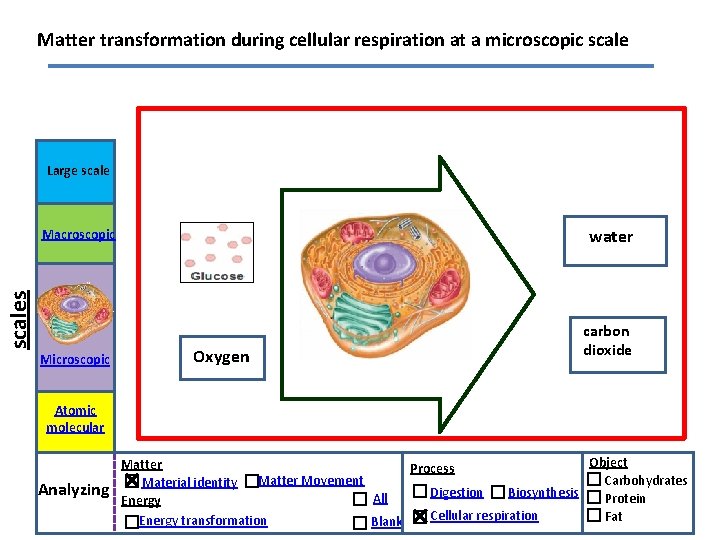
Matter transformation during cellular respiration at a microscopic scale Large scale water scales Macroscopic Microscopic Oxygen carbon dioxide Atomic molecular Analyzing Object Matter Process Matter Movement Carbohydrates Material identity Digestion Biosynthesis All Protein Energy Cellular respiration Fat Energy transformation Blank
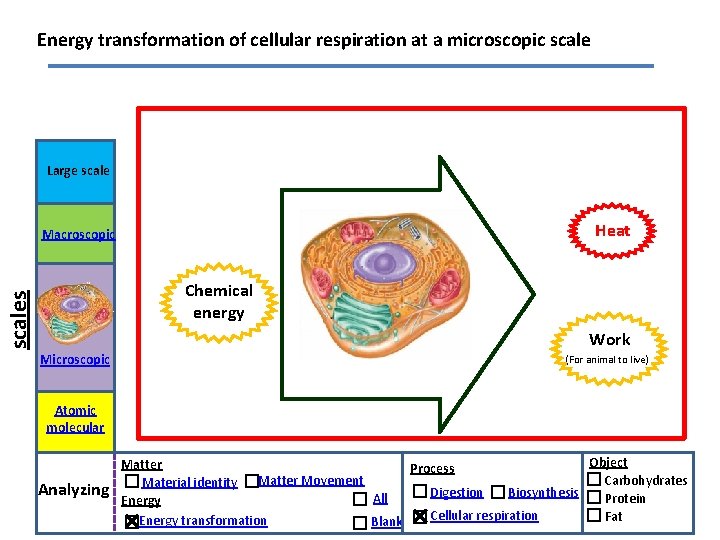
Energy transformation of cellular respiration at a microscopic scale Large scale Heat Macroscopic scales Chemical energy Work Microscopic (For animal to live) Atomic molecular Analyzing Object Matter Process Matter Movement Carbohydrates Material identity Digestion Biosynthesis All Protein Energy Cellular respiration Fat Energy transformation Blank
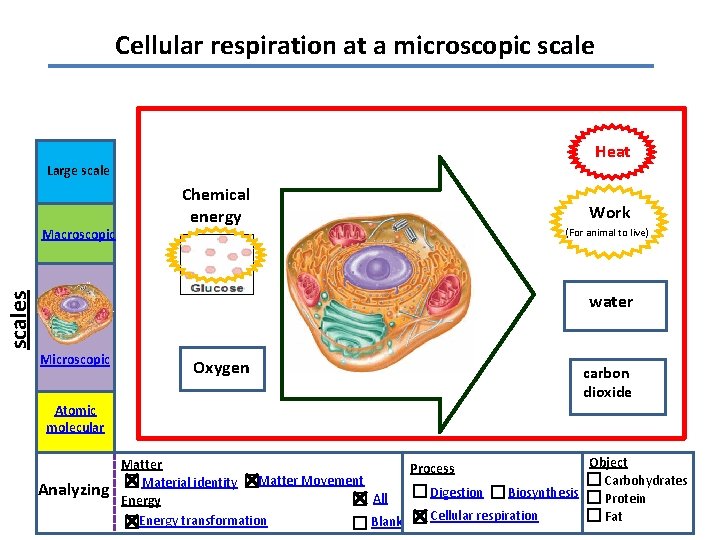
Cellular respiration at a microscopic scale Heat Large scales Macroscopic Chemical energy Work (For animal to live) water Microscopic Oxygen carbon dioxide Atomic molecular Analyzing Object Matter Process Matter Movement Carbohydrates Material identity Digestion Biosynthesis All Protein Energy Cellular respiration Fat Energy transformation Blank
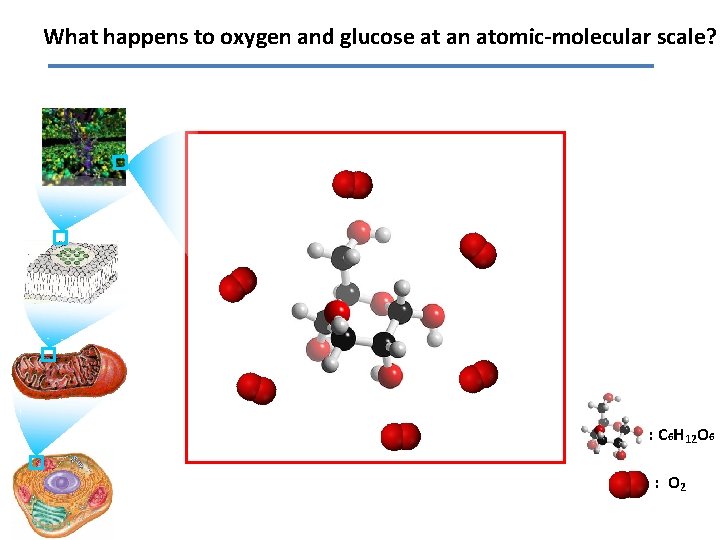
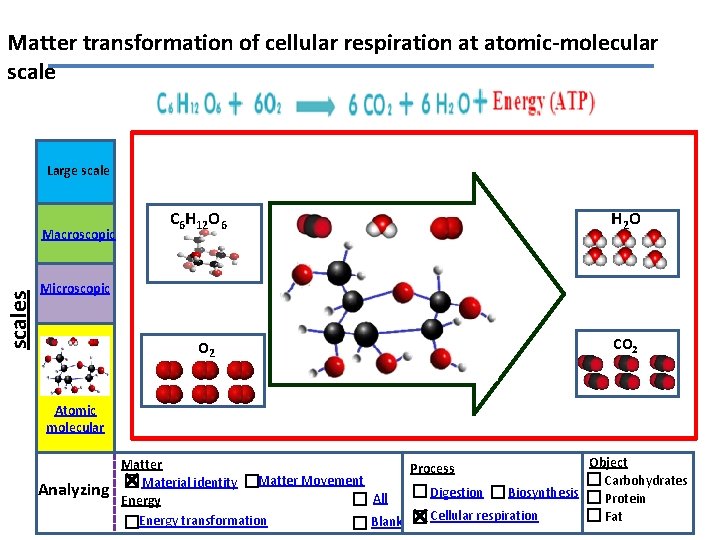
What happens to oxygen and glucose at an atomic-molecular scale? : C 6 H 12 O 6 : O 2
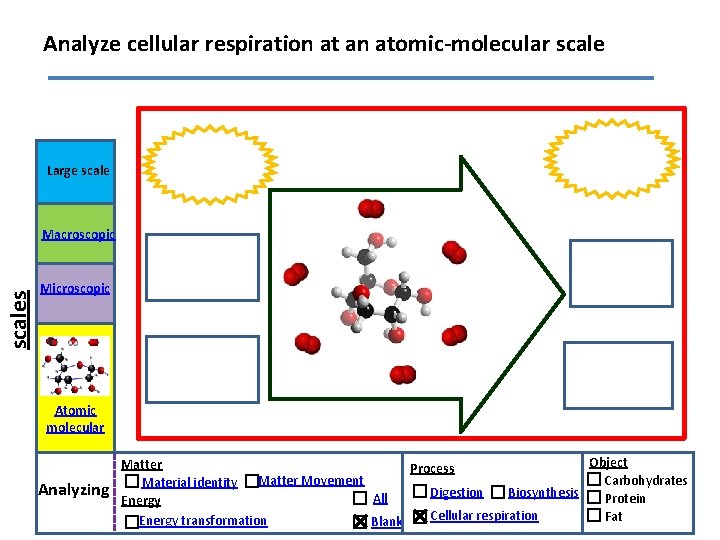
Analyze cellular respiration at an atomic-molecular scale Large scales Macroscopic Microscopic Atomic molecular Analyzing Object Matter Process Matter Movement Carbohydrates Material identity Digestion Biosynthesis All Protein Energy Cellular respiration Fat Energy transformation Blank
Matter transformation of cellular respiration at atomic-molecular scale Large scales Macroscopic C 6 H 12 O 6 H 2 O Microscopic O 2 CO 2 Atomic molecular Analyzing Object Matter Process Matter Movement Carbohydrates Material identity Digestion Biosynthesis All Protein Energy Cellular respiration Fat Energy transformation Blank
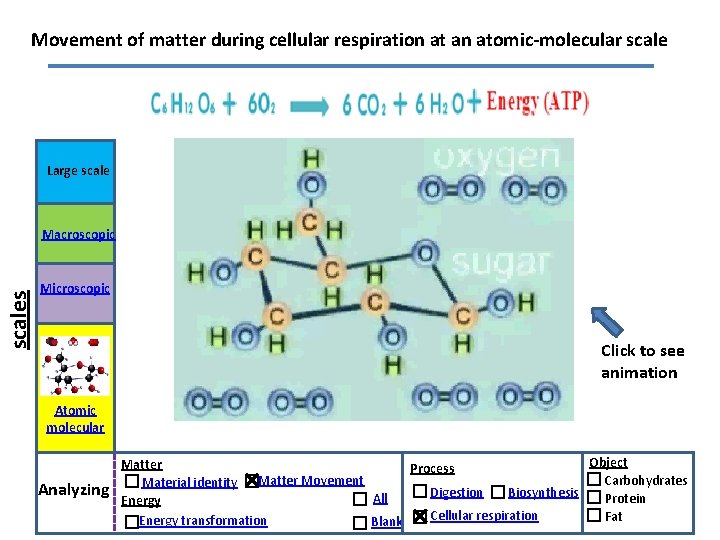
Movement of matter during cellular respiration at an atomic-molecular scale Large scales Macroscopic Microscopic Click to see animation Atomic molecular Analyzing Object Matter Process Matter Movement Carbohydrates Material identity Digestion Biosynthesis All Protein Energy Cellular respiration Fat Energy transformation Blank
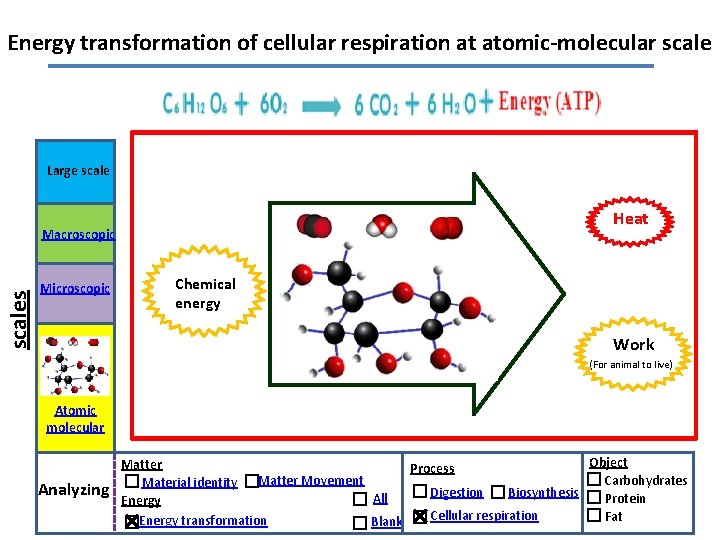
Energy transformation of cellular respiration at atomic-molecular scale Large scale Heat scales Macroscopic Microscopic Chemical energy Work (For animal to live) Atomic molecular Analyzing Object Matter Process Matter Movement Carbohydrates Material identity Digestion Biosynthesis All Protein Energy Cellular respiration Fat Energy transformation Blank
Cellular respiration at an atomic-molecular scale Large scales Macroscopic Heat Chemical energy C 6 H 12 O 6 Work (For animal to live) H 2 O Microscopic O 2 CO 2 Atomic molecular Analyzing Object Matter Process Matter Movement Carbohydrates Material identity Digestion Biosynthesis All Protein Energy Cellular respiration Fat Energy transformation Blank
The end
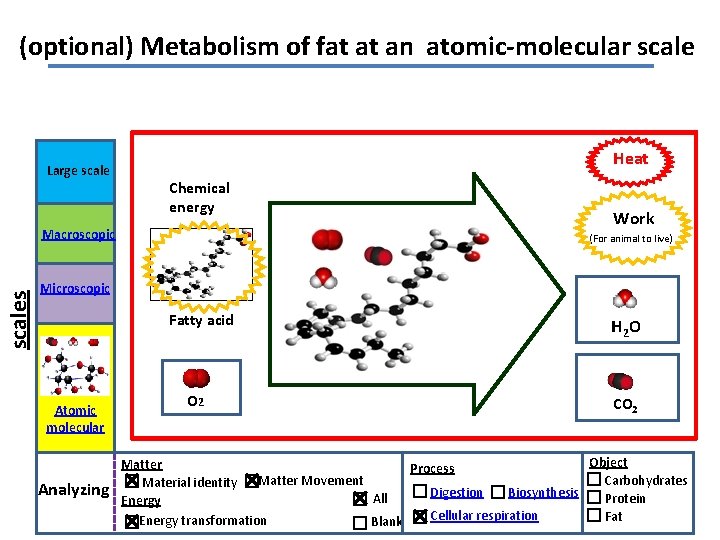
(optional) Metabolism of fat at an atomic-molecular scale Large scale Heat Chemical energy scales Macroscopic Work (For animal to live) Microscopic Fatty acid Atomic molecular Analyzing O 2 H 2 O CO 2 Object Matter Process Matter Movement Carbohydrates Material identity Digestion Biosynthesis All Protein Energy Cellular respiration Fat Energy transformation Blank