
Driving Fundamentals Unit D 1 Driving Fundamentals Successful

- Slides: 39
Driving Fundamentals Unit D 1
Driving Fundamentals Successful Driving Operational Skills- Drivers must have the skill set needed to safely operate the school bus. Vehicle Awareness- Drivers must constantly be aware of the dimensions of the school bus and understand its operation. 2
Types of School Buses • Type A 1 - Entrance door behind front wheels 10, 000 lbs. or less • Type A 2 -Entrance door behind front wheels, greater than 10, 000 lbs. • Type C- Utilizes a chassis with a hood and front fender assembly, entrance door is behind the front wheels • Type D- Constructed utilizing a stripped chassis, entrance door is ahead of the front wheels 3
Fuel Types of Schools Buses • Electric • Propane • Diesel • Gas 4
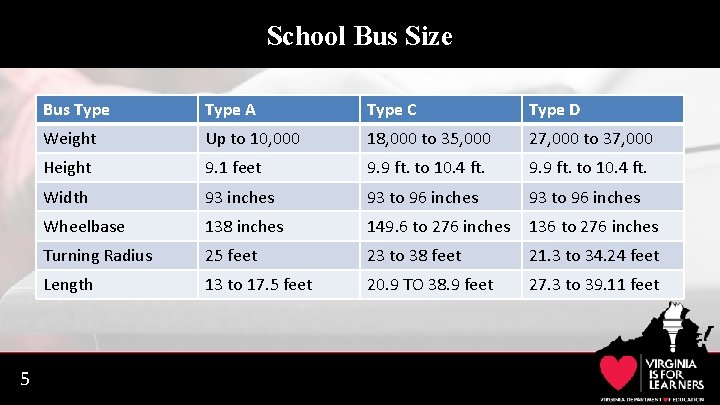
School Bus Size 5 Bus Type A Type C Type D Weight Up to 10, 000 18, 000 to 35, 000 27, 000 to 37, 000 Height 9. 1 feet 9. 9 ft. to 10. 4 ft. Width 93 inches 93 to 96 inches Wheelbase 138 inches 149. 6 to 276 inches 136 to 276 inches Turning Radius 25 feet 23 to 38 feet 21. 3 to 34. 24 feet Length 13 to 17. 5 feet 20. 9 TO 38. 9 feet 27. 3 to 39. 11 feet
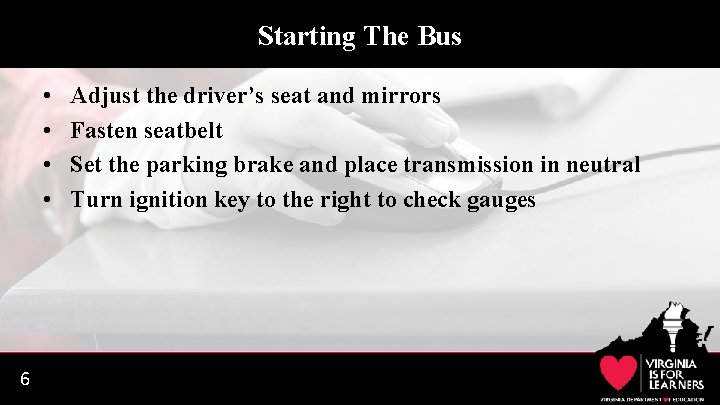
Starting The Bus • • 6 Adjust the driver’s seat and mirrors Fasten seatbelt Set the parking brake and place transmission in neutral Turn ignition key to the right to check gauges
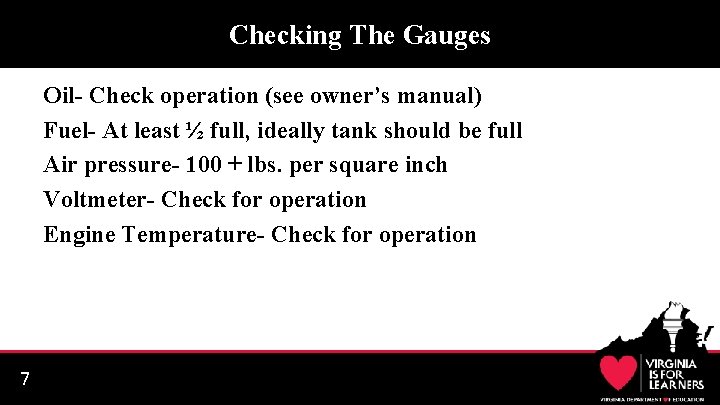
Checking The Gauges Oil- Check operation (see owner’s manual) Fuel- At least ½ full, ideally tank should be full Air pressure- 100 + lbs. per square inch Voltmeter- Check for operation Engine Temperature- Check for operation 7
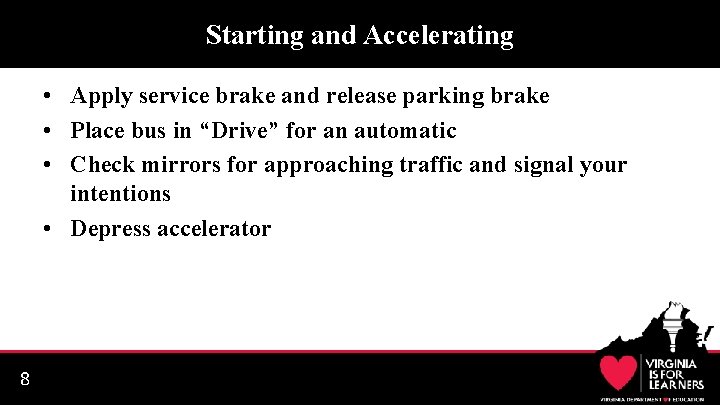
Starting and Accelerating • Apply service brake and release parking brake • Place bus in “Drive” for an automatic • Check mirrors for approaching traffic and signal your intentions • Depress accelerator 8
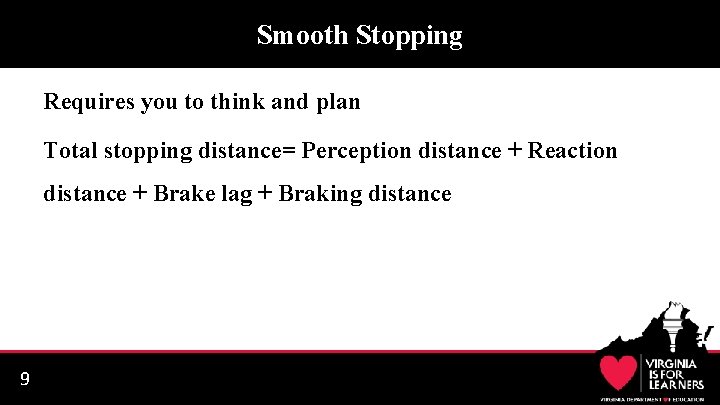
Smooth Stopping Requires you to think and plan Total stopping distance= Perception distance + Reaction distance + Brake lag + Braking distance 9
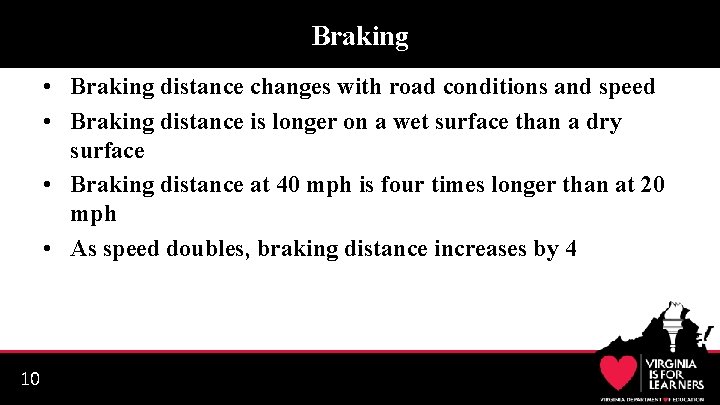
Braking • Braking distance changes with road conditions and speed • Braking distance is longer on a wet surface than a dry surface • Braking distance at 40 mph is four times longer than at 20 mph • As speed doubles, braking distance increases by 4 10
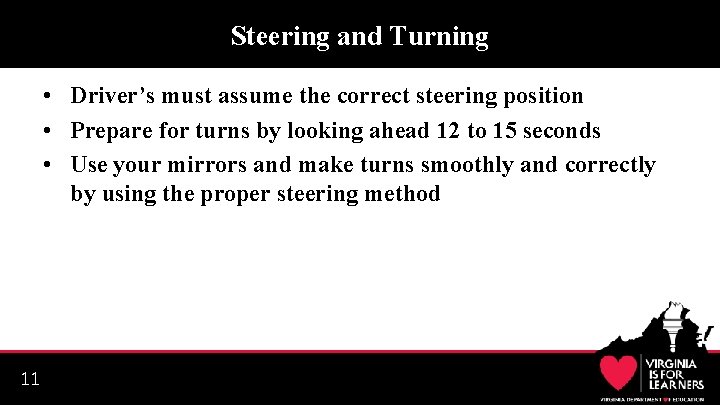
Steering and Turning • Driver’s must assume the correct steering position • Prepare for turns by looking ahead 12 to 15 seconds • Use your mirrors and make turns smoothly and correctly by using the proper steering method 11
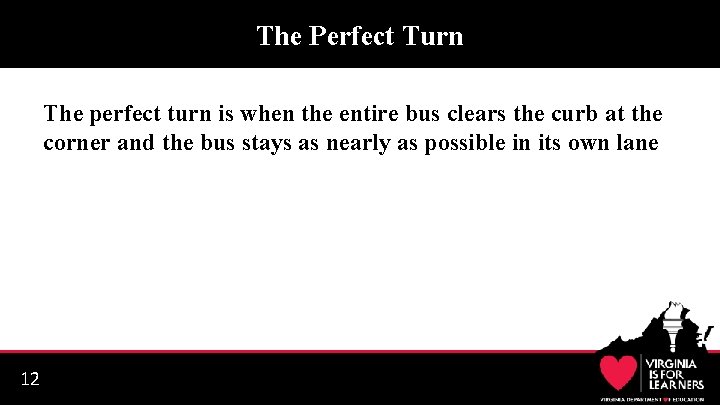
The Perfect Turn The perfect turn is when the entire bus clears the curb at the corner and the bus stays as nearly as possible in its own lane 12
Making a Right Turn • • • Check the traffic surrounding the bus Give ample signal for the current speed and distance Move to the far right hand lane and slow down Observe and obey all traffic signs and signals Reduce speed to 10 mph or less, turning slowly gives the driver and others time to avoid problems • When making a turn, allow sufficient space to avoid running over the curb or striking parked vehicles 13
Making a Right Turn • Check for pedestrians and check traffic left and right, yield to all pedestrians and vehicles • Turn wide as needed to complete the turn • Complete the turn and deactivate the signal light if necessary 14
Making a Left Turn • • 15 Check traffic, signal intention Move to far left lane or right outer lane if 2 left turn lanes Reduce speed to 10 mph or less Judge space to avoid curb & parked vehicles Check for and Yield to bicyclist & pedestrians Check traffic left, right and straight ahead Reach center of intersection and start turn Deactivate signal light if necessary
Backing • Activate the four way hazard lights at least 100 feet before stopping • Stop the bus in the proper position to back • Check clearance to sides and overhead • Before and during the backing maneuver constantly check mirrors to see that the way is clear, if ever in doubt do not back • Tap the horn and check mirrors again • Back slowly and smoothly 16
Off Set Backing • Off set backing has the same procedures except for the final step • Back slowly and smoothly into the opposite lane until the front of the vehicle has passed the parking boundary 17
The Backing Rule Load Before Backing And Back Before Unloading 18
Parking • When the bus is parked on level ground or an upgrade, shift the gear to low and turn the front wheels away from the curb • When the bus is parked on a downgrade, shift the gear to reverse and turn the front wheels toward the curb or the edge of the road • Turn off the ignition, remove the key and set the parking brake • Whenever possible the driver should park the bus in a manner that eliminates backing 19
Parallel Parking the Bus • Make certain to know the size of the bus you are driving • Signal your intentions with the side you wish to park • Line the bus parallel with the parked vehicle, position the bus about 3 feet away • Activate the four way hazard lights, check mirrors to make certain you are clear to begin backing • With the transmission in reverse slowly begin to back the bus 20
Parallel Parking the Bus • Turn the steering wheel hard in the opposite direction you wish to back • Visually check in front of and around the bus often, continue backing the bus until it is predominantly in the parking space • Slowly move forward to straighten the bus out 21
Positioning the Bus on the Roadway • Parking lanes are for emergency vehicles or emergency conditions • Drive in the farthest lane to the right when possible • On unmarked roads, position bus to the right of the center of the road • Rural roads may have weak outer edges and soft shoulders • Always use a safe following distance 22
Intersections • Give the right of way to all pedestrians • Obey all traffic signs, signals and laws • Approach intersections with caution and observe all surrounding traffic. The driver should be prepared to stop if necessary even though they may have the right of way 23
Following Distance Rule 0 -40 mph 1 second for every 10 feet of your vehicle Over 40 mph Add 1 second Example 0 -40 mph 40 ft. vehicle = 4 seconds Over 40 mph 40 ft. vehicle = 5 seconds 24
Outside Cities and Town • Keep at least 200 ft. behind other trucks and buses NEVER follow another vehicle closer than one bus length • Blind Spots areas around larger vehicles where crashes are more likely to occur • Blind spots on the side, front and rear also including areas where cars and other vehicles disappear from the driver’s view 25
Passing and Being Passed • Generally, the school bus driver will not have to pass another vehicle but when it is necessary, the driver should pass only where it is permitted, pass on the left at a safe distance • Avoid passing or running side by side with another school bus 26
Passing and Being Passed • Never pass another vehicle that is weaving or looks to be out of control • When another vehicle passes, stay in the right lane, continue at same speed or decrease and allow the vehicle to pass 27
Railroad Crossing • Tap the service brake to alert drivers behind the bus • Activate the 4 -way hazard lights and stop the bus within 50 ft. but not less then 15 ft. from the railroad crossing • With the bus stopped, apply the emergency brake and place the gear in park or neutral • Turn off all noisy equipment, open the entrance door and driver window to look and listen for a train in both directions • When safe to cross, close entrance doors and turn off 4 -way hazard lights and cross the tracks without changing gears 28
Speed Limits for School Buses The maximum speed limit for school buses shall be 45 mph or the minimum speed allowable, whichever is greater, on any highway where the maximum speed limit is 55 mph or less and 60 mph on all interstate highways and on other highways where the maximum speed limit is more than 55 mph 29
Driving on School Grounds • • Stay alert and proceed slowly and cautiously Stop at designated place for loading and unloading Always follow road rules Never deactivate warning lights when loading and/or unloading • Never pass or allow another vehicle to pass when loading or unloading 30
Driving on School Grounds • Check mirrors often before moving • Leave school grounds safely and orderly 31
Driving under Special Conditions Driving conditions vary greatly by location Special conditions put special responsibilities on the driver. The professional driver modifies driving approaches under unfavorable driving conditions. 32
Rural Driving • Drive with caution and reduce speed on narrow roads • Be cautious of wild animals like deer possibly jumping out in front of the bus 33
Urban Driving • Be aware of the frequency of intersection and limited escape routes • Speed of the vehicle should be consistent with traffic in the non-accelerate lane 34
Expressway Driving • • 35 Be certain you are entering the correct ramp Check traffic around you, signal and search for a gap Accelerate speed to blend into traffic smoothly Using caution as you merge, turn off signal and adjust speed
Driving in Darkness • Prepare the bus by completing a through pre-trip, check and clean headlights, taillights, signal lights and windows • Lights will not help you see better in early twilight, but they will make it easier for other drivers to see you • Always reduce speed and increase your following distance 36
Activity Trips • Prepare for a trip by familiarizing yourself with the route • Designate the teacher or coach to maintain safe behavior on the bus • Never allow the emergency exits to be blocked • Always secure loose items • Inform all passengers of emergency procedures and how to use emergency equipment • Stay on schedule 37
SIPDE Technique • • • 38 Search – Search aggressively for potential hazards Identify – Locate hazards and potential conflicts Predict- Anticipate how the hazard may affect you Decide- Determine how to reduce the hazard Execute- Carry out your decision
Connect with VDOE Jackie. Johnson@doe. virginia. gov Twitter: @VDOE_News Facebook: @VDOENews #VAis 4 Learners #Ed. Equity. VA 39