
Driving Forces Analysis Worksheet Instructions Cancer programs need
- Slides: 2
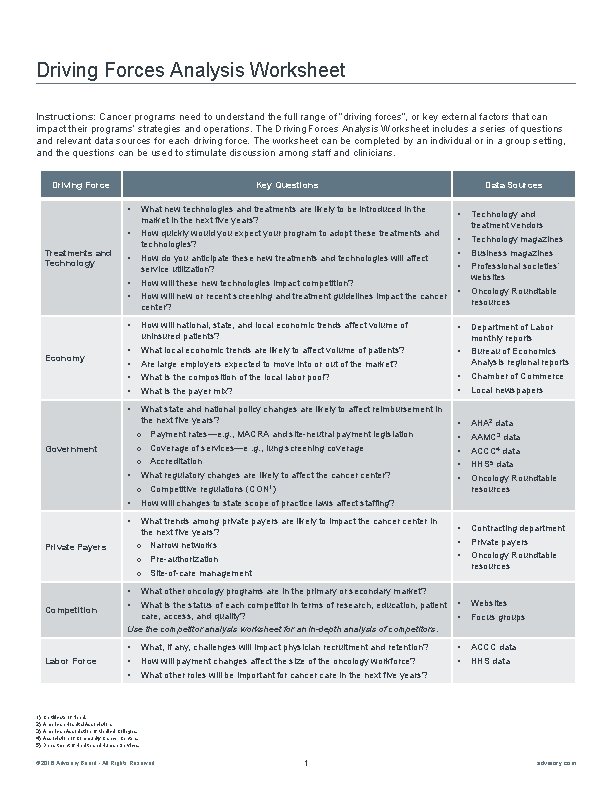
Driving Forces Analysis Worksheet Instructions: Cancer programs need to understand the full range of “driving forces”, or key external factors that can impact their programs’ strategies and operations. The Driving Forces Analysis Worksheet includes a series of questions and relevant data sources for each driving force. The worksheet can be completed by an individual or in a group setting, and the questions can be used to stimulate discussion among staff and clinicians. Driving Force Treatments and Technology Economy Key Questions • What new technologies and treatments are likely to be introduced in the market in the next five years? • How quickly would you expect your program to adopt these treatments and technologies? • How do you anticipate these new treatments and technologies will affect service utilization? • • How will these new technologies impact competition? • Data Sources • Technology and treatment vendors • • • Technology magazines • Oncology Roundtable resources How will national, state, and local economic trends affect volume of uninsured patients? • Department of Labor monthly reports • • What local economic trends are likely to affect volume of patients? • Bureau of Economics Analysis regional reports • • Chamber of Commerce • What state and national policy changes are likely to affect reimbursement in the next five years? • • • AHA 2 data • • • Contracting department • • Websites • • ACCC data How will new or recent screening and treatment guidelines impact the cancer center? Are large employers expected to move into or out of the market? What is the composition of the local labor pool? What is the payer mix? o Payment rates—e. g. , MACRA and site-neutral payment legislation o Coverage of services—e. g. , lung screening coverage o Accreditation Government • What regulatory changes are likely to affect the cancer center? o Competitive regulations (CON 1) • How will changes to state scope of practice laws affect staffing? • What trends among private payers are likely to impact the cancer center in the next five years? o Narrow networks o Pre-authorization o Site-of-care management Private Payers Competition • • Business magazines Professional societies’ websites Local newspapers AAMC 3 data ACCC 4 data HHS 5 data Oncology Roundtable resources Private payers Oncology Roundtable resources What other oncology programs are in the primary or secondary market? What is the status of each competitor in terms of research, education, patient care, access, and quality? Focus groups Use the competitor analysis worksheet for an in-depth analysis of competitors. Labor Force 1) 2) 3) 4) 5) • • • What, if any, challenges will impact physician recruitment and retention? How will payment changes affect the size of the oncology workforce? HHS data What other roles will be important for cancer care in the next five years? Certificate of Need. American Hospital Association. American Association of Medical Colleges. Association of Community Cancer Centers. Department of Health and Human Services. © 2016 Advisory Board • All Rights Reserved 1 advisory. com
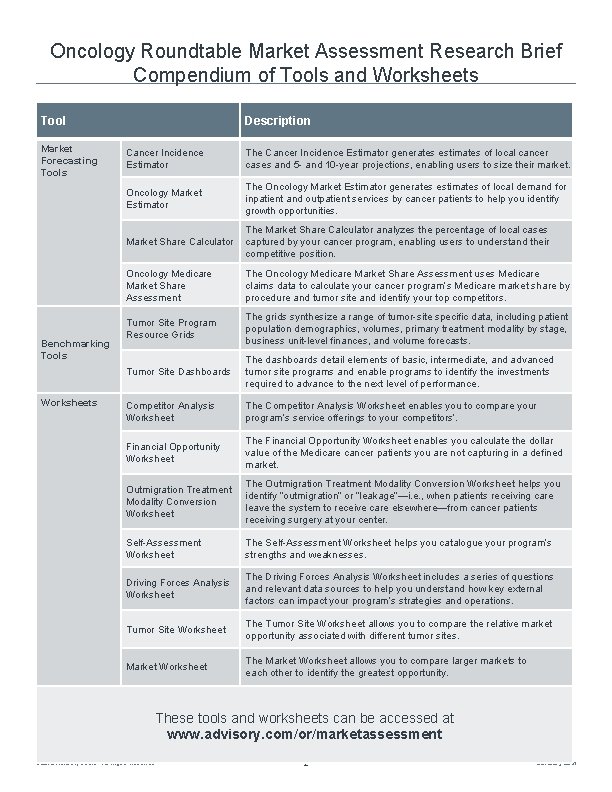
Oncology Roundtable Market Assessment Research Brief Compendium of Tools and Worksheets Tool Market Forecasting Tools Benchmarking Tools Worksheets Description Cancer Incidence Estimator The Cancer Incidence Estimator generates estimates of local cancer cases and 5 - and 10 -year projections, enabling users to size their market. Oncology Market Estimator The Oncology Market Estimator generates estimates of local demand for inpatient and outpatient services by cancer patients to help you identify growth opportunities. Market Share Calculator The Market Share Calculator analyzes the percentage of local cases captured by your cancer program, enabling users to understand their competitive position. Oncology Medicare Market Share Assessment The Oncology Medicare Market Share Assessment uses Medicare claims data to calculate your cancer program’s Medicare market share by procedure and tumor site and identify your top competitors. Tumor Site Program Resource Grids The grids synthesize a range of tumor-site specific data, including patient population demographics, volumes, primary treatment modality by stage, business unit-level finances, and volume forecasts. Tumor Site Dashboards The dashboards detail elements of basic, intermediate, and advanced tumor site programs and enable programs to identify the investments required to advance to the next level of performance. Competitor Analysis Worksheet The Competitor Analysis Worksheet enables you to compare your program’s service offerings to your competitors’. Financial Opportunity Worksheet The Financial Opportunity Worksheet enables you calculate the dollar value of the Medicare cancer patients you are not capturing in a defined market. Outmigration Treatment Modality Conversion Worksheet The Outmigration Treatment Modality Conversion Worksheet helps you identify “outmigration” or “leakage”—i. e. , when patients receiving care leave the system to receive care elsewhere—from cancer patients receiving surgery at your center. Self-Assessment Worksheet The Self-Assessment Worksheet helps you catalogue your program’s strengths and weaknesses. Driving Forces Analysis Worksheet The Driving Forces Analysis Worksheet includes a series of questions and relevant data sources to help you understand how key external factors can impact your program’s strategies and operations. Tumor Site Worksheet The Tumor Site Worksheet allows you to compare the relative market opportunity associated with different tumor sites. Market Worksheet The Market Worksheet allows you to compare larger markets to each other to identify the greatest opportunity. These tools and worksheets can be accessed at www. advisory. com/or/marketassessment © 2016 Advisory Board • All Rights Reserved 2 advisory. com