
DRIVING AND DEMENTIA BURKE DRIVER EVALUATION PROGRAM Andrea
DRIVING AND DEMENTIA BURKE DRIVER EVALUATION PROGRAM Andrea Sullivan OT/L Occupational Therapy Supervisor Out-Patient Services Burke Rehabilitation Hospital White Plains, NY
Why are driver evaluations needed? � Medical changes �Stroke, Traumatic brain injury, Neurological impairments, SCI � Normal Aging changes � Physical changes � Amputation, Arthritis, joint problems, postural changes � Diabetic conditions � Mental Illness/Attention Deficit/Learning Impairment � Dementia/Alzheimer’s �Peripheral neuropathy, diabetic retinopathy
“Normal” Aging � Vision � Hearing � Strength/stamina � Memory � Processing speed � Divided attention
Presence of AD � Loss of time � Topographical orientation � Working memory � Visual perceptual abilities
Presence of AD con’t � Problem solving/reasoning skills � Judgment � Motor planning � Self awareness
Some Info… 20 major decisions are made during each mile driven (AARP) �. 5 seconds to react to prevent potential collision (AARP) � The nation's 65 -and-older population is projected to reach 83. 7 million in 2050, almost double from the 2012 level of 43. 1 million (U. S. Census) �
MD Role � Review medical history � Medications � Provide diagnosis � Ethical and legal responsibilities � No mandatory reporting laws in NYS � Physician’s Request for Driver Review (DS-6) � Refer for Driver Evaluation
Burke’s Driving Evaluation 2 parts � Part 1: In-clinic Evaluation �Conducted by an occupational therapist (OT) �Evaluation of component skills needed for driving �Followed by in-vehicle assessment if appropriate � Part 2: In-vehicle Evaluation �On the road test with trained individual �May include and adapted van/car evaluation
Part 1: In-clinic Evaluation � Requires a prescription from the doctor, not covered by Medicare, some commercial insurances do cover � Reaction time tester, OPTEC and various paper pencil tests � Length of test- up to 60 minutes
Benefits of Clinical test � Under the supervision of a physician � Becomes part of medical record � Possible future litigation and insurance co. concerns � Let us be the “bad guys”; assists families � Assists physician’s in making informed decision
OT Evaluation � Observe performance of complex IADL and assess vision, cognition, motor skills and perception � Help to guide CDRS/CDI on what to be prepared for on the road test � Use of clinical reasoning based on evidence based practice
Areas evaluated by OT • • • Vision Perception Cognition /Attention Problem solving/safety Memory function Reaction time Motor skills and strength, coordination and ROM Knowledge of traffic situations Need for adaptive equipment ○ **If only vehicle modifications may go straight to driving school
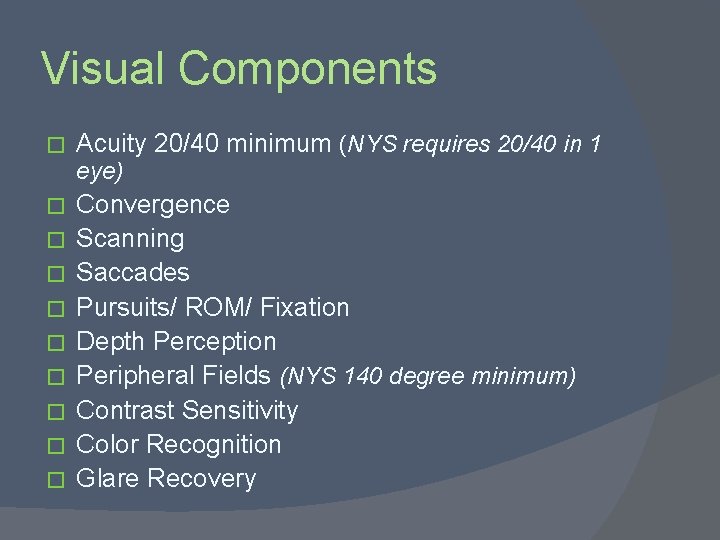
Visual Components � Acuity 20/40 minimum (NYS requires 20/40 in 1 eye) � � � � � Convergence Scanning Saccades Pursuits/ ROM/ Fixation Depth Perception Peripheral Fields (NYS 140 degree minimum) Contrast Sensitivity Color Recognition Glare Recovery
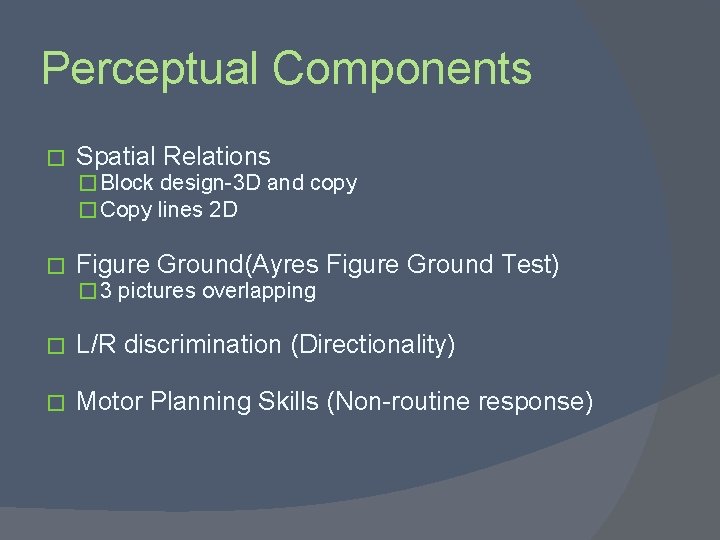
Perceptual Components � Spatial Relations � Block design-3 D and copy � Copy lines 2 D � Figure Ground(Ayres Figure Ground Test) � 3 pictures overlapping � L/R discrimination (Directionality) � Motor Planning Skills (Non-routine response)
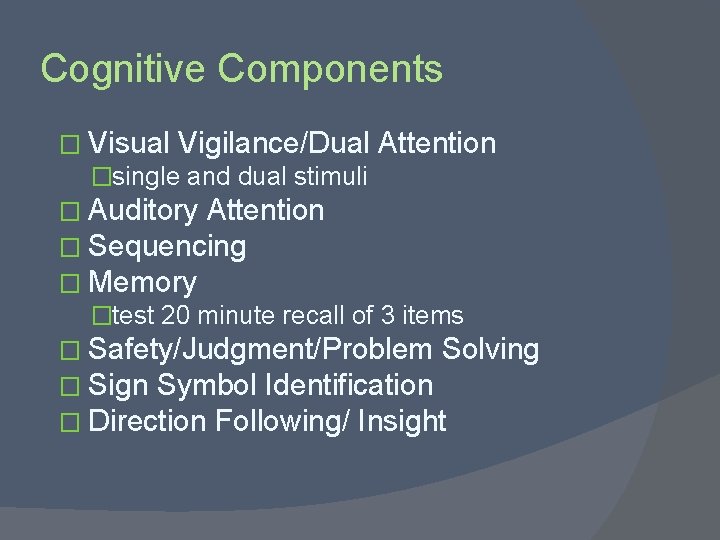
Cognitive Components � Visual Vigilance/Dual Attention �single and dual stimuli � Auditory Attention � Sequencing � Memory �test 20 minute recall of 3 items � Safety/Judgment/Problem Solving � Sign Symbol Identification � Direction Following/ Insight
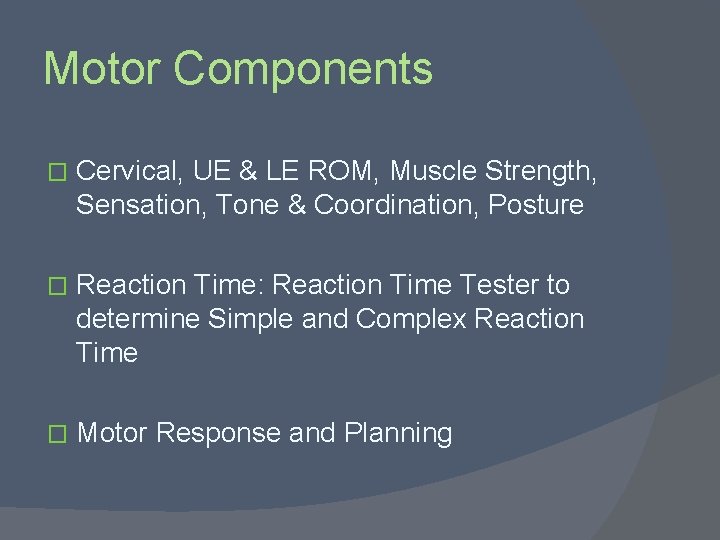
Motor Components � Cervical, UE & LE ROM, Muscle Strength, Sensation, Tone & Coordination, Posture � Reaction Time: Reaction Time Tester to determine Simple and Complex Reaction Time � Motor Response and Planning
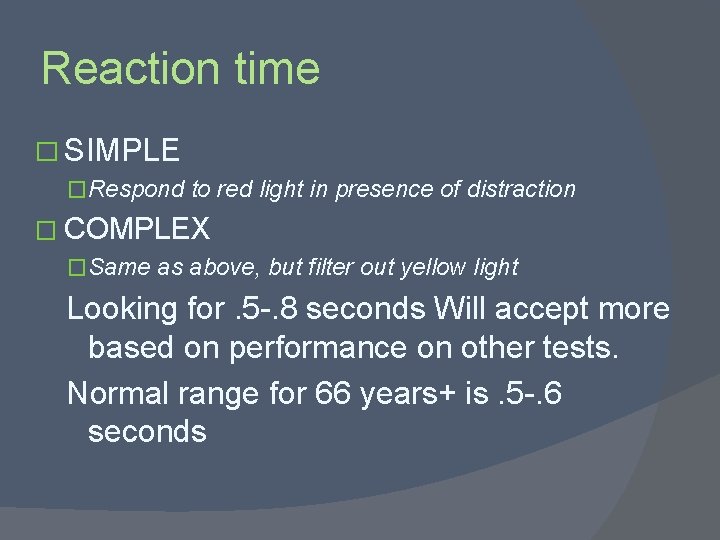
Reaction time � SIMPLE �Respond to red light in presence of distraction � COMPLEX �Same as above, but filter out yellow light Looking for. 5 -. 8 seconds Will accept more based on performance on other tests. Normal range for 66 years+ is. 5 -. 6 seconds
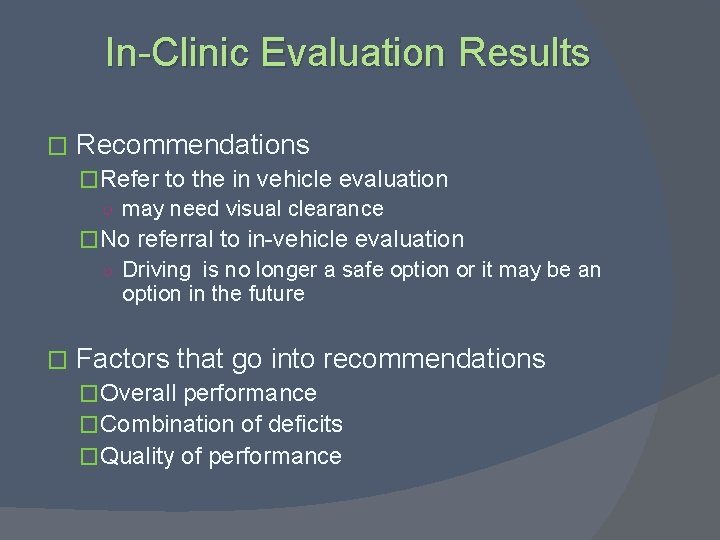
In-Clinic Evaluation Results � Recommendations �Refer to the in vehicle evaluation ○ may need visual clearance �No referral to in-vehicle evaluation ○ Driving is no longer a safe option or it may be an option in the future � Factors that go into recommendations �Overall performance �Combination of deficits �Quality of performance
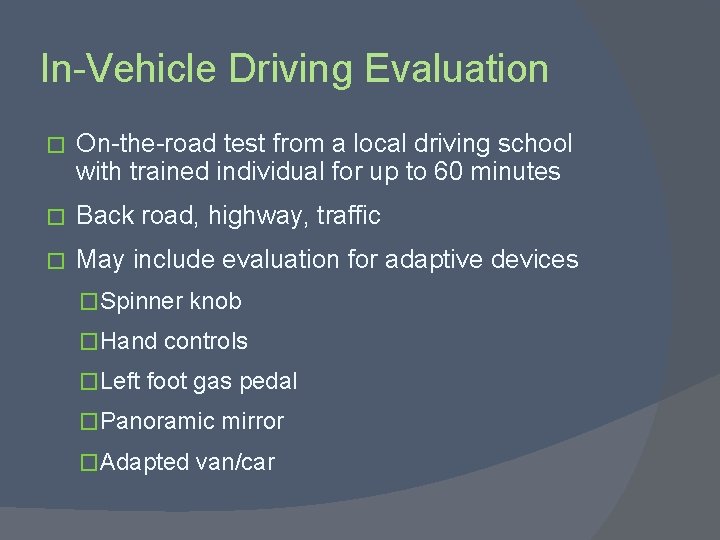
In-Vehicle Driving Evaluation � On-the-road test from a local driving school with trained individual for up to 60 minutes � Back road, highway, traffic � May include evaluation for adaptive devices �Spinner knob �Hand controls �Left foot gas pedal �Panoramic mirror �Adapted van/car
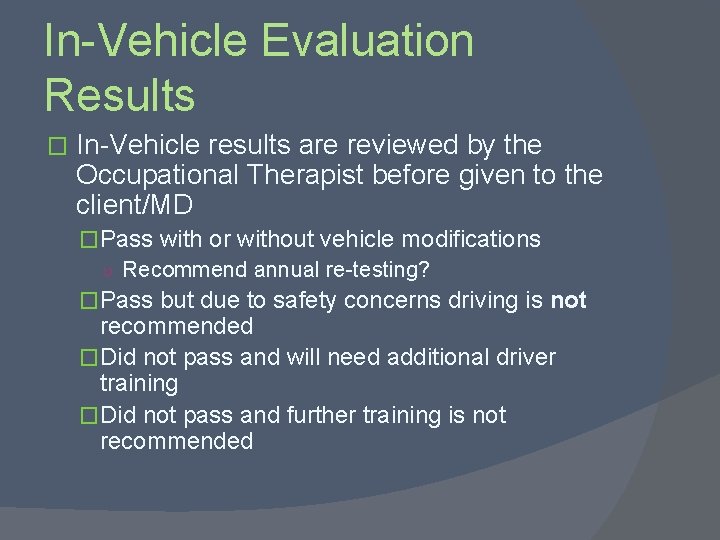
In-Vehicle Evaluation Results � In-Vehicle results are reviewed by the Occupational Therapist before given to the client/MD �Pass with or without vehicle modifications ○ Recommend annual re-testing? �Pass but due to safety concerns driving is not recommended �Did not pass and will need additional driver training �Did not pass and further training is not recommended
Recommendation to no longer drive � A letter is sent to physician to inform them of the results as well as a Physician’s statement for medical review ( DS-6) � A letter is sent to the patient along with resources for transportation
PHYSICIAN REPORTING (DS-6) • Automatic suspension of individuals license • Driving • MD retesting performed by DMV must approve revoking suspension of license
Reporting By A Citizen To DMV (DS-7) � Form can be given to individual (family, concerned citizen) to alert DMV. � DMV will initiate investigation following 3 letters of concern. � DMV MAY disclose identity of concerned citizen
Patient and Family Education � Provide Family and Patient with Transportation Options � Clearly State Whether There Is A Chance for Re-testing or Driving is Not a Future Option (6 month minimum) � Family Support and Acknowledgment Are Key to Success of Intervention � Explain Liability To Patient and Family If Recommendation Are Ignored.

Useful Resources www. nhtsa. dot. gov www. aaafoundation. org www. driver-ed. org www. aota. org www. ama-assn. org www. aarp. org www. nysdmv. com
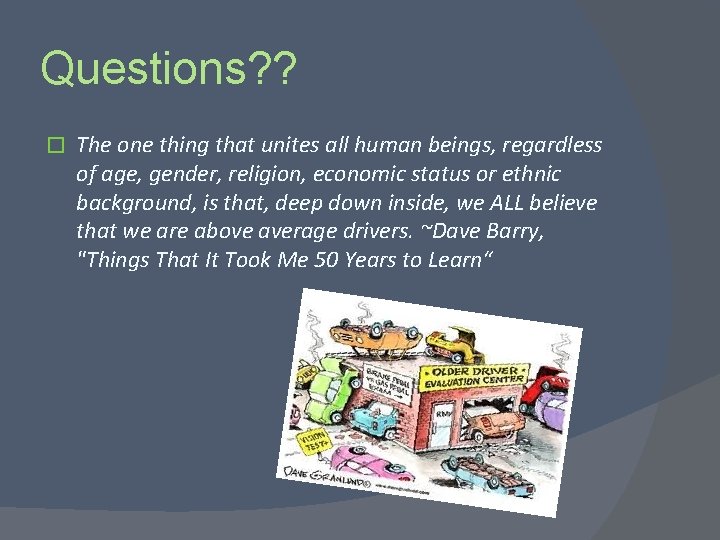
Questions? ? � The one thing that unites all human beings, regardless of age, gender, religion, economic status or ethnic background, is that, deep down inside, we ALL believe that we are above average drivers. ~Dave Barry, "Things That It Took Me 50 Years to Learn“
- Slides: 26