
Drivetrains What is a drive train The drivetrain



- Slides: 16
Drivetrains
What is a drive train? The drivetrain is, by definition, is the system in a motor vehicle that connects the transmission to the drive axles. Its purpose is to move the robot around the field, push/pull objects, and climb up ramps or over/around obstacles. It is the most important sub-system since without mobility, it is impossible to score or prevent points. The drivetrain must be durable and reliable to be successful and its important abilities are speed, pushing force, and agility. The basic components of it are the frame, wheels, gearboxes, and chain.
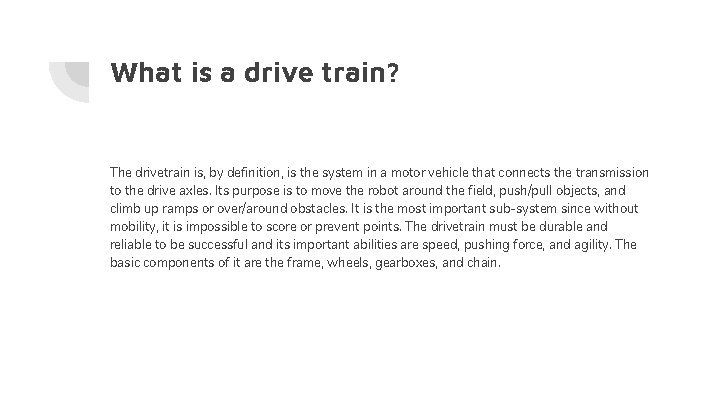
Frame ● The base ● The drivetrain without to wiring, gearboxes, wheels and such
Wheels
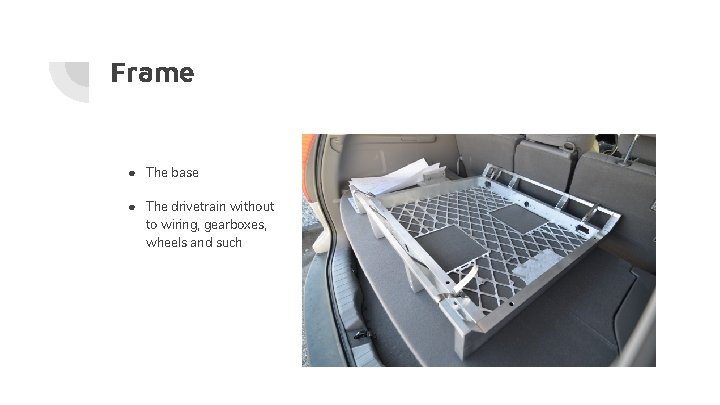
Traction ● Standard wheels ● Varying amounts of traction, strength, and weight
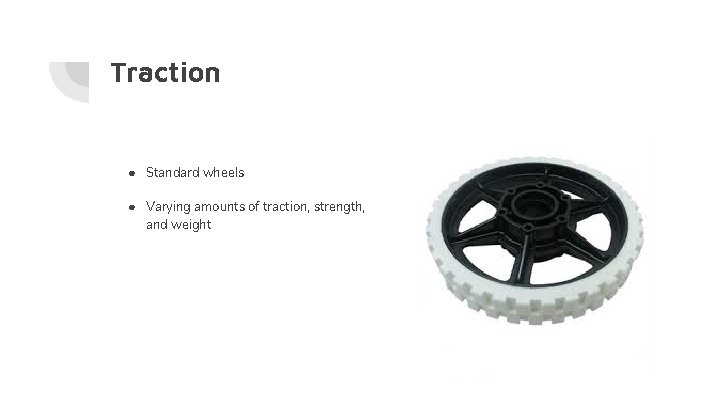
Omni ● Rollers attached to circumference ● Perpendicular to the axis of rotation of the wheel ● Allows for omni directional motion
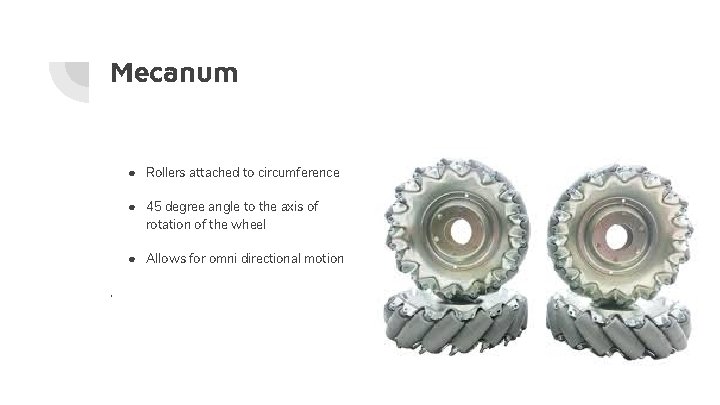
Mecanum ● Rollers attached to circumference ● 45 degree angle to the axis of rotation of the wheel ● Allows for omni directional motion.
Gearboxes
What are gearboxes A gearbox is a set of gears within a casing that increases torque while reducing speed from the motor. The selection of what gears go inside the gearbox is based on gear ratios. A gear ratio is the relationship between the numbers teeth on two meshed gears, and it's represented as a ratio. If a gear with a large circumference is turning one that is only half as big, the smaller gear will spin twice as fast as the larger one
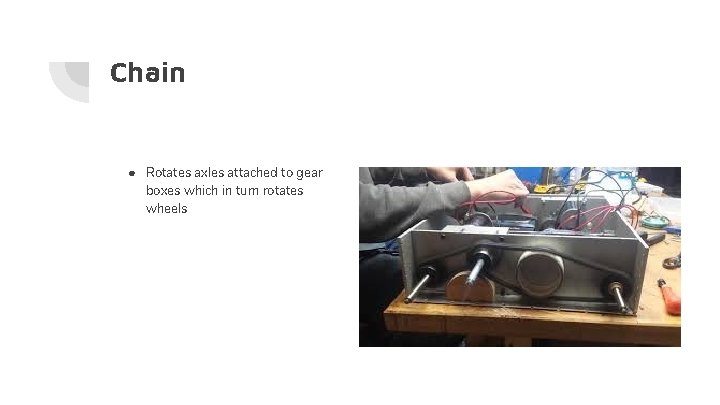
Chain ● Rotates axles attached to gear boxes which in turn rotates wheels
Types of Drivetrains
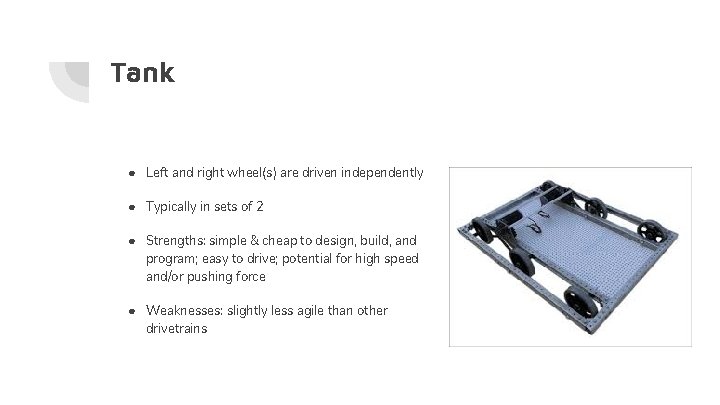
Tank ● Left and right wheel(s) are driven independently ● Typically in sets of 2 ● Strengths: simple & cheap to design, build, and program; easy to drive; potential for high speed and/or pushing force ● Weaknesses: slightly less agile than other drivetrains
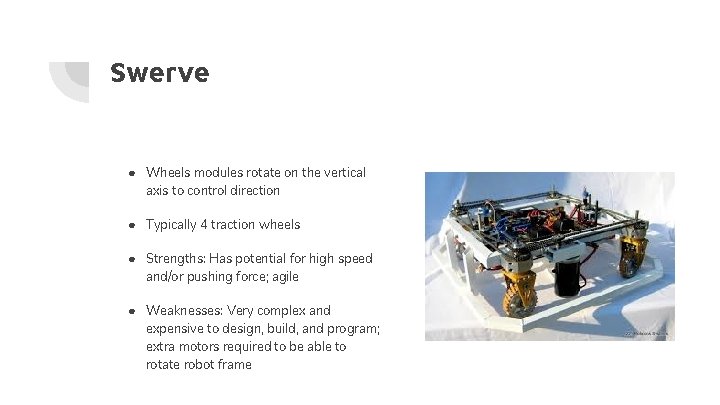
Swerve ● Wheels modules rotate on the vertical axis to control direction ● Typically 4 traction wheels ● Strengths: Has potential for high speed and/or pushing force; agile ● Weaknesses: Very complex and expensive to design, build, and program; extra motors required to be able to rotate robot frame
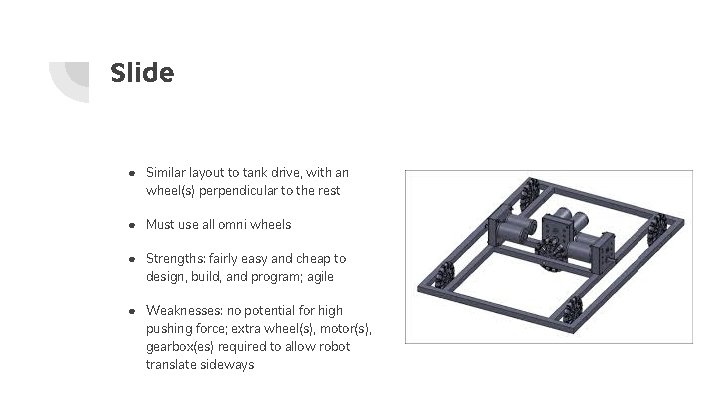
Slide ● Similar layout to tank drive, with an wheel(s) perpendicular to the rest ● Must use all omni wheels ● Strengths: fairly easy and cheap to design, build, and program; agile ● Weaknesses: no potential for high pushing force; extra wheel(s), motor(s), gearbox(es) required to allow robot translate sideways
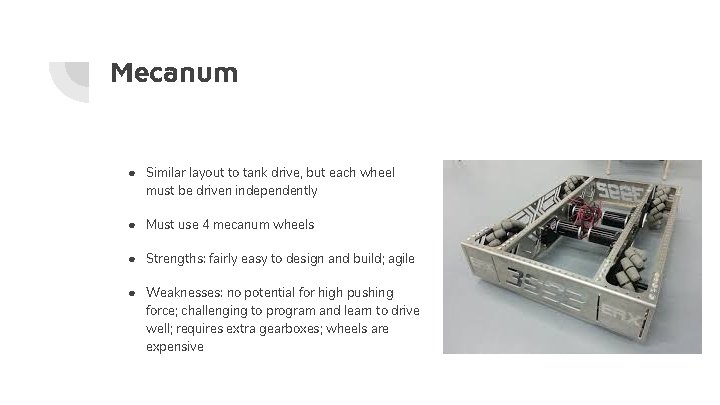
Mecanum ● Similar layout to tank drive, but each wheel must be driven independently ● Must use 4 mecanum wheels ● Strengths: fairly easy to design and build; agile ● Weaknesses: no potential for high pushing force; challenging to program and learn to drive well; requires extra gearboxes; wheels are expensive
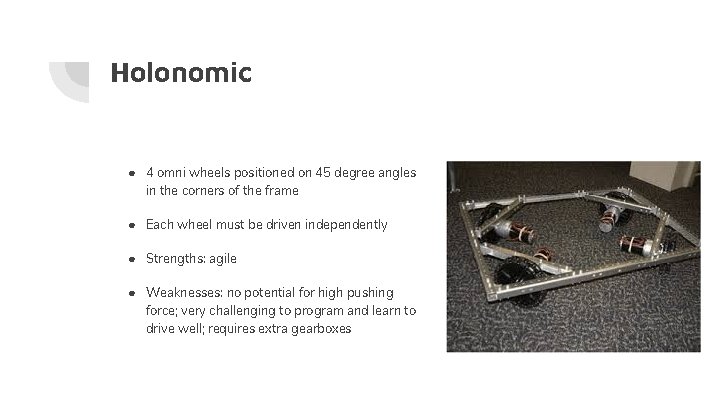
Holonomic ● 4 omni wheels positioned on 45 degree angles in the corners of the frame ● Each wheel must be driven independently ● Strengths: agile ● Weaknesses: no potential for high pushing force; very challenging to program and learn to drive well; requires extra gearboxes