
Drives Storage System Presented By Group 6 Storage
Drives & Storage System Presented By: Group 6
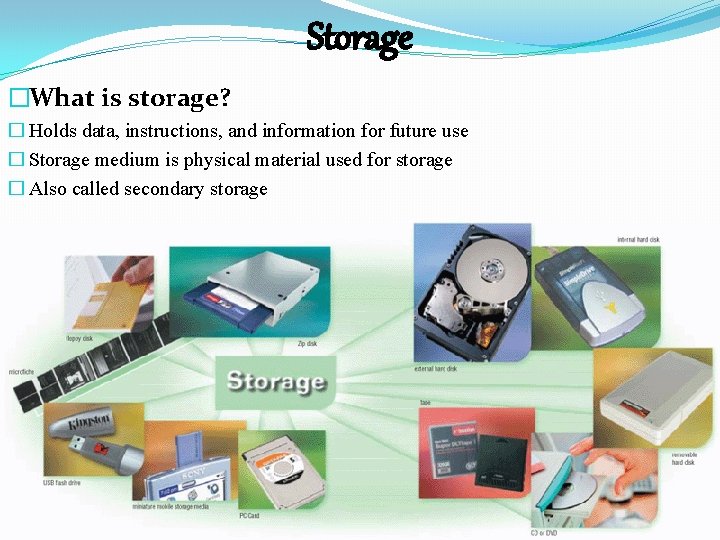
Storage �What is storage? � Holds data, instructions, and information for future use � Storage medium is physical material used for storage � Also called secondary storage
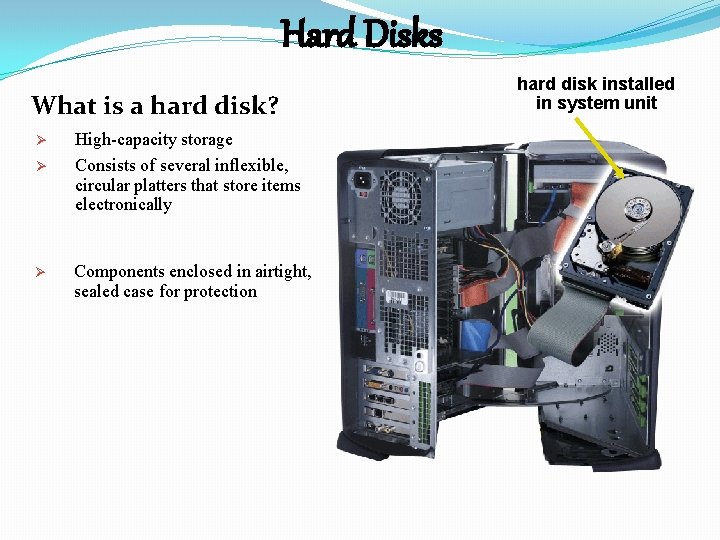
Hard Disks What is a hard disk? Ø Ø Ø High-capacity storage Consists of several inflexible, circular platters that store items electronically Components enclosed in airtight, sealed case for protection hard disk installed in system unit
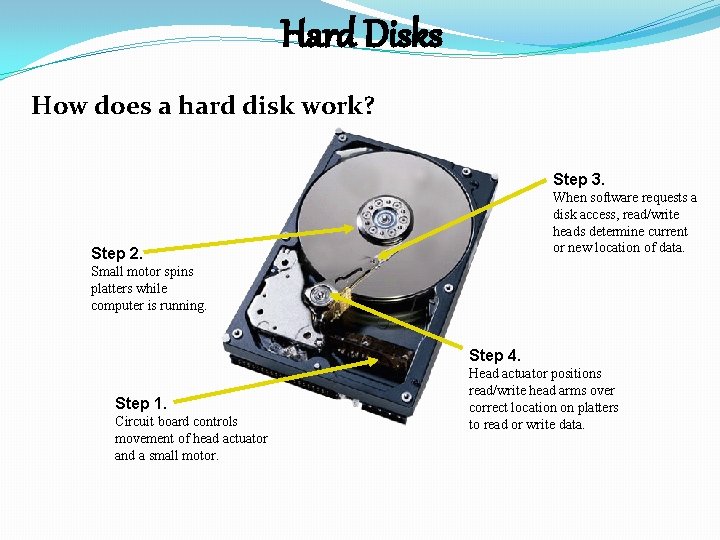
Hard Disks How does a hard disk work? Step 3. When software requests a disk access, read/write heads determine current or new location of data. Step 2. Small motor spins platters while computer is running. Step 4. Step 1. Circuit board controls movement of head actuator and a small motor. Head actuator positions read/write head arms over correct location on platters to read or write data.
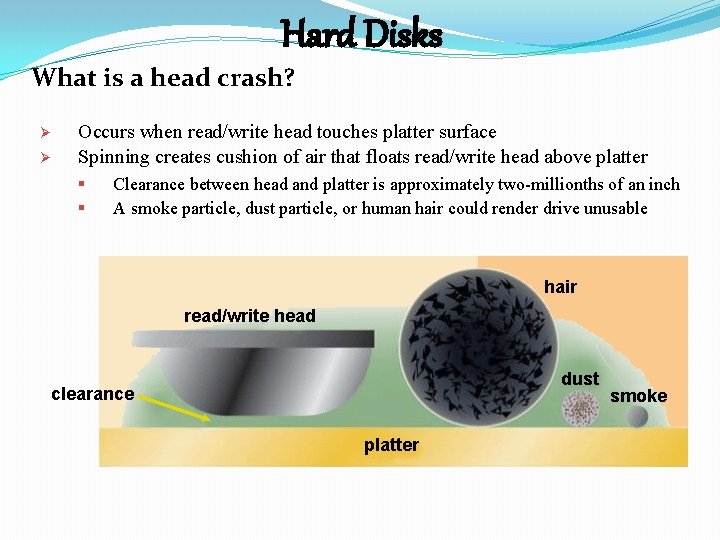
Hard Disks What is a head crash? Ø Ø Occurs when read/write head touches platter surface Spinning creates cushion of air that floats read/write head above platter § § Clearance between head and platter is approximately two-millionths of an inch A smoke particle, dust particle, or human hair could render drive unusable hair read/write head dust clearance platter smoke
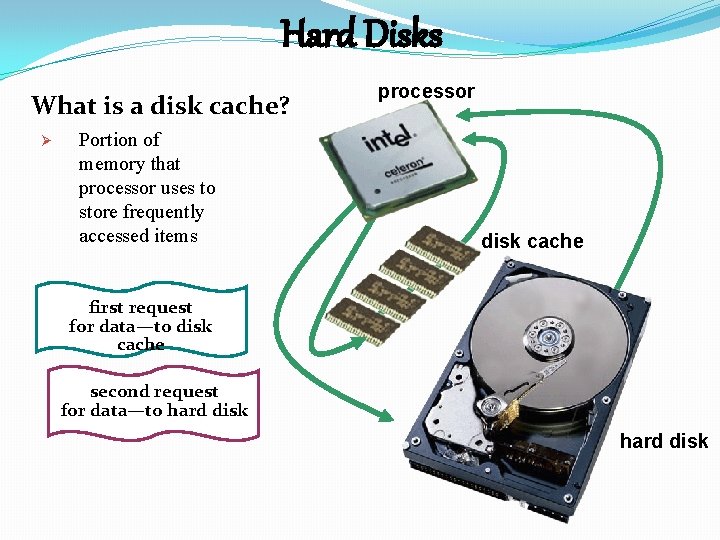
Hard Disks What is a disk cache? Ø Portion of memory that processor uses to store frequently accessed items processor disk cache first request for data—to disk cache second request for data—to hard disk
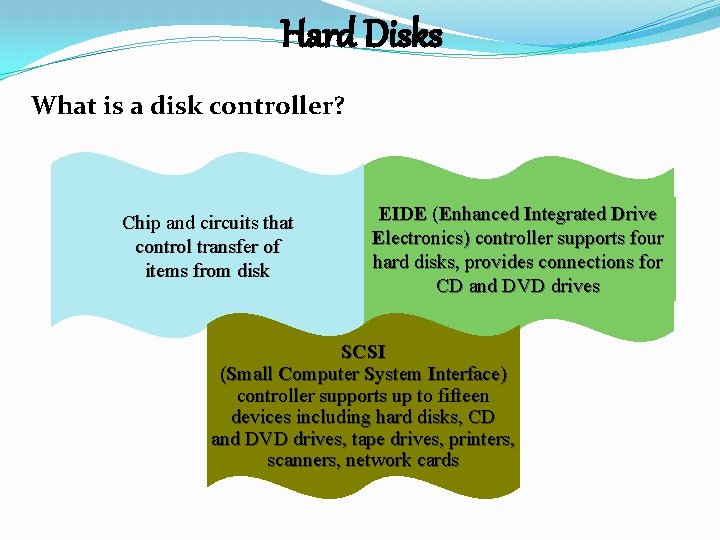
Hard Disks What is a disk controller? Chip and circuits that control transfer of items from disk EIDE (Enhanced Integrated Drive Electronics) controller supports four hard disks, provides connections for CD and DVD drives SCSI (Small Computer System Interface) controller supports up to fifteen devices including hard disks, CD and DVD drives, tape drives, printers, scanners, network cards
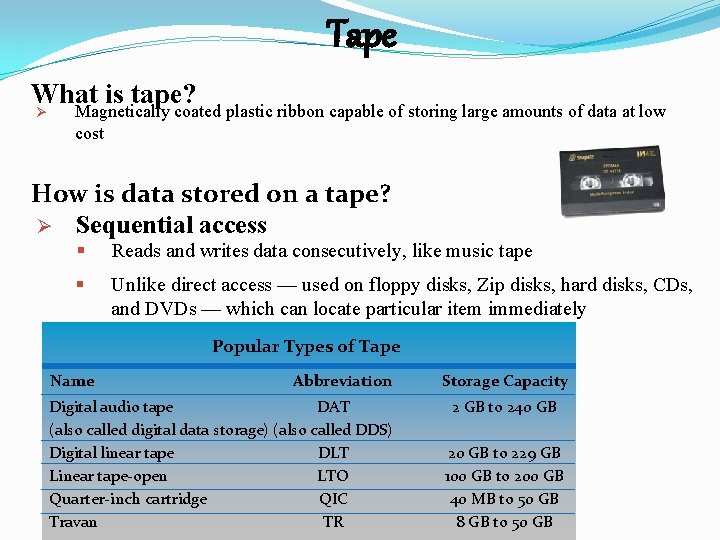
Tape What is tape? Ø Magnetically coated plastic ribbon capable of storing large amounts of data at low cost How is data stored on a tape? Ø Sequential access § Reads and writes data consecutively, like music tape § Unlike direct access — used on floppy disks, Zip disks, hard disks, CDs, and DVDs — which can locate particular item immediately Popular Types of Tape Name Abbreviation Digital audio tape DAT (also called digital data storage) (also called DDS) Digital linear tape DLT Linear tape-open LTO Quarter-inch cartridge QIC Travan TR Storage Capacity 2 GB to 240 GB 20 GB to 229 GB 100 GB to 200 GB 40 MB to 50 GB 8 GB to 50 GB
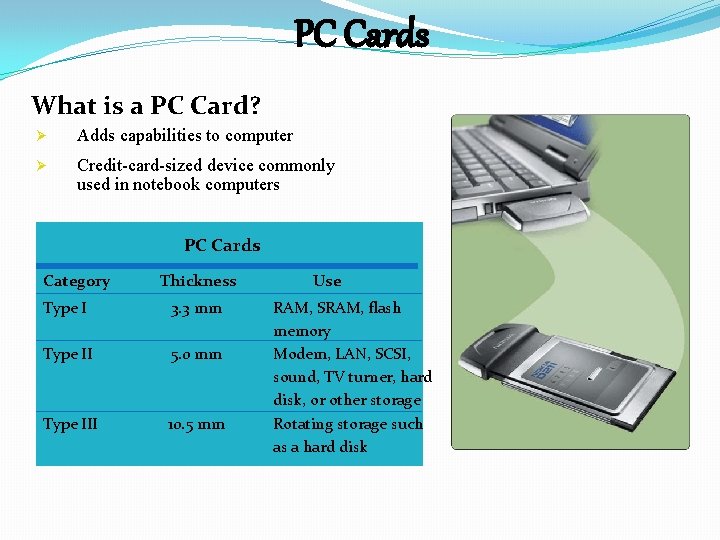
PC Cards What is a PC Card? Ø Adds capabilities to computer Ø Credit-card-sized device commonly used in notebook computers PC Cards Category Thickness Type I 3. 3 mm Type II 5. 0 mm Type III 10. 5 mm Use RAM, SRAM, flash memory Modem, LAN, SCSI, sound, TV turner, hard disk, or other storage Rotating storage such as a hard disk
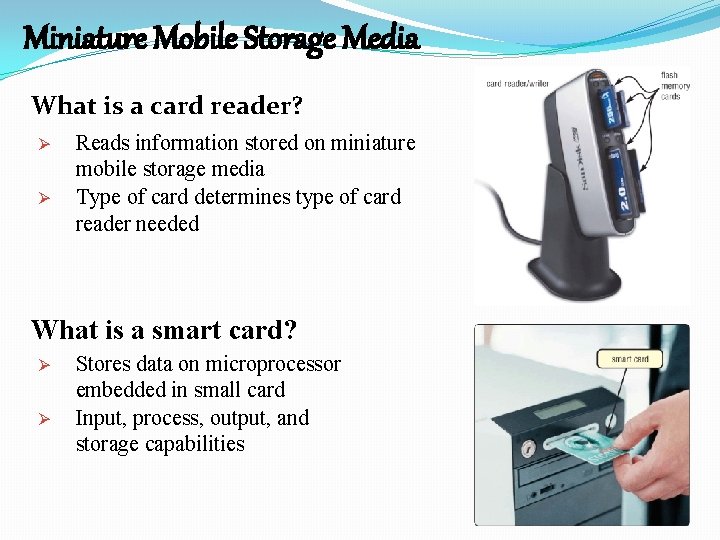
Miniature Mobile Storage Media What is a card reader? Ø Ø Reads information stored on miniature mobile storage media Type of card determines type of card reader needed What is a smart card? Ø Ø Stores data on microprocessor embedded in small card Input, process, output, and storage capabilities
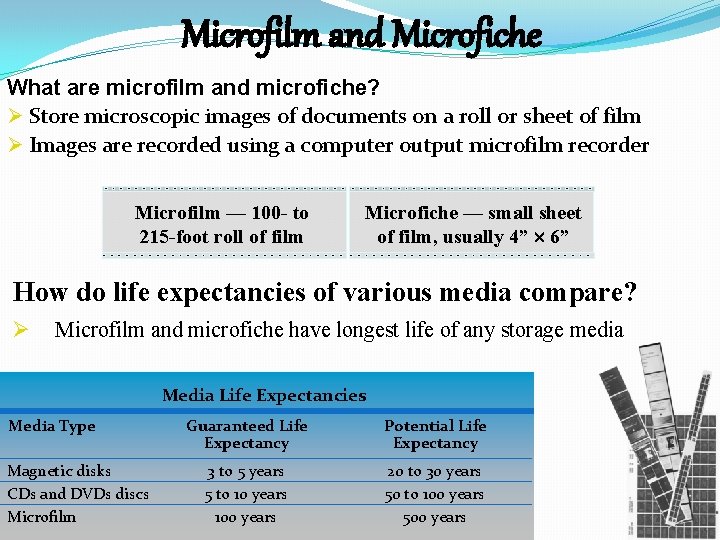
Microfilm and Microfiche What are microfilm and microfiche? Ø Store microscopic images of documents on a roll or sheet of film Ø Images are recorded using a computer output microfilm recorder Microfilm — 100 - to 215 -foot roll of film Microfiche — small sheet of film, usually 4” 6” How do life expectancies of various media compare? Ø Microfilm and microfiche have longest life of any storage media Media Life Expectancies Media Type Magnetic disks CDs and DVDs discs Microfilm Guaranteed Life Expectancy Potential Life Expectancy 3 to 5 years 5 to 10 years 100 years 20 to 30 years 50 to 100 years 500 years
- Slides: 11