
Drivers of Supply Chain How to achieve Efficiency
- Slides: 23
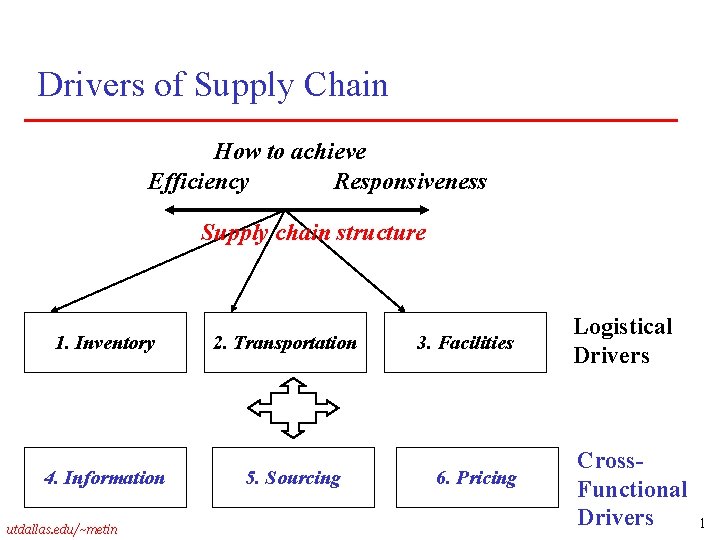
Drivers of Supply Chain How to achieve Efficiency Responsiveness Supply chain structure 1. Inventory 4. Information utdallas. edu/~metin 2. Transportation 5. Sourcing 3. Facilities 6. Pricing Logistical Drivers Cross. Functional Drivers 1
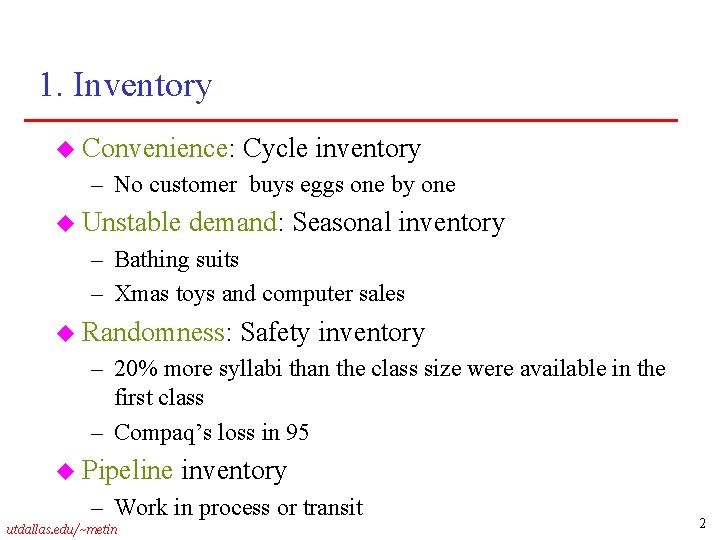
1. Inventory u Convenience: Cycle inventory – No customer buys eggs one by one u Unstable demand: Seasonal inventory – Bathing suits – Xmas toys and computer sales u Randomness: Safety inventory – 20% more syllabi than the class size were available in the first class – Compaq’s loss in 95 u Pipeline inventory – Work in process or transit utdallas. edu/~metin 2
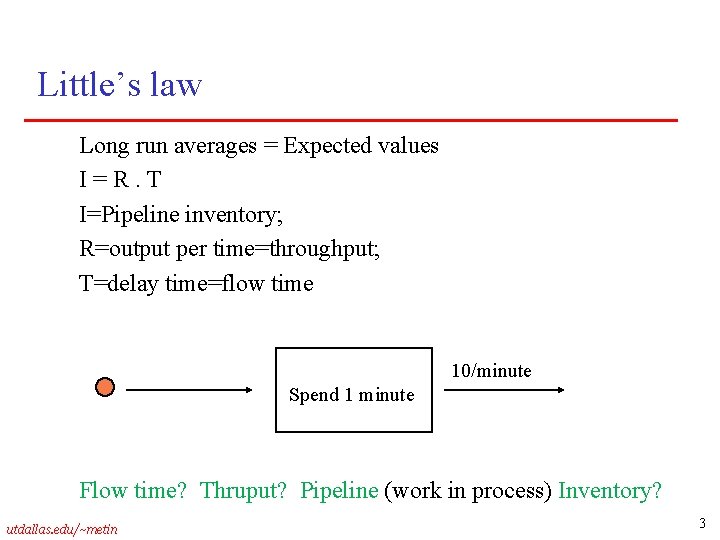
Little’s law Long run averages = Expected values I=R. T I=Pipeline inventory; R=output per time=throughput; T=delay time=flow time 10/minute Spend 1 minute Flow time? Thruput? Pipeline (work in process) Inventory? utdallas. edu/~metin 3
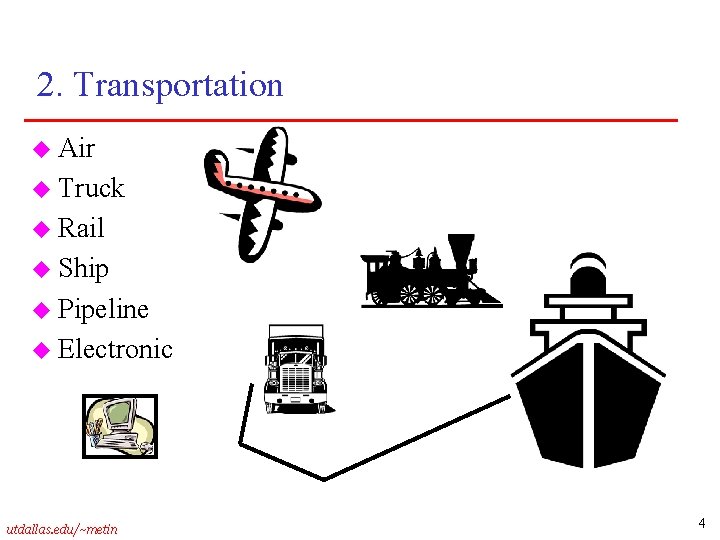
2. Transportation u Air u Truck u Rail u Ship u Pipeline u Electronic utdallas. edu/~metin 4
3. Facilities u Production – Flexible vs. Dedicated – Flexibility costs » Production: Remember BMW: “a sports car disguised as a sedan” » Service: Can your instructor teach music as well as SCM? » Sports: A playmaker who shoots well is rare. u Inventory-like operations: Receiving, Prepackaging, Storing, Picking, Packaging, Sorting, Accumulating, Shipping – Receiving, Sorting, Storing, Packaging, Shipping is not trivial. » Blockbuster Distribution Center in Mc. Kinney. – Job Lot Storage: Store full sets of fixtures separately for each process. » Need more space. Reticle storage in IBM semiconductor fabs. – Crossdocking: Wal-Mart utdallas. edu/~metin 5
4. Information u Role in the supply chain – Connector between the various stages in the supply chain » Integration to create synergies is a central theme in supply chain management – Crucial to daily operation of each stage in a supply chain » E. g. , production scheduling, inventory levels u Role in the competitive strategy – Allows supply chain to become more efficient and more responsive at the same time (reduces the need for a trade-off) – Information technology » Andersen Windows is a wood window manufacturer whose customers can choose from a library of 50, 000 designs or create their own. Customer orders automatically sent to the factory. utdallas. edu/~metin 6
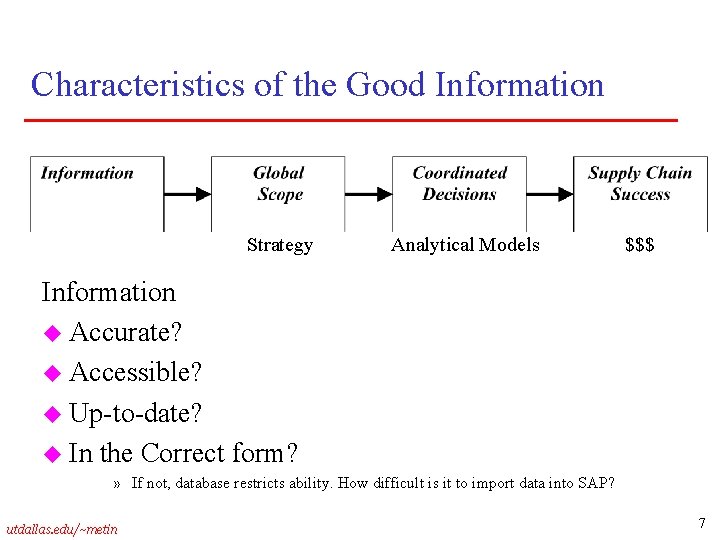
Characteristics of the Good Information Strategy Analytical Models $$$ Information u Accurate? u Accessible? u Up-to-date? u In the Correct form? » If not, database restricts ability. How difficult is it to import data into SAP? utdallas. edu/~metin 7
Quality of Information u Information drives the decisions: – Good information means good decisions u IT helps: MRP, ERP, SAP, EDI u Relevant information? u How to use information? utdallas. edu/~metin 8
Information Technology in a Supply Chain: Legacy Systems utdallas. edu/~metin 9
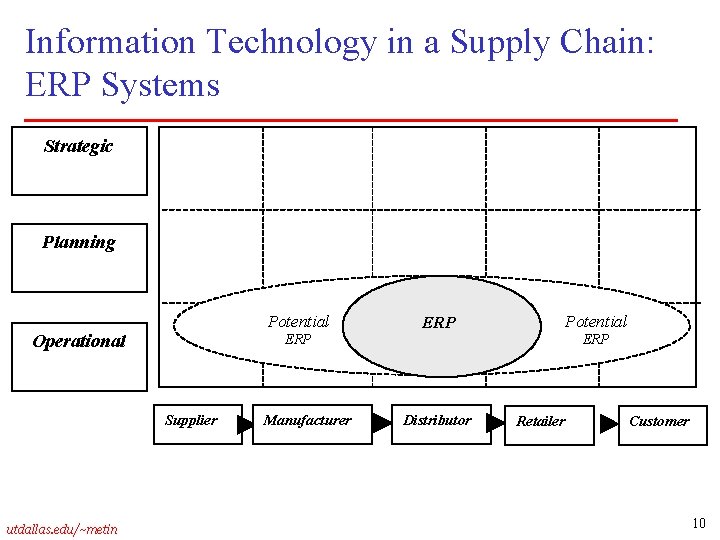
Information Technology in a Supply Chain: ERP Systems Strategic Planning Potential Operational ERP Supplier utdallas. edu/~metin Manufacturer Potential ERP Distributor ERP Retailer Customer 10
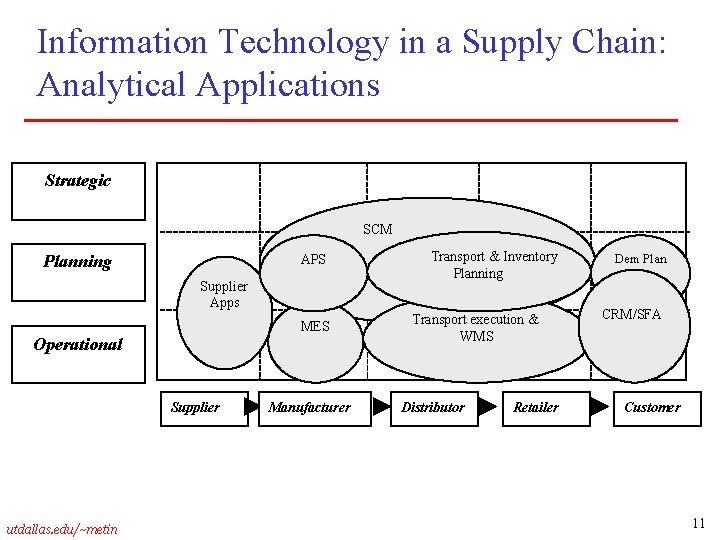
Information Technology in a Supply Chain: Analytical Applications Strategic SCM Planning APS Supplier Apps MES Operational Supplier utdallas. edu/~metin Manufacturer Transport & Inventory Planning Transport execution & WMS Distributor Retailer Dem Plan CRM/SFA Customer 11
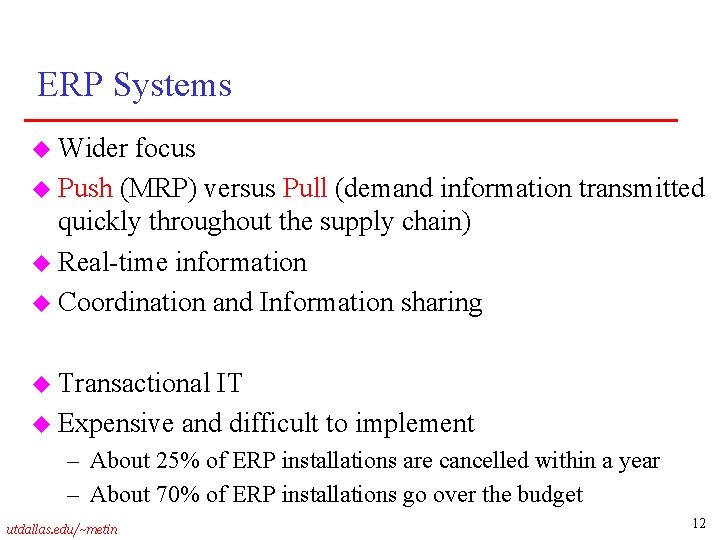
ERP Systems u Wider focus u Push (MRP) versus Pull (demand information transmitted quickly throughout the supply chain) u Real-time information u Coordination and Information sharing u Transactional IT u Expensive and difficult to implement – About 25% of ERP installations are cancelled within a year – About 70% of ERP installations go over the budget utdallas. edu/~metin 12
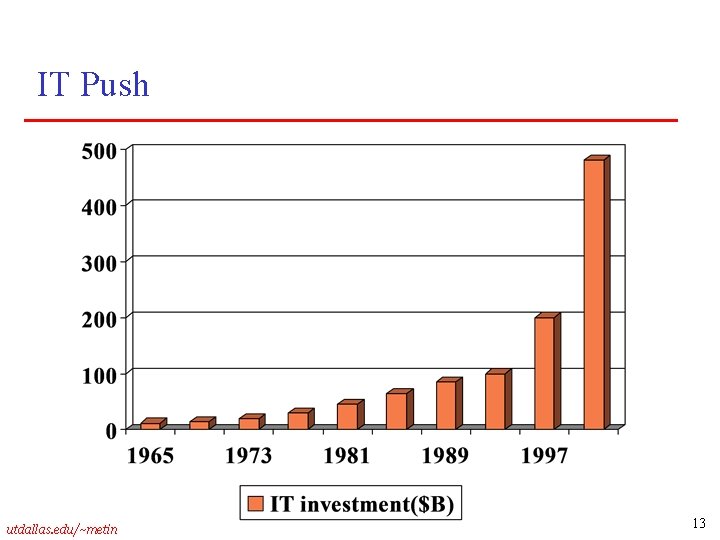
IT Push utdallas. edu/~metin 13
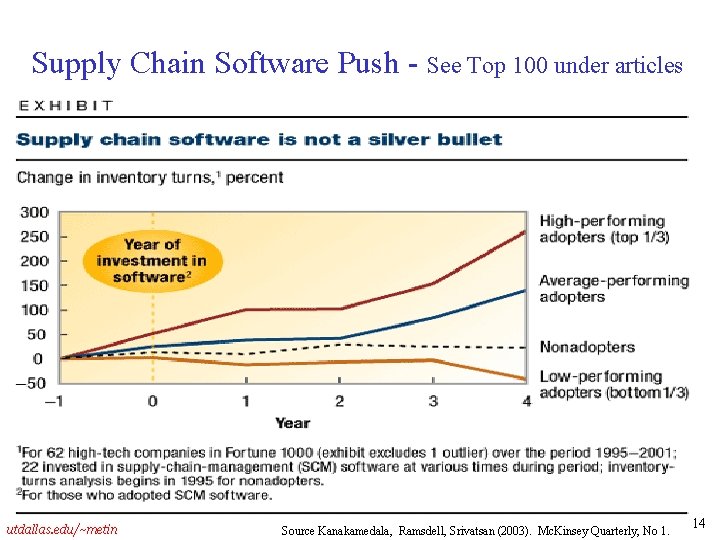
Supply Chain Software Push - See Top 100 under articles utdallas. edu/~metin Source Kanakamedala, Ramsdell, Srivatsan (2003). Mc. Kinsey Quarterly, No 1. 14
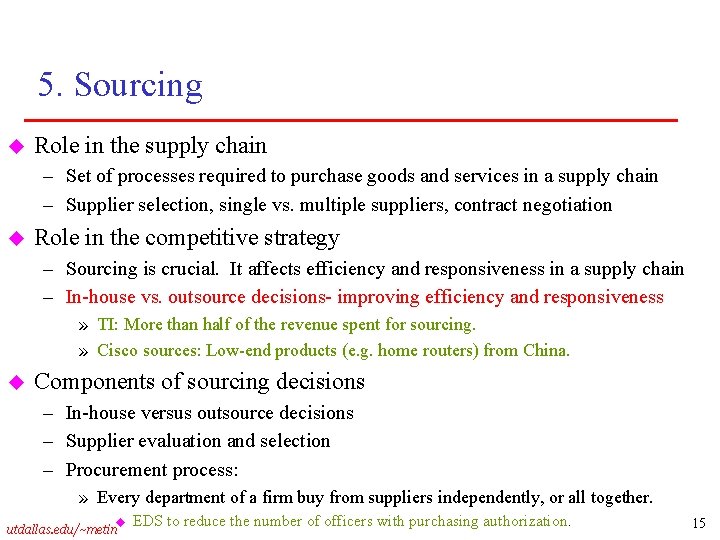
5. Sourcing u Role in the supply chain – Set of processes required to purchase goods and services in a supply chain – Supplier selection, single vs. multiple suppliers, contract negotiation u Role in the competitive strategy – Sourcing is crucial. It affects efficiency and responsiveness in a supply chain – In-house vs. outsource decisions- improving efficiency and responsiveness » TI: More than half of the revenue spent for sourcing. » Cisco sources: Low-end products (e. g. home routers) from China. u Components of sourcing decisions – In-house versus outsource decisions – Supplier evaluation and selection – Procurement process: » Every department of a firm buy from suppliers independently, or all together. u utdallas. edu/~metin EDS to reduce the number of officers with purchasing authorization. 15
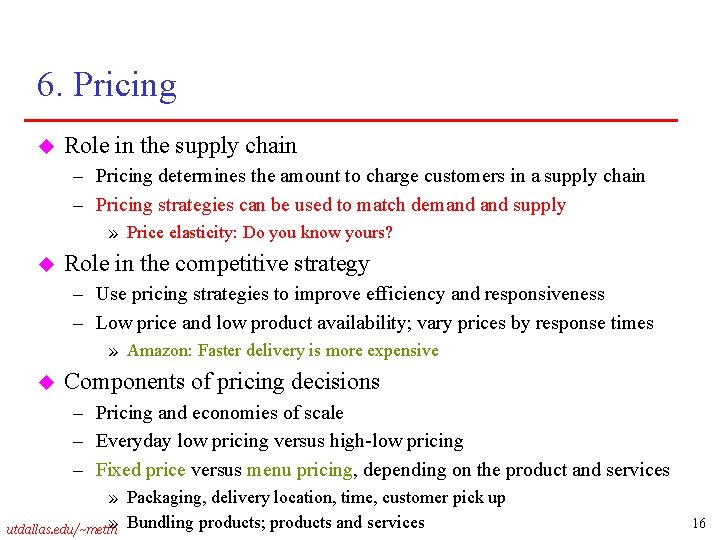
6. Pricing u Role in the supply chain – Pricing determines the amount to charge customers in a supply chain – Pricing strategies can be used to match demand supply » Price elasticity: Do you know yours? u Role in the competitive strategy – Use pricing strategies to improve efficiency and responsiveness – Low price and low product availability; vary prices by response times » Amazon: Faster delivery is more expensive u Components of pricing decisions – Pricing and economies of scale – Everyday low pricing versus high-low pricing – Fixed price versus menu pricing, depending on the product and services » Packaging, delivery location, time, customer pick up » Bundling products; products and services utdallas. edu/~metin 16
Considerations for Supply Chain Drivers utdallas. edu/~metin 17
Major Obstacles to Achieving Fit: Size 1. SC is big and fragmented – Variety of products/services – Variety of distribution channels » Brick & Mortar vs. Online » Regular stores vs. Discount Outlets – Spoiled customer – Globalization – Multiple owners » Procurement, Production, Inventory, Marketing in a company » Manufacturer, Distributor, Retailer in a Supply Chain – Multiple objectives utdallas. edu/~metin 18
Dealing with Multiple Owners / Local Optimization u Information Coordination – Information sharing / Shyness / Legal and ethical issues u Contractual Coordination – Mechanisms to align local objectives with global ones u Coordination with (real) options – Rare in the practice u Without coordination, misleading reliance on metrics: – Average safety inventory, Average incoming shipment size, Average purchase price of raw materials. utdallas. edu/~metin Local optimization and lack of global fit 19
Major obstacles to achieving fit: u 2. Change Instability and Randomness: – Instability refers to knowing that there will be a change in the future and also knowing the amount of change. – Randomness refers to only knowing that there will be a change in the future but not knowing the amount of change. – Increasing product variety – Shrinking product life cycles – Customer fragmentation: Push for customization, segmentation – Fragmentation of Supply Chain ownership: Globalization utdallas. edu/~metin Increasing implied uncertainty 20
Common problems u Lack of relevant SCM metrics: How to measure responsiveness? » How to measure efficiency, costs, worker performance, etc? u Poor inventory status information » Theft: Major problem for furniture retailers. » Transaction errors: Retailers with inaccurate inventory records » » » for 65% of SKUs Information delays, dated information, incompatible info. systems Misplaced inventory: 16% of items cannot be found at a major retailer Spoilage: active ingredients in the products are losing their properties Product quality and yield Lack of visibility in SCs u u utdallas. edu/~metin Do you know the inventory your distribution centers hold? Do you know the inventory your fellow retailer holds? 21
Common problems u Poor delivery status information » Not knowing the order status u Poor IT design » Unreliable, duplicate data » Security problems: too much or too little u Ignoring uncertainties – “The flight from uncertainty and ambiguity is so motivated that we often create pseudocertainty. ” – Nitin Nohra, HBR February 2006 issue, p. 40. u Internal customer discrimination » Giving lower priority to internal customers than external customers u u Poor integration Elusive inventory costs » Accounting systems do not capture opportunity costs u SC-insensitive product design utdallas. edu/~metin 22
Summary u Components » Logistical: Inventory, Transportation, Facilities » Cross-Functional: Information, Sourcing, Pricing u Challenges » Obstacles: Size and Change » Common Problems utdallas. edu/~metin 23