
Drivers of ED performance against the fourhour standard
- Slides: 7
Drivers of ED performance against the four-hour standard Chris Mullin, Economics Director Paul Devenish, Senior Economist 21/07/2016 – DRAFT FINDINGS The Economics Team has updated and expanded the analysis that underpinned the 2015 Monitor report, A&E delays: Why did patients wait longer last winter? We have spoken to experts, looked at how relevant factors have changed over time, and modelled potential drivers to see which factors explain variation in ED waiting times
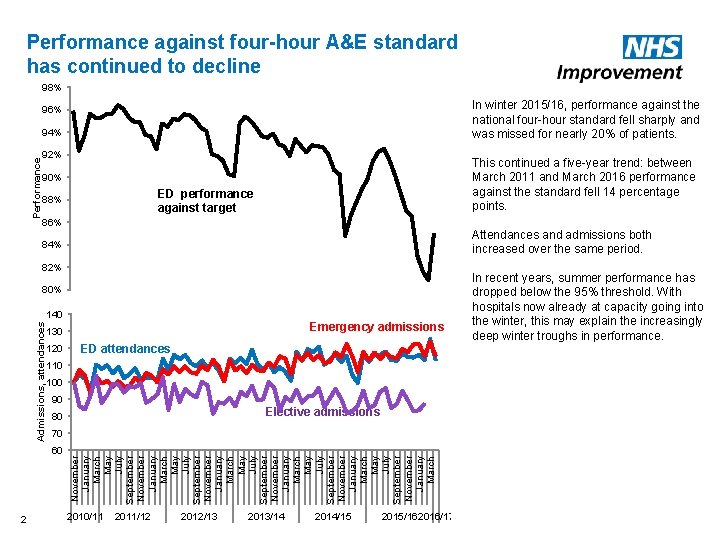
Performance against four-hour A&E standard has continued to decline 98% In winter 2015/16, performance against the national four-hour standard fell sharply and was missed for nearly 20% of patients. 96% Performance 94% 92% This continued a five-year trend: between March 2011 and March 2016 performance against the standard fell 14 percentage points. 90% ED performance against target 88% 86% Attendances and admissions both increased over the same period. 84% 82% 80% 120 ED attendances 110 100 90 Elective admissions 80 70 60 2 Emergency admissions 130 November January March May July September November January March May July September November January March Admissions, attendances 140 2010/11 2011/12 2012/13 2013/14 2014/15 2015/162016/17 In recent years, summer performance has dropped below the 95% threshold. With hospitals now already at capacity going into the winter, this may explain the increasingly deep winter troughs in performance.
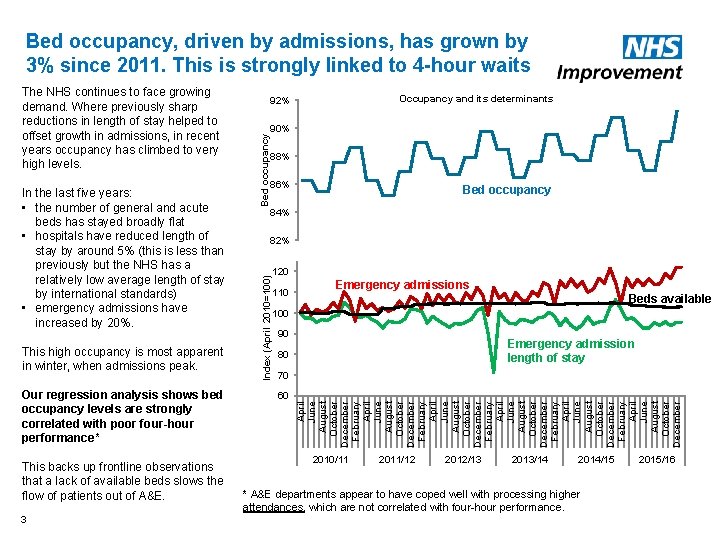
Bed occupancy, driven by admissions, has grown by 3% since 2011. This is strongly linked to 4 -hour waits Our regression analysis shows bed occupancy levels are strongly correlated with poor four-hour performance* This backs up frontline observations that a lack of available beds slows the flow of patients out of A&E. 3 90% 88% 86% Bed occupancy 84% 82% 120 110 Emergency admissions Beds available 100 90 Emergency admission length of stay 80 70 60 April June August October December February April June August October December February April June August October December This high occupancy is most apparent in winter, when admissions peak. Bed occupancy In the last five years: • the number of general and acute beds has stayed broadly flat • hospitals have reduced length of stay by around 5% (this is less than previously but the NHS has a relatively low average length of stay by international standards) • emergency admissions have increased by 20%. Occupancy and its determinants 92% Index (April 2010=100) The NHS continues to face growing demand. Where previously sharp reductions in length of stay helped to offset growth in admissions, in recent years occupancy has climbed to very high levels. 2010/11 2011/12 2012/13 2013/14 2014/15 * A&E departments appear to have coped well with processing higher attendances, which are not correlated with four-hour performance. 2015/16
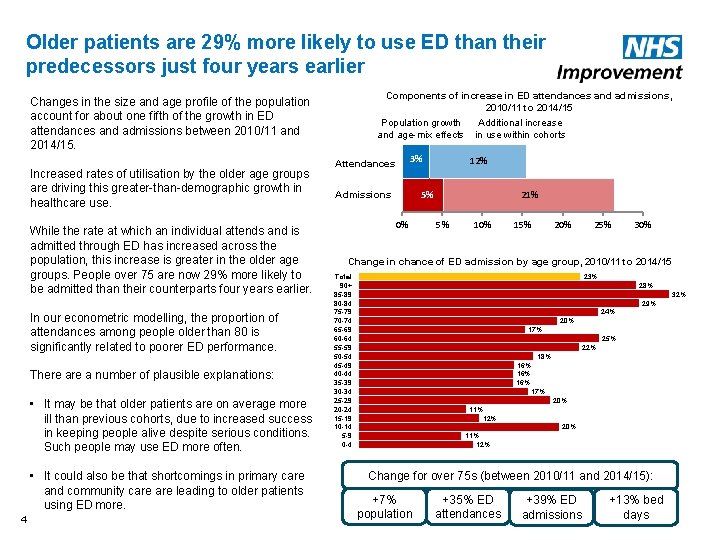
Older patients are 29% more likely to use ED than their predecessors just four years earlier Components of increase in ED attendances and admissions, 2010/11 to 2014/15 Population growth Additional increase and age-mix effects in use within cohorts Changes in the size and age profile of the population account for about one fifth of the growth in ED attendances and admissions between 2010/11 and 2014/15. Increased rates of utilisation by the older age groups are driving this greater-than-demographic growth in healthcare use. While the rate at which an individual attends and is admitted through ED has increased across the population, this increase is greater in the older age groups. People over 75 are now 29% more likely to be admitted than their counterparts four years earlier. In our econometric modelling, the proportion of attendances among people older than 80 is significantly related to poorer ED performance. There a number of plausible explanations: • It may be that older patients are on average more ill than previous cohorts, due to increased success in keeping people alive despite serious conditions. Such people may use ED more often. • It could also be that shortcomings in primary care and community care leading to older patients using ED more. 4 3% Attendances 12% 5% Admissions 0% 21% 5% 10% 15% 20% 25% 30% Change in chance of ED admission by age group, 2010/11 to 2014/15 Total 90+ 85 -89 80 -84 75 -79 70 -74 65 -69 60 -64 55 -59 50 -54 45 -49 40 -44 35 -39 30 -34 25 -29 20 -24 15 -19 10 -14 5 -9 0 -4 23% 28% 32% 29% 24% 20% 17% 25% 22% 18% 16% 16% 17% 20% 11% 12% Change for over 75 s (between 2010/11 and 2014/15): +7% population +35% ED attendances +39% ED admissions +13% bed days
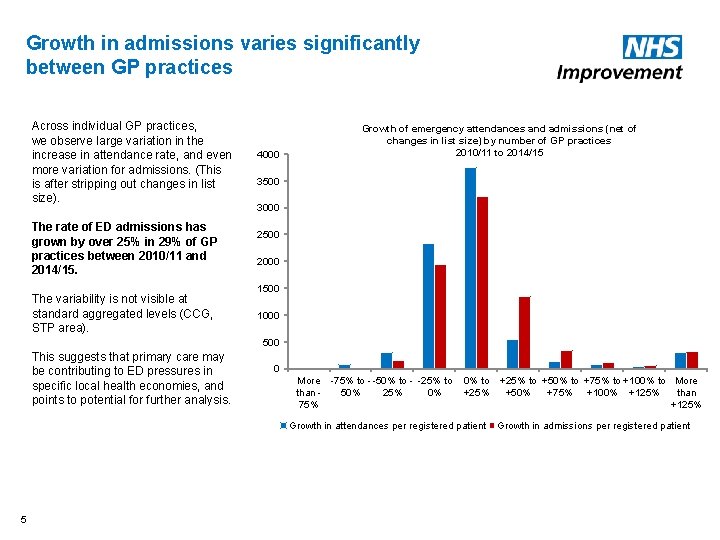
Growth in admissions varies significantly between GP practices Across individual GP practices, we observe large variation in the increase in attendance rate, and even more variation for admissions. (This is after stripping out changes in list size). The rate of ED admissions has grown by over 25% in 29% of GP practices between 2010/11 and 2014/15. The variability is not visible at standard aggregated levels (CCG, STP area). 4000 Growth of emergency attendances and admissions (net of changes in list size) by number of GP practices 2010/11 to 2014/15 3500 3000 2500 2000 1500 1000 500 This suggests that primary care may be contributing to ED pressures in specific local health economies, and points to potential for further analysis. 0 More -75% to - -50% to - -25% to than 50% 25% 0% 75% 0% to +25% Growth in attendances per registered patient 5 +25% to +50% to +75% to +100% to More +50% +75% +100% +125% than +125% Growth in admissions per registered patient
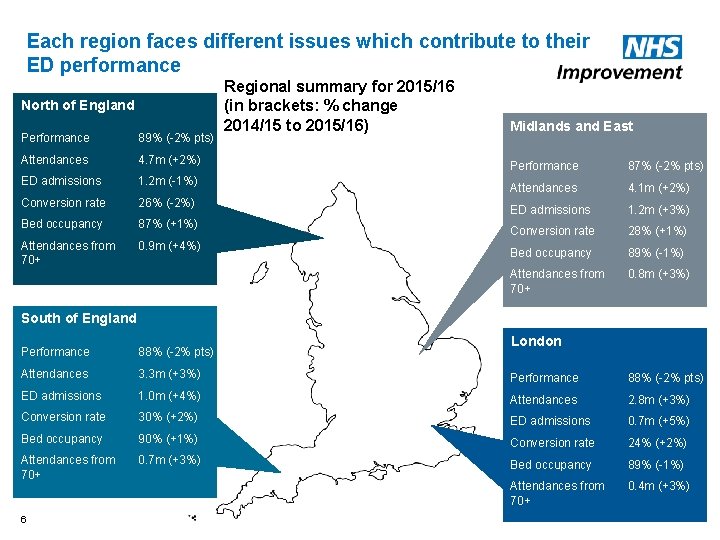
Each region faces different issues which contribute to their ED performance North of England Performance 89% (-2% pts) Attendances 4. 7 m (+2%) ED admissions 1. 2 m (-1%) Conversion rate 26% (-2%) Bed occupancy 87% (+1%) Attendances from 70+ 0. 9 m (+4%) Regional summary for 2015/16 (in brackets: % change 2014/15 to 2015/16) Midlands and East Performance 87% (-2% pts) Attendances 4. 1 m (+2%) ED admissions 1. 2 m (+3%) Conversion rate 28% (+1%) Bed occupancy 89% (-1%) Attendances from 70+ 0. 8 m (+3%) South of England London Performance 88% (-2% pts) Attendances 3. 3 m (+3%) Performance 88% (-2% pts) ED admissions 1. 0 m (+4%) Attendances 2. 8 m (+3%) Conversion rate 30% (+2%) ED admissions 0. 7 m (+5%) Bed occupancy 90% (+1%) Conversion rate 24% (+2%) Attendances from 70+ 0. 7 m (+3%) Bed occupancy 89% (-1%) Attendances from 70+ 0. 4 m (+3%) 6
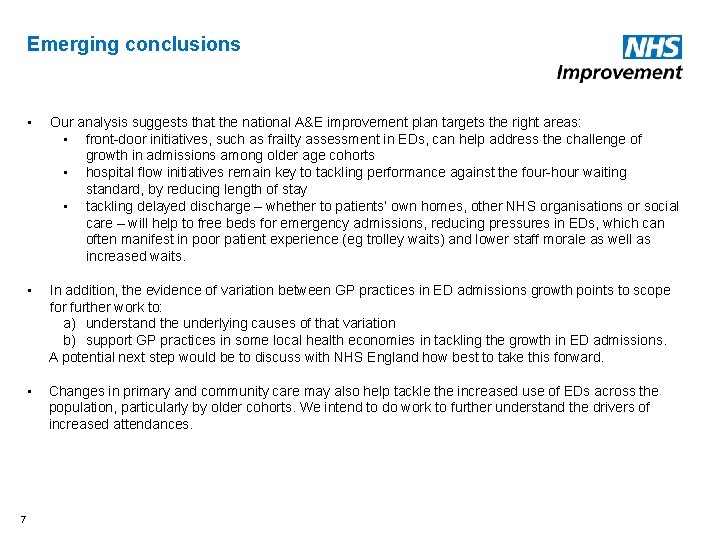
Emerging conclusions 7 • Our analysis suggests that the national A&E improvement plan targets the right areas: • front-door initiatives, such as frailty assessment in EDs, can help address the challenge of growth in admissions among older age cohorts • hospital flow initiatives remain key to tackling performance against the four-hour waiting standard, by reducing length of stay • tackling delayed discharge – whether to patients’ own homes, other NHS organisations or social care – will help to free beds for emergency admissions, reducing pressures in EDs, which can often manifest in poor patient experience (eg trolley waits) and lower staff morale as well as increased waits. • In addition, the evidence of variation between GP practices in ED admissions growth points to scope for further work to: a) understand the underlying causes of that variation b) support GP practices in some local health economies in tackling the growth in ED admissions. A potential next step would be to discuss with NHS England how best to take this forward. • Changes in primary and community care may also help tackle the increased use of EDs across the population, particularly by older cohorts. We intend to do work to further understand the drivers of increased attendances.