
Drivers of Deforestation and Forest Degradation in Kenya
- Slides: 19
Drivers of Deforestation and Forest Degradation in Kenya & Candidate REDD Strategies P. M. Kariuki Kenya Forest Service
Contents Forests in Kenya & change over time Key drivers / causes of DD Analysis of measures to address DD Information gaps Candidate strategies for REDD
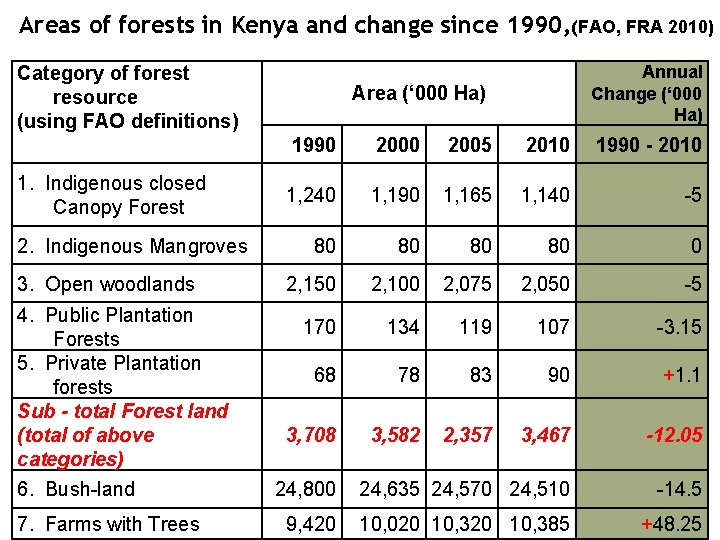
Areas of forests in Kenya and change since 1990, (FAO, FRA 2010) Category of forest resource (using FAO definitions) 1. Indigenous closed Canopy Forest 2. Indigenous Mangroves 3. Open woodlands 4. Public Plantation Forests 5. Private Plantation forests Sub - total Forest land (total of above categories) 6. Bush-land 7. Farms with Trees Annual Change (‘ 000 Ha) Area (‘ 000 Ha) 1990 2005 2010 1990 - 2010 1, 240 1, 190 1, 165 1, 140 -5 80 80 0 2, 150 2, 100 2, 075 2, 050 -5 170 134 119 107 -3. 15 68 78 83 90 +1. 1 3, 708 3, 582 2, 357 3, 467 -12. 05 24, 800 24, 635 24, 570 24, 510 -14. 5 9, 420 10, 020 10, 385 +48. 25
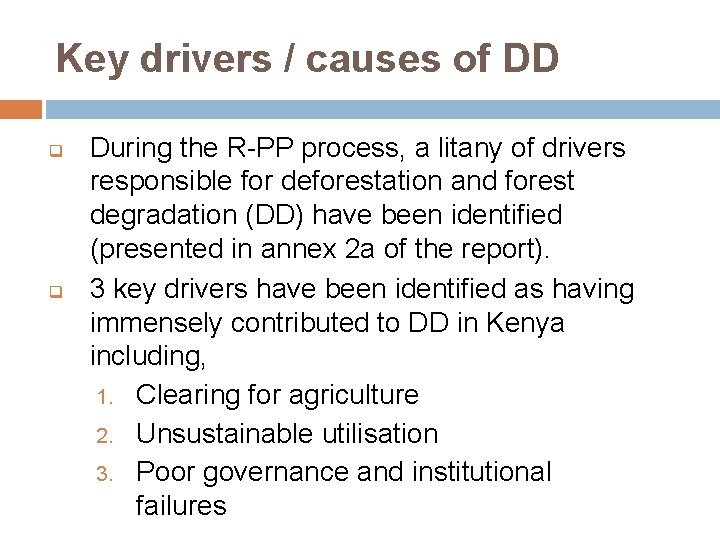
Key drivers / causes of DD q q During the R-PP process, a litany of drivers responsible for deforestation and forest degradation (DD) have been identified (presented in annex 2 a of the report). 3 key drivers have been identified as having immensely contributed to DD in Kenya including, 1. Clearing for agriculture 2. Unsustainable utilisation 3. Poor governance and institutional failures
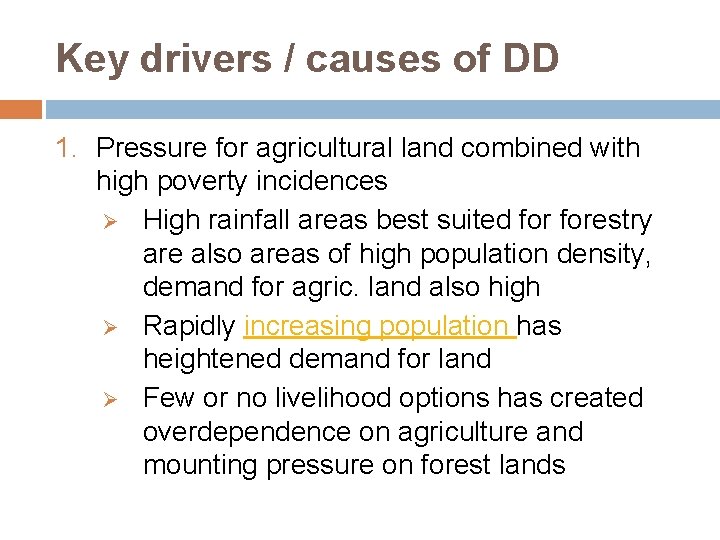
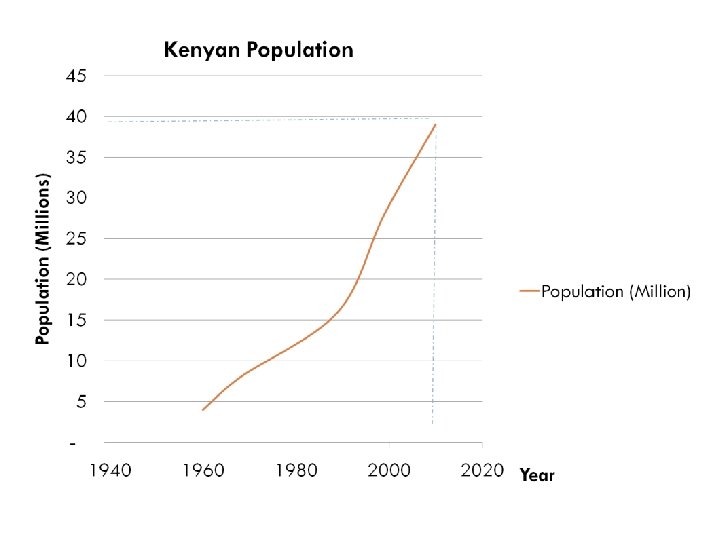
Key drivers / causes of DD 1. Pressure for agricultural land combined with high poverty incidences Ø High rainfall areas best suited forestry are also areas of high population density, demand for agric. land also high Ø Rapidly increasing population has heightened demand for land Ø Few or no livelihood options has created overdependence on agriculture and mounting pressure on forest lands
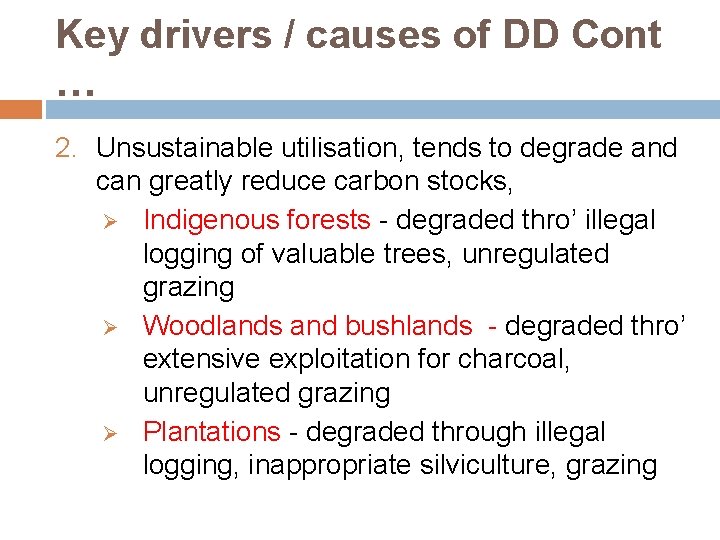
Key drivers / causes of DD Cont … 2. Unsustainable utilisation, tends to degrade and can greatly reduce carbon stocks, Ø Indigenous forests - degraded thro’ illegal logging of valuable trees, unregulated grazing Ø Woodlands and bushlands - degraded thro’ extensive exploitation for charcoal, unregulated grazing Ø Plantations - degraded through illegal logging, inappropriate silviculture, grazing
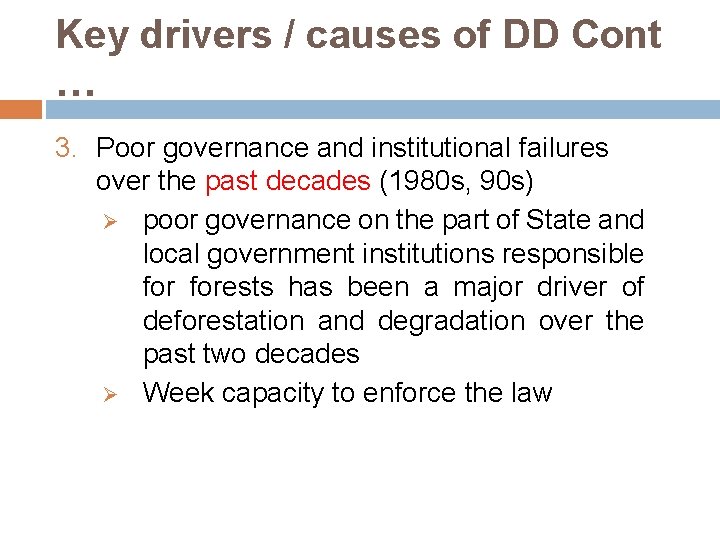
Key drivers / causes of DD Cont … 3. Poor governance and institutional failures over the past decades (1980 s, 90 s) Ø poor governance on the part of State and local government institutions responsible forests has been a major driver of deforestation and degradation over the past two decades Ø Week capacity to enforce the law
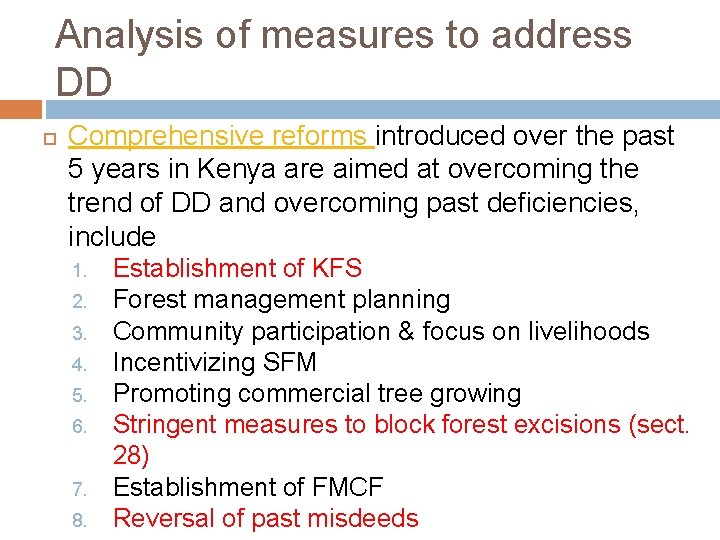
Analysis of measures to address DD Comprehensive reforms introduced over the past 5 years in Kenya are aimed at overcoming the trend of DD and overcoming past deficiencies, include 1. 2. 3. 4. 5. 6. 7. 8. Establishment of KFS Forest management planning Community participation & focus on livelihoods Incentivizing SFM Promoting commercial tree growing Stringent measures to block forest excisions (sect. 28) Establishment of FMCF Reversal of past misdeeds
Information gaps Gaps related to drivers of DD and which require to be understood include, 1. Inadequate data on forest resources 2. Current domestic timber requirements – S/D 3. Timber value chain 4. Supply / demand modelling 5. Unsustainable charcoal production & understanding the charcoal value chain 6. Mechanisms of benefit sharing arrangements 7. Forest degradation related to overgrazing
Objectives of REDD & REDD Strategy Options
Objectives of the REDD strategy 1. To reduce emissions from deforestation and degradation of existing forest lands 2. To increase carbon stocks in existing forests 3. To reduce pressure on forests 4. To enhance the value of forests to livelihoods and the national economy
Candidate REDD strategies 4 priority areas have been identified including, 1. Reducing pressure to clear forests for agriculture 2. Promoting sustainable utilisation of forests 3. Improving governance in the forest sector 4. Promoting enhancement of carbon stocks
Candidate strategies cont … 1. Reducing pressure to clear forests for agriculture especially in the trustlands Ø Awareness and advocacy among farming communities Ø Strengthening capacity of LAs to manage forests Ø pilot management of trustland forests by CFAs Ø Assist KFS in piloting community participation arrangements Ø Pilot test benefit sharing arrangements Ø Support alternative income generating acticities – FAC Ø Encourage farmers to move into intensive agriculture Ø Promote agroforestry / farm forestry
Candidate strategies cont … 2. Promoting sustainable utilisation of forests Ø Assist KFS to operationalise the recently gazetted subsidiary legislation on charcoal production Ø Promote efficient charcoal making technology aimed at reducing waste Ø Promote fuel-efficient charcoal stoves Ø Promote development of fuelwood plantations
Candidate strategies cont … 3. Improving governance in the forest sector Ø Strengthen the capacity of KFS to implement reforms Ø Elaborating subsidiary legislation in support of the Forests Act Ø Capacity building at all levels to implement the new governance arrangements Ø Support and strengthen community and private sector partnerships, including piloting joint management arrangements Ø Development of management plans, Capacity building of CFAs Ø Advocacy and awareness activities related to the new governance arrangements; Strengthen the National Environment Tribunal
Candidate strategies cont … 4. Enhancement of carbon stocks Ø Advocacy, awareness, at all levels, changing attitudes, including strengthening civil society organisations Ø Tree planting campaigns Ø Farm forestry extension, including developing manuals and tools to support best practice in tree growing Ø Support Go. K to introduce incentives for commercial scale investment in tree planting Ø Support to promotion of SFM Ø Support forest protection that increases carbon stock, improves biodiversity and livelihood benefits Ø Support to the Go. K target to plant 10% of land with trees
End of Presentation Thank you
Well grounded reforms Analysis of Measures to Address Forest Destruction and Degradation The reforms were carefully formulated over the last 2 decades and were based on comprehensive research and detailed data collection and therefore most promising strategy for REDD+ is to provide support for the implementation of the current reforms