
Driver Safety Management System Driving for Work Seminars
- Slides: 13
Driver Safety Management System Driving for Work Seminars June 2017 www. jacobs. com | worldwide
Disclaimer Important The material in this presentation has been prepared by Jacobs®. Copyright and other intellectual property rights in this presentation vest exclusively with Jacobs. Apart from any use permitted under applicable copyright legislation, no part of this work may in any form or by any means (electronic, graphic, mechanical, photocopying, recording or otherwise) be reproduced, copied, stored in a retrieval system or transmitted without prior written permission. Jacobs is a trademark of Jacobs Engineering Group Inc. © Copyright December 4, 2020 Jacobs Engineering Group Inc. All rights reserved. 2
Agenda 1. Who are Jacobs 2. Why Driver Safety Management is so important to us 3. Our Journey – Started in 2006, and where we are today 4. Our Integrated Driver Safety Management System 3
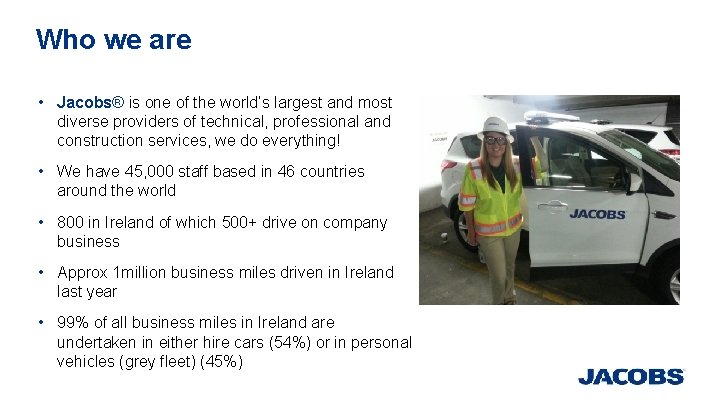
Who we are • Jacobs® is one of the world’s largest and most diverse providers of technical, professional and construction services, we do everything! • We have 45, 000 staff based in 46 countries around the world • 800 in Ireland of which 500+ drive on company business • Approx 1 million business miles driven in Ireland last year • 99% of all business miles in Ireland are undertaken in either hire cars (54%) or in personal vehicles (grey fleet) (45%)
Why Driver Safety Management • Driving is the most hazardous activity the majority of our staff will be exposed to • Driving Kills • We put people in cars – we have a legal and moral duty to manage the risk 5
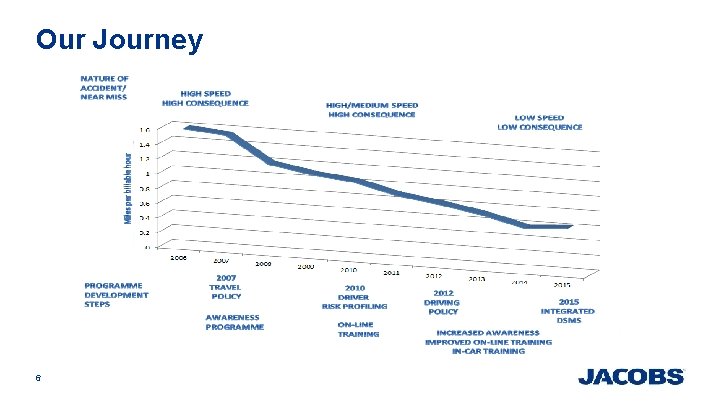
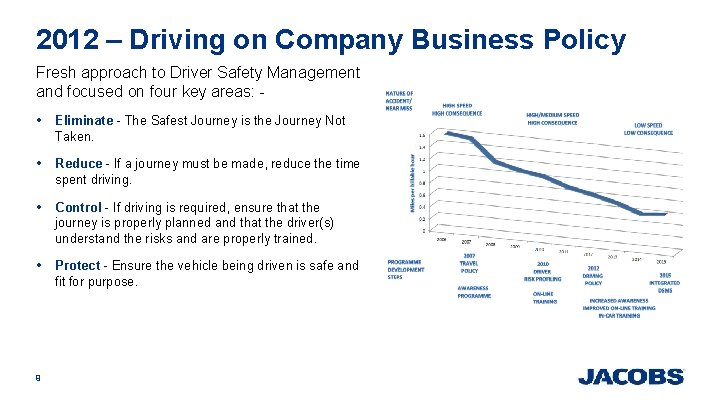
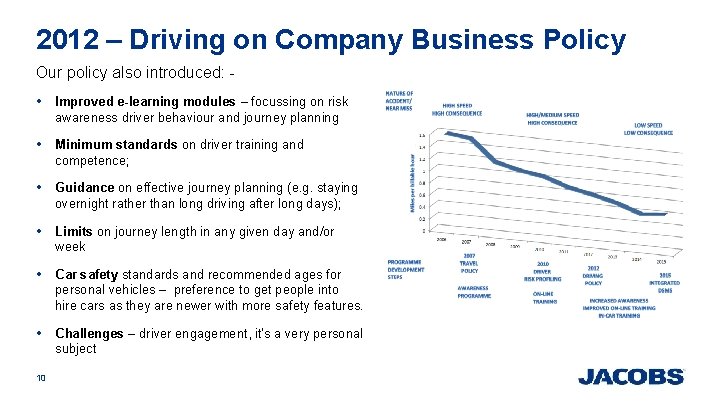
Our Journey 6
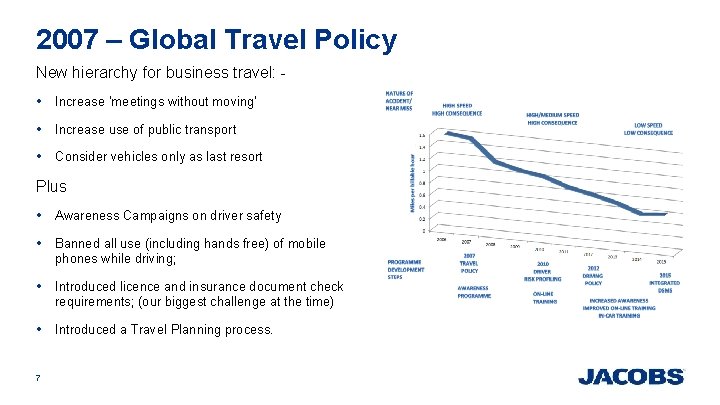
2007 – Global Travel Policy New hierarchy for business travel: • Increase ‘meetings without moving’ • Increase use of public transport • Consider vehicles only as last resort Plus • Awareness Campaigns on driver safety • Banned all use (including hands free) of mobile phones while driving; • Introduced licence and insurance document check requirements; (our biggest challenge at the time) • Introduced a Travel Planning process. 7
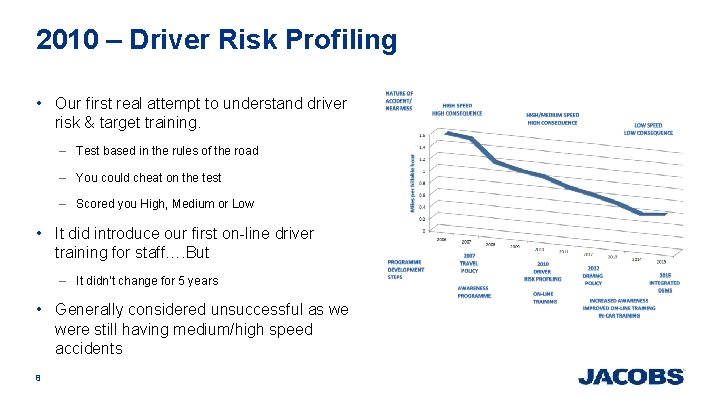
2010 – Driver Risk Profiling • Our first real attempt to understand driver risk & target training. – Test based in the rules of the road – You could cheat on the test – Scored you High, Medium or Low • It did introduce our first on-line driver training for staff…. But – It didn’t change for 5 years • Generally considered unsuccessful as we were still having medium/high speed accidents 8
2012 – Driving on Company Business Policy Fresh approach to Driver Safety Management and focused on four key areas: • Eliminate - The Safest Journey is the Journey Not Taken. • Reduce - If a journey must be made, reduce the time spent driving. • Control - If driving is required, ensure that the journey is properly planned and that the driver(s) understand the risks and are properly trained. • Protect - Ensure the vehicle being driven is safe and fit for purpose. 9
2012 – Driving on Company Business Policy Our policy also introduced: • Improved e-learning modules – focussing on risk awareness driver behaviour and journey planning • Minimum standards on driver training and competence; • Guidance on effective journey planning (e. g. staying overnight rather than long driving after long days); • Limits on journey length in any given day and/or week • Car safety standards and recommended ages for personal vehicles – preference to get people into hire cars as they are newer with more safety features. • Challenges – driver engagement, it’s a very personal subject 10
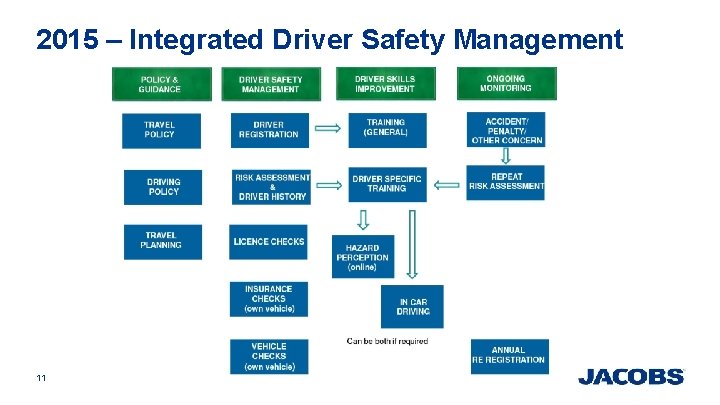
2015 – Integrated Driver Safety Management 11
Successes in Year 1 of Integrated DSM System • 34% drop in Motor Vehicle Accidents • 85% compliance rate • 8% drivers identified as having issues with licences and/or insurance – drivers informed and are now compliant • Improved engagement with staff 12
Benefits of Driver Safety Management for Jacobs • Safer drivers driving safer vehicles • Reduced travel to meetings, greater efficiencies – value passed on to client’s & improved client relationships • Significant reduction in Jacobs corporate risk profile • Reduction in number of accidents/near misses • Able to demonstrate compliance with Statutory obligations (reduced risk of prosecution) 13