
Driver Safety Introduction 15 driversafety topics Important points

- Slides: 33
Driver Safety • Introduction • 15 driver-safety topics • Important points to remember
Why Driver Training? • Driving is something we do daily. • It’s the most dangerous thing we do! ✴ 40, 000 ✴ 115 people die each year in their vehicles. people who leave home in their vehicle today will not return to their loved ones.
Why “Accidents” Occur Most frequent causes of incidents: 1. Inattention to detail (no cell-phone use while driving!) 2. Speeding 3. DWI/DUI 4. Driving too fast for conditions 5. Failure to yield
Why “Accidents” Occur Most frequent causes of incidents: 6. Road conditions 7. Weather related & environmental conditions 8. Vehicle maintenance A. Tire treadwear/pressure B. Brakes
Accident Costs • Physical damage to the vehicle • Property damage • Pain & suffering • Medical costs • Liability Costs
Requirements • Clear. Defense requires high standards of performance, including safe driving. • Clear. Defense requires not just safe-driving performance, but award-winning safety performance. • Why? It’s reasonable. It’s cost effective. It’s the right thing to do for you and Clear. Defense.
Safety First • 15 -step process • Defensive-driving techniques • Rules of the road • General safety rules
15 -step Process 1. Pre-trip inspection 2. Inside the vehicle 3. Your state of mind 4. Getting the big picture 5. Following distance
15 -step Process 6. Lane changes 7. Line markings 8. Sign postings 9. Right of way 10. Parking
15 -step Process 11. On-and-off ramps 12. Railroad crossings 13. Emergency vehicles 14. Winter driving 15. Accident reporting
1. Pre-Trip Inspection Pre-flight your vehicle: 1. Windows clean? 2. Lights, signals clean & working? 3. Tires properly inflated; tread wear OK? 4. Fluid leaks on the ground? 5. Plates current?
2. Inside the Vehicle 1. Adjust your seat and fasten seat belt 2. Check and adjust all mirrors 3. Adjust your headrest 4. Assure doors fully closed and secured 5. Scan gauges
2. Inside the Vehicle 6. Check windows/windshield 7. Adjust the vents, windows, heater, air conditioner 8. Make sure you’re emotionally ready to focus on safe driving
3. Your State Of Mind 1. Stress / Emotions / Attitudes 2. Drowsiness / Fatigue 3. Vision / Hearing 4. Alcohol
Myths About Alcohol • Myth: Coffee will sober up a drinker. ★ Fact: • Myth: Strenuous exercise will sober up a drinker. ★ Fact: • Exercise makes a hot, sticky, smelly drunk. Myth: A cold shower will sober up a drinker. ★ Fact: • Coffee only makes a drunk wide awake. A cold shower only makes a cold, wet drunk. Myth: A cold swim will sober up a drinker. ★ Fact: A cold swim could result in a dead drunk.
The Alcohol Process • When ingested, approximately 5% enters the blood stream directly thru the mouth and throat tissues. • 80% is absorbed thru the small intestine after passing thru the stomach. • Alcohol distributes itself to organs with the highest fluid content, concentrating on organs with large blood supplies like the brain and liver.
The Alcohol Process • Alcohol cannot be stored in tissue and less than 10% is eliminated by the kidneys, lungs, and skin. • The liver eliminates the other 90% thru the process of oxidation. • The liver can eliminate approximately one drink per hour.
4. Getting the Big Picture 1. Scan the road ahead • City (approximately 1 block) • Rural (approximately 1/4 mile) 2. Keep your eyes moving • Check your mirrors every 5 seconds.
5. Following Distance Speed & stopping distance are key • Stay 3 -to-4 seconds behind Tailgaters • Avoid quick changes • Increase your following distance • Don’t speed up • Avoid revenge (control your emotions)
6. Lane Changes • Check to make sure there is enough room • Signal your intentions • Check your blind spot and spacing again • Make the lane change slowly and safely • Avoid blind spots ✴ Don’t drive in someone else’s blind spot. ✴ Make yourself as visible as possible at all times
7. Line Markings • Yellow lines: Traffic in both directions. • White lines: One-way traffic. ✴ Broken: ✴ Solid: Passing allowed. No passing.
8. Sign Postings • Regulatory ✴ Red & white • Warning ✴ Yellow & black • Construction ✴ Orange • Guide signs ✴ Blue/Black/Green
9. Right-of-way • At an intersection, first vehicle on the right has the presumed right-of-way. • Be aware of pedestrians and school crossings. • Scan the intersection. Stop at the limit line. • Assume that no one is guaranteed the right of way.
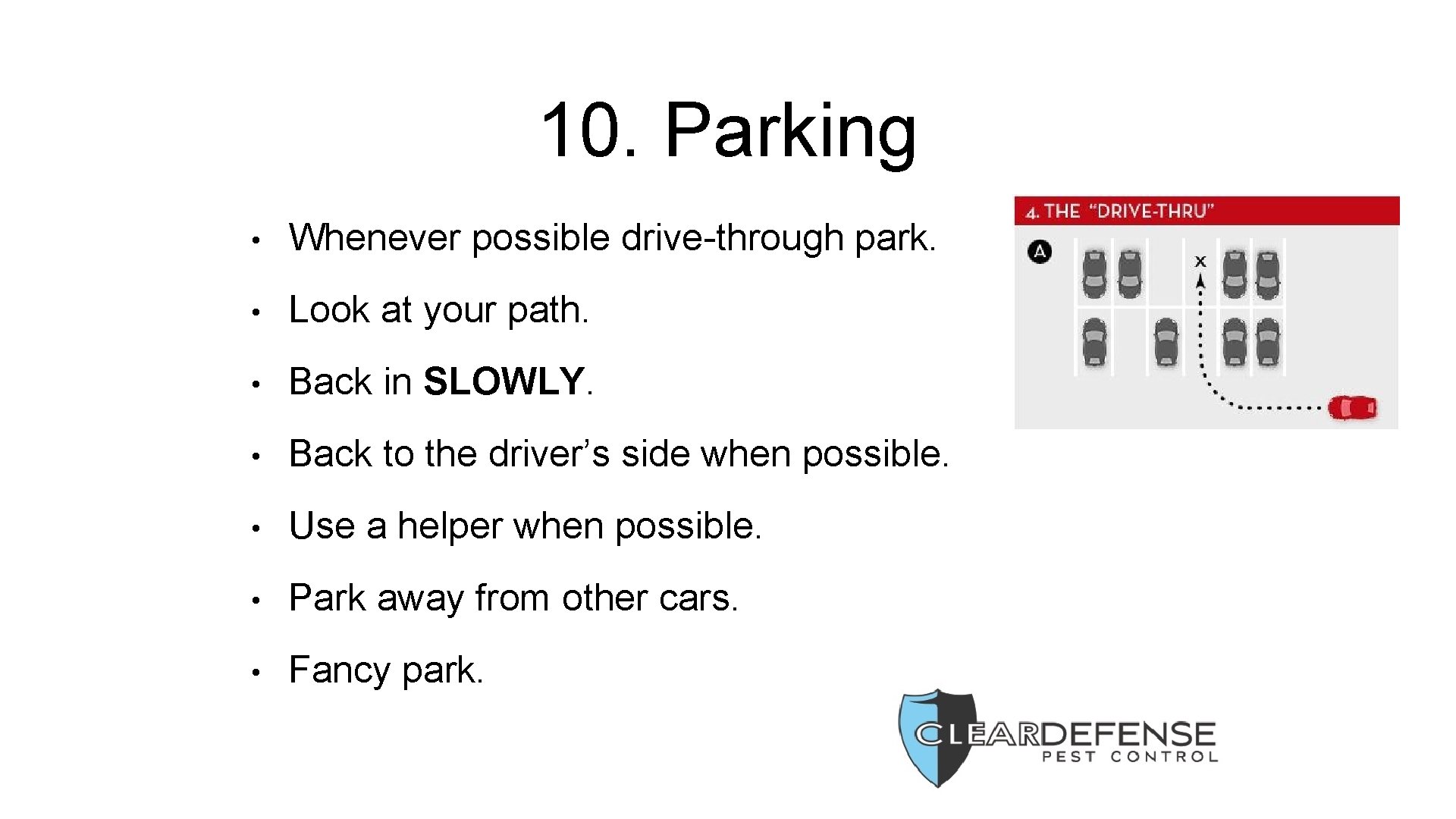
10. Parking • Whenever possible drive-through park. • Look at your path. • Back in SLOWLY. • Back to the driver’s side when possible. • Use a helper when possible. • Park away from other cars. • Fancy park.
11. On-and-off Ramps • Obey speed limits. Adjust for conditions. ✴ Speed limits designed for autos; larger vehicles required to go slower. • Exits merging downhill are particularly dangerous. ✴ Adjust ✴ Be speed and position. familiar with surroundings.
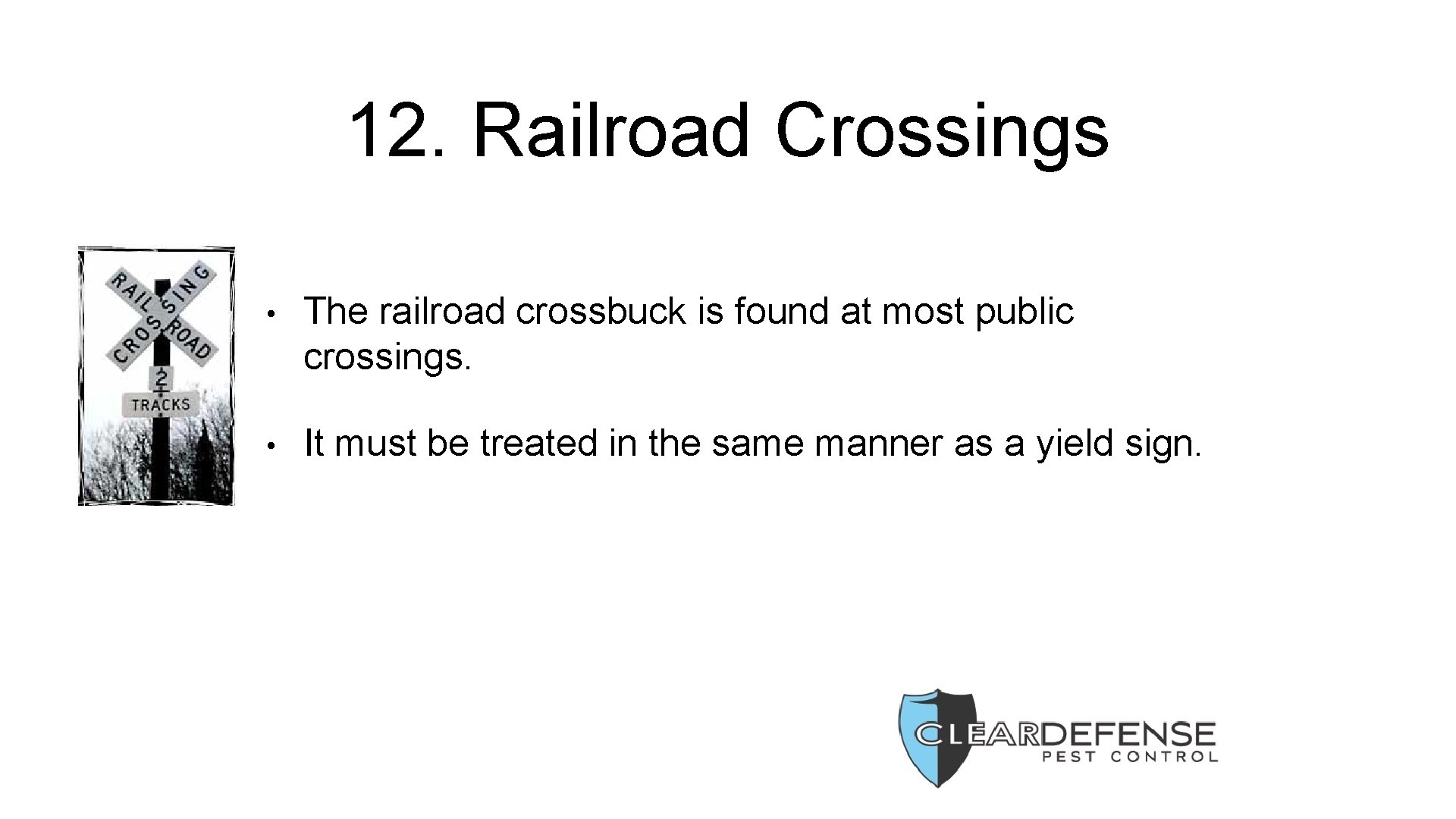
12. Railroad Crossings • The railroad crossbuck is found at most public crossings. • It must be treated in the same manner as a yield sign.
13. Emergency Vehicles • Immediately move to the right of your lane, to another lane, or to the shoulder if possible. • If moving right is not possible, stay where you are. Do not move left.
14. Winter Driving IDENTIFYING SLIPPERY SURFACES: • Shaded areas: Shady parts of the road will remain icy and slippery after ice in open areas has melted. • Bridges: Bridges freeze before surface roads do. • Melting ice: Slight melting will make ice wet. • Black ice: Expect it if the temperature is below freezing and the road looks wet. • Vehicle ice: Open the window and feel the front of the mirror and antenna. The road may be icing up!
14. Winter Driving • Just after rain begins, oil and rainwater on surface makes the road very slippery • Hydroplaning: ✴ Release ✴ Do the accelerator. not brake. ✴ Occurs ✴ Worn at speeds as low as 30 mph. tread and low tire pressure contributing factor.
14. Winter Driving Equipment & supplies: • Scraper with brush • Snow shovel • Flashlight • Abrasive materials (cat litter, sand, salt) • Jumper cables • Warning devices (flares) • Sleeping bag or blankets • Lighter or matches, candle & high-energy food
14. Winter Driving Getting unstuck: • Turn wheels side to side a few times to push snow out of the way. • Lightly touch gas; ease forward. • Rock the vehicle if necessary. • Shift from forward to reverse and lightly touch accelerator.
15. Accident Reporting • Report any accident immediately, no matter how minor. • Get a police report whenever possible. • Complete the accident report form ASAP.
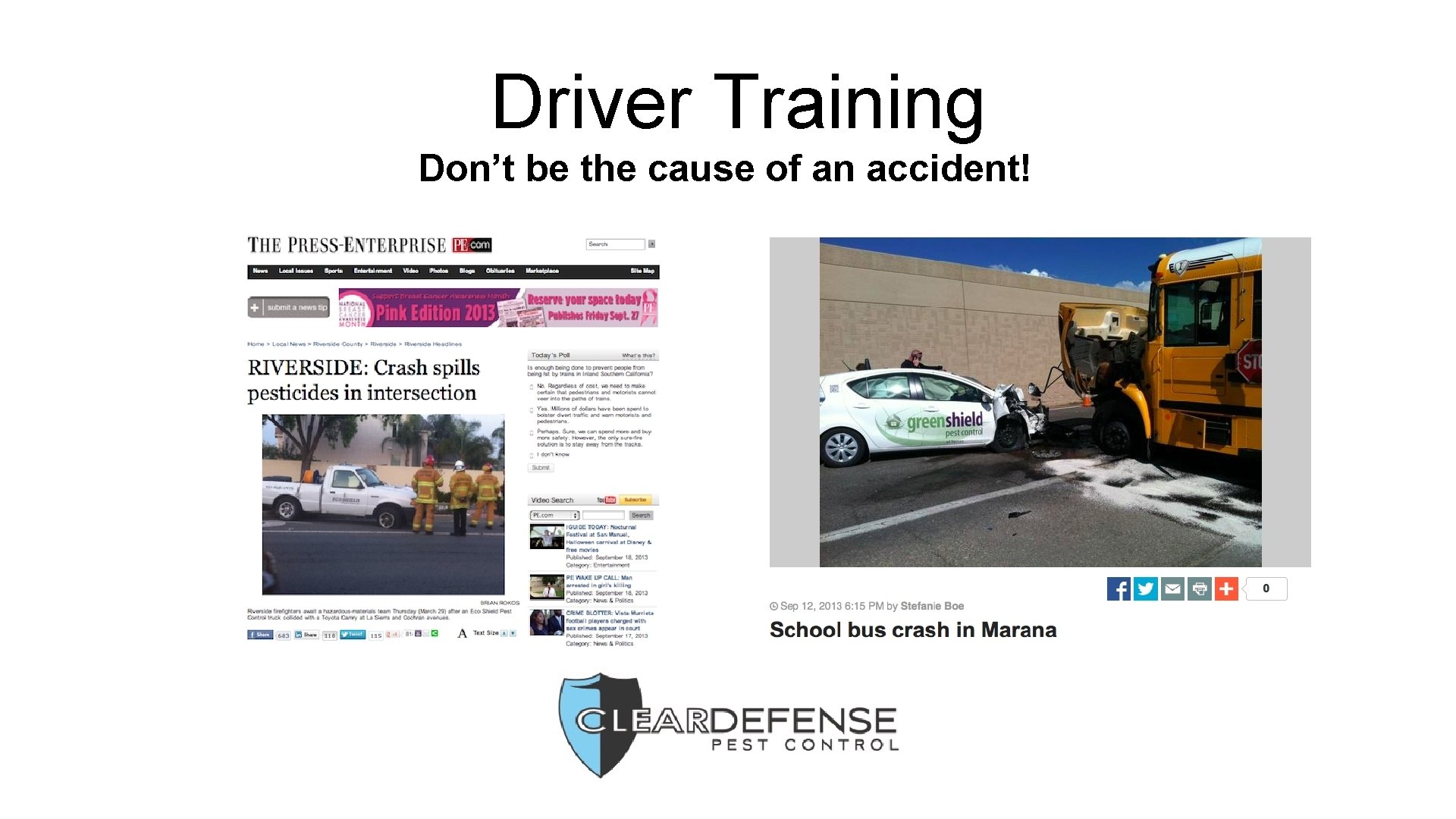
Driver Training Don’t be the cause of an accident!