
Driver Product Safety Training MDI TDI Bulk Liquid
Driver Product & Safety Training MDI / TDI Bulk Liquid Transportation 1 Version March 2012 Revision March 2012
![Driver Training MDI / TDI Company [name] Location [place] Date 24/10/2020 Trainer [name] 2](http://slidetodoc.com/presentation_image/050035e64572bee743dfd447f5c4ecd7/image-2.jpg "Driver Training MDI / TDI Company [name] Location [place] Date 24/10/2020 Trainer [name] 2")
Driver Training MDI / TDI Company [name] Location [place] Date 24/10/2020 Trainer [name] 2 Version March 2012
Background § MDI / TDI can be handled safely and are in widespread use across the world. § This programme helps in the safe transport of these chemicals by ensuring proper training of drivers § The training package is a joint effort of ISOPA and the carriers based on practical experience. § Drivers who successfully complete the driver training are issued with a MDI / TDI Driver Training Card 3 Version March 2012
Introduction ISOPA § European ISOcyanate P olyol roducers Association § See website www. isopa. org § Member companies: 4 Version March 2012

5 Version March 2012
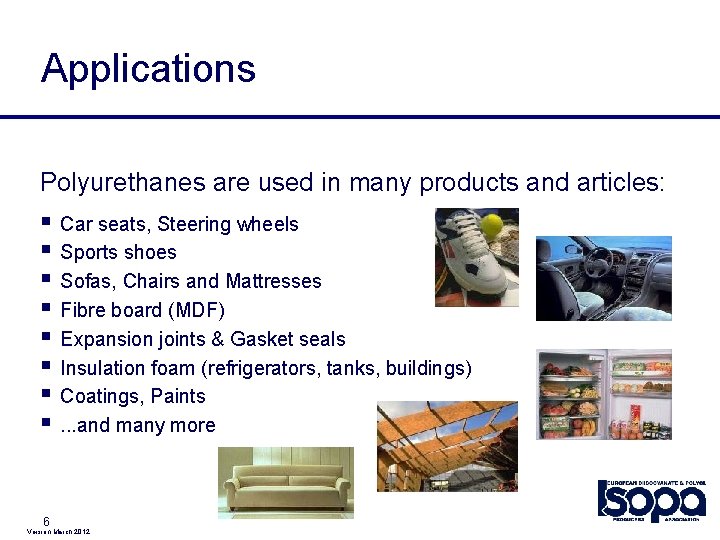
Applications Polyurethanes are used in many products and articles: § § § § 6 Car seats, Steering wheels Sports shoes Sofas, Chairs and Mattresses Fibre board (MDF) Expansion joints & Gasket seals Insulation foam (refrigerators, tanks, buildings) Coatings, Paints. . . and many more Version March 2012

Appearance Liquid Reacted MDI Clear to brown Slightly musty Brown Crusty TDI Clear to pale yellow Sharp, pungent White Foamy 7 Version March 2012
Maximum Allowable Concentration (MAC) MAC : 5. 0 – 10. 0 ppb Odour threshold : 0. 2 – 0. 4 ppm Therefore: § When you smell it, it’s above the limit ! § No used PPE in the cabin 8 Version March 2012
Main Physical and Chemical Properties (1) § Vapour pressure: Dangers of MDI and TDI are of the same magnitude but… vapour pressure of TDI is much higher (20 x), therefore the RISKS of TDI are much bigger § Vapour density = 6× Air density i. e. the vapours are heavier than air! 9 Version March 2012
Main Physical and Chemical Properties (2) § Density range 1. 20 – 1. 29 (For TDI filling degree conform ADR see next slide) § Important temperatures: • Crystallization starts at • Melting when reheated to 10 Version March 2012 ± 15°C (product temp. ) ± 45°C (product temp. )
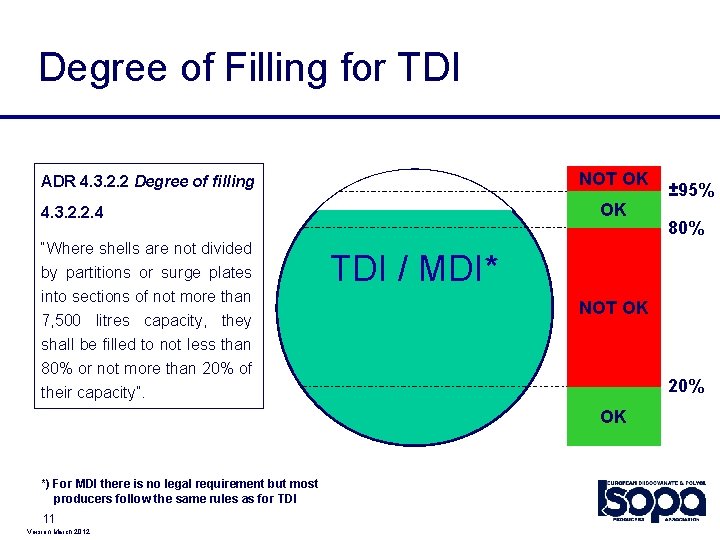
Degree of Filling for TDI NOT OK ADR 4. 3. 2. 2 Degree of filling OK 4. 3. 2. 2. 4 “Where shells are not divided by partitions or surge plates into sections of not more than 7, 500 litres capacity, they shall be filled to not less than 80% or not more than 20% of their capacity”. 11 Version March 2012 80% TDI / MDI* NOT OK 20% OK *) For MDI there is no legal requirement but most producers follow the same rules as for TDI ± 95%
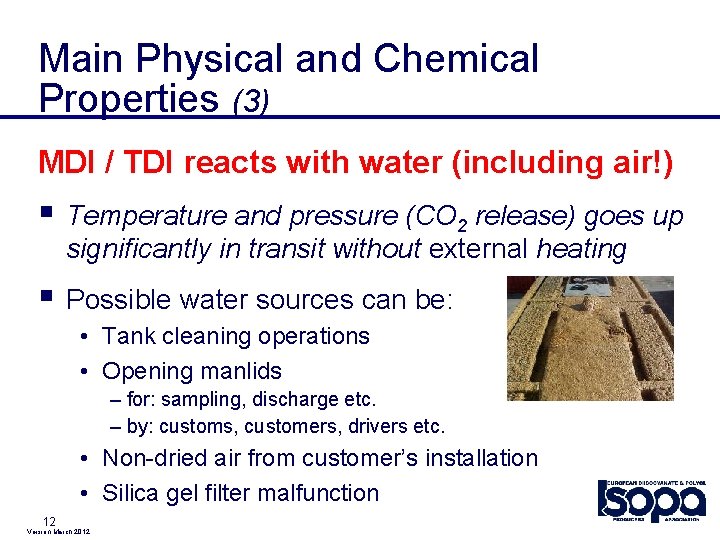
Main Physical and Chemical Properties (3) MDI / TDI reacts with water (including air!) § Temperature and pressure (CO 2 release) goes up significantly in transit without external heating § Possible water sources can be: • Tank cleaning operations • Opening manlids – for: sampling, discharge etc. – by: customs, customers, drivers etc. • Non-dried air from customer’s installation • Silica gel filter malfunction 12 Version March 2012
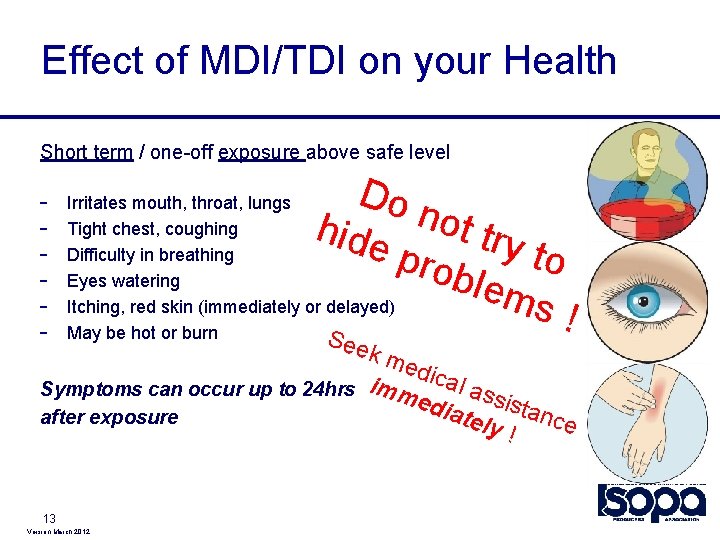
Effect of MDI/TDI on your Health Short term / one-off exposure above safe level - Do hide not try to pro blem s ! Irritates mouth, throat, lungs Tight chest, coughing Difficulty in breathing Eyes watering Itching, red skin (immediately or delayed) May be hot or burn S eek me dica i l as Symptoms can occur up to 24 hrs mm edia sista nce after exposure tely ! 13 Version March 2012
Effect of MDI/TDI on your Health Long term/repeated over- exposure from breathing or skin contact leads to risk of sensitisation Symptoms such as occasional breathing difficulties similar to asthma, hay fever, sneezing When sensitised, potentially severe asthma in the case of even low MDI/TDI exposure Sensitisation will prevent working with isocyanates for life Sensitisation is non-reversible and is a reaction of the immune system. Not to be confused with irritation 14 Version March 2012
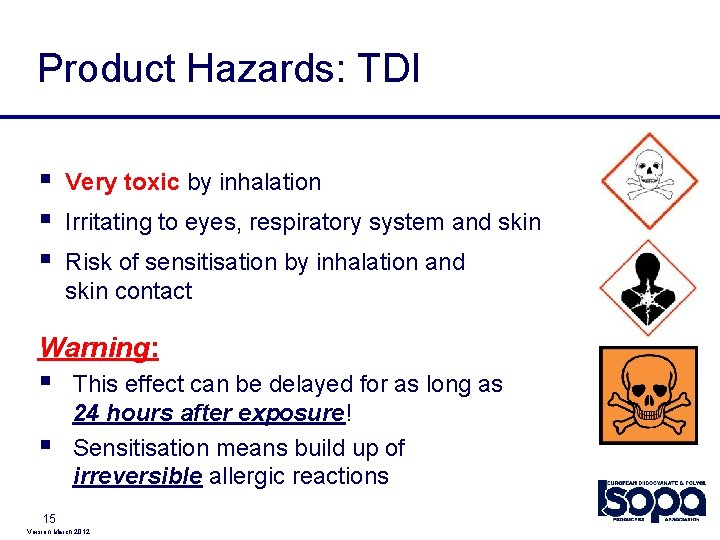
Product Hazards: TDI § § § Very toxic by inhalation Irritating to eyes, respiratory system and skin Risk of sensitisation by inhalation and skin contact Warning: § § This effect can be delayed for as long as 24 hours after exposure! Sensitisation means build up of irreversible allergic reactions 15 Version March 2012
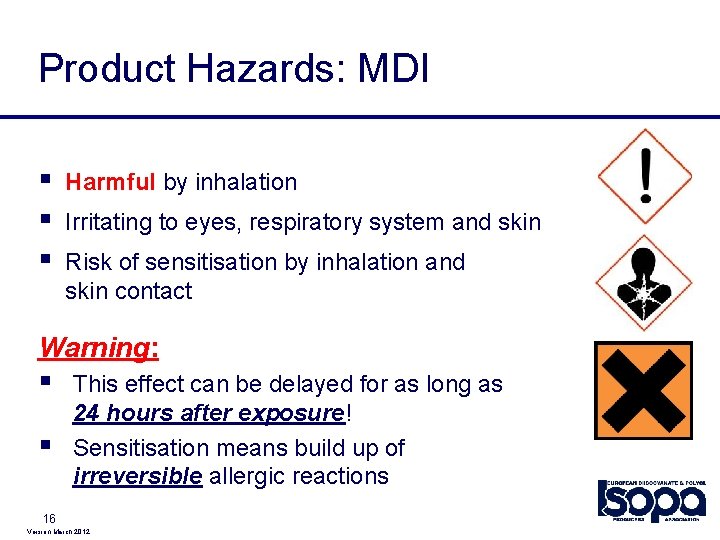
Product Hazards: MDI § § § Harmful by inhalation Irritating to eyes, respiratory system and skin Risk of sensitisation by inhalation and skin contact Warning: § § This effect can be delayed for as long as 24 hours after exposure! Sensitisation means build up of irreversible allergic reactions 16 Version March 2012
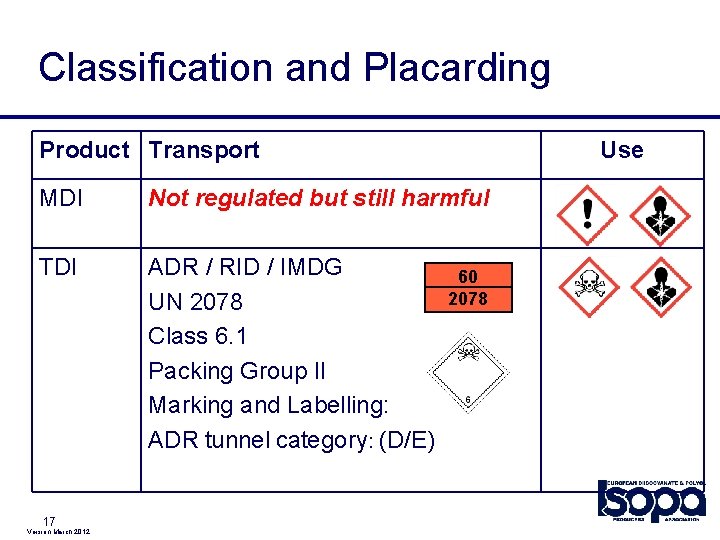
Classification and Placarding Product Transport Use MDI Not regulated but still harmful TDI ADR / RID / IMDG UN 2078 Class 6. 1 Packing Group II Marking and Labelling: ADR tunnel category: (D/E) 17 Version March 2012 60 2078
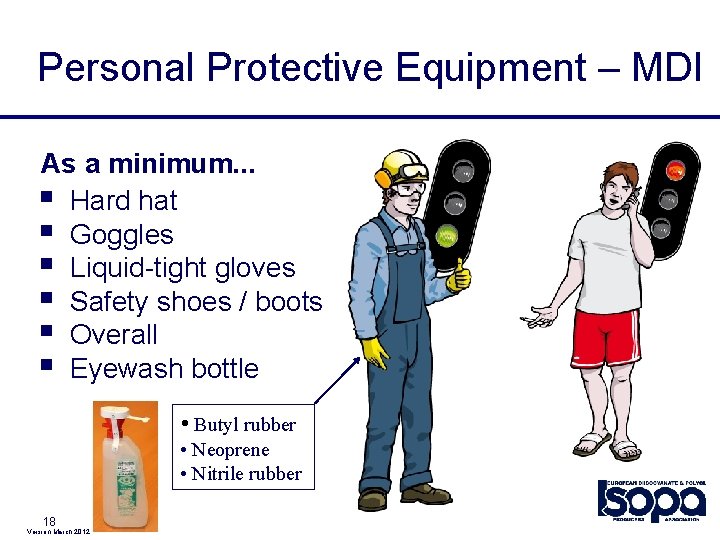
Personal Protective Equipment – MDI As a minimum. . . § Hard hat § Goggles § Liquid-tight gloves § Safety shoes / boots § Overall § Eyewash bottle • Butyl rubber • Neoprene • Nitrile rubber 18 Version March 2012
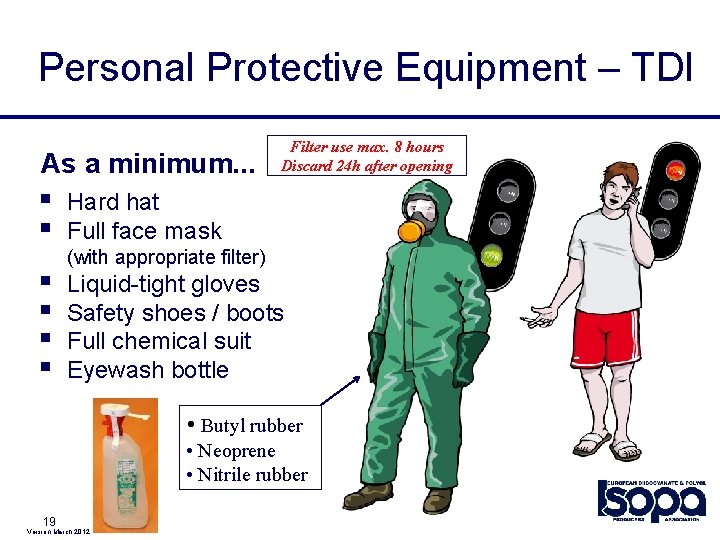
Personal Protective Equipment – TDI As a minimum. . . § § § Filter use max. 8 hours Discard 24 h after opening Hard hat Full face mask (with appropriate filter) Liquid-tight gloves Safety shoes / boots Full chemical suit Eyewash bottle • Butyl rubber • Neoprene • Nitrile rubber 19 Version March 2012
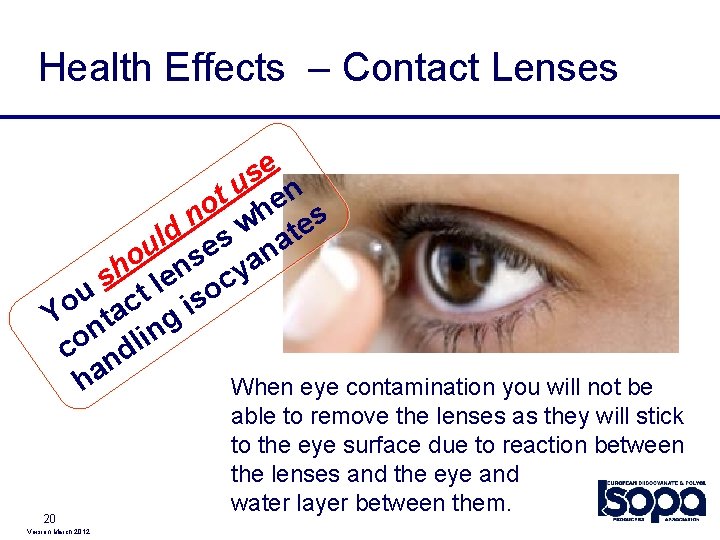
Health Effects – Contact Lenses e s u n t e o h n w es t d s l a u se an o sh len ocy u ct is o Y nta g n i o l c nd ha When eye contamination you will not be 20 Version March 2012 able to remove the lenses as they will stick to the eye surface due to reaction between the lenses and the eye and water layer between them.
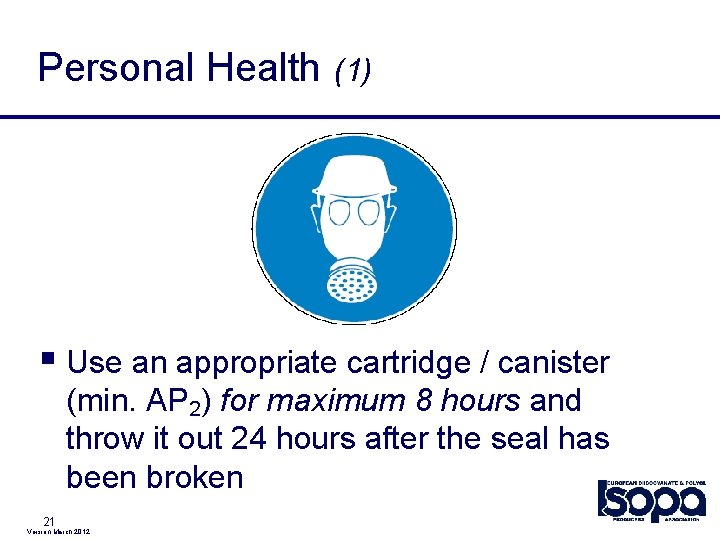
Personal Health (1) § Use an appropriate cartridge / canister (min. AP 2) for maximum 8 hours and throw it out 24 hours after the seal has been broken 21 Version March 2012
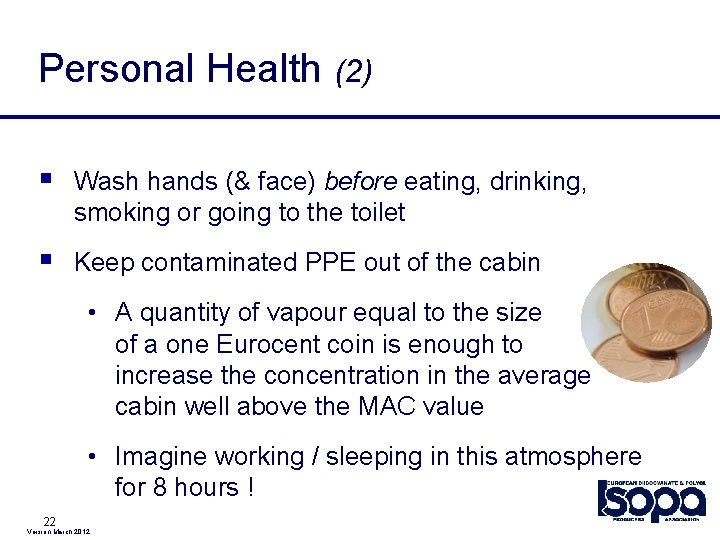
Personal Health (2) § Wash hands (& face) before eating, drinking, smoking or going to the toilet § Keep contaminated PPE out of the cabin • A quantity of vapour equal to the size of a one Eurocent coin is enough to increase the concentration in the average cabin well above the MAC value • Imagine working / sleeping in this atmosphere for 8 hours ! 22 Version March 2012
Product Quality Control § Certificate of Analysis (Co. A) § Samples (Not recommended) • Co. A is strongly preferred to a sample • Drivers should not take samples ! • Never take a sample in your cab !!! Not even for 1 minute !!! § Temperature (Customer specific) 23 Version March 2012
Site Safety Make yourself familiar with the site emergency policy and location of following items: § Signs & Alarms § Wind direction indicator § Emergency stop button § Emergency shower § Assembly point § Waste bin (for used gaskets, gloves, etc. ) § Decontamination & Absorption material 24 Version March 2012
Spill Handling (by Emergency Services) Always wear PPE !! § Drivers should observe from a safe distance and remain available to provide information § Emergency services should: 1. Cover sewer system 2. Absorb the spill 3. Neutralise 4. Wait (30– 60 minutes after reaction has finished) 5. Remove spill after reaction has finished. 6. Put residues in designated chemicals waste bin 7. Apply decontamination fluid 25 Version March 2012
Loading: Key Items § PPE must be worn § Tank equipment § 3 -Minutes check before & after loading 26 Version March 2012
Fall protection (1) Text under construction 27 Version March 2012
Fall protection (2) Text under construction 28 Version March 2012
Tank Equipment § Manlid must be kept closed! (moisture prevention) § § § Ensure customs letter (if applicable) is present Do not mix-up the vapour return and liquid line !!! Tank depressurised? Cleaned tanks must be dry ! Capacity (keep filling degree in mind!) 29 Version March 2012
3 -Minutes Check before Loading Equipment § § § Tanker exterior clean? Spillage tray clean? Tanker correctly labelled and placarded? All valves closed? Manlid closed and bolts tightened? Check temperature 30 Version March 2012
3 -Minutes Check after Loading Equipment § Disconnected? § Free of spillages including spillage tray? § Safety handrail down? § Valves closed, blind-flanged and new gasket? § Only slight overpressure (max 0. 1 bar)? § Temperature setting correct? § Sample (if necessary)? Documentation § Transport document, Customs letter, Co. A, Weight ticket, DGD? § Instructions in writing? 31 Version March 2012
Transport § Hours / Speed § Check temperature (and pressure) § Reporting unsafe conditions / incidents § Parking 32 Version March 2012
Opening of Tanks in Transit by Customs Officials § Tanks should not be opened whilst in transit because of the dangers to human health § ISOPA issued a letter to Customs Officials explaining the reasons why § Letter is available in 14 languages i. e. CZ - DE - EN - ES - FR - HU - IT - LV - PL - RO - RU - SK - TUR - UA § Letter can be downloaded from the ISOPA website http: //www. isopa. org/isopa/index. php? page=logistics-ehs 33 Version March 2012
Security en Route What to do & not to do: § Do not leave the vehicle unlocked § Do not disclose information about product carried, customer, route or destination § Park preferably on secure parking areas 34 Version March 2012
Heating All methods: § Maximum product contact temperature = 60°C § Do-not-open-the-manlid Steam: § Only external steam coils § Maximum 1. 7 bar (= ~ 115 °C) 35 Version March 2012
Unloading: Key Points (1) § Follow site regulations § Behaviour You are the supplier’s representative § Know the operational responsibilities between operator and driver as described in the CEFIC / ECTA Behaviour Based Safety Guidelines § Report unsafe conditions at customers (including near misses) 36 Version March 2012
Unloading: Key Points (2) § Storage tank capacity • communication driver / operator § PPE must be worn § Observe connections, pressure during unloading § Samples (Report back if you have to take a sample) § Unloading methods (Details on next slides) 37 Version March 2012
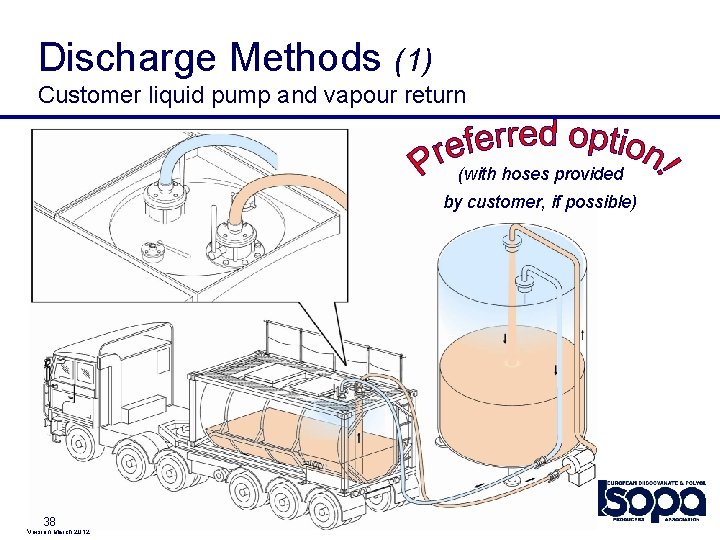
Discharge Methods (1) Customer liquid pump and vapour return (with hoses provided by customer, if possible) 38 Version March 2012
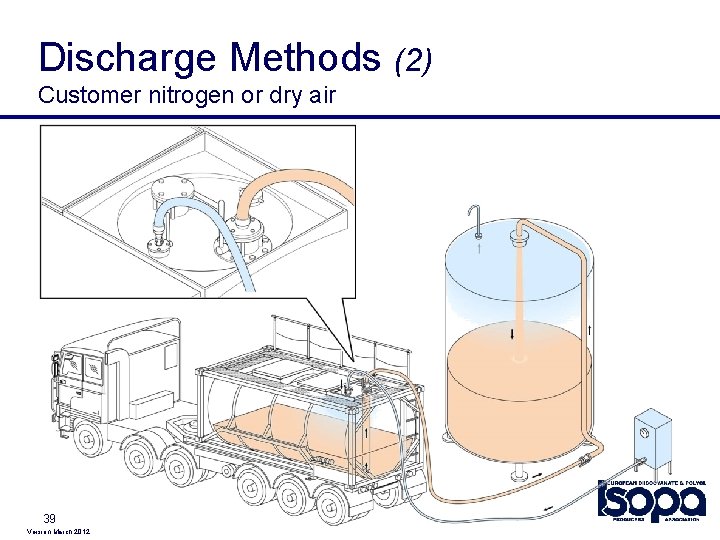
Discharge Methods (2) Customer nitrogen or dry air 39 Version March 2012
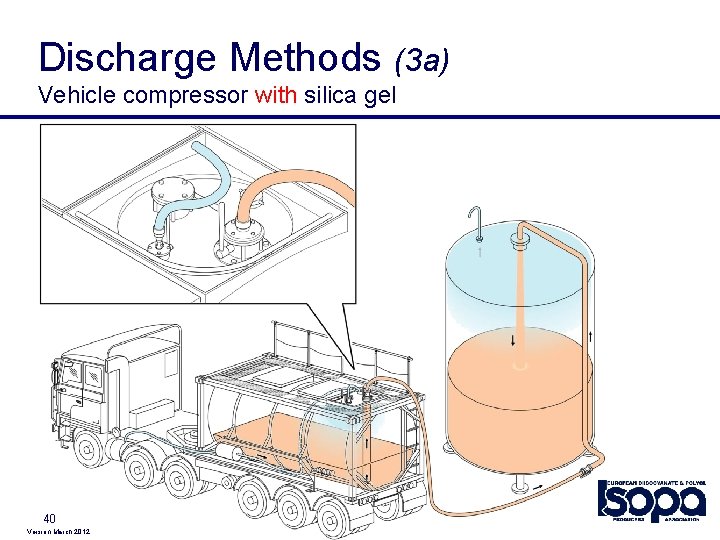
Discharge Methods (3 a) Vehicle compressor with silica gel 40 Version March 2012
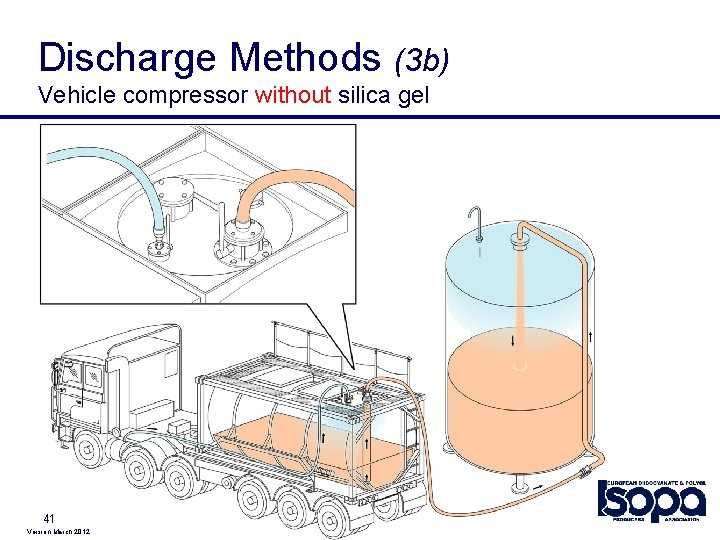
Discharge Methods (3 b) Vehicle compressor without silica gel 41 Version March 2012
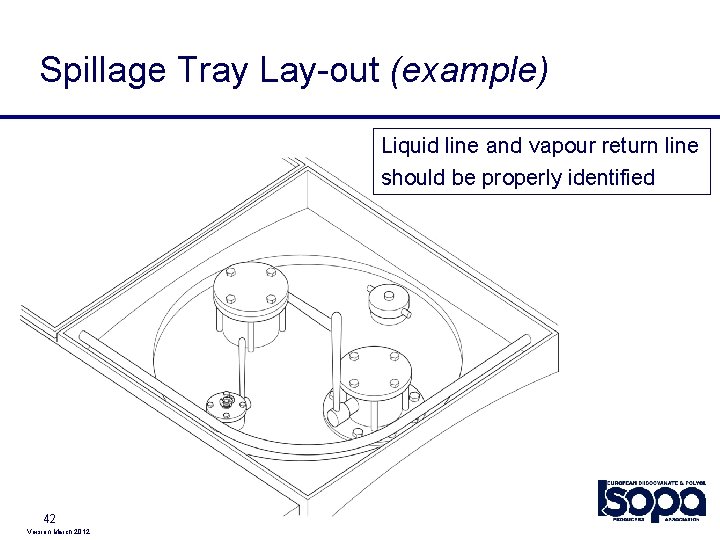
Spillage Tray Lay-out (example) Liquid line and vapour return line should be properly identified 42 Version March 2012
3 -Minutes Check after Discharge (1) Equipment § § § § Disconnected? Free of spillages including spillage tray? Safety handrail down? Valves closed and blind-flanged, manlids closed? Spillage tray covers closed? Only slight overpressure (max 0. 1 bar)? Depressurise at the customer if possible, or inform planner Documentation (1) § § Handed to the customer? Transport documentation signed? 43 Version March 2012
3 -Minutes Check after Discharge (2) Documentation (2) § Customer needs: • Copy of transport document signed by driver & customer • Certificate of Analysis § Driver keeps: • Copy of transport document signed by driver & customer For TDI: Obtain or make transport document reading: Empty tank container*), last load: UN 2078 Toluene Diisocyanate, 6. 1, II (D/E) *) or: tank vehicle; demountable tank; portable tank 44 Version March 2012
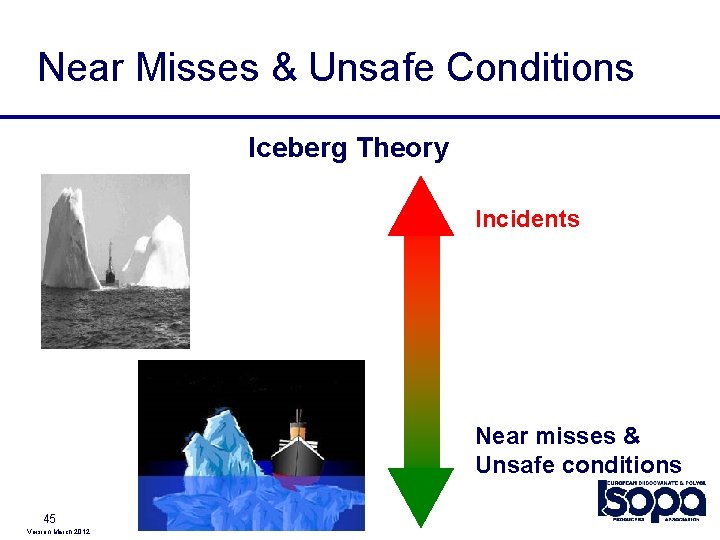
Near Misses & Unsafe Conditions Iceberg Theory Incidents Near misses & Unsafe conditions 45 Version March 2012
Near misses and unsafe conditions Reporting examples Active near miss reporting will reduce / avoid serious incidents: § Road traffic incidents § Equipment failures § Incorrect human behaviour § Overflows § Overpressure § Spills § Unexpected temperature rise (check regularly!) § Unsafe working conditions (missing safety shower etc. ) § Unsecure routing 46 Version March 2012
Incidents Statistics indicate: § More than 80% of all incidents are related to human behaviour § Most incidents and accidents occur during loading & unloading So THIS is your Challenge: You are the most important safety factor (OR you will be the most important risk factor !) 47 Version March 2012
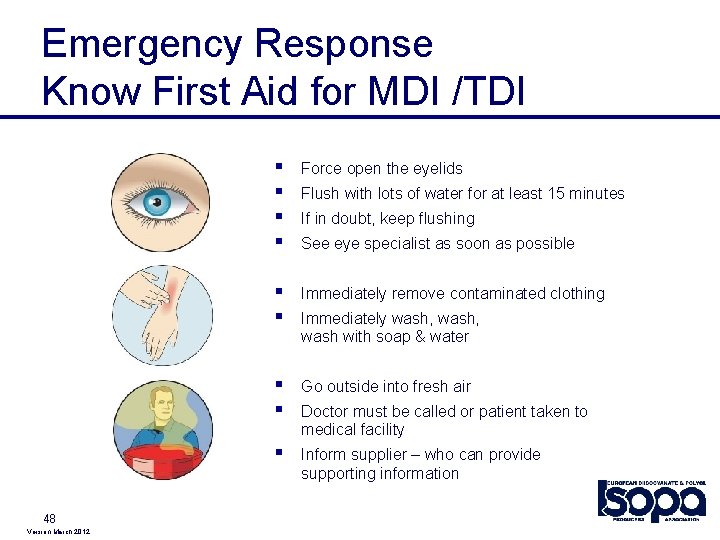
Emergency Response Know First Aid for MDI /TDI 48 Version March 2012 § § Force open the eyelids § § Immediately remove contaminated clothing § § Go outside into fresh air § Inform supplier – who can provide supporting information Flush with lots of water for at least 15 minutes If in doubt, keep flushing See eye specialist as soon as possible Immediately wash, wash with soap & water Doctor must be called or patient taken to medical facility
Emergency Procedures Exposure to MDI / TDI § A single high exposure to MDI / TDI is one possible cause of sensitisation § § § Early treatment is important Remember that symptoms may occur later Help is available for the doctor from ISOPA member companies Ø Speed is essential Ø Practice First Aid procedures Ø Seek medical advice 49 Version March 2012
And. . . In any case of emergency: call us. . don‘t try to be a hero. . . !! 50 Version March 2012
Emergency Response CDs / DVDs TDI § Danish incident § French incidents § Portuguese incident § Swedish incident § Turkish incidents MDI § British incident § German incident § Italian incident 51 Version March 2012 – Packed – Bulk – Bulk
Emergency Response CD / DVD Emergency incident scenario § What went well ? § What can be improved ? 52 Version March 2012

Test 53 Version March 2012 § § § 20 multiple choice questions: § Corrections are allowed (as long as it is clear which answer you decided upon!) § The minimum score is 70% = 14 correct answers One correct answer only Ticking more than one answer for the same question = miss
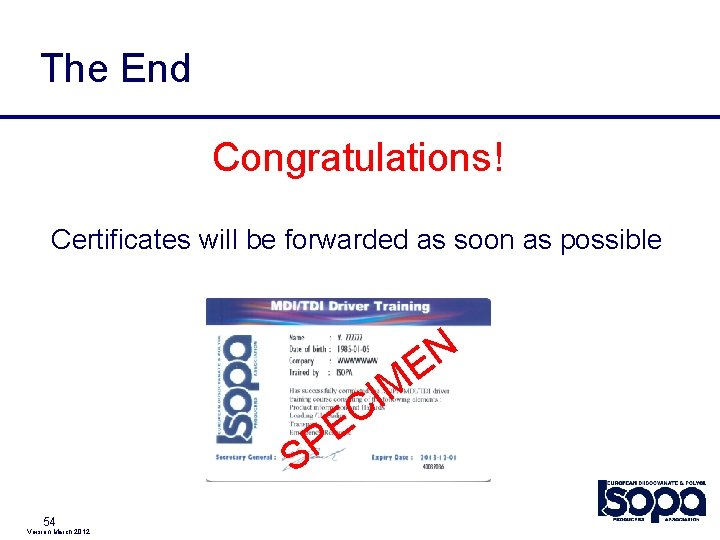
The End Congratulations! Certificates will be forwarded as soon as possible N E M I C E P S 54 Version March 2012
Disclaimer These product stewardship initiatives of ISOPA and its members do not exempt customers, producers and others in the supply chain of their occupational health, safety and environmental duties and regulatory obligations. With respect to this, ISOPA and its associated members disclaim any liability in connection with the use of services rendered and of the related information provided. It is the responsibility of the user to verify the accuracy of the services and the related information which can be used by the user at his own risk. 55 Version March 2012
- Slides: 55