
Driver Behaviour Controlling Emotions Having the physical ability


Driver Behaviour Controlling Emotions Having the physical ability to operate a motor vehicle is really only half the picture. Being in the right psychological and emotional state - that is, having the right attitudes, traits, and motivation is also essential to driving safely, being courteous, and avoiding accidents and traffic citations.
Driver Behaviour Controlling Emotions Drivers 16 to 19 have very high traffic accident, injury, and conviction rates. Drivers under 18 are 2. 5 times more likely to have a fatal accident than the average driver. Nearly half of drivers who start driving before they are 20 are convicted of a traffic violation within the first year of driving. Teenage drivers have total accident rates which are twice that of adults and traffic accidents are the leading cause of death.
Driver Behaviour Controlling Emotions Young drivers’ over-involvement in traffic accidents stems from a lack of: Driving experience, exposure to accident risk, alcohol / drug consumption, perceptual abilities, inexperience in identifying and handling hazardous situations, over-confidence in abilities, personality structure, internal and external influences, poor judgment, excessive speed, and attitudinal factors such as risk-taking propensity.
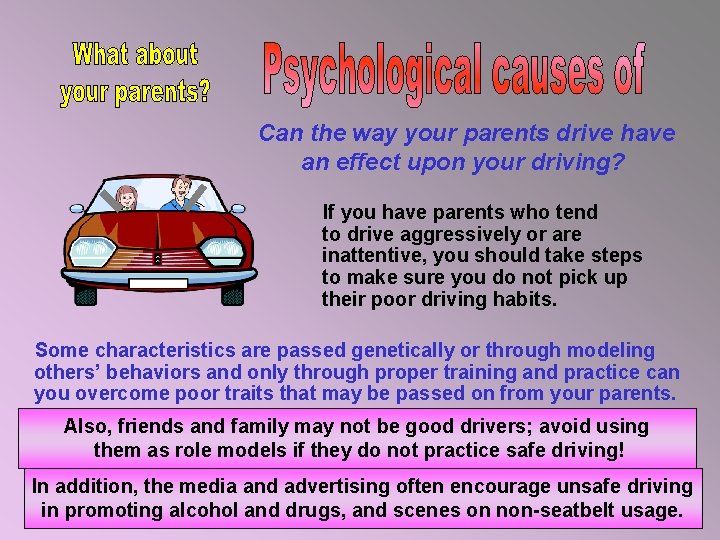
Can the way your parents drive have an effect upon your driving? If you have parents who tend to drive aggressively or are inattentive, you should take steps to make sure you do not pick up their poor driving habits. Some characteristics are passed genetically or through modeling others’ behaviors and only through proper training and practice can you overcome poor traits that may be passed on from your parents. Also, friends and family may not be good drivers; avoid using them as role models if they do not practice safe driving! In addition, the media and advertising often encourage unsafe driving in promoting alcohol and drugs, and scenes on non-seatbelt usage.
Driver Behaviour Controlling Emotions Proper training through driver education and training on the road will make you more comfortable with driving. When you first begin, you will likely be nervous about your ability level. As good driving behaviors and attitudes become automatic through practice, you will better enjoy driving. When you see others just learning how to drive, be courteous and remember how nervous you were when you first started behind the wheel. Let’s now think about potential effects on driver decision-making
Driver Behaviour Controlling Emotions Controlling your emotions is critical as you drive. Over reacting to other drivers selfish actions can be very dangerous. For example, a car pulls out in front of you causing you to brake hard…you then lay on the horn for several seconds and tailgate them…this is not controlling your emotions and is asking for trouble…as this driver may emotionally react to you by slamming on the brakes, setting up a rear end collision. What might happen as you both get out of your vehicles? On the other hand if you just backed off (no horn or tailgating) all the negati 9 ve potential effects could be avoided Let’s now think about recognizing internal cues and responses
Driver Behaviour Controlling Emotions Controlling your emotions is critical as you drive. You need to know yourself…the types of things that have a tendency to annoy or irritate you. For example, if you realize you are impatient with others, a slower driver in front of you on a 2 lane road in a no passing zone will be challenging to you. Recognizing this tendency in your is important before you can successfully deal with it. The best way to control this impatient tendency in yourself is to acknowledge to yourself that there will always be slower drivers on the road, and you will not be gaining substantial time savings by attempting to pass. Determine to back off, give them their space and congratulate yourself for doing the right thing. Let’s now think about positive driving attitudes and behaviours
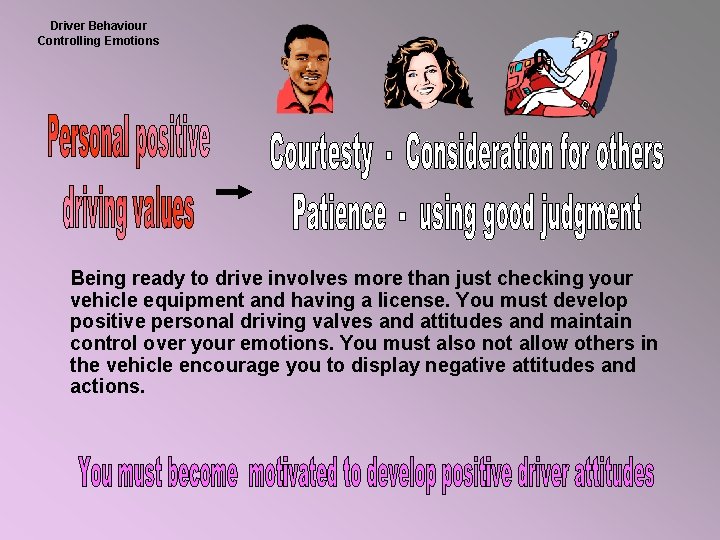
Driver Behaviour Controlling Emotions Being ready to drive involves more than just checking your vehicle equipment and having a license. You must develop positive personal driving valves and attitudes and maintain control over your emotions. You must also not allow others in the vehicle encourage you to display negative attitudes and actions.
Driver Behaviour Controlling Emotions Starts with learning how to be a safe driver with responsible attitudes and then being motivated to apply them to actual driving situations. Your personal driving values must show respect for others and a right to share the road with them. Not all drivers will exhibit safe attitudes, but you have to be motivated to have a safe attitude regardless of others.
Driver Behaviour Controlling Emotions Many young drivers are more willing to take risks compared to other drivers; they are more likely to perceive hazardous situations as less dangerous than they really are. Although drivers under the age of 25 have the fastest reaction times, they respond to hazards more slowly than do mid-age drivers, suggesting that they frequently fail to recognize some situations as being potentially hazardous, are possibly influenced by peers, or demonstrate emotional immaturity when driving.
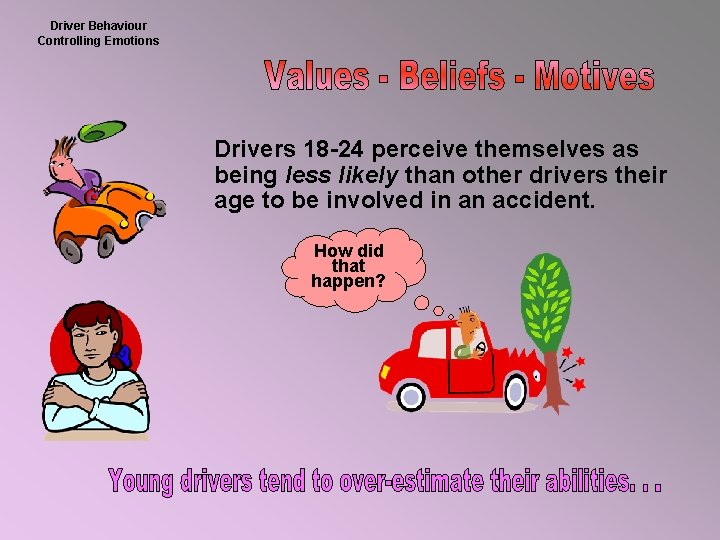
Driver Behaviour Controlling Emotions Drivers 18 -24 perceive themselves as being less likely than other drivers their age to be involved in an accident. How did that happen?
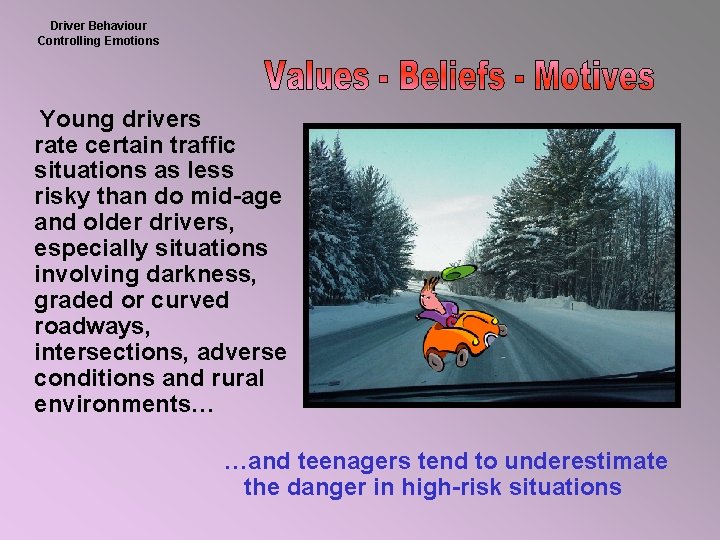
Driver Behaviour Controlling Emotions Young drivers rate certain traffic situations as less risky than do mid-age and older drivers, especially situations involving darkness, graded or curved roadways, intersections, adverse conditions and rural environments… …and teenagers tend to underestimate the danger in high-risk situations
Driver Behaviour Controlling Emotions Do not do a good job of judging their skill level or the dangerousness of driving situations. It is important that you and the people who teach you how to drive analyze and identify the problem attitudes and behaviors you may exhibit while driving and help you become aware of them. All these things we have considered so far demonstrate that most teens: …and you need to constantly monitor yourself when you are driving to identify poor driving habits and attitudes…and have the willingness to correct them!
Driver Behaviour Controlling Emotions The media (TV, radio, newspapers, magazines, internet, etc. ) can shape our perceptions of vehicles and driving. For example, car commercials will glorify how fast their cars can accelerate or how show fast they can negotiate sharp curves. It is important to remember that their objective is to sell their vehicles and appealing to a sense of excitement is their marketing strategy. It’s important to realize these things and make decisions to do what is lawful and what is safe Besides car commercials, TV and movies will often depict unsafe driving behaviours such as racing, disregarding traffic laws and failing to fasten safety belts. .
Driver Behaviour Controlling Emotions The media (TV, radio, newspapers, magazines, internet, etc. ) can shape our perceptions of vehicles and driving. For example, car commercials will glorify how fast their cars can accelerate or how show fast they can negotiate sharp curves. It is important to remember that their objective is to sell their vehicles and appealing to a sense of excitement is their marketing strategy. It’s important to realize these things and make decisions to do what is lawful and what is safe In our society demonstrating a disregard for traffic laws or dangerous racing or reckless driving will result in the loss of your driving privilege.
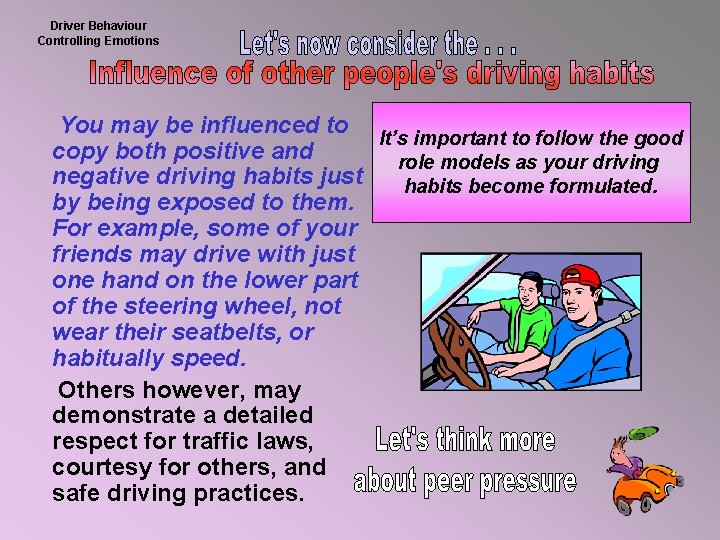
Driver Behaviour Controlling Emotions You may be influenced to It’s important to follow the good copy both positive and role models as your driving negative driving habits just habits become formulated. by being exposed to them. For example, some of your friends may drive with just one hand on the lower part of the steering wheel, not wear their seatbelts, or habitually speed. Others however, may demonstrate a detailed respect for traffic laws, courtesy for others, and safe driving practices.
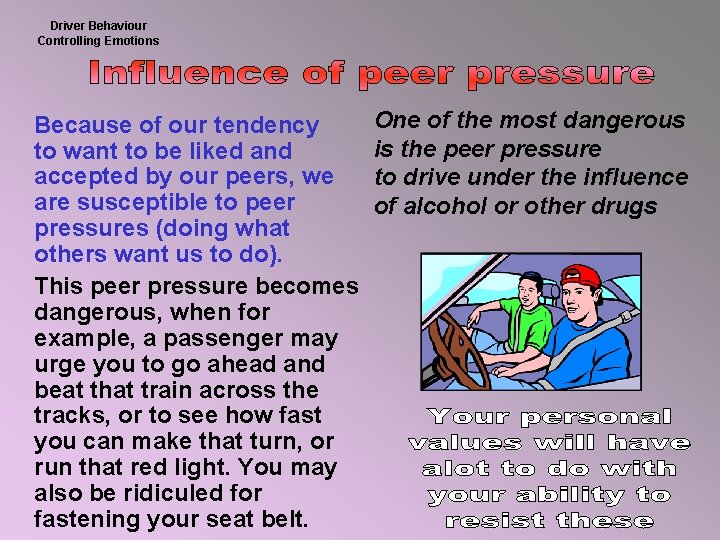
Driver Behaviour Controlling Emotions Because of our tendency to want to be liked and accepted by our peers, we are susceptible to peer pressures (doing what others want us to do). This peer pressure becomes dangerous, when for example, a passenger may urge you to go ahead and beat that train across the tracks, or to see how fast you can make that turn, or run that red light. You may also be ridiculed for fastening your seat belt. One of the most dangerous is the peer pressure to drive under the influence of alcohol or other drugs
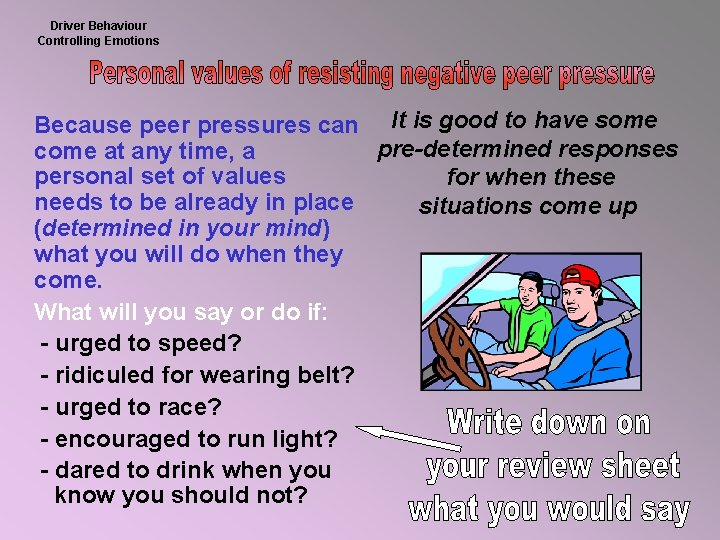
Driver Behaviour Controlling Emotions Because peer pressures can It is good to have some pre-determined responses come at any time, a personal set of values for when these needs to be already in place situations come up (determined in your mind) what you will do when they come. What will you say or do if: - urged to speed? - ridiculed for wearing belt? - urged to race? - encouraged to run light? - dared to drink when you know you should not?
Driver Behaviour Controlling Emotions Creative ways to say NO to drinking 1) I’m a lover, not a drinker! 2) Last time I had a drink, I wanted to attack a chicken! 3) I become so witty that no one will talk to me! 4) I sing off key as it is… 5) I might forget where I parked my mind. 6) I don’t need to loosen up, I just got it together. 7) I don’t need any more hair on my chest. 8) I’d rather hang loose than hangover. 9) It’s never as much fun as it looks on TV. 10) My liver and I have this understanding!
Driver Behaviour Controlling Emotions Because this is the case, you can lose this privilege by not standing strong with a pre-determined set of personal beliefs on all the important driving issues we’ve covered in this section. You must overcome the negative motives of your peers and do the right thing in all situations. Do not lose your license.
Driver Behaviour Controlling Emotions The old saying: “courtesy is contagious” holds true as your good example in driving can be passed on to others as you strive to always do the safe and lawful thing. By all roadway users cooperating in this way the driving experience can be more pleasant and safe for all.
Driver Behaviour Controlling Emotions The safe driving practices, the formal rules of the road you are learning, along with the positive attitudes and strategies to resist negative peer pressures will all help you to make informed behaviour decisions as you strive to drive responsible. In addition, the familiar SIPDE process we’ve been utilizing in this course is the key for handling specific driving situations that arise in all types of traffic environments. The reward of learning and applying the SIPDE decision -making process will be evident with fewer violation and “accident” incidents.
Driver Behaviour Controlling Emotions Once you identify a poor driving behaviour, you need to change it by substituting the correct one until it becomes automatic. Let’s now think about psychological causes of various driving behaviors For example, if you notice you are forgetting to make the blind spot head check…you need to catch yourself and correct it until it becomes an automatic habit every time. Also remember that good habits can deteriorate over time unless you keep checking yourself. You must continue to practice the good habits you are taught and strive for the best possible attitude when driving to maintain these things in the future.
Driver Behaviour Controlling Emotions Your emotional state influences your ability to concentrate, stay alert, be courteous, think clearly and rapidly, contain anger, and aggressiveness, and control tendencies to “show off. ” There a number of characteristics that can affect your psychological ability to focus on the driving task, and react safely and courteously. These characteristics include: (a) emotional tension (b) environmental conditions (c) heredity of behaviors (d) physical condition of your body, and (e) the amount of training and practice you’ve accumulated as a driver
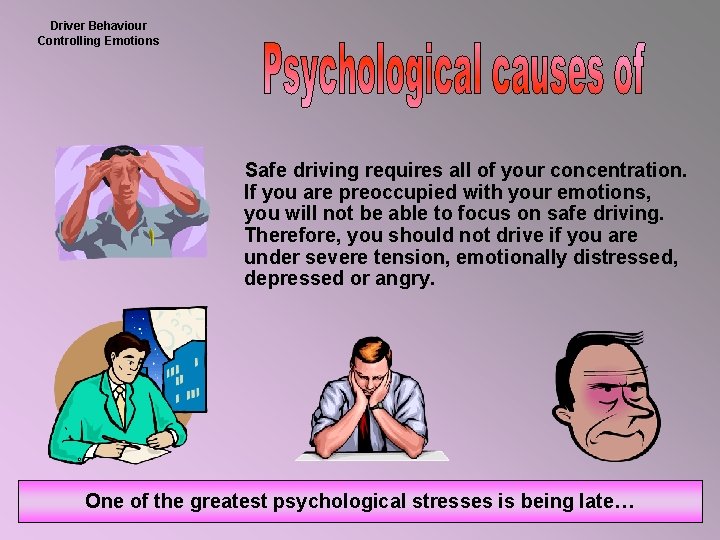
Driver Behaviour Controlling Emotions Safe driving requires all of your concentration. If you are preoccupied with your emotions, you will not be able to focus on safe driving. Therefore, you should not drive if you are under severe tension, emotionally distressed, depressed or angry. One of the greatest psychological stresses is being late…
Driver Behaviour Controlling Emotions Being late causes many people to become stressed and drive unsafely. Being late is not an excuse for poor driving. The few minutes you may make up by weaving through traffic and speeding will not likely make a difference. Accept the fact that you will be late and try to plan better the next time. One of the greatest psychological stresses is being late…
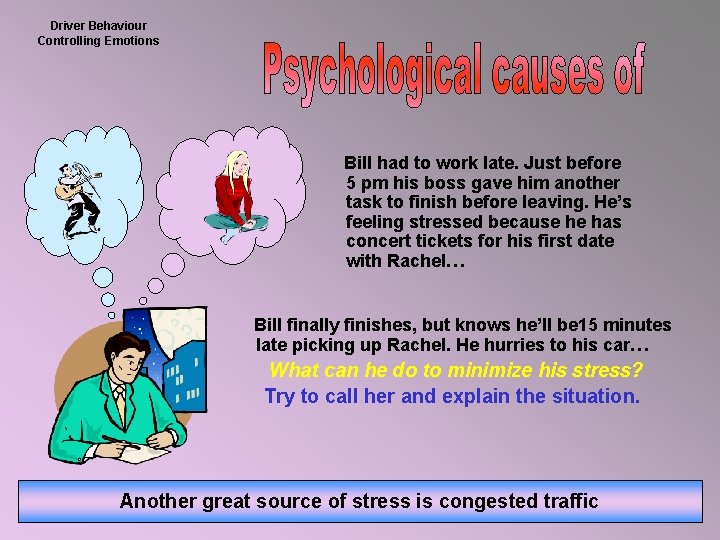
Driver Behaviour Controlling Emotions Bill had to work late. Just before 5 pm his boss gave him another task to finish before leaving. He’s feeling stressed because he has concert tickets for his first date with Rachel… Bill finally finishes, but knows he’ll be 15 minutes late picking up Rachel. He hurries to his car… What can he do to minimize his stress? Try to call her and explain the situation. Another great Let’ssource consider of stress this example is congested … traffic
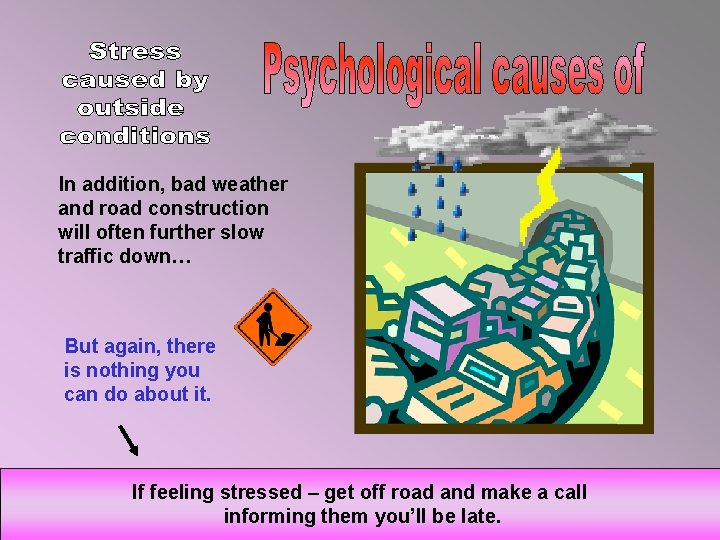
In addition, bad weather and road construction will often further slow traffic down… But again, there is nothing you can do about it. If feeling stressed – get off road and make atraffic call Another great source of stress is congested informing them you’ll be late.
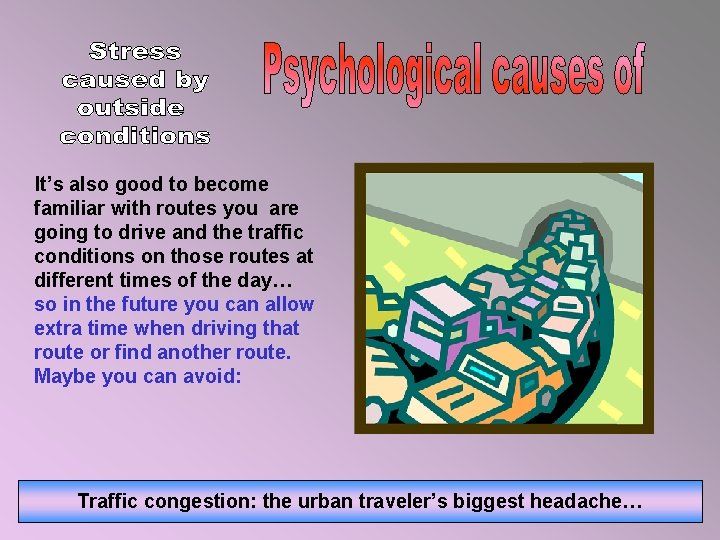
It’s also good to become familiar with routes you are going to drive and the traffic conditions on those routes at different times of the day… so in the future you can allow extra time when driving that route or find another route. Maybe you can avoid: Traffic congestion: the urban traveler’s biggest headache…
Even small changes in your driving habits can provide some relief. Avoid doing the following: (a) slowing to look at accidents (rubbernecking) (b) following too closely (c) unnecessary lane changes (d) inattention (e. g. , eating, grooming, cell phones, etc. ) Also, distracting conditions inside your vehicle such as loud music and passengers can cause you to drive unsafely…we’ll cover these in more detail later. Driving is a complex task that requires your full attention! If other drivers make you angry, try not to act aggressively. All drivers make mistakes…take a few deep breaths and forget it!
In addition to what we’ve already considered…other attitudes, emotions and states of mind can affect driver behaviour Happiness and excitement Day Dreaming Depression Let’s briefly notice how these things can adversely affect safe driving
Driver Behaviour Controlling Emotions Happiness and excitement
Driver Behaviour Controlling Emotions How can an excited, happy driver be a hazard on the road? • • Happiness and excitement they can be too excited at the wheel not paying attention to signs, traffic conditions etc. blasting of music, excited conversation with friends overconfidence, thinking nothing could go wrong Let’s think about some examples…
Driver Behaviour Controlling Emotions Michael had just proposed to his girl friend Amy, and she accepted. She was so happy. As she was driving home she was singing to the radio…her mind on an up-coming wedding… What could happen? Finish this story. Let’s think of another example…
Driver Behaviour Controlling Emotions In overtime Jason drives to the basket, leaps high and jams it…scoring the winning basket just as time runs out. As Jason leaves the parking lot he was very excited…two of his teammates are with him… What could happen? finish this story… How to can passengers Offer drive…explain an overly that help you don’t feel safe driver? with excited their state of mind.
Driver Behaviour Controlling Emotions SYMPTOMS at the wheel may include: • • Depression crying, sobbing, emotional at the wheel cannot concentrate on driving; alertness reduced depressed; caught up in negative, sad feelings hopeless feelings; confused thinking Let’s consider an example
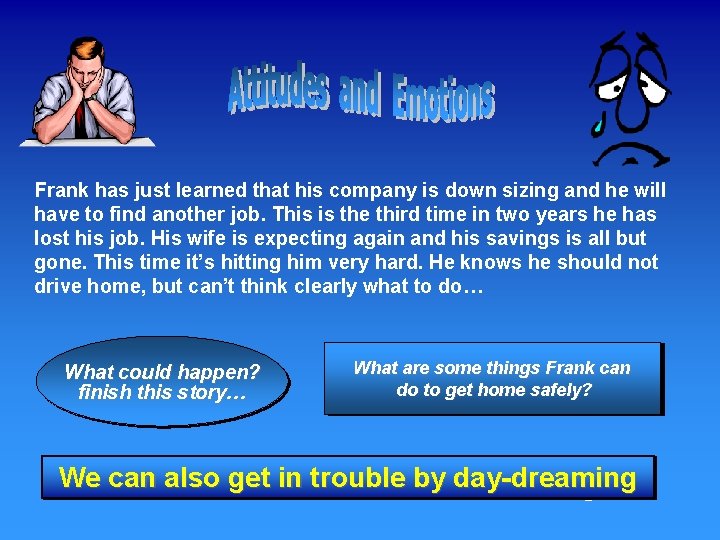
Frank has just learned that his company is down sizing and he will have to find another job. This is the third time in two years he has lost his job. His wife is expecting again and his savings is all but gone. This time it’s hitting him very hard. He knows he should not drive home, but can’t think clearly what to do… What could happen? finish this story… What are some things Frank can do to get home safely? Yes, the best thing he can do, is realize he must not drive. We can also get in trouble by day-dreaming He must contact someone who will do the driving.
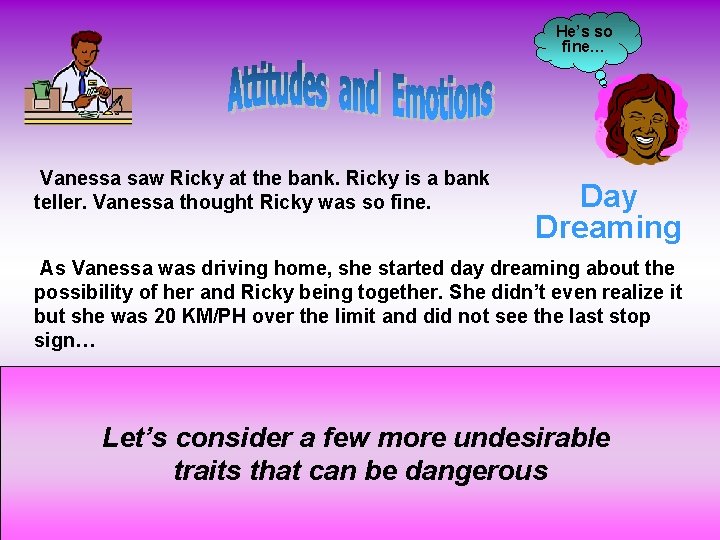
He’s so fine… Vanessa saw Ricky at the bank. Ricky is a bank teller. Vanessa thought Ricky was so fine. Day Dreaming As Vanessa was driving home, she started day dreaming about the possibility of her and Ricky being together. She didn’t even realize it but she was 20 KM/PH over the limit and did not see the last stop sign… What could happen here? consider finish. Let’s this story… As Most a passenger, day dreaming if you occurs notice when the driver seems be daywe dreaming the driver is to alone… must few more undesirable “snap out what of it” canoryou riskdo? a collision a traits that can be dangerous Talk to them
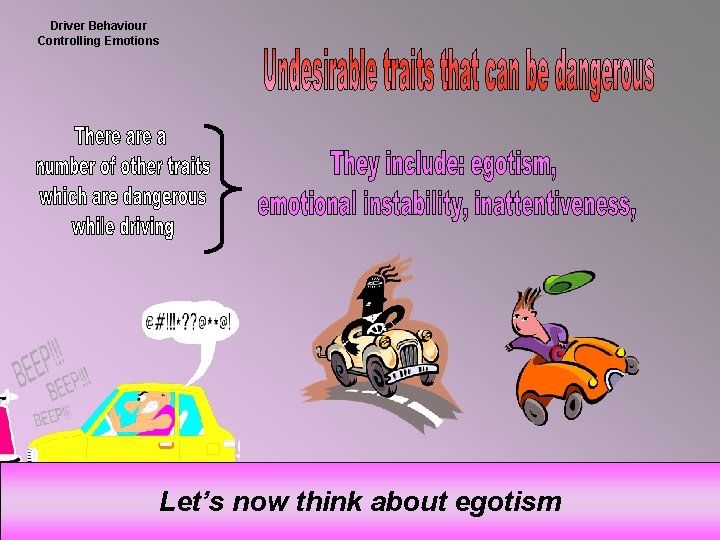
Driver Behaviour Controlling Emotions Let’s now think about egotism
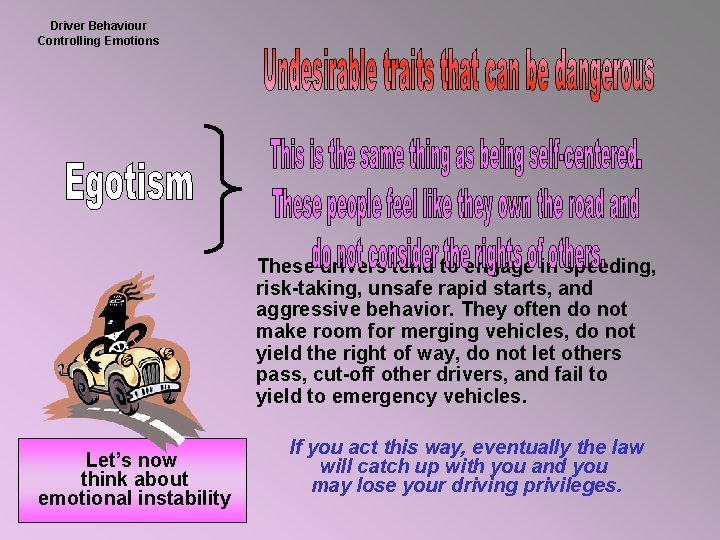
Driver Behaviour Controlling Emotions These drivers tend to engage in speeding, risk-taking, unsafe rapid starts, and aggressive behavior. They often do not make room for merging vehicles, do not yield the right of way, do not let others pass, cut-off other drivers, and fail to yield to emergency vehicles. Let’s now think about emotional instability If you act this way, eventually the law will catch up with you and you may lose your driving privileges.
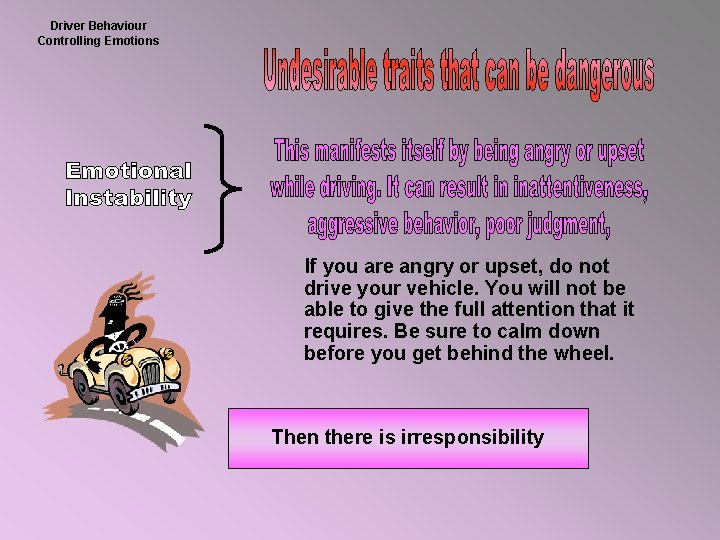
Driver Behaviour Controlling Emotions If you are angry or upset, do not drive your vehicle. You will not be able to give the full attention that it requires. Be sure to calm down before you get behind the wheel. Then there is irresponsibility
Driver Behaviour Controlling Emotions Your life and the life of others are in your hands. Think and act responsibly! Drivers who engage in high risk activities outside the driving situation tend to have higher traffic accident involvement whether they are driving or as a passenger. This suggest that risky driving may be a part of a general risktaking behavior. Safe driving requires courtesy to others, understanding of the rules of the road, application of good judgment to situations, ability to recognize hazards, and taking responsibility for your own actions.
Driver Behaviour – Controlling Emotions Review time…let’s see what you remember…
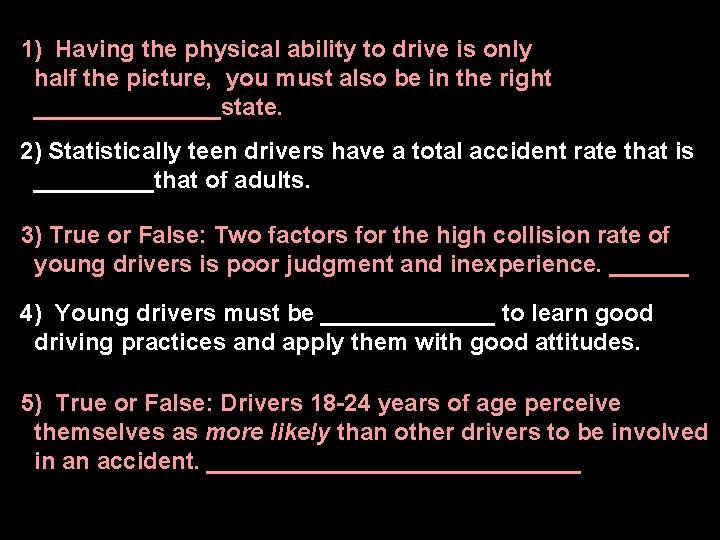
1) Having the physical ability to drive is only half the picture, you must also be in the right _______state. 2) Statistically teen drivers have a total accident rate that is _____that of adults. 3) True or False: Two factors for the high collision rate of young drivers is poor judgment and inexperience. ______ 4) Young drivers must be _______ to learn good driving practices and apply them with good attitudes. 5) True or False: Drivers 18 -24 years of age perceive themselves as more likely than other drivers to be involved in an accident. ______________
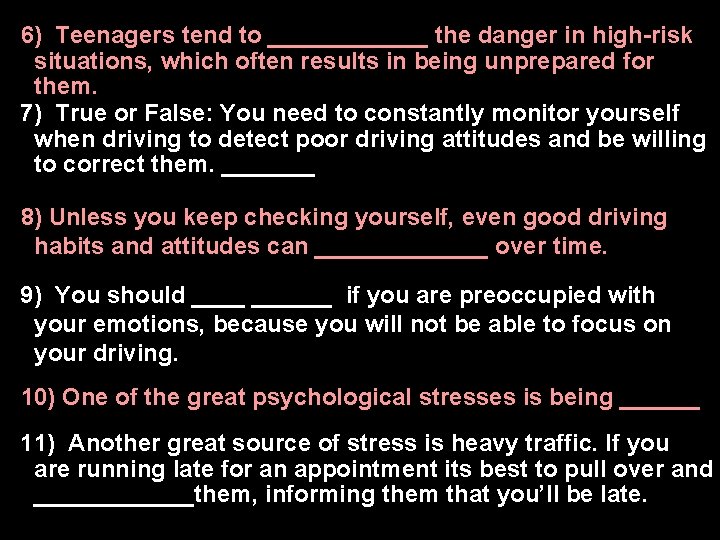
6) Teenagers tend to ______ the danger in high-risk situations, which often results in being unprepared for them. 7) True or False: You need to constantly monitor yourself when driving to detect poor driving attitudes and be willing to correct them. _______ 8) Unless you keep checking yourself, even good driving habits and attitudes can _______ over time. 9) You should ______ if you are preoccupied with your emotions, because you will not be able to focus on your driving. 10) One of the great psychological stresses is being ______ 11) Another great source of stress is heavy traffic. If you are running late for an appointment its best to pull over and ______them, informing them that you’ll be late.
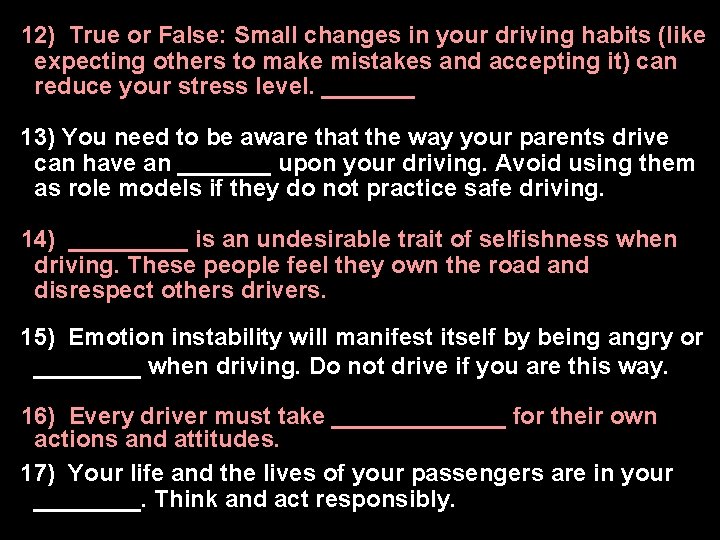
12) True or False: Small changes in your driving habits (like expecting others to make mistakes and accepting it) can reduce your stress level. _______ 13) You need to be aware that the way your parents drive can have an _______ upon your driving. Avoid using them as role models if they do not practice safe driving. 14) _____ is an undesirable trait of selfishness when driving. These people feel they own the road and disrespect others drivers. 15) Emotion instability will manifest itself by being angry or ____ when driving. Do not drive if you are this way. 16) Every driver must take _______ for their own actions and attitudes. 17) Your life and the lives of your passengers are in your ____. Think and act responsibly.
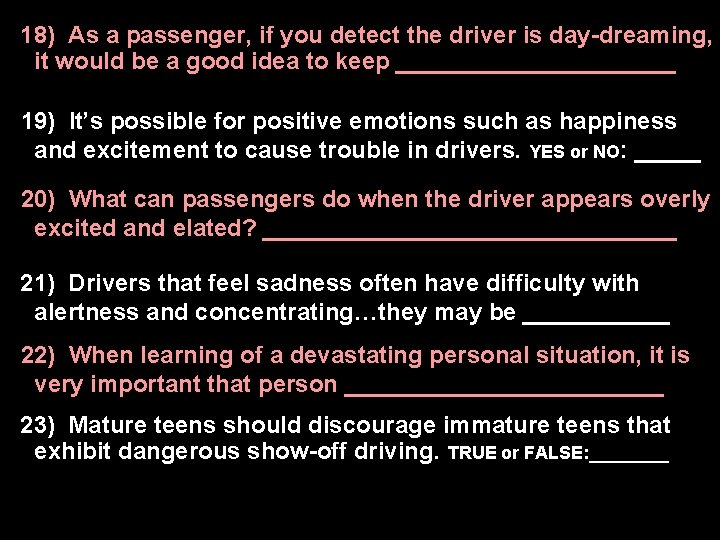
18) As a passenger, if you detect the driver is day-dreaming, it would be a good idea to keep ___________ 19) It’s possible for positive emotions such as happiness and excitement to cause trouble in drivers. YES or NO: _____ 20) What can passengers do when the driver appears overly excited and elated? ________________ 21) Drivers that feel sadness often have difficulty with alertness and concentrating…they may be ______ 22) When learning of a devastating personal situation, it is very important that person ____________ 23) Mature teens should discourage immature teens that exhibit dangerous show-off driving. TRUE or FALSE: ____
Driver Behaviour – Controlling Emotions The End Use Esc (escape key) to exit…if you have completed this lesson on the website…click Back Button twice to return to home page
Drivers Edge: Interactive slides and videos® Copyrighted Driver Education School Literature These electronic slide shows are produced by Inter. Active Enterprises. Microsoft Power. Point ® was used to create the presentations. Each segment includes discussion questions and may include illustrations, photographs, videos, animations, etc. Contact us at for more information at: 2183 Doctor Robertson Rd. Spring Hill, TN 37174 Email with suggestions, comments, questions or for more information. See other restrictions in regards to graphics as required by agreements with graphic providers. RESTRICTIONS: “This product/publication includes images from Microsoft Design Gallery, Animation Factory, Corel Mega. Gallery and Corel Gallery 1, 000 and Click Art which are protected by the copyright laws of the U. S. , Canada and elsewhere. Used under license. These images are for viewing purposes only in this series and may not be saved or downloaded for other uses. Other images used by permission are from: In-Motion magazine, General Motors; selected videos from the U. S. Dept. of Transportation (Moving Safely Across America) Many other images are from the public domain. A limited warranty or guarantee is in effect upon initial receipt of this product. Any defective product will be replaced upon notification within 90 days of receipt of product. Copyright © 2009 Inter. Active Enterprises iae@charter. net
- Slides: 51