
Driven to Adapt An Application of Adaptive Design
- Slides: 1
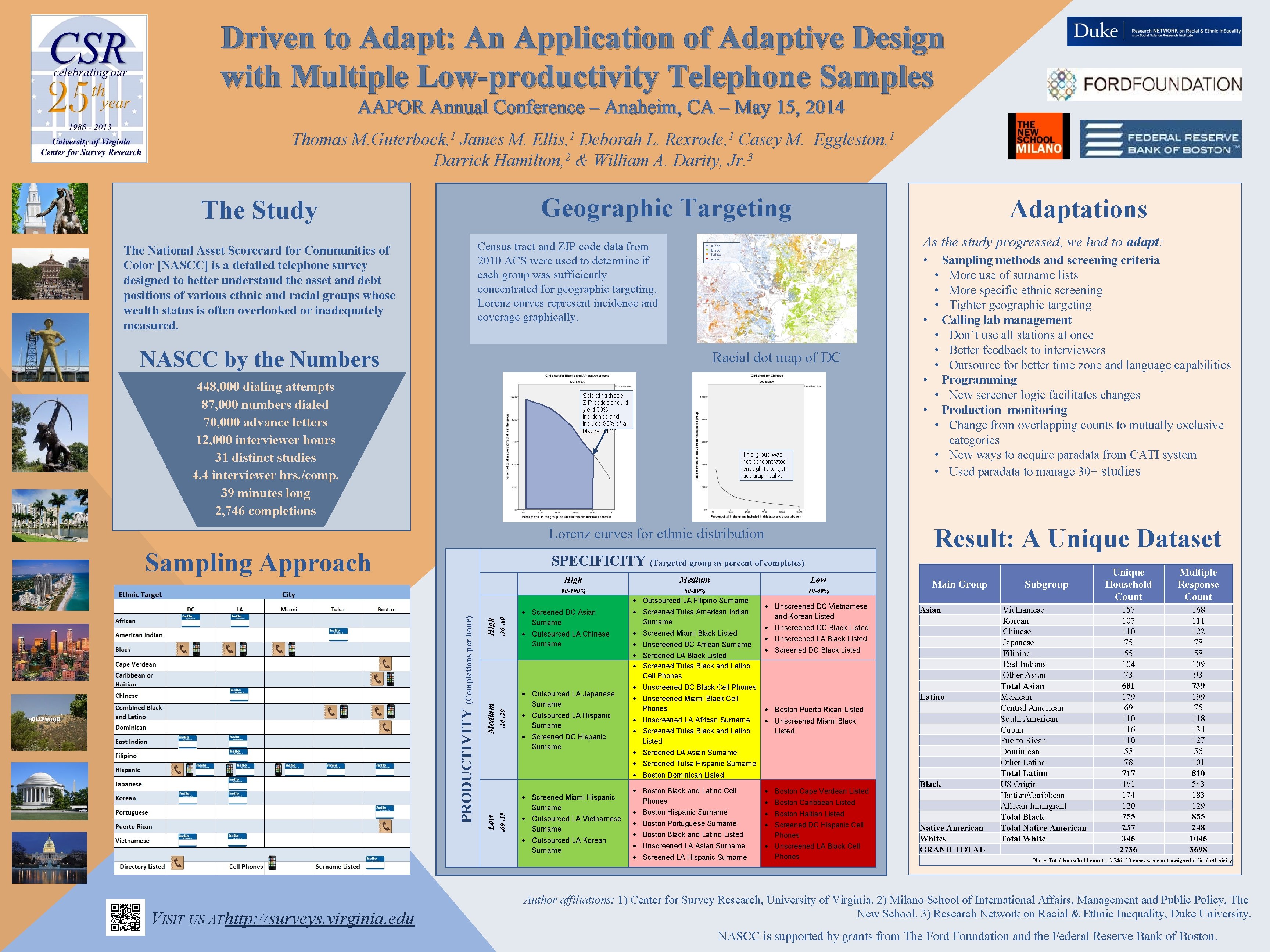
Driven to Adapt: An Application of Adaptive Design with Multiple Low-productivity Telephone Samples AAPOR Annual Conference – Anaheim, CA – May 15, 2014 Thomas M. Guterbock, 1 James M. Ellis, 1 Deborah L. Rexrode, 1 Casey M. Eggleston, 1 2 3 Darrick Hamilton, & William A. Darity, Jr. Geographic Targeting The Study Census tract and ZIP code data from 2010 ACS were used to determine if each group was sufficiently concentrated for geographic targeting. Lorenz curves represent incidence and coverage graphically. The National Asset Scorecard for Communities of Color [NASCC] is a detailed telephone survey designed to better understand the asset and debt positions of various ethnic and racial groups whose wealth status is often overlooked or inadequately measured. § § NASCC by the Numbers Adaptations As the study progressed, we had to adapt: White Black Latino Asian • Racial dot map of DC 448, 000 dialing attempts 87, 000 numbers dialed 70, 000 advance letters 12, 000 interviewer hours 31 distinct studies 4. 4 interviewer hrs. /comp. 39 minutes long 2, 746 completions Selecting these ZIP codes should yield 50% incidence and include 80% of all blacks in DC. This group was not concentrated enough to target geographically. Result: A Unique Dataset Lorenz curves for ethnic distribution Sampling Approach VISIT US AT http: //surveys. virginia. edu Low 90 -100% 50 -89% 10 -49% . 30 -. 60 Medium . 20 -. 29 High Screened DC Asian Surname Outsourced LA Chinese Surname Outsourced LA Japanese Surname Outsourced LA Hispanic Surname Screened DC Hispanic Surname . 00 -. 19 High Medium Low PRODUCTIVITY (Completions per hour) SPECIFICITY (Targeted group as percent of completes) Screened Miami Hispanic Surname Outsourced LA Vietnamese Surname Outsourced LA Korean Surname Outsourced LA Filipino Surname Screened Tulsa American Indian Surname Screened Miami Black Listed Unscreened DC African Surname Screened LA Black Listed Screened Tulsa Black and Latino Cell Phones Unscreened DC Black Cell Phones Unscreened Miami Black Cell Phones Unscreened LA African Surname Screened Tulsa Black and Latino Listed Screened LA Asian Surname Screened Tulsa Hispanic Surname Boston Dominican Listed Boston Black and Latino Cell Phones Boston Hispanic Surname Boston Portuguese Surname Boston Black and Latino Listed Unscreened LA Asian Surname Screened LA Hispanic Surname Sampling methods and screening criteria • More use of surname lists • More specific ethnic screening • Tighter geographic targeting • Calling lab management • Don’t use all stations at once • Better feedback to interviewers • Outsource for better time zone and language capabilities • Programming • New screener logic facilitates changes • Production monitoring • Change from overlapping counts to mutually exclusive categories • New ways to acquire paradata from CATI system • Used paradata to manage 30+ studies Unscreened DC Vietnamese and Korean Listed Unscreened DC Black Listed Unscreened LA Black Listed Screened DC Black Listed Main Group Asian Latino Boston Puerto Rican Listed Unscreened Miami Black Listed Boston Cape Verdean Listed Black Boston Caribbean Listed Boston Haitian Listed Screened DC Hispanic Cell Phones Unscreened LA Black Cell Phones Native American Whites GRAND TOTAL Subgroup Vietnamese Korean Chinese Japanese Filipino East Indians Other Asian Total Asian Mexican Central American South American Cuban Puerto Rican Dominican Other Latino Total Latino US Origin Haitian/Caribbean African Immigrant Total Black Total Native American Total White Unique Household Count Multiple Response Count 157 107 110 75 55 104 73 681 179 69 110 116 110 55 78 717 461 174 120 755 237 346 2736 168 111 122 78 58 109 93 739 199 75 118 134 127 56 101 810 543 183 129 855 248 1046 3698 Note: Total household count =2, 746; 10 cases were not assigned a final ethnicity. Author affiliations: 1) Center for Survey Research, University of Virginia. 2) Milano School of International Affairs, Management and Public Policy, The New School. 3) Research Network on Racial & Ethnic Inequality, Duke University. NASCC is supported by grants from The Ford Foundation and the Federal Reserve Bank of Boston.