
Drive Laser Introduction ir master oscillator power amplifier
- Slides: 7
Drive Laser Introduction • ‘ir’ master oscillator power amplifier chain (MOPA) uses standard chirped pulse amplification scheme (CPA) • third harmonic generation (THG) produces required uv for photocathode irradiation • ‘ir’ master oscillator is a mode-locked source which is locked to external RF • Finesse and Reliability are key – stabilities and shaping • readily accommodate technical upgrades
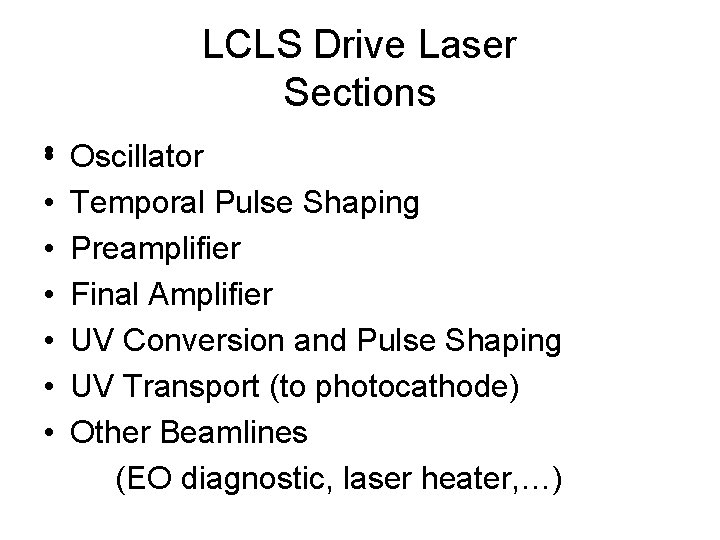
LCLS Drive Laser Sections • • Oscillator Temporal Pulse Shaping Preamplifier Final Amplifier UV Conversion and Pulse Shaping UV Transport (to photocathode) Other Beamlines (EO diagnostic, laser heater, …)
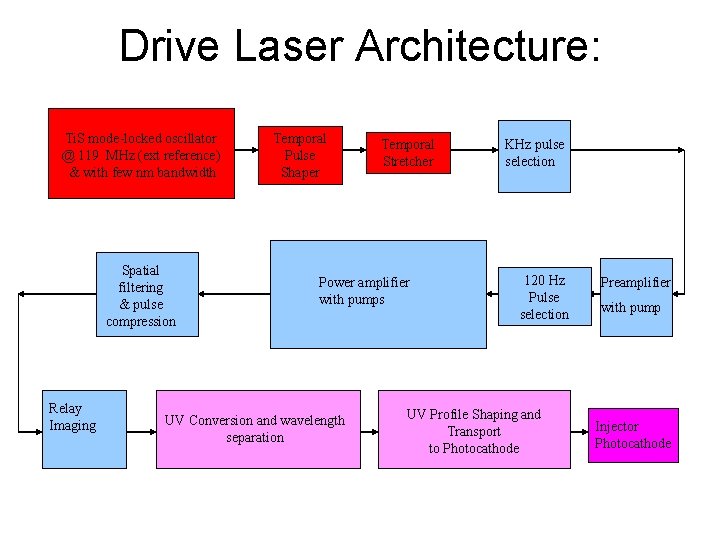
Drive Laser Architecture: Ti. S mode-locked oscillator @ 119 MHz (ext reference) & with few nm bandwidth Spatial filtering & pulse compression Relay Imaging Temporal Pulse Shaper Temporal Stretcher Power amplifier with pumps UV Conversion and wavelength separation KHz pulse selection 120 Hz Pulse selection UV Profile Shaping and Transport to Photocathode Preamplifier with pump Injector Photocathode
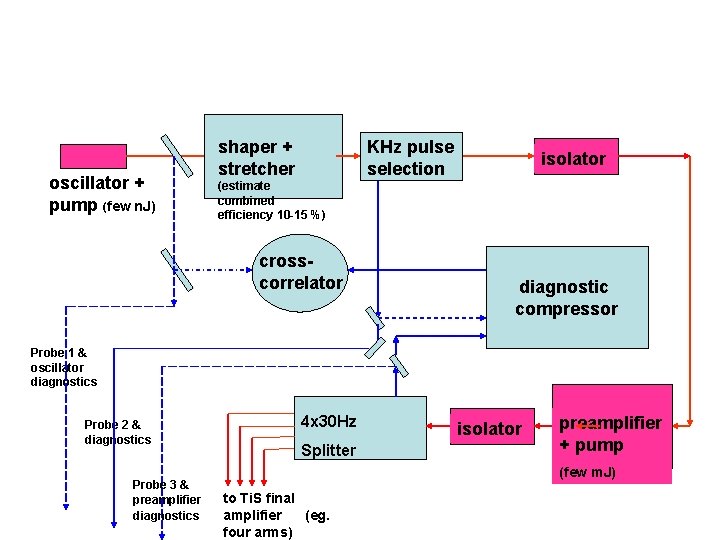
oscillator + pump (few n. J) shaper + stretcher KHz pulse selection isolator (estimate combined efficiency 10 -15 %) crosscorrelator diagnostic compressor Probe 1 & oscillator diagnostics Probe 2 & diagnostics Probe 3 & preamplifier diagnostics 4 x 30 Hz Splitter isolator preamplifier + pump (few m. J) to Ti. S final amplifier (eg. four arms)
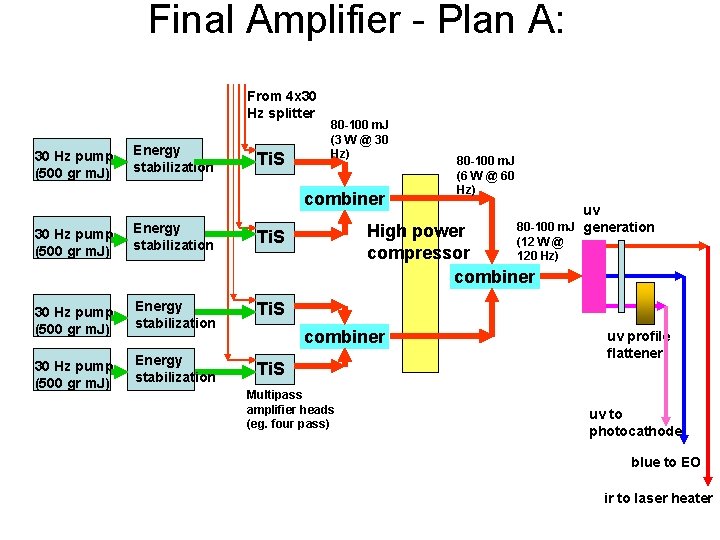
Final Amplifier - Plan A: From 4 x 30 Hz splitter 30 Hz pump (500 gr m. J) Energy stabilization Ti. S 80 -100 m. J (3 W @ 30 Hz) combiner 30 Hz pump (500 gr m. J) Energy stabilization Ti. S 80 -100 m. J (6 W @ 60 Hz) uv 80 -100 m. J generation High power (12 W @ compressor 120 Hz) combiner Multipass amplifier heads (eg. four pass) uv profile flattener uv to photocathode blue to EO ir to laser heater
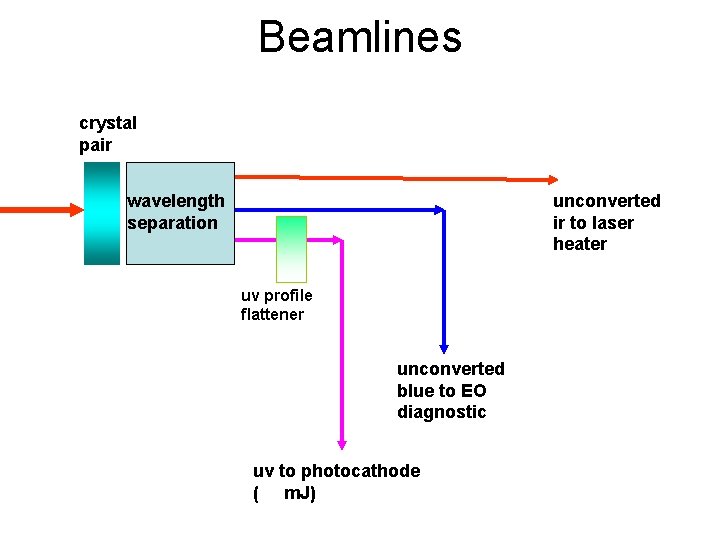
Beamlines crystal pair wavelength separation unconverted ir to laser heater uv profile flattener unconverted blue to EO diagnostic uv to photocathode ( m. J)
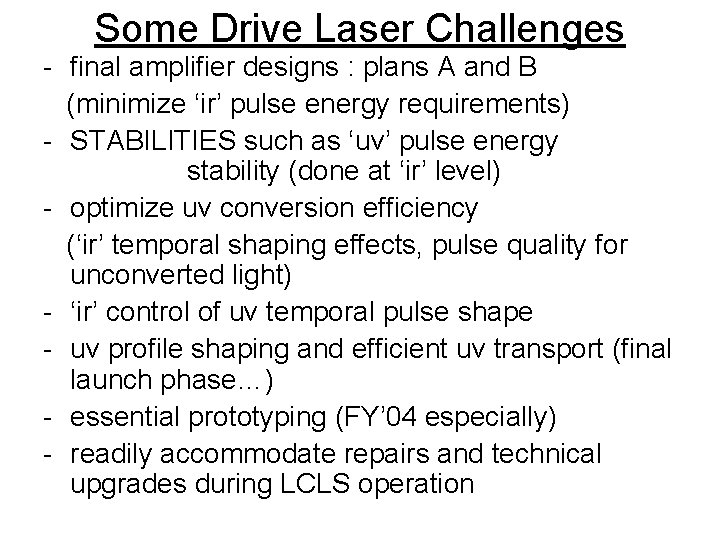
Some Drive Laser Challenges - final amplifier designs : plans A and B (minimize ‘ir’ pulse energy requirements) - STABILITIES such as ‘uv’ pulse energy stability (done at ‘ir’ level) - optimize uv conversion efficiency (‘ir’ temporal shaping effects, pulse quality for unconverted light) - ‘ir’ control of uv temporal pulse shape - uv profile shaping and efficient uv transport (final launch phase…) - essential prototyping (FY’ 04 especially) - readily accommodate repairs and technical upgrades during LCLS operation