
Drink Driver Rehabilitation and New Developments Dr Gavan
Drink Driver Rehabilitation and New Developments Dr Gavan Palk, Ms Michelle Fitts, Dr Hollie Wilson, Prof Mary Sheehan, Dr Darren Wishart, & Ms Susan Taylor. ACRS Conference October 2015 CRICOS No. 00213 J
Overview • Background to the drink driving problem • State by State overview of drink driving rehabilitation program in Australia • Overview of “Under The Limit” • New developments in Queensland • Online first offender program • Indigenous drink driving program • Revised Under the Limit program • Conclusions & future implications
Background • Safe Systems Approach has contributed to significant reductions in fatalities although serious injury has increased in most Australian jurisdictions • Drink driving continues to be a major public health concern • Drink driving rehabilitation programs that use a combination of deterrence, education and social control models have been moderately successful in reducing recidivism. • Limitations of current programs are they do not adequately address alcohol related health concerns or the needs of drink drivers in remote and rural areas • Scant attention has been given to brief online drink driving interventions
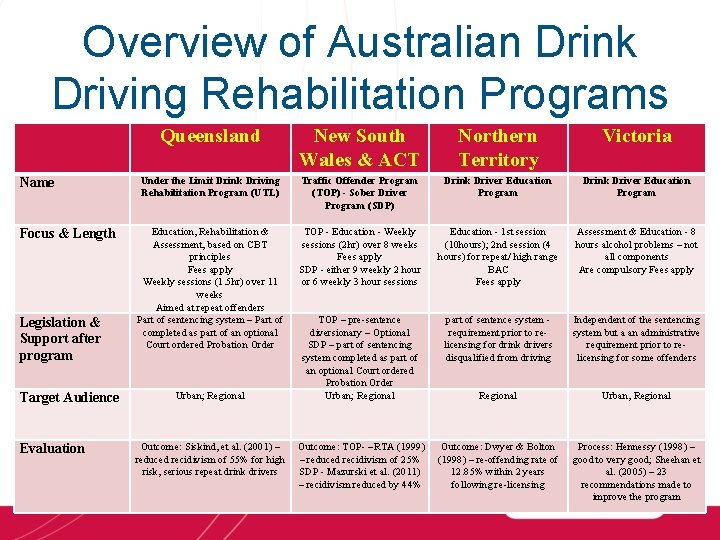
Overview of Australian Drink Driving Rehabilitation Programs Name Focus & Length Legislation & Support after program Target Audience Evaluation Queensland New South Wales & ACT Northern Territory Victoria Under the Limit Drink Driving Rehabilitation Program (UTL) Traffic Offender Program (TOP) - Sober Driver Program (SDP) Drink Driver Education Program Education, Rehabilitation & Assessment, based on CBT principles Fees apply Weekly sessions (1. 5 hr) over 11 weeks Aimed at repeat offenders Part of sentencing system – Part of completed as part of an optional Court ordered Probation Order TOP Education Weekly sessions (2 hr) over 8 weeks Fees apply SDP either 9 weekly 2 hour or 6 weekly 3 hour sessions Education 1 st session (10 hours); 2 nd session (4 hours) for repeat/ high range BAC Fees apply Assessment & Education 8 hours alcohol problems – not all components Are compulsory Fees apply TOP – pre sentence diversionary – Optional SDP – part of sentencing system completed as part of an optional Court ordered Probation Order Urban; Regional part of sentence system requirement prior to re licensing for drink drivers disqualified from driving Independent of the sentencing system but a an administrative requirement prior to re licensing for some offenders Regional Urban, Regional Outcome: TOP –RTA (1999) – reduced recidivism of 25% SDP Mazurski et al. (2011) – recidivism reduced by 44% Outcome: Dwyer & Bolton (1998) – re offending rate of 12. 85% within 2 years following re licensing Process: Hennessy (1998) – good to very good; Sheehan et al. (2005) – 23 recommendations made to improve the program Urban; Regional Outcome: Siskind, et al. (2001) – reduced recidivism of 55% for high risk, serious repeat drink drivers
Theoretical Frameworks • Majority of programs informed by – Theory of Planned Behaviour (Ajzen, 1991; Ajzen, & Fishbein, 2005), – Trans-theoretical stages of change (Prochaska, Di. Clementa, & Norcross, 1992) – Elements of deterrence theory (Homel, 1988) – Social control models (Sheehan, 1994).
Under the limit • Under the Limit drink driving rehabilitation program’ (UTL) – – initially trialled in the early 1990 s been operating in excess of 20 years Over 12, 000 drink drivers have completed the UTL Program is largely used as a post-sentencing option for high range (BAC ≥ 0. 15 g/m. L) first offenders and repeat drink drivers – Eleven sessions of 1½ hours duration conducted in groups of 8 to 10
New Developments in Qld • Steering Clear – First Offender Drink Driving program – Online – Brief intervention • Hero to Healing – Indigenous program • Revised UTL – 6 week face to face
Current outcomes • Steering Clear – currently being trialled and initial feedback has been positive efficacy unknown at this stage • Hero to Healing – Feedback from participating trial communities about the content and delivery style has been positive and effectiveness will be explored in the program’s next planned phase • Revised UTL – Implemented an evaluation framework for this program is currently under development.
Conclusions • The Integral Role of Education in Road Safety • Multicomponent Approach & the Value of Coercion • Evaluations difficulties & best practice valuation frameworks • Contemporary, best practice evidence & high quality delivery • Catering for a variety of subgroups –culturally meaningful • The value of online brief interventions • Legislation to mandate drink driving rehabilitation programs
Questions? [gavan. palk@qut. edu. au] Mark your Diaries! Sixth International Conference on Traffic & Transport Psychology 2 -5 August 2016 Brisbane, Australia http: //icttp 2016. com/ CRICOS No. 00213 J
- Slides: 10