
Drilling and Blasting Toolbox Talk 03 Updated Aug
Drilling and Blasting Toolbox Talk : 03 Updated Aug 2014 Blast Site Edge Protection Information on the use of edge protection systems in the blasting area Target Audience Any person likely to be working in the blasting area and those supervising such operations. This toolbox talk may be freely reproduced except for advertising, endorsement or commercial purposes. It has been developed by the Quarries National Joint Advisory Committee (QNJAC) to help quarry operators, contractors, managers and others make health and safety improvements in the quarry industry. This guidance represents good practice which may go further than the minimum you need to do to comply with the law. If you use the information provided in this document please acknowledge ‘QNJAC’ as the source. Slide of 14
Blast site edge protection 1 : Introduction • • Lives have been lost in the past through falls from quarry faces. Thankfully this is now very rare mainly due to control measures introduced to prevent it. This toolbox talk is designed to help the industry to reduce further the likelihood of these incidents. In deciding what are the most suitable control measures for any particular circumstance, account needs to be taken of both the Quarries Regulations 1999 and the Work at Height Regulations 2005. Slide 2 of 14
Blast site edge protection 2 : Managing the Risk • The Operator is responsible for Health and Safety on site including all drilling and blasting activities – This includes the design, construction and provision of blast site edge protection • Blast site activities include – Surveying, marking out, drilling, loading and firing • It is therefore very important to carry out a site specific risk assessment including all the personnel likely to be involved in the blasting operation – For Example • Driller, Shotfirer, Explosives Supervisor, Quarry Manager • Bulk explosive supplier, Geotechnical Consultant Slide 3 of 14
Blast site edge protection 2 : Managing the Risk • The following topics should be considered as a minimum in a risk assessment – Prevention of personnel and equipment from falling over the edge – The site geology and stability of the face. – Access to the blast site for drill rig, delivery of stemming, explosives delivery vehicles, bulk explosive trucks and emergency vehicles. – Blast design parameters Such as spacing, burden, etc – Profiling and surveying operations – Weather conditions Slide 4 of 14
Blast site edge protection 2 : Managing the Risk • The Work at Height hierarchy should be followed in selecting the method used: - – Collective measures should be given priority over personal protective measures. Physical barriers such as the safety bund and post and strap should be considered first – Where the use of physical barriers creates an unacceptable risk then other measures such as delineation of the danger zone or harnesses should be considered – The Quarry operator should be able to show that they have considered how a fall from an open edge will be prevented for that particular shot. Slide 5 of 14
Blast site edge protection 3 : Protection Methods • Safety Bund – Advantages • Provides protection for people • Does not need removing before blast – Disadvantages • Can cover up bad edge conditions – A safe system of work needs to be established detailing how such bunds put in place • Requires the movement of mobile plant close to the crest Slide 6 of 14
Blast site edge protection 3 : Protection Methods • Safety Bund – How high do the bunds need to be ? – People only on the blast area • Not less than 1 m • In this case a second bund will be required behind the blast to prevent vehicles from encroaching – Vehicles operating on the blast area • A minimum of 1. 5 m or the radius of the largest vehicle wheel Slide 7 of 14
Blast site edge protection 3 : Protection Methods (continued) • Post and Strap – Designed to prevent personnel from accidentally approaching the edge – Advantages • Acts as a physical barrier to prevent personnel from falling over face – Disadvantages • Barrier will not prevent machinery from falling over face • Requires a drill rig to approach the edge to drill post holes • Placing and removal of system requires personnel to approach the edge – Normally this will require the use of an additional fall prevention system • Removal of system can result in the initiation system being disturbed with the potential for misfires Slide 8 of 14

Blast site edge protection 3 : Protection Methods (continued) • Post and Strap – Bad Practice Only a single strap has been used ! ! Slide 9 of 14 Worse than useless as the protection has been placed such that the face edge comes inside the protection
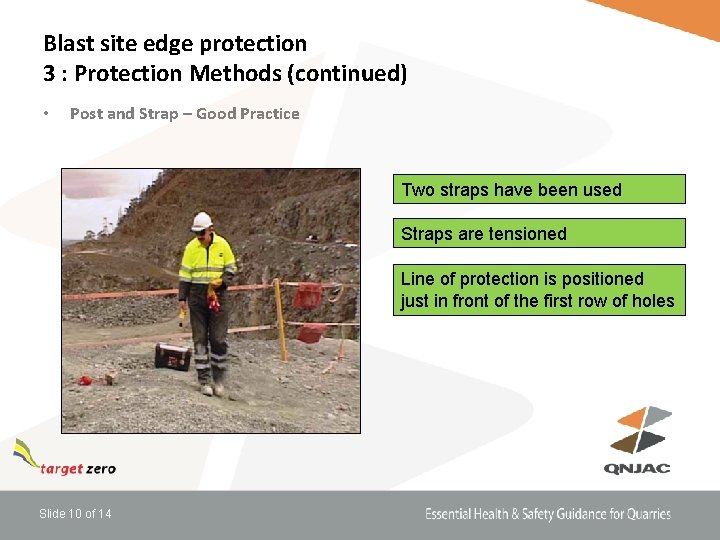
Blast site edge protection 3 : Protection Methods (continued) • Post and Strap – Good Practice Two straps have been used Straps are tensioned Line of protection is positioned just in front of the first row of holes Slide 10 of 14
Blast site edge protection 3 : Protection Methods (continued) • Stand-off Distance – In this case workers may not approach within a specified distance to an unprotected edge – The distance needs to be well delineated with some form of barrier • Good example is when used with cones and rope – This system needs to be well supervised – Advantages • No need for the drill rig to approach the bench edge • Can easily be removed before the blast – Disadvantages • Does not prevent either people or equipment from falling over face Slide 11 of 14
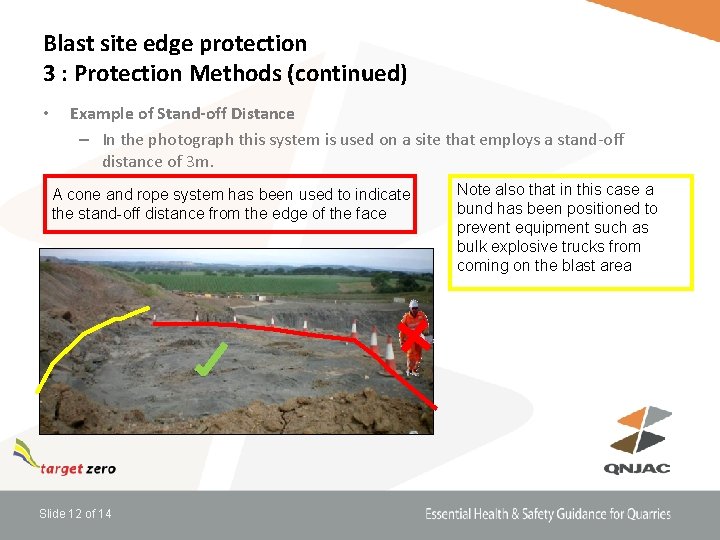
Blast site edge protection 3 : Protection Methods (continued) • Example of Stand-off Distance – In the photograph this system is used on a site that employs a stand-off distance of 3 m. A cone and rope system has been used to indicate the stand-off distance from the edge of the face Slide 12 of 14 Note also that in this case a bund has been positioned to prevent equipment such as bulk explosive trucks from coming on the blast area
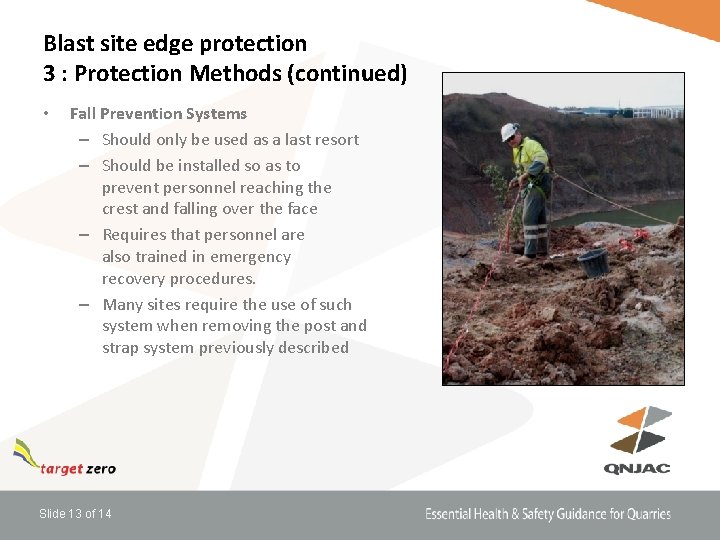
Blast site edge protection 3 : Protection Methods (continued) • Fall Prevention Systems – Should only be used as a last resort – Should be installed so as to prevent personnel reaching the crest and falling over the face – Requires that personnel are also trained in emergency recovery procedures. – Many sites require the use of such system when removing the post and strap system previously described Slide 13 of 14
Blast Site Edge Protection 4 : Key Points • Edge protection is required for all blast areas • Each blast should be separately assessed to determine suitable protection measures for that location • A single edge protection system may not be universally appropriate • If you think the edge protection is inadequate STOP WORK and inform your supervisor Slide 14 of 14
- Slides: 14