
Drill Copy down the definition Scanning a Poem
- Slides: 14
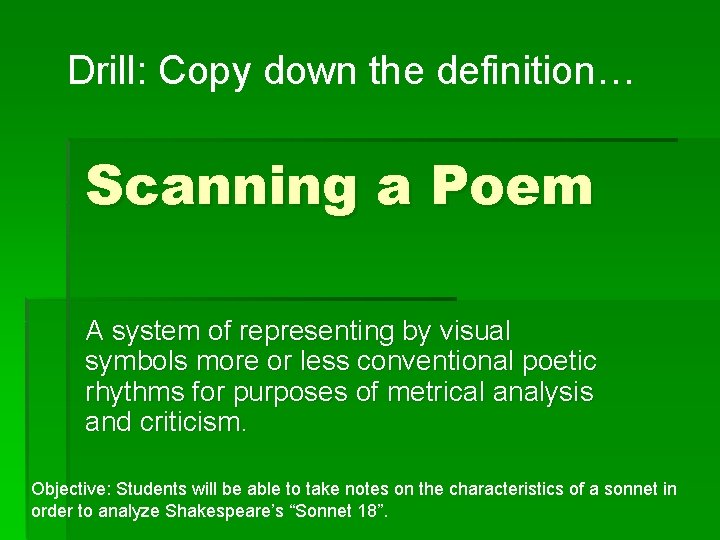
Drill: Copy down the definition… Scanning a Poem A system of representing by visual symbols more or less conventional poetic rhythms for purposes of metrical analysis and criticism. Objective: Students will be able to take notes on the characteristics of a sonnet in order to analyze Shakespeare’s “Sonnet 18”.
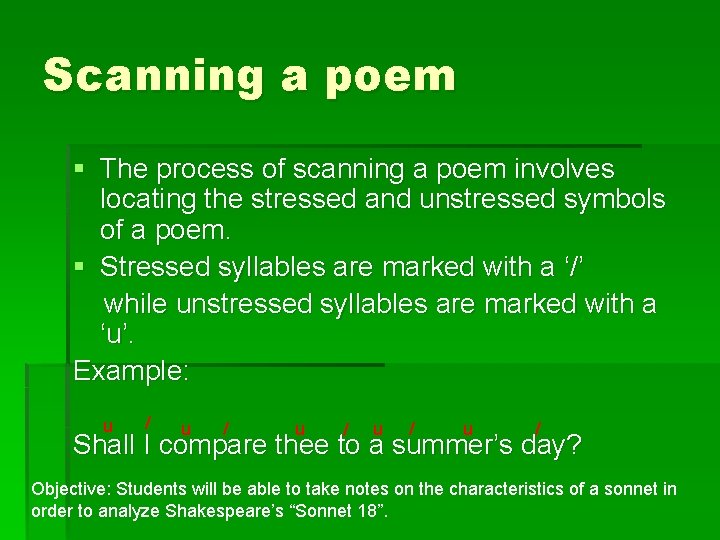
Scanning a poem § The process of scanning a poem involves locating the stressed and unstressed symbols of a poem. § Stressed syllables are marked with a ‘/’ while unstressed syllables are marked with a ‘u’. Example: u / u / u / Shall I compare thee to a summer’s day? Objective: Students will be able to take notes on the characteristics of a sonnet in order to analyze Shakespeare’s “Sonnet 18”.
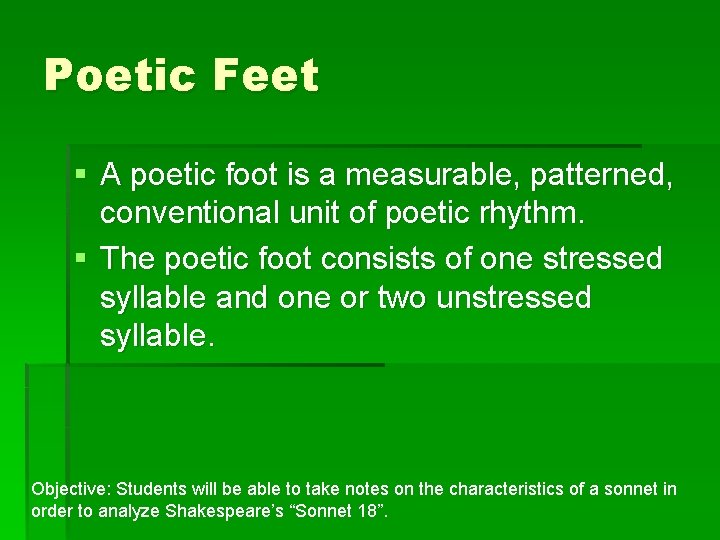
Poetic Feet § A poetic foot is a measurable, patterned, conventional unit of poetic rhythm. § The poetic foot consists of one stressed syllable and one or two unstressed syllable. Objective: Students will be able to take notes on the characteristics of a sonnet in order to analyze Shakespeare’s “Sonnet 18”.
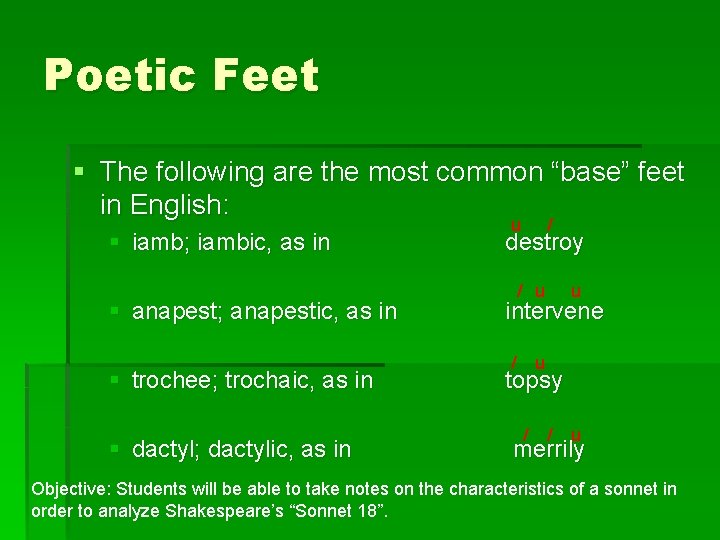
Poetic Feet § The following are the most common “base” feet in English: § iamb; iambic, as in § anapest; anapestic, as in § trochee; trochaic, as in § dactyl; dactylic, as in u / destroy / u u intervene / u topsy / / u merrily Objective: Students will be able to take notes on the characteristics of a sonnet in order to analyze Shakespeare’s “Sonnet 18”.
Recurrent Patterns § Certain poems are based on a recurrent pattern of poetic feet in each line. Objective: Students will be able to take notes on the characteristics of a sonnet in order to analyze Shakespeare’s “Sonnet 18”.
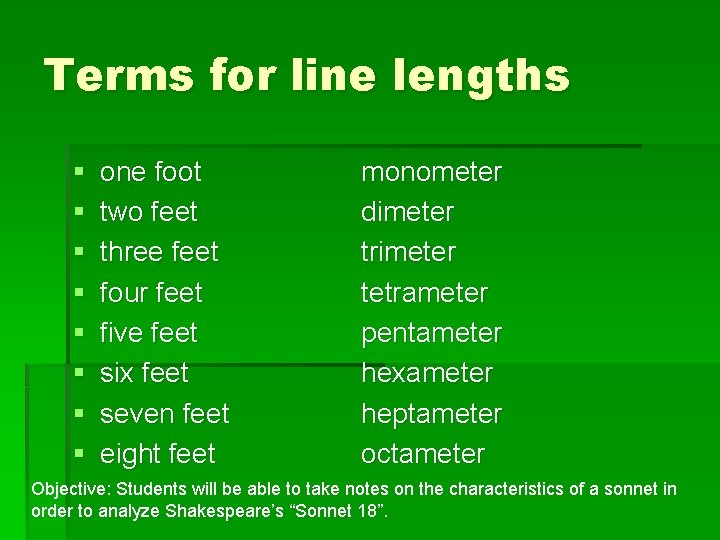
Terms for line lengths § § § § one foot two feet three feet four feet five feet six feet seven feet eight feet monometer dimeter trimeter tetrameter pentameter hexameter heptameter octameter Objective: Students will be able to take notes on the characteristics of a sonnet in order to analyze Shakespeare’s “Sonnet 18”.
Identifying Poetic Rhythm § Certain styles of poetry have the same number of poetic feet in each line, giving the poem a consistent rhythm. § An example would be the sonnet. Every sonnet is written in iambic pentameter, or there are five iambs per line. Objective: Students will be able to take notes on the characteristics of a sonnet in order to analyze Shakespeare’s “Sonnet 18”.
The Sonnet § There are three major styles of sonnets: § Shakespearean: originated by the English poet, William Shakespeare. § Petrarchean: originated by the Italian poet, Petrarch. § Spencerean, adapted from the Shakespearean sonnets by Edmund Spencer. Objective: Students will be able to take notes on the characteristics of a sonnet in order to analyze Shakespeare’s “Sonnet 18”.
The Sonnet § The sonnet is always written in iambic pentameter. § The sonnet is typically 14 lines long. § The rhyme scheme depends on the style of sonnet that the poem is written. Objective: Students will be able to take notes on the characteristics of a sonnet in order to analyze Shakespeare’s “Sonnet 18”.
The Sonnet § Petrachean: § Divided into two parts: § An eight line section called the octave, with rhyme scheme: abba § Followed by a six line section called the sestet, with rhyme scheme: cdecde or cdcdcd. § The octave establishes the speaker’s situation and the sestet resolves, draws conclusions about, or expresses a reaction to the situation. § Example: PAGE 400 Objective: Students will be able to take notes on the characteristics of a sonnet in order to analyze Shakespeare’s “Sonnet 18”.
The Sonnet § Shakespearean § Contains three quatrains, or set of four lines, followed by a final couplet, or set of two rhyming lines. § The rhyme scheme is: § Quatrain #1: abab § Quatrain #2: cdcd § Quatrain #3: efef § Couplet: gg Objective: Students will be able to take notes on the characteristics of a sonnet in order to analyze Shakespeare’s “Sonnet 18”.
The Sonnet § Shakespearean cont. § The logical organization varies, but often, the turn or shift in focus or thought begins in the beginning of the third quatrain at line 9. Objective: Students will be able to take notes on the characteristics of a sonnet in order to analyze Shakespeare’s “Sonnet 18”.
Analyzing Shakespeare’s Sonnets § Class work: § Read Shakespeare’s 18 th sonnet as a class. (page 391 of the green textbook) § Individually, paraphrase three quatrains and the final couplet. § Example: § § Quatrain one: Quatrain two: Quatrain three: Couplet: Objective: Students will be able to take notes on the characteristics of a sonnet in order to analyze Shakespeare’s “Sonnet 18”.
Analyzing Shakespeare’s Sonnets § Answer the following questions: § Where does the turn or shift in the speaker’s thought or focus occur in this poem? § What inferences can you make about the speaker based on the turn? § What is Shakespeare implying about the tradition of love poetry? § How does the rhythm of the sonnet add to its theme? Objective: Students will be able to take notes on the characteristics of a sonnet in order to analyze Shakespeare’s “Sonnet 18”.