
DRILL Calculate ac Fc of a 25 kg


- Slides: 48
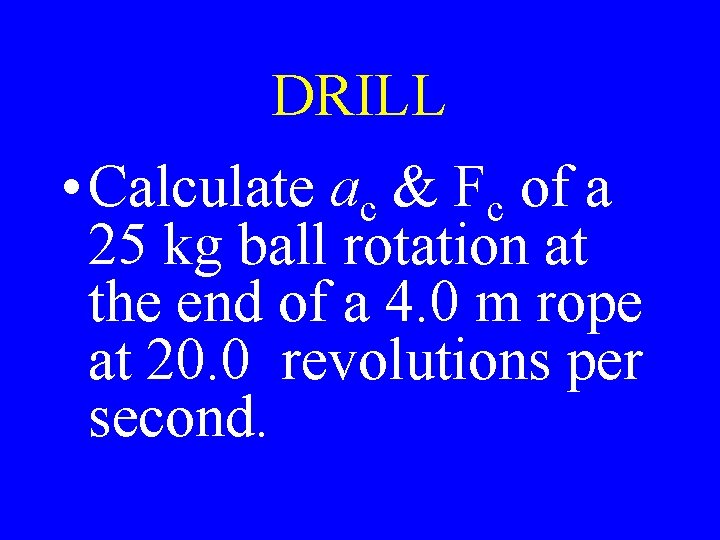
DRILL • Calculate ac & Fc of a 25 kg ball rotation at the end of a 4. 0 m rope at 20. 0 revolutions per second.
Momentum & Its Conservation
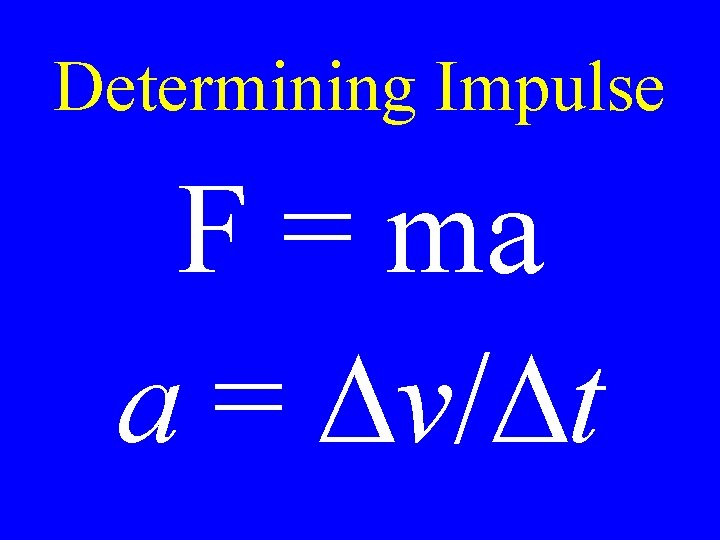
Determining Impulse F = ma a = Dv/Dt
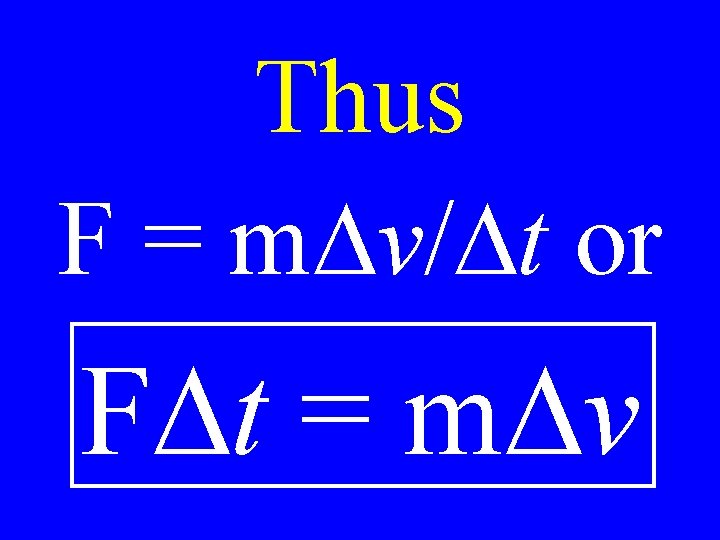
Thus F = m. Dv/Dt or FDt = m. Dv
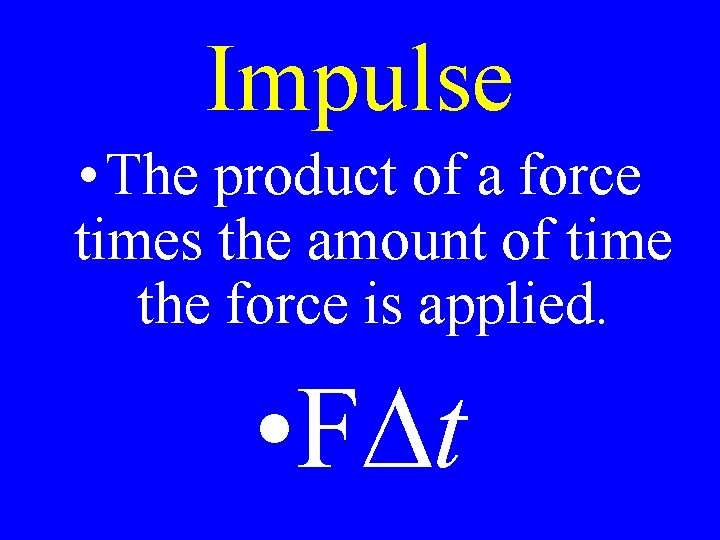
Impulse • The product of a force times the amount of time the force is applied. • FDt
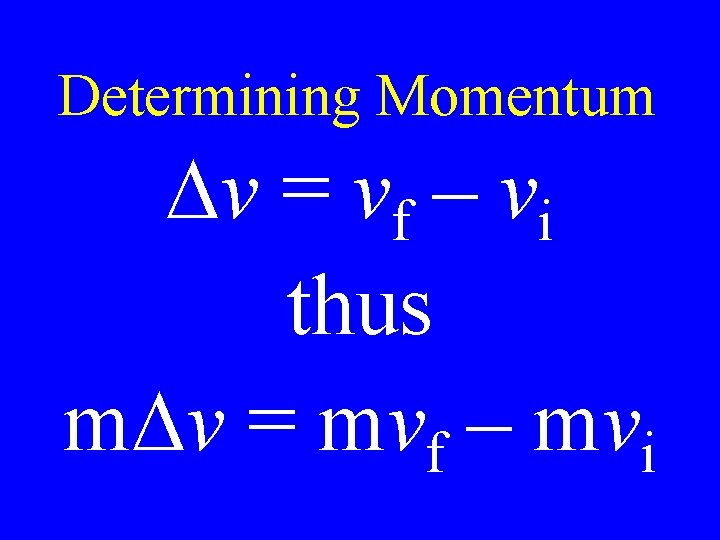
Determining Momentum Dv = vf – vi thus m. Dv = mvf – mvi
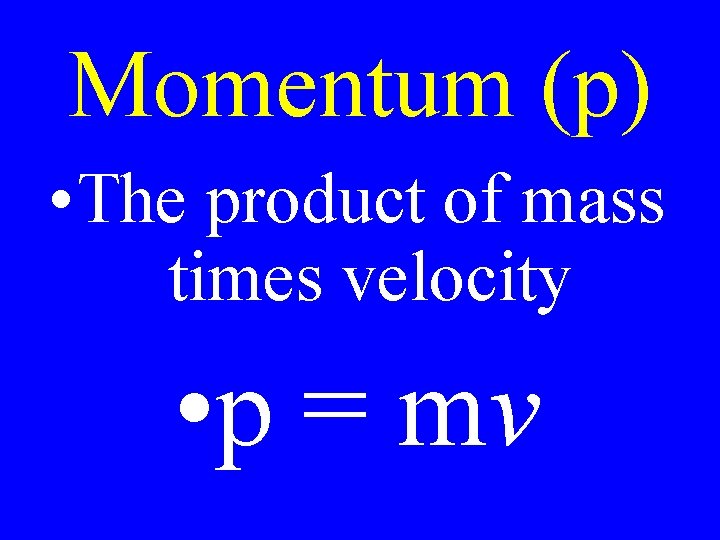
Momentum (p) • The product of mass times velocity • p = mv
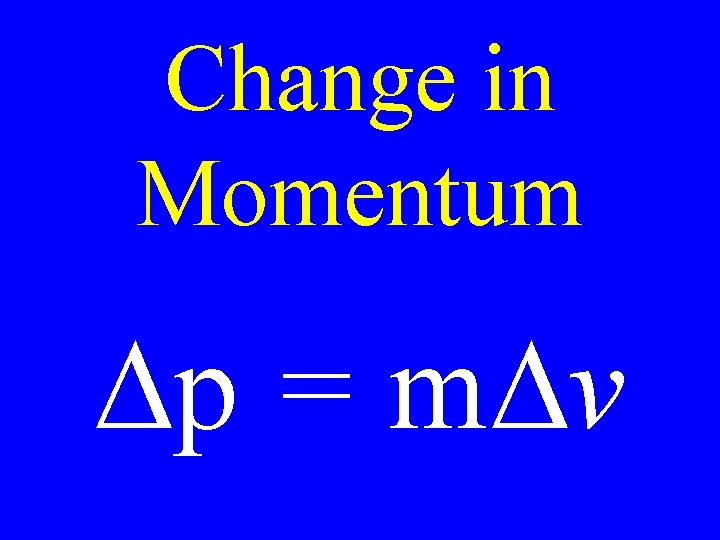
Change in Momentum Dp = m. Dv
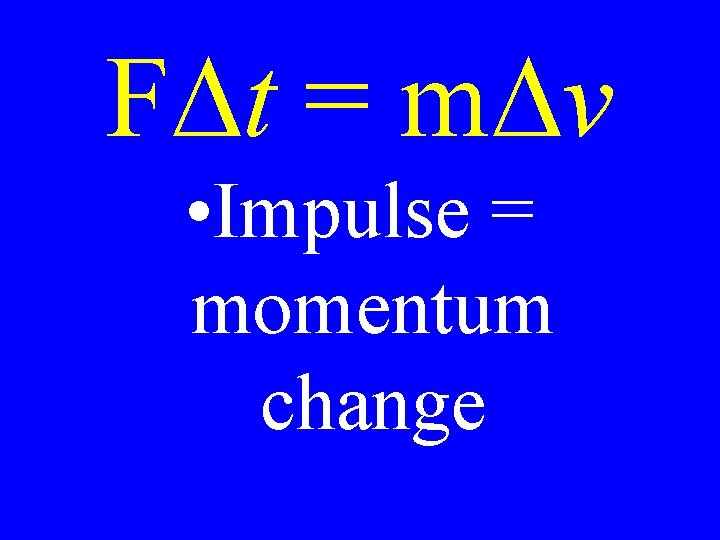
FDt = m. Dv • Impulse = momentum change
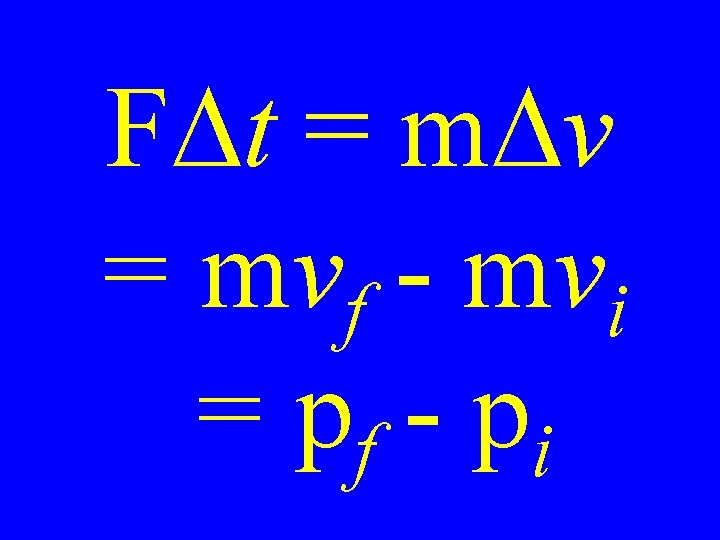
FDt = m. Dv = mvf - mvi = pf - pi
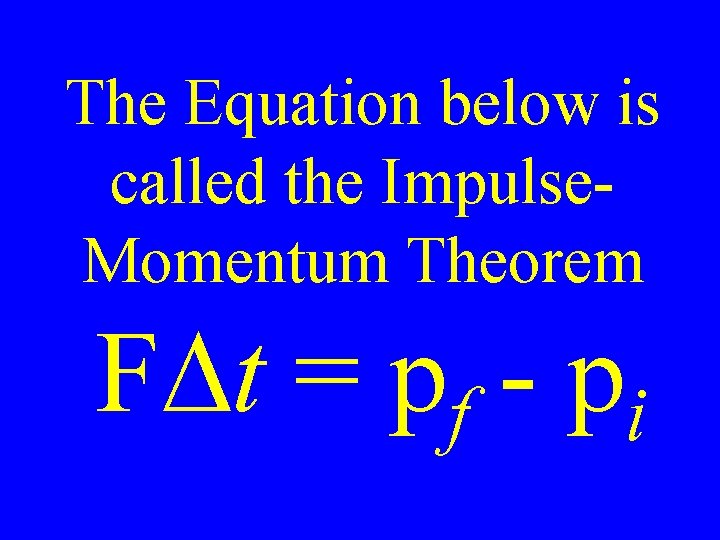
The Equation below is called the Impulse. Momentum Theorem FDt = pf - pi
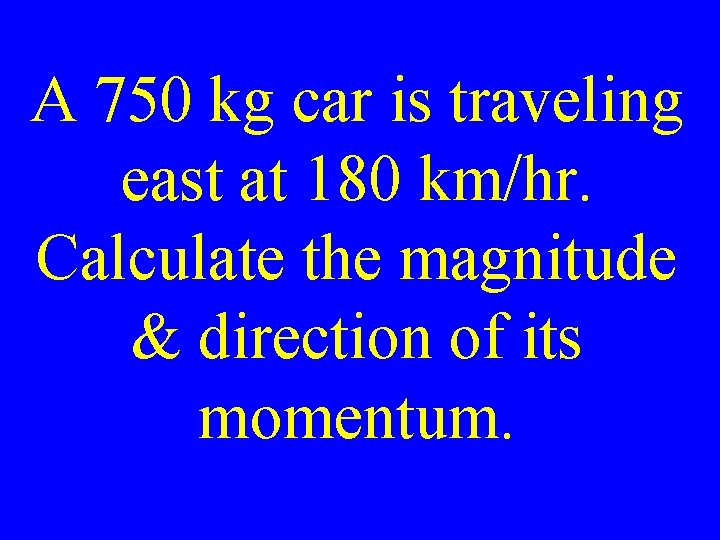
A 750 kg car is traveling east at 180 km/hr. Calculate the magnitude & direction of its momentum.
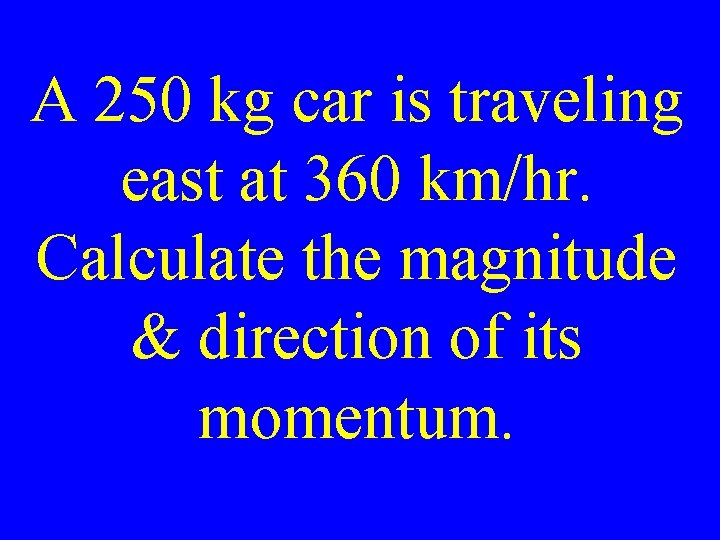
A 250 kg car is traveling east at 360 km/hr. Calculate the magnitude & direction of its momentum.
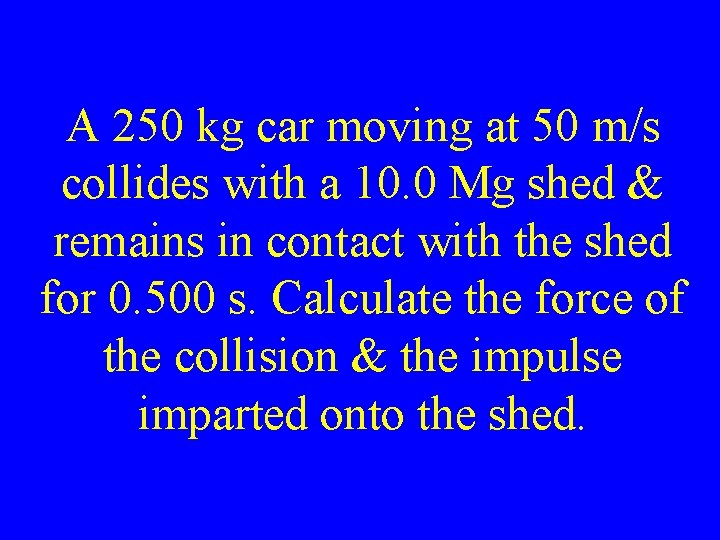
A 250 kg car moving at 50 m/s collides with a 10. 0 Mg shed & remains in contact with the shed for 0. 500 s. Calculate the force of the collision & the impulse imparted onto the shed.
CLASSWORK • Complete the worksheet • Will be collected at the end of the period.
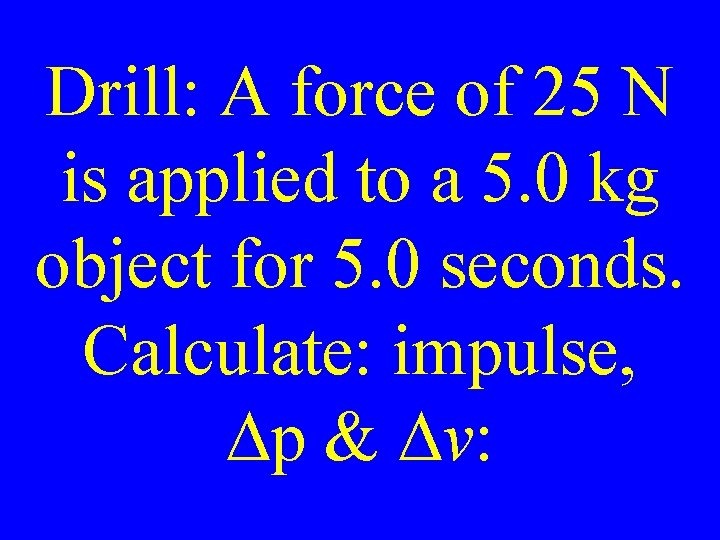
Drill: A force of 25 N is applied to a 5. 0 kg object for 5. 0 seconds. Calculate: impulse, Dp & Dv:
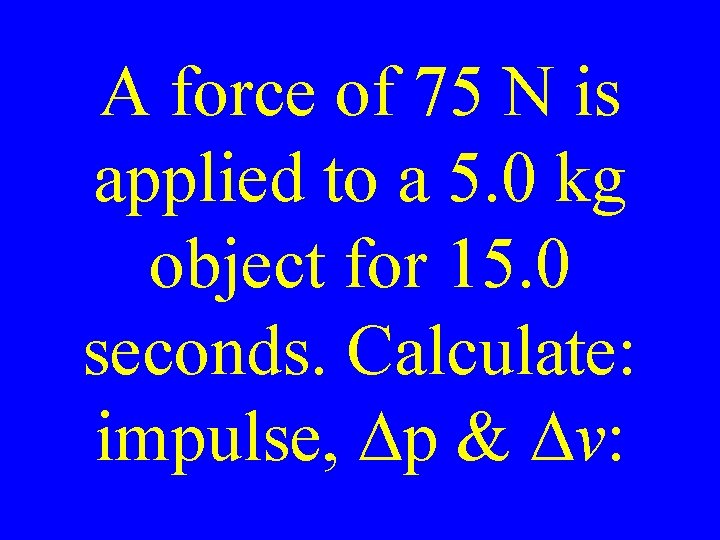
A force of 75 N is applied to a 5. 0 kg object for 15. 0 seconds. Calculate: impulse, Dp & Dv:
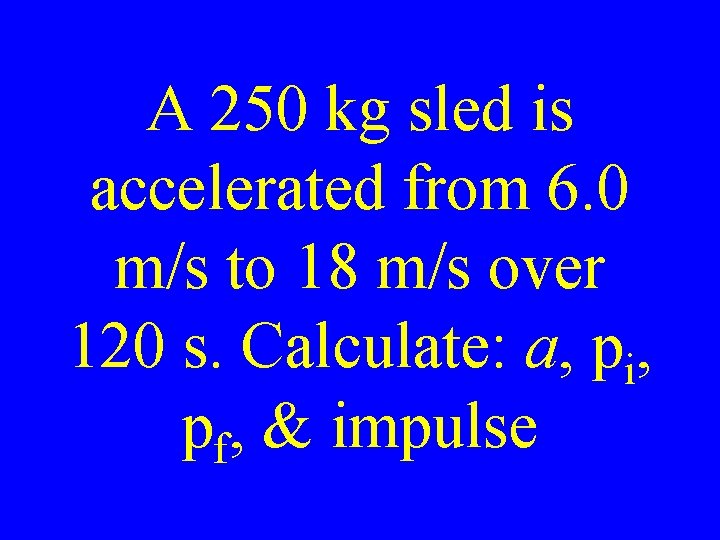
A 250 kg sled is accelerated from 6. 0 m/s to 18 m/s over 120 s. Calculate: a, pi, pf, & impulse
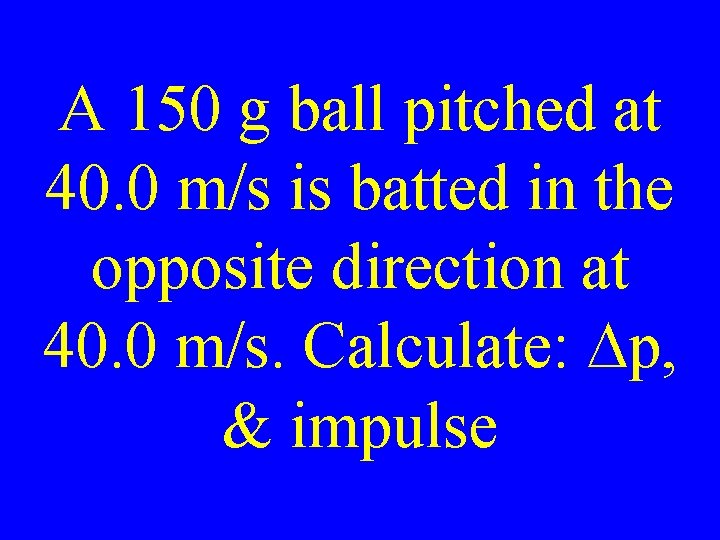
A 150 g ball pitched at 40. 0 m/s is batted in the opposite direction at 40. 0 m/s. Calculate: Dp, & impulse
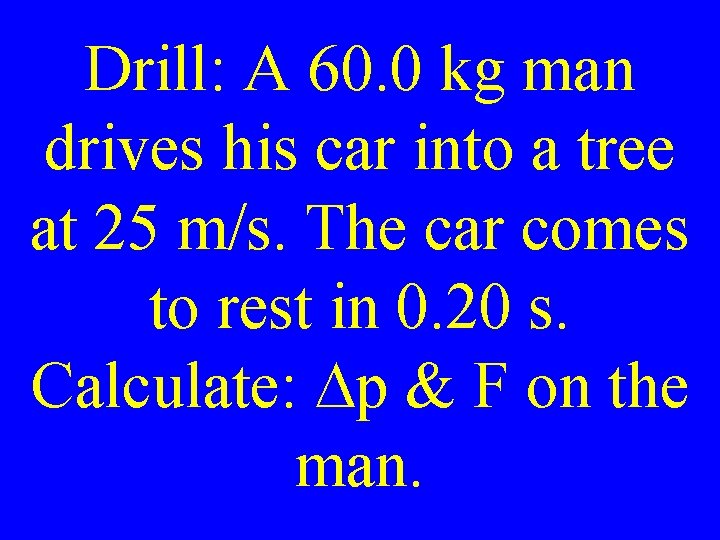
Drill: A 60. 0 kg man drives his car into a tree at 25 m/s. The car comes to rest in 0. 20 s. Calculate: Dp & F on the man.
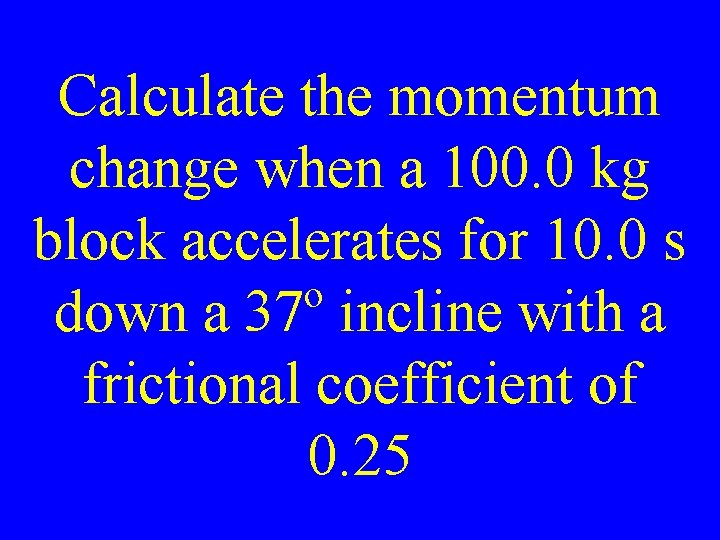
Calculate the momentum change when a 100. 0 kg block accelerates for 10. 0 s o down a 37 incline with a frictional coefficient of 0. 25
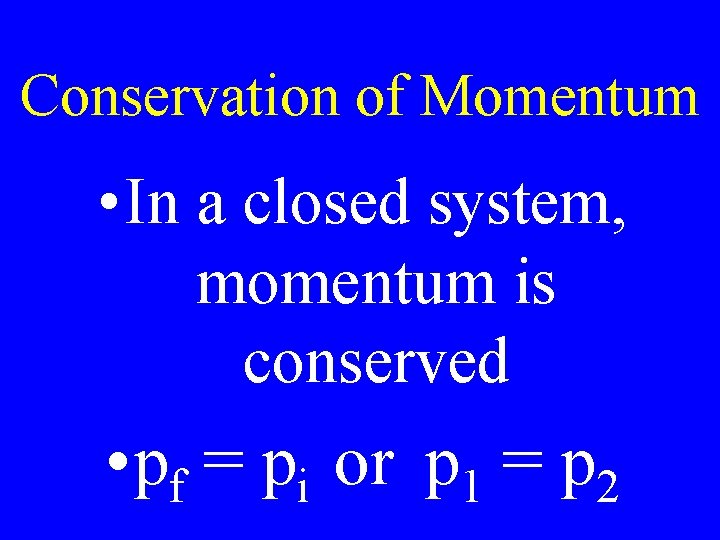
Conservation of Momentum • In a closed system, momentum is conserved • pf = pi or p 1 = p 2
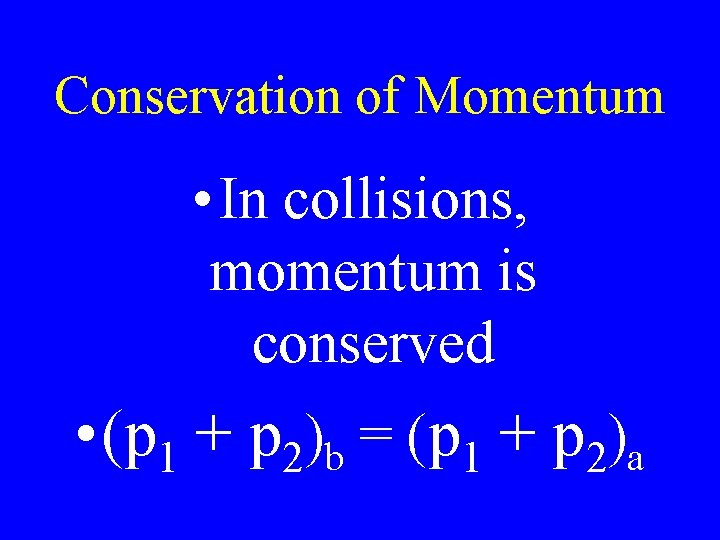
Conservation of Momentum • In collisions, momentum is conserved • (p 1 + p 2)b = (p 1 + p 2)a
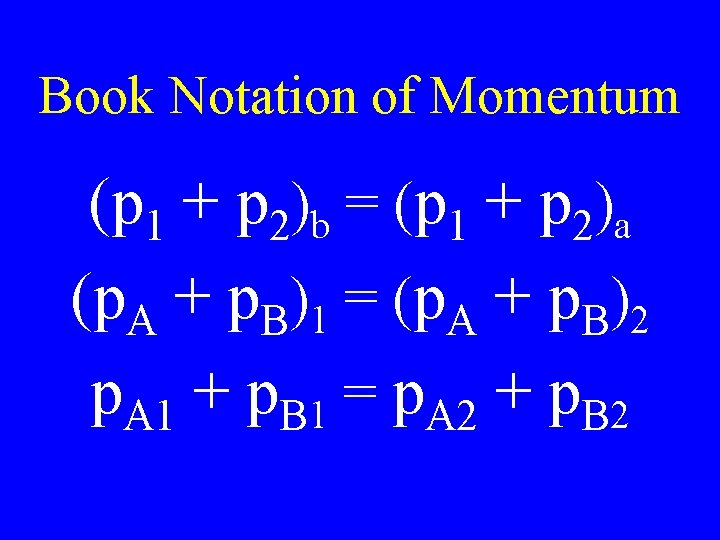
Book Notation of Momentum (p 1 + p 2)b = (p 1 + p 2)a (p. A + p. B)1 = (p. A + p. B)2 p. A 1 + p. B 1 = p. A 2 + p. B 2
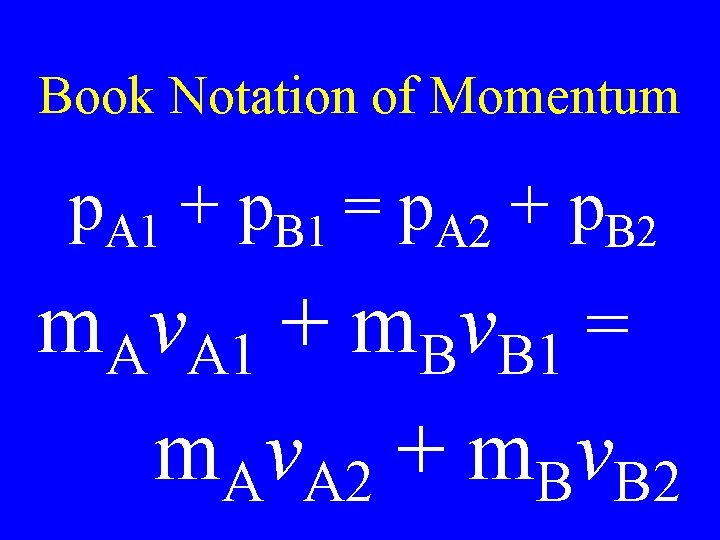
Book Notation of Momentum p. A 1 + p. B 1 = p. A 2 + p. B 2 m. Av. A 1 + m. Bv. B 1 = m. Av. A 2 + m. Bv. B 2
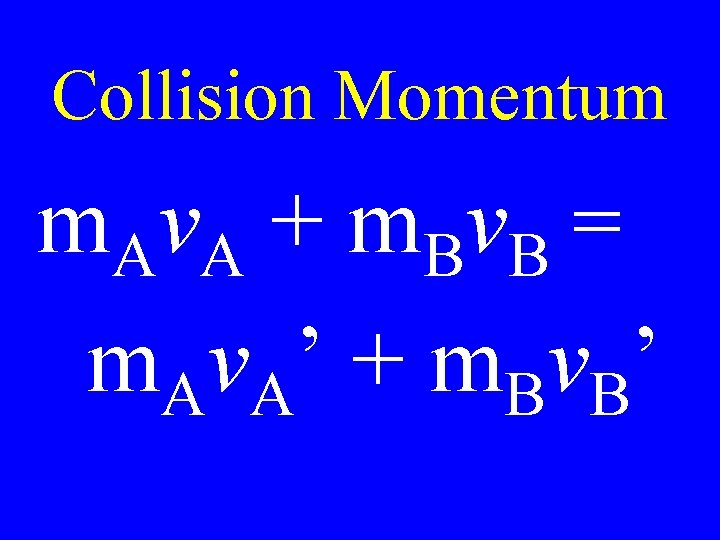
Collision Momentum m Av A + m B v B = m Av A’ + m B v B ’
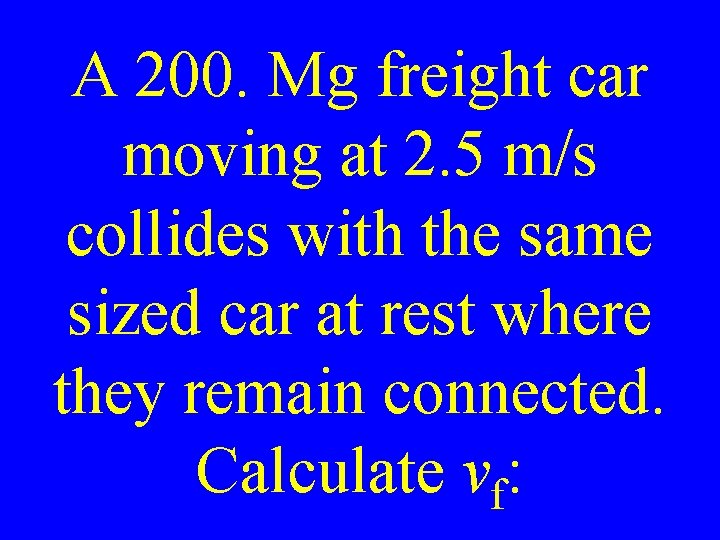
A 200. Mg freight car moving at 2. 5 m/s collides with the same sized car at rest where they remain connected. Calculate vf:
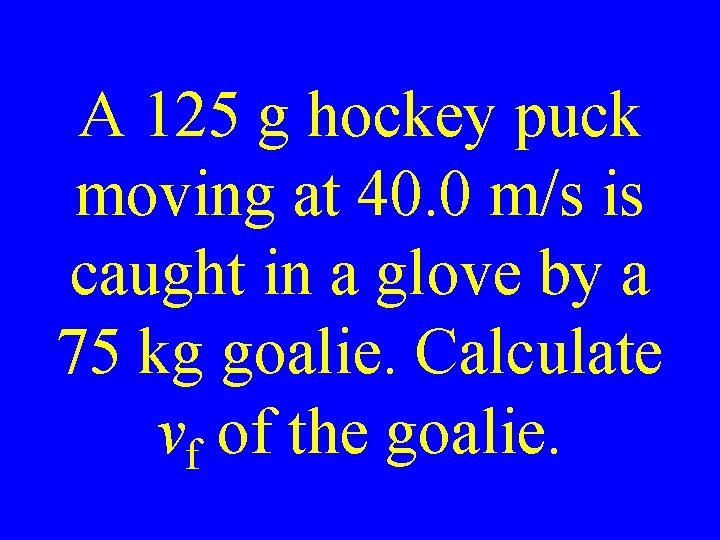
A 125 g hockey puck moving at 40. 0 m/s is caught in a glove by a 75 kg goalie. Calculate vf of the goalie.
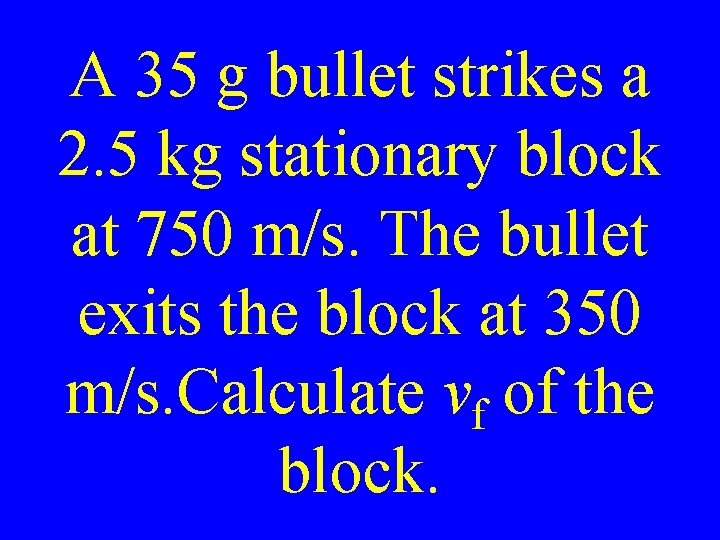
A 35 g bullet strikes a 2. 5 kg stationary block at 750 m/s. The bullet exits the block at 350 m/s. Calculate vf of the block.
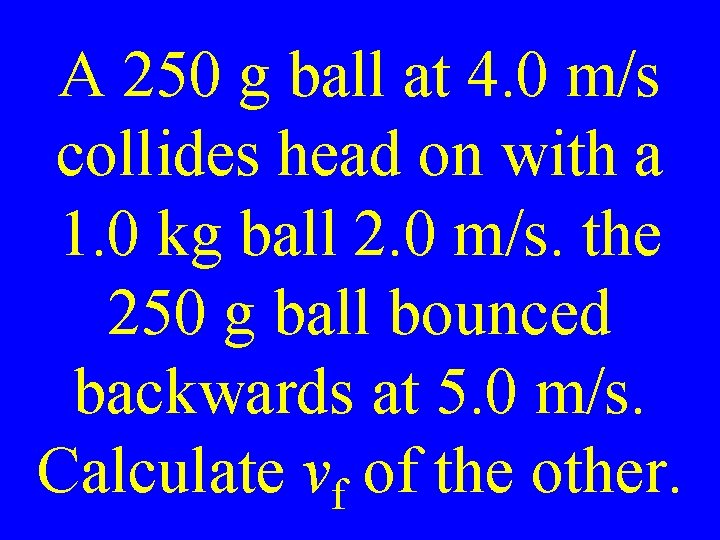
A 250 g ball at 4. 0 m/s collides head on with a 1. 0 kg ball 2. 0 m/s. the 250 g ball bounced backwards at 5. 0 m/s. Calculate vf of the other.
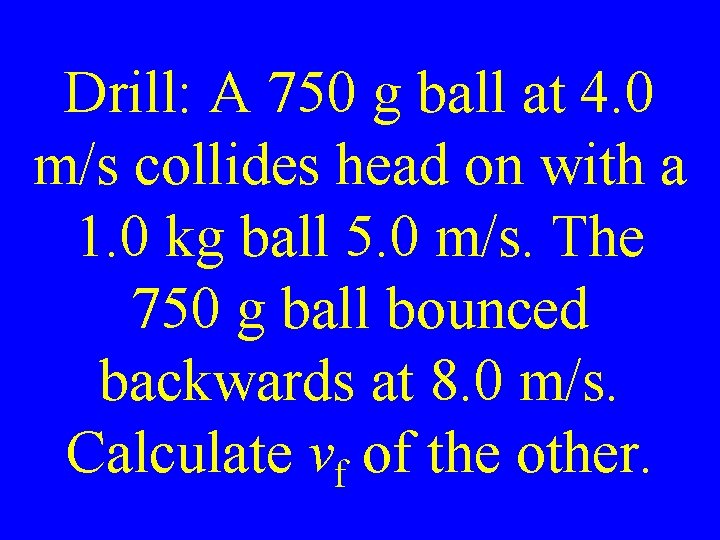
Drill: A 750 g ball at 4. 0 m/s collides head on with a 1. 0 kg ball 5. 0 m/s. The 750 g ball bounced backwards at 8. 0 m/s. Calculate vf of the other.
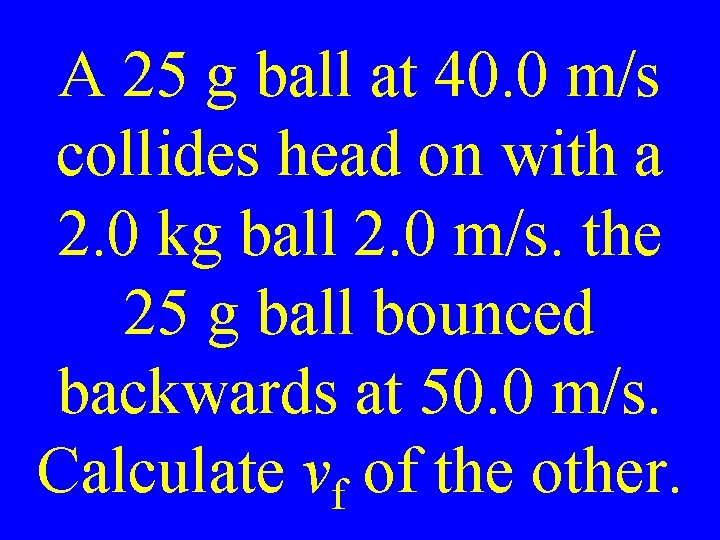
A 25 g ball at 40. 0 m/s collides head on with a 2. 0 kg ball 2. 0 m/s. the 25 g ball bounced backwards at 50. 0 m/s. Calculate vf of the other.
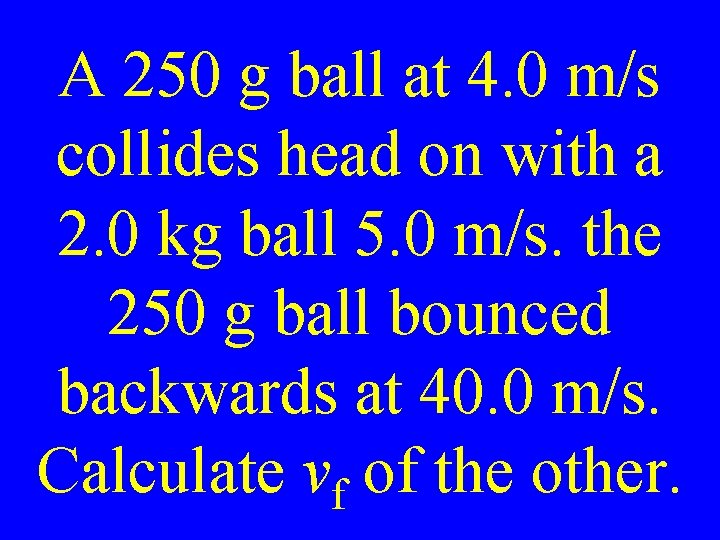
A 250 g ball at 4. 0 m/s collides head on with a 2. 0 kg ball 5. 0 m/s. the 250 g ball bounced backwards at 40. 0 m/s. Calculate vf of the other.
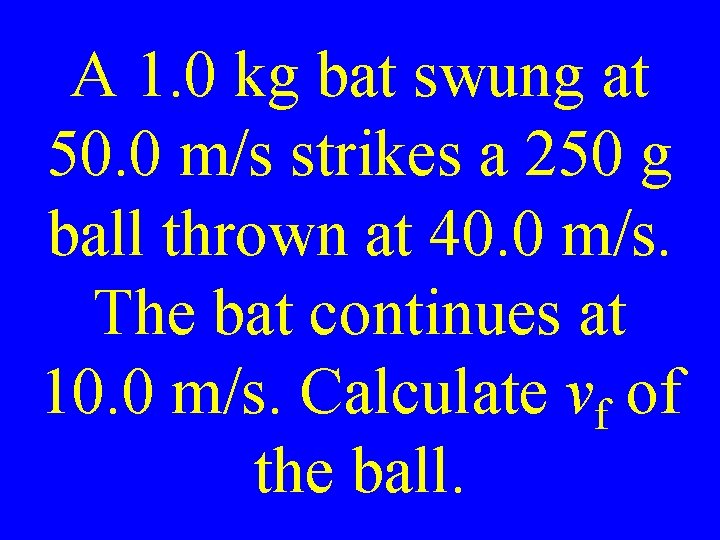
A 1. 0 kg bat swung at 50. 0 m/s strikes a 250 g ball thrown at 40. 0 m/s. The bat continues at 10. 0 m/s. Calculate vf of the ball.
Explosion Momentum • The momentum before the explosion must = the momentum after the explosion. • The momentum before the explosion = 0
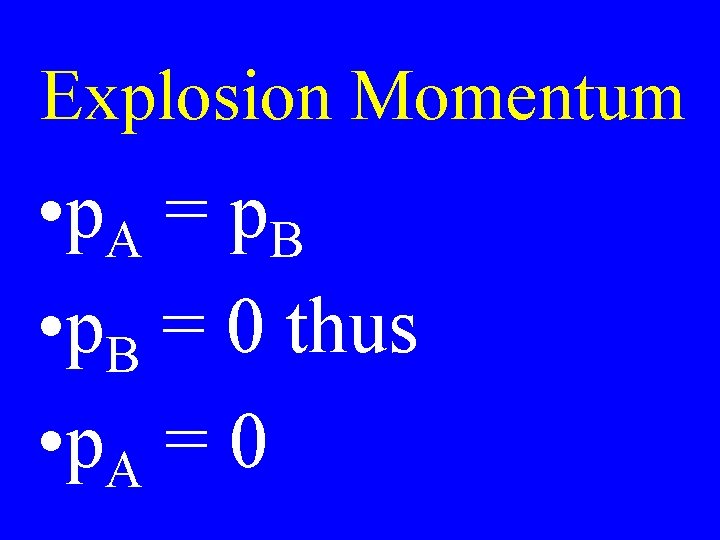
Explosion Momentum • p. A = p. B • p. B = 0 thus • p. A = 0
Explosion Momentum • The summation of all parts after the explosion = 0
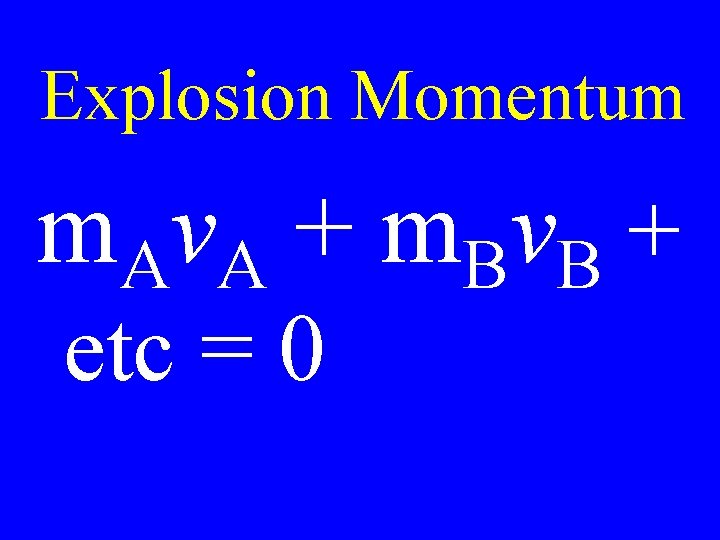
Explosion Momentum m Av A + m B v B + etc = 0
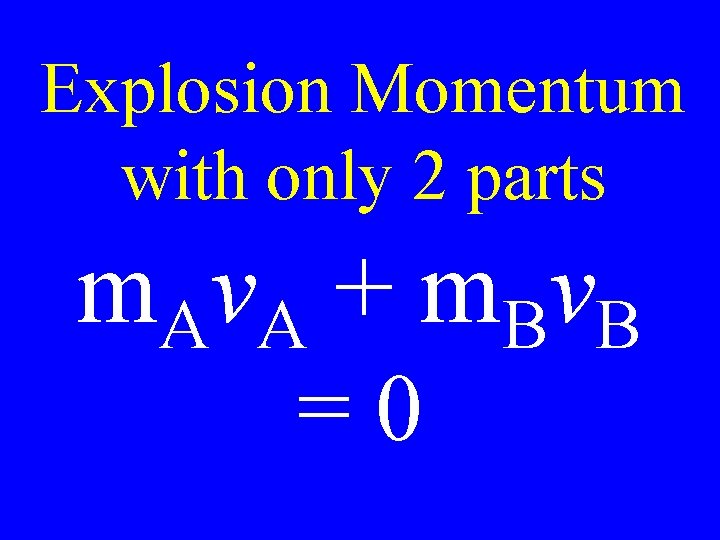
Explosion Momentum with only 2 parts m Av A + m B v B =0
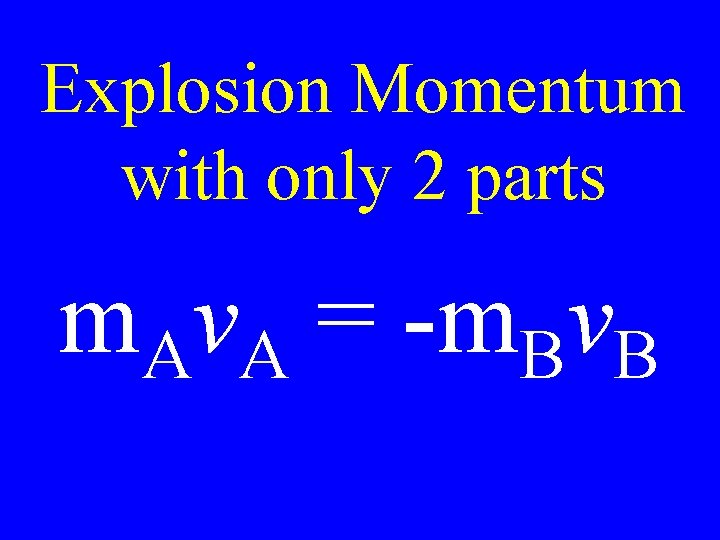
Explosion Momentum with only 2 parts m. Av. A = -m. Bv. B
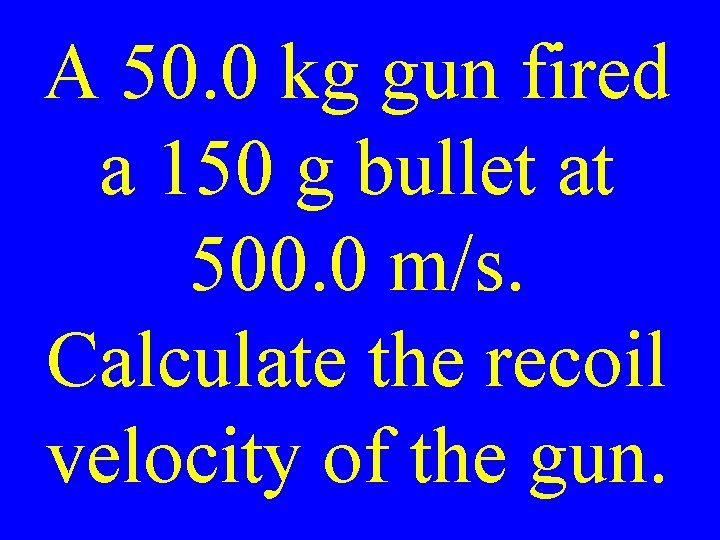
A 50. 0 kg gun fired a 150 g bullet at 500. 0 m/s. Calculate the recoil velocity of the gun.
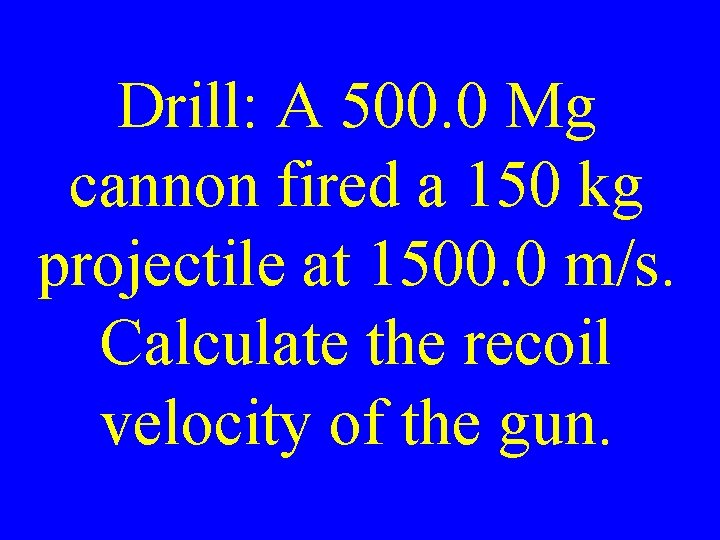
Drill: A 500. 0 Mg cannon fired a 150 kg projectile at 1500. 0 m/s. Calculate the recoil velocity of the gun.
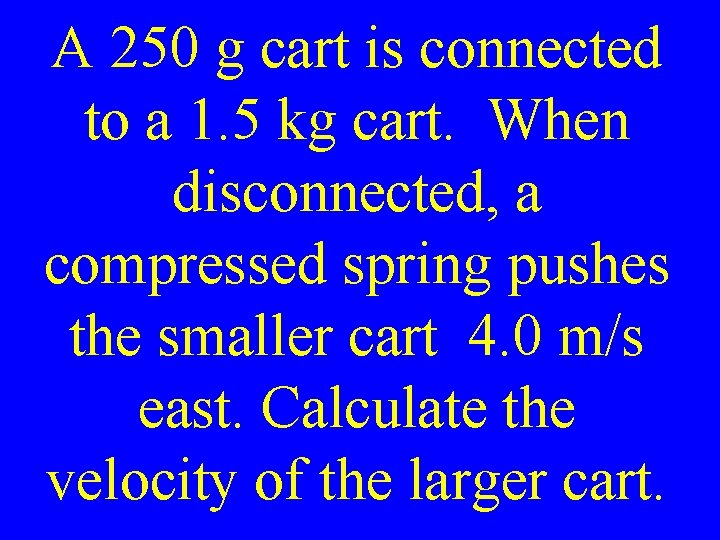
A 250 g cart is connected to a 1. 5 kg cart. When disconnected, a compressed spring pushes the smaller cart 4. 0 m/s east. Calculate the velocity of the larger cart.
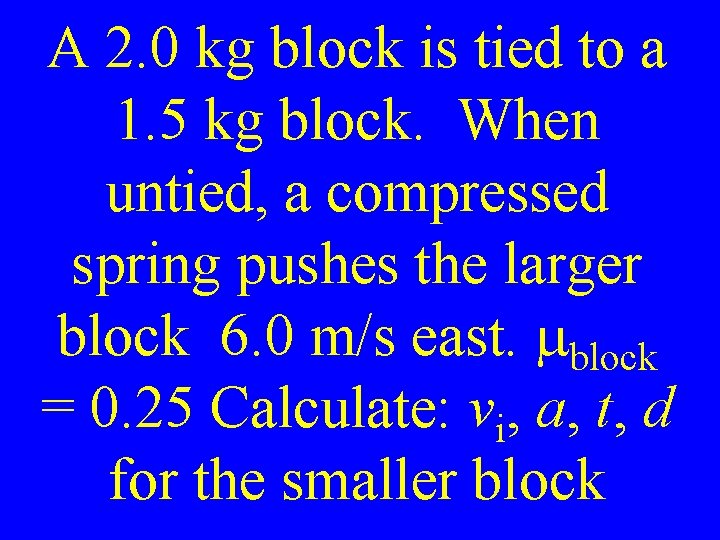
A 2. 0 kg block is tied to a 1. 5 kg block. When untied, a compressed spring pushes the larger block 6. 0 m/s east. mblock = 0. 25 Calculate: vi, a, t, d for the smaller block
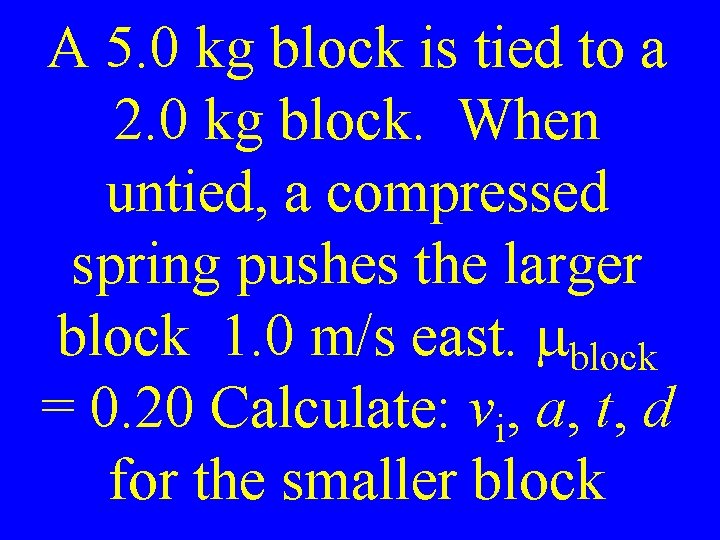
A 5. 0 kg block is tied to a 2. 0 kg block. When untied, a compressed spring pushes the larger block 1. 0 m/s east. mblock = 0. 20 Calculate: vi, a, t, d for the smaller block
Two Dimensional Collisions
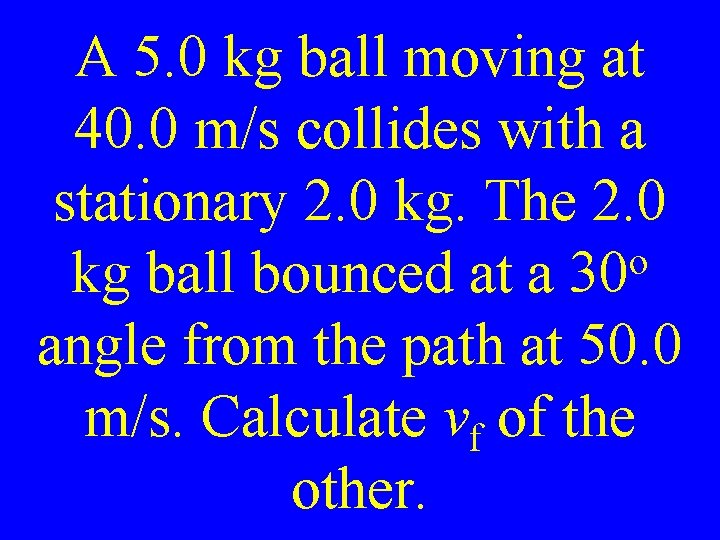
A 5. 0 kg ball moving at 40. 0 m/s collides with a stationary 2. 0 kg. The 2. 0 o kg ball bounced at a 30 angle from the path at 50. 0 m/s. Calculate vf of the other.
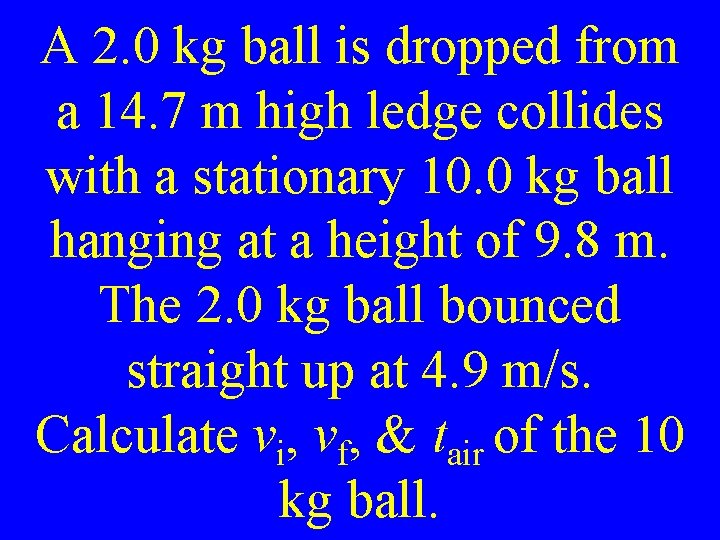
A 2. 0 kg ball is dropped from a 14. 7 m high ledge collides with a stationary 10. 0 kg ball hanging at a height of 9. 8 m. The 2. 0 kg ball bounced straight up at 4. 9 m/s. Calculate vi, vf, & tair of the 10 kg ball.